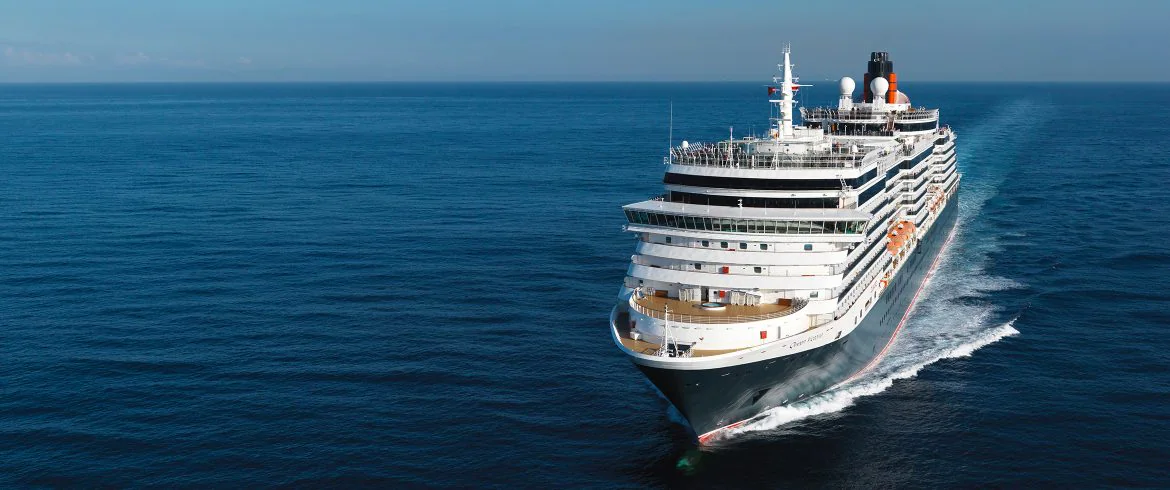
Cunard Line
Luxury Cruising
Cunard is the only cruise line where dressing for dinner still feels like an event, not an obligation. The Transatlantic Crossing on Queen Mary 2 remains one of the great travel experiences — seven days of genuine ocean voyaging with a sense of occasion that no other line can match.
Cunard Line was founded in 1840 when Samuel Cunard, a Halifax-born shipping magnate, won the British government's contract to carry Royal Mail across the Atlantic by steamship. The paddle steamer Britannia departed Liverpool on 4 July of that year, establishing regular transatlantic service that has run, with wartime interruptions, for nearly two centuries. No other cruise line operating today can trace its origins so directly to the birth of ocean passenger travel. Cunard held the Blue Riband for the fastest Atlantic crossing for much of the nineteenth century, and its ships carried royalty, heads of state, and generations of emigrants and travellers between the old world and the new.
Today Cunard operates within Carnival Corporation, the world's largest cruise company, and sits under the Carnival UK division alongside P&O Cruises. The fleet comprises four ships — Queen Mary 2, Queen Victoria, Queen Elizabeth, and the 2024-launched Queen Anne. What makes Cunard genuinely different from every other line, including its Carnival stablemates, is the deliberate preservation of a formal, occasion-driven atmosphere rooted in British maritime tradition. Afternoon tea with white-gloved service, gala evenings with ballroom dancing, enrichment lectures from prominent speakers, a RADA theatrical partnership, and the world's only operating ocean liner are not marketing embellishments. They are the core product. Cunard is not for everyone, and the line knows it — the appeal lies precisely in what it refuses to compromise on.
Understanding what Cunard includes requires understanding the class system that defines the entire experience. There are four accommodation tiers — Britannia, Britannia Club, Princess Grill, and Queens Grill — and inclusions differ meaningfully between them. Every guest receives accommodation, main restaurant dining, afternoon tea, basic beverages (tea, coffee, water, juice), entertainment, pools, and fitness facilities. Beyond that, the picture varies considerably.
Britannia guests — the majority of passengers — pay additionally for alcoholic drinks, gratuities (charged at a daily rate per person), Wi-Fi (available via Starlink across the fleet but not cheap), and speciality dining. These add-ons accumulate quickly, and the total daily cost can be substantially higher than the headline fare suggests. Britannia Club adds open-seating dining and 24-hour room service but does not change the extras equation. The real shift comes at the Grills level: Princess Grill and Queens Grill bookings on voyages of five nights or more now include a complimentary drinks package and hotel service charges, bringing the value proposition closer to what competitors offer. Queens Grill adds butler service, a stocked minibar, daily canapes, and welcome champagne. Wi-Fi, speciality dining, shore excursions, and spa treatments remain additional at every level without exception.
This tiered structure is Cunard's most polarising feature. Loyal Grills passengers argue the dining quality and quiet elegance justify the premium. Britannia passengers sometimes feel the add-on model erodes the value compared to lines offering bundled or all-inclusive pricing. Both perspectives have merit, and the right choice depends entirely on your tolerance for extras and which tier you book.
Cunard's dining is structured around the class system. Britannia passengers dine in the grand Britannia Restaurant — an Art Deco setting with assigned tables and two sittings, serving a five-course menu that changes daily. Britannia Club guests eat the same menu in a smaller, dedicated restaurant with open seating and a single sitting. Princess Grill and Queens Grill passengers have their own exclusive restaurants with enhanced menus, open seating, and a level of attention that reflects the suite-level pricing. The Queens Grill, in particular, is widely regarded as some of the finest dining at sea, with dishes cooked to order and menus influenced by Michelin-starred chef Michel Roux on Queen Elizabeth.
Beyond the main restaurants, the fleet offers the Golden Lion pub — a traditional British pub serving complimentary food including beer-battered cod, Angus burgers, and ploughman's — and the Kings Court buffet for casual meals. Queen Anne expanded the dining choice significantly with Aranya (Indian cuisine), Aji Wa (Asian), Tramonto (Mediterranean), Sir Samuel's steakhouse, and the Artisans' Foodhall, though most of these carry an additional cover charge that draws mixed reactions from passengers. Speciality dining across the fleet typically runs in the range of thirty to forty-five dollars per person.
The daily afternoon tea is one of the great rituals in cruising. Served in the Queens Room from 3:30pm, white-gloved waiters carry silver trays of finger sandwiches, warm scones with clotted cream and strawberry preserve, and fine patisserie on bone china, accompanied by live harp or string music. It is included at every accommodation level, universally praised, and genuinely worth building your afternoon around. The honest assessment of food quality overall: exceptional at the Grills level, surprisingly good in the Golden Lion, and competent but unremarkable in the Britannia Restaurant, where menu repetition on longer voyages is a common complaint.
Cunard is the most formal cruise line operating today, and this formality is either the primary attraction or the primary deterrent depending on the traveller. The dress code is real — gala evenings call for dinner jackets and floor-length gowns, and the expectation is observed with genuine enthusiasm by the majority of passengers. Themed galas (Black and White, Masquerade, Roaring Twenties) occur at least once per voyage, and the sight of the Queens Room filled with elegantly dressed couples ballroom dancing to a live orchestra is something no other line replicates. Professional dance hosts are employed on every sailing to partner solo travellers and encourage participation. The Queens Room is the largest ballroom at sea, and it is genuinely used every evening, not just on special occasions.
The enrichment programme is a significant differentiator. Cunard Insights brings prominent speakers aboard — actors, politicians, academics, authors — for lectures and Q&A sessions calibrated to the itinerary. The RADA partnership delivers theatrical performances and acting workshops. Queen Mary 2 houses the only planetarium at sea. The library on Queen Anne holds over 2,700 volumes across two beautifully designed levels. Evenings follow a structured rhythm: pre-dinner drinks in the Commodore Club, dinner in your assigned restaurant, a production show in the Royal Court Theatre, dancing, then a nightcap. The energy level drops noticeably after ten or eleven at night. There is no late-night club scene.
The passenger demographic skews firmly to the over-55s on most voyages, with World Voyages averaging older still. British passengers predominate regardless of itinerary, typically comprising 65 to 70 per cent of the manifest on European and Transatlantic sailings. Who genuinely loves Cunard? Anglophiles, ballroom dancers, enrichment seekers, repeat guests who treat it as a floating club, and anyone who finds the formal evening ritual charming rather than burdensome. Who finds it stuffy? Younger travellers expecting a relaxed resort atmosphere, casual dressers who resent being told what to wear after six o'clock, and anyone who equates formality with pretension. Queen Anne has softened the edges slightly with a more contemporary design and additional casual spaces, but the core Cunard character remains traditional, structured, and unapologetically British.
The Cunard World Club enrols you automatically after your first completed voyage. Progression across four tiers — Silver, Gold, Platinum, and Diamond — is based on either number of voyages or cumulative nights sailed, whichever reaches the next tier first. Silver provides loyalty offers and the Cunarder magazine. Gold (two voyages or twenty nights) adds a cocktail reception with senior officers and a Wi-Fi credit. Platinum (seven voyages or seventy nights) brings a larger Wi-Fi credit, a laundry discount, a complimentary wine tasting, and priority check-in at selected ports. Diamond (fifteen voyages or 150 nights) includes one complimentary speciality dining meal on voyages of six nights or more.
It is worth being honest: the Cunard World Club is modest compared to competitor programmes. There are no complimentary cabin upgrades, no meaningful shipboard credits, and no cross-brand recognition within the Carnival Corporation portfolio. Holland America's Mariner Society and Celebrity's Captain's Club both offer more generous tier benefits and faster progression. The programme rewards loyalty with gestures rather than substantial perks, and for frequent cruisers weighing their allegiance across multiple lines, it is not the strongest incentive to concentrate sailings with Cunard.
The most significant development for Australian Cunard passengers is the end of Australian homeporting after the 2025/26 season. Queen Elizabeth, which served as Cunard's Sydney-based ship during Southern Hemisphere summers, is moving to year-round North American deployment from 2026. No replacement homeporting is planned. This means Australian departures — roundtrip cruises from Sydney that required no international flights — will no longer be available. The decision generated considerable negative reaction in the Australian travel trade and among Australian Cunard loyalists.
Cunard ships will continue to visit Australia during their annual World Voyages, with port calls in Sydney, Melbourne, and other cities. World Voyage sectors from Australian ports remain bookable, offering segments of twenty or more nights connecting Australia to Asia, the Americas, or the Pacific without committing to the full circumnavigation. For Australians wanting the signature Transatlantic Crossing on Queen Mary 2, the routing typically involves flying to Southampton via Singapore, Dubai, or Doha (around 22 to 24 hours), or to New York via Los Angeles (around 20 to 22 hours). The loss of homeporting adds international airfares to the total cost, which is a meaningful consideration when comparing Cunard against lines that still offer Australian departures.
Cunard maintains Australian sales and marketing support through Carnival UK's local operations, including an Australian call centre, BDMs supporting local agents, and AUD pricing on the Australian website. Working with an Australian cruise specialist remains worthwhile for AUD pricing, local payment terms, and the ability to secure onboard credit or cabin upgrades that are not available when booking directly.
Cunard's pricing spans an unusually wide range because of the tiered class system. Entry-level Britannia inside staterooms can start from surprisingly modest per-night rates on short voyages and promotional fares, positioning the headline price competitively against premium lines like Holland America and Celebrity. Britannia balcony cabins — the most popular category — sit comfortably in the premium range. The step up to Britannia Club adds a modest premium for open-seating dining. Princess Grill and Queens Grill suites move into genuine luxury territory, with Queens Grill Grand Suites and Duplexes on Queen Mary 2 reaching the upper end of the market.
The critical consideration is total cost. In Britannia, adding drinks, gratuities, Wi-Fi, and one or two speciality dining experiences can increase the effective daily spend substantially beyond the cabin fare. This is the area where competitors with bundled pricing — Holland America's Have It All package, Celebrity's Always Included fare, or the genuinely all-inclusive models at Regent and Silversea — often deliver better overall value. In the Grills, the included drinks package and gratuities on voyages of five nights or more improve the equation considerably, though Wi-Fi, speciality dining, and shore excursions remain extra even at the highest tier.
The Transatlantic Crossing on Queen Mary 2 represents one of the best value propositions in the Cunard portfolio — a unique, irreplaceable experience at pricing that compares favourably to conventional luxury cruises of similar duration. World Voyage segments offer long-haul value for travellers with the time to commit. Solo travellers should note the 175 per cent supplement on double cabins, one of the industry's highest, and investigate the purpose-built single staterooms on Queen Mary 2 and Queen Victoria instead. Deposits are typically 25 per cent of the fare for voyages up to 30 nights, with cancellation penalties escalating from 120 days before sailing. Wave season from January to March consistently delivers the strongest promotional pricing, and Grills suites on popular itineraries sell out well in advance.
Share your dates and preferences and we will come back with Cunard Line cabin options, pricing, and insider tips.


Our Transatlantic Crossing was the highlight of a lifetime. Pan Australian arranged everything perfectly — from the Queens Grill suite to the pre-cruise hotel in Southampton. Simply magnificent.