Virgin Voyages
Premium Cruising
Virgin Voyages is the line I recommend to clients who have told me they would never go on a cruise. It deliberately breaks every convention — no main dining room, no buffet, no formal nights, no kids — and replaces them with 20-plus restaurants, a tattoo parlour, late-night immersive shows and a genuinely cool design aesthetic. Drinks are not included and there are no packages, which catches some people off guard, so set that expectation upfront. But if your clients are in their 30s to 50s and want a floating boutique hotel with a nightlife scene, nothing else comes close.
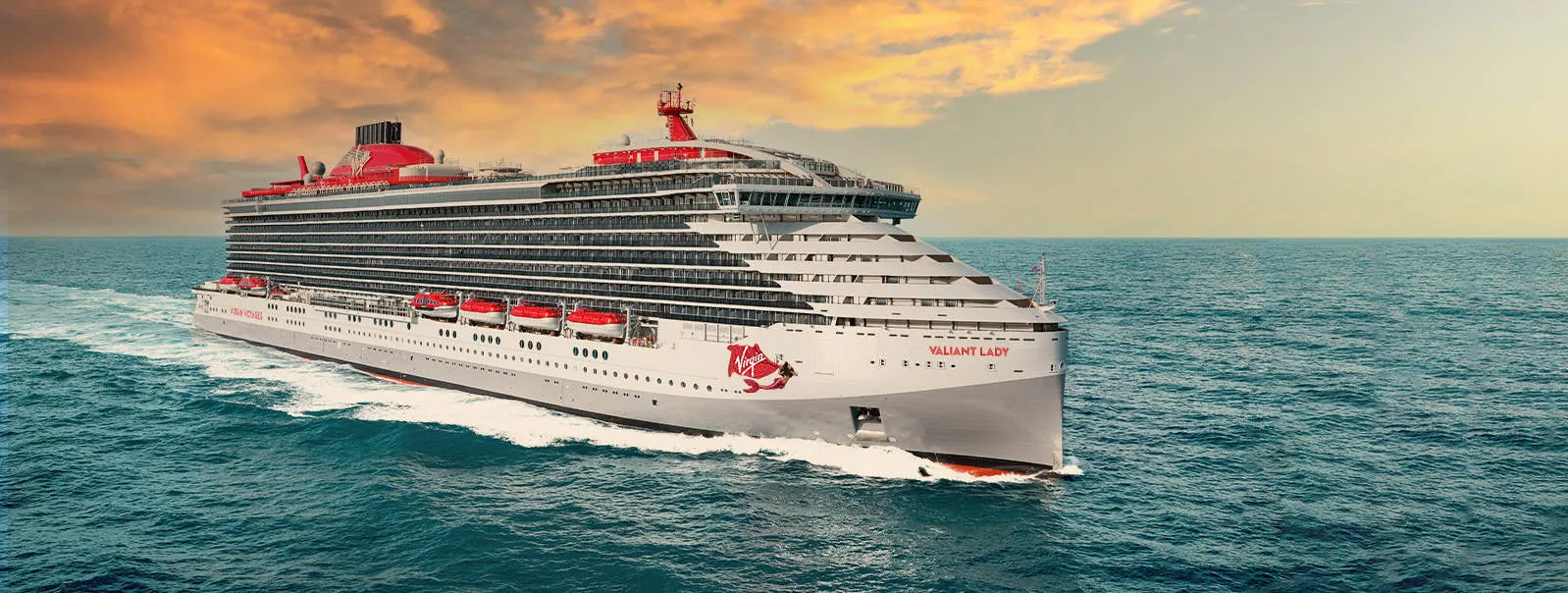
Virgin Voyages exists because Richard Branson looked at the cruise industry and decided it needed dismantling. Announced in 2014 as a joint venture between Virgin Group and Bain Capital, the brand deliberately dropped the word "cruise" from its name in 2017 — rebranding from Virgin Cruises to Virgin Voyages as a signal that everything about the traditional cruise experience was being rethought. The first ship, Scarlet Lady, was delivered in 2020 but did not sail until late 2021 due to the pandemic. Three sister ships followed, with Brilliant Lady completing the four-ship fleet in 2025. Each vessel carries around 2,770 adults — and only adults — in an atmosphere that has more in common with a boutique hotel crossed with a music festival than anything you would associate with a conventional cruise ship.
What makes Virgin Voyages genuinely different rather than just marketing-different is the list of things it removed. There is no main dining room, no buffet, no formal night, no assigned seating, no children, no daily gratuity charge, and no traditional cruise director. In their place are more than 20 distinct restaurants all included in the fare, a tattoo parlour, immersive theatrical shows, a two-storey nightclub, private karaoke suites, and a festival-style party programme that runs well past midnight. The ships were designed by leading names including Tom Dixon and Concrete Amsterdam, and the interiors feel deliberately un-cruise-like — moody lighting, industrial-chic finishes, terrazzo floors, and the signature red hammock on every balcony. It is polarising by design. Virgin does not want everyone to love it, and that honesty about who it is for — and who it is not for — is arguably its greatest strength.
The brand has matured considerably since its chaotic pandemic-era launch. A 2023 capital raise of US$550 million from Ares Management stabilised the finances, a new CEO brought operational discipline, and the 2025 launch of Brilliant Lady (with enlarged pools and refined entertainment) showed a company learning from early feedback. Named Travel + Leisure's World's Best Mega Ship three years running, Virgin Voyages has earned its place as a credible, differentiated player in the premium segment. It is no longer a novelty. It is a genuine alternative to the established order — provided you are the right traveller for it.
Virgin Voyages includes more in the base fare than most premium competitors, though it is not fully all-inclusive, and the gap between what is covered and what is not catches some first-time passengers off guard. Understanding the distinction before you book avoids disappointment.
Included in every fare: all dining across more than 20 restaurants and eateries with zero surcharges, basic Wi-Fi (single device, adequate for messaging and browsing but not streaming), gratuities, group fitness classes (yoga, cycling, boxing, HIIT, barre), basic beverages (filtered water, drip coffee, tea, select juices), room service via the app, all entertainment and shows, and complimentary access to The Beach Club at Bimini on Caribbean sailings. The dining inclusion is the headline — no cover charges, no premium restaurant fees, no upselling at the table. You eat wherever you want, as often as you want, at no additional cost. In the premium segment, nothing else comes close to this.
Not included: alcoholic beverages, which is the single biggest surprise for most passengers. There are no traditional drink packages. Instead, Virgin uses a pre-paid Bar Tab system where you purchase credit and receive bonus top-ups. Individual cocktails run in the range of US$12 to 18, beer US$7 to 9, and wine US$9 to 15 by the glass. Moderate drinkers tend to find this reasonable; heavy drinkers will spend more than they would on a bundled package with Celebrity or Princess. Also not included: premium Wi-Fi for streaming, spa treatments, shore excursions (branded "Shore Things"), and the tattoo studio. The overall value proposition is strong — the included dining and gratuities offset a meaningful amount of what other lines charge as extras — but alcohol spend needs to be budgeted separately and can add up quickly.
The dining programme is Virgin Voyages' single most impressive achievement and the feature that converts the most sceptics. The line made the bold decision to eliminate both the traditional main dining room and the buffet entirely, replacing them with more than 20 distinct venues — each with its own dedicated galley and executive chef — all included in the fare. No surcharges, no cover charges, no premium dining fees. You eat where you want, when you want.
The sit-down restaurants each occupy their own identity. The Wake is a handsome steakhouse with ocean views and consistently excellent cuts. Pink Agave serves refined Mexican fine dining that would hold its own in any major city. Gunbae is a communal Korean BBQ where strangers cook together at shared tables — an inspired social concept that solo travellers and groups alike praise. Extra Virgin is a lively Italian trattoria. Razzle Dazzle (or Rojo by Razzle Dazzle on Brilliant Lady) serves vegetarian-forward dishes with flair. And Test Kitchen delivers a multi-course experimental tasting menu that changes themes and plays with technique in ways you simply do not expect on a ship. Beyond the sit-down venues, The Galley food hall offers made-to-order stations serving everything from sushi to noodles to Mexican street food — a vastly superior alternative to the traditional buffet — alongside casual options including Neapolitan pizza, ice cream, Asian noodles, and Japanese-inspired grab-and-go bites.
The honest assessment: at its best, the food is genuinely excellent and competitive with good shoreside restaurants. The Wake and Pink Agave are consistent highlights, and Test Kitchen rewards adventurous palates. However, quality can be inconsistent across sailings and venues — some meals are outstanding, others merely adequate. Popular sit-down restaurants book out fast, and the app-based reservation system creates a first-day scramble that frustrates many passengers. The solution is to book immediately upon check-in and remain flexible. The breadth of more than 20 venues means there is always somewhere to eat, and even on a week-long sailing the variety is sufficient that repetition is minimal. For the premium segment, where competitors charge supplements of thirty to fifty dollars for their speciality restaurants, the all-included model is a genuine and unmatched advantage.
Virgin Voyages attracts a noticeably younger demographic than most cruise lines. The core audience is 30 to 55, with strong representation from millennials and Generation X travellers who were drawn to the brand precisely because it does not feel like a cruise. The passenger mix skews around 75 to 80 per cent North American, with British and European travellers making up 10 to 15 per cent, and the remainder from the rest of the world including Australians on holiday. The atmosphere is energetic, social, and contemporary — closer to a boutique hotel or members' club than a traditional ship.
The adults-only policy underpins everything. Without children in the pools, restaurants, or entertainment venues, the entire ship operates at an adult frequency. The dress code is genuinely relaxed — no formal nights, no jacket requirements, no dress code for any restaurant. Jeans and trainers are welcome everywhere, every night. Evenings come alive with immersive theatrical shows in The Red Room, drag performances hosted by a resident Diva, themed nightclub events in The Manor (a two-storey club with professional DJs that runs well past midnight), and the signature Scarlet Night, which transforms the ship into a red-lit carnival culminating in a pool-deck dance party. The line is explicitly LGBTQ+ friendly, with an inclusive culture that extends from entertainment to crew interactions. There is also a tattoo parlour, private karaoke suites, a vinyl record shop, and a retro gaming lounge. The atmosphere is, deliberately, festival-like.
This is where honesty matters most, because Virgin Voyages is genuinely polarising. If you are in your 30s to 50s, enjoy good food, late nights, contemporary design, and a social scene, this may be the best ship you have ever sailed on. If you prefer quiet evenings, enrichment lectures, structured daytime activities, ballroom dancing, or Broadway-style shows, you will likely find it loud, shallow, and exhausting. Passengers who go to bed early report noise carrying from the entertainment areas. The app-dependent onboard experience frustrates those who dislike having their phone out constantly. Sea days can feel under-programmed compared to mainstream lines. And the heavy emphasis on nightlife and party culture means this is emphatically not a contemplative, library-and-lecture ship. Know yourself before you book, and you will either love it or avoid a costly mismatch.
Virgin Voyages' loyalty programme, Sailor Loot, reflects the brand's relative youth. After completing your first voyage, you enter the Deep Blue Extras tier, which provides onboard credit on future bookings, early access to new voyage releases, and birthday recognition. After multiple voyages, you progress to Deep Blue Originals, which adds enhanced onboard credit, priority embarkation, complimentary premium Wi-Fi upgrades on select sailings, and invitations to exclusive events.
It is fair to say the programme is still developing. Compared to the mature, multi-tiered loyalty programmes at Celebrity (Captain's Club, six tiers), Princess (Captain's Circle, four tiers), or Viking (Viking Explorer Society), Sailor Loot offers fewer tangible benefits and lacks features such as complimentary cabin upgrades, free nights, or meaningful shipboard credits at the higher levels. There is no formal status-matching programme from other cruise lines, though informal match promotions have appeared periodically. For travellers who accumulate loyalty currency across brands, Virgin Voyages does not yet offer the depth of reward that would justify concentrating sailings here over a more established competitor. That said, the brand has indicated ongoing development, and the programme should be expected to expand as the fleet matures and the repeat-guest base grows.
The most significant limitation for Australian travellers considering Virgin Voyages is straightforward: the line does not sail from Australia and has announced no plans to do so. All four ships are based in the Northern Hemisphere, with primary departures from Miami, Barcelona, Athens, Seattle, New York, and Los Angeles. There is no Australian office, and the website displays prices exclusively in US dollars. Australian travel agents can quote in AUD at prevailing exchange rates, which is one of the practical reasons to book through a specialist rather than directly.
Getting to a Virgin Voyages embarkation port from Australia involves a long-haul flight. Miami, the primary Caribbean departure port, is roughly 20 to 24 hours from Sydney or Melbourne via Los Angeles, Dallas, or Honolulu. Barcelona and Athens for Mediterranean sailings route through Singapore, Dubai, or Doha at 22 to 28 hours. Seattle for Alaska is the most accessible at around 16 to 20 hours via the US West Coast. Most Australian travellers combine a Virgin Voyages sailing with a pre- or post-cruise land stay in the United States, Caribbean, or Europe, which makes the overall trip more worthwhile given the flight investment. The Caribbean short breaks of four or five nights, while attractively priced, may not justify the travel time from Australia — Mediterranean or Alaska voyages of seven nights or longer tend to make more sense for travellers coming this far.
The Virgin brand has strong recognition in Australia through Virgin Australia and Virgin Active, which helps with awareness, but there is no direct cruise industry infrastructure here. No frequent flyer partnerships exist between Virgin Voyages and Australian loyalty programmes such as Qantas Frequent Flyer or Velocity, though flights to embarkation ports will earn points through the relevant airline. For Australians drawn to the concept, the experience is absolutely worth the journey — but it requires more planning and a higher total budget than lines offering local departures.
Virgin Voyages sits in the premium tier on headline pricing, broadly comparable to Celebrity Cruises and somewhat above Royal Caribbean. Interior cabins on short Caribbean sailings offer the lowest entry point, with balcony cabins — the most popular category and the one with the signature red hammock — sitting in the mid-premium range. Suites escalate steeply, with the RockStar and Mega RockStar Quarters reaching rates that compete with genuine luxury lines. All pricing is denominated in US dollars, so Australian travellers face exchange-rate variability on top of the fare itself.
The value argument rests heavily on what is included. When you factor in all dining across more than 20 restaurants at no surcharge, included gratuities, basic Wi-Fi, and group fitness, the effective daily spend compares very favourably to competitors where speciality dining supplements, automatic gratuity charges, and Wi-Fi packages quickly inflate the total. A Celebrity or Princess passenger paying headline fare plus two speciality dinners, daily gratuities, and a Wi-Fi package will often end up at a similar or higher total cost than a Virgin Voyages passenger in an equivalent cabin category — before drinks enter the equation. The drinks question is where it gets personal: moderate drinkers will spend less on the Bar Tab system than they would on a bundled package they did not fully use; heavy drinkers will spend more. Budget somewhere in the range of US$30 to 80 per day for a moderate drinking couple and adjust from there.
Solo travellers benefit from purpose-built Solo Insider cabins priced for single occupancy with no supplement — a genuine rarity in the premium segment. Solo travellers booking double-occupancy cabins pay a supplement that varies by sailing, though periodic promotions reduce it by up to 70 per cent on select dates. Deposits are 20 per cent of the voyage fare, and final payment is due 120 days before sailing. Cancellation terms depend on the fare tier booked under the VoyageFair system introduced in late 2025: the most affordable Lock It In and Base fares are non-refundable, while Essential and Premium fares offer a seven-day grace period and Future Voyage Credit options further out. Wave season from January to March consistently delivers the strongest promotional pricing and Bar Tab bonuses, and new season launches 12 to 18 months ahead offer the widest cabin selection.
Share your dates and preferences and we will come back with Virgin Voyages cabin options, pricing, and insider tips.