Royal Caribbean International
Mainstream Cruising
Royal Caribbean is the line that keeps reinventing what a cruise ship can be. Icon of the Seas genuinely changed the game — it's a floating theme park, resort, and entertainment complex rolled into one. I send families here because the kids' programming is unmatched, but couples and groups have a blast too. Just don't expect intimacy — this is big, bold cruising at its most ambitious.
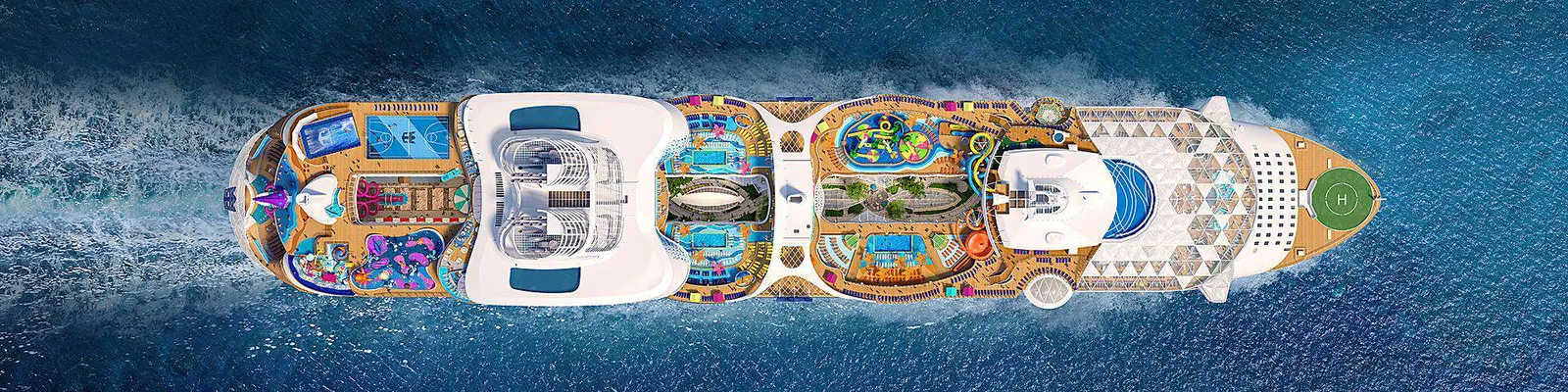
Royal Caribbean International is the flagship brand of Royal Caribbean Group and the world's largest cruise line by gross tonnage, operating a fleet of 29 ships with several more on order through the end of the decade. Founded in 1968 by Norwegian shipping companies with American hospitality expertise, the line has spent five decades pushing the boundaries of what a cruise ship can be. The Icon class, led by Icon of the Seas and Star of the Seas, represents the current peak of that ambition — at 250,800 gross tons and carrying over 5,000 guests across eight distinct neighbourhoods, these are the largest passenger vessels ever built and unlike anything else afloat.
The scale is genuinely staggering, but what distinguishes Royal Caribbean from its mainstream competitors is not merely size — it is the density of what they put inside the ships. Icon of the Seas features the largest waterpark at sea, a surf simulator, rock climbing walls, a zip line, an ice-skating rink, and a Central Park-style open-air garden on a single vessel. The Oasis class, which preceded Icon and includes six ships from the original Oasis of the Seas through to Utopia of the Seas, pioneered the neighbourhood concept that makes mega-ship cruising feel navigable rather than overwhelming. Broadway-calibre musicals, AquaTheater diving shows, and the FlowRider surf simulator have become signatures of the brand. Royal Caribbean does not do quiet refinement — it does bold, ambitious, activity-driven cruising, and it does it better than anyone else in the mainstream space.
The fleet spans an enormous quality range, and this matters. An Icon-class experience and a 1996 Vision-class experience are recognisably the same brand but separated by three decades of design evolution. Newer ships carry more dining venues, more activities, better technology, and more polished public spaces. Choosing the right ship for your priorities is as important as choosing the right itinerary, and it is an area where specialist advice genuinely pays off.
Royal Caribbean is not an all-inclusive cruise line. The base fare covers accommodation, meals in the Main Dining Room and Windjammer buffet, a selection of casual complimentary eateries that varies by ship, access to the pool deck and fitness centre, all production shows and live entertainment, and most onboard activities including the FlowRider, rock climbing walls, waterslides, and Adventure Ocean kids' programme during standard hours. That is a generous baseline, but the extras add up quickly — and understanding the true cost before you board is essential.
The big-ticket add-ons are the Deluxe Beverage Package, Wi-Fi, and speciality dining. The Deluxe Beverage Package covers cocktails, beer, wine by the glass, premium coffees, and soft drinks, with pricing that fluctuates from US$55 to $120 per person per day depending on ship, sailing date, and demand, plus 18 per cent gratuity on top. Both adults in a cabin must purchase it if one does. Wi-Fi runs US$20 to $33 per day — there is no free tier at any loyalty level, unlike Celebrity's Always Included or Norwegian's Free at Sea. Speciality dining surcharges range from US$35 to $95 per person per visit depending on the venue. Daily gratuities of US$18 to $20.50 per person are auto-charged to your onboard account. When you add all of this together, the total cost of a seven-night cruise can easily approach double the advertised fare. Pre-purchasing packages through the Cruise Planner before your sailing typically saves 20 to 30 per cent, and I strongly recommend doing so.
The exception to this cost structure is Star Class suites on Icon and Oasis-class ships. Star Class functions as a genuine ship-within-a-ship: guests receive a Royal Genie personal assistant, a Deluxe Beverage Package, all speciality dining included, priority access to every attraction and show, and exclusive access to Coastal Kitchen restaurant and the Suite Sun Deck. It is the closest Royal Caribbean comes to an all-inclusive proposition, and for travellers who want the mega-ship experience with luxury-level service, it represents surprisingly strong value at the top end.
Royal Caribbean's dining programme is built around volume and variety rather than culinary ambition. The Main Dining Room serves multi-course dinners with waiter service on every ship — guests can choose Traditional Dining with fixed seating times or My Time Dining for flexible scheduling. The food is competent and reliable, occasionally excellent, but it does not reach the standard set by Celebrity, Viking, or the luxury lines. The Windjammer Marketplace buffet is the practical workhorse of the fleet, open for breakfast, lunch, and dinner with a broad international selection. It is perfectly adequate — varied, filling, and convenient — but honest assessment places it in cafeteria territory, particularly on older ships. Icon-class vessels have notably improved the buffet with better flow design and higher-quality cooking stations.
Where Royal Caribbean earns real dining marks is in two areas: the speciality restaurants and the complimentary casual venues. Chops Grille steakhouse is consistently well-regarded across the fleet. Wonderland, available on Quantum and Oasis-class ships, offers an imaginative molecular-gastronomy experience that is genuinely unlike anything on a competitor. 150 Central Park on Oasis-class ships delivers fine dining in a setting overlooking the ship's internal park. Izumi serves solid Japanese cuisine, and Jamie's Italian brings Jamie Oliver's trattoria-style cooking to eight ships. These venues carry surcharges of US$35 to $95 per person, and on a seven-night sailing two or three speciality dinners add genuine variety to the voyage. The Unlimited Dining Package bundles most speciality restaurants for US$45 to $65 per day and pays for itself if you dine out more than once daily.
The complimentary casual options deserve mention because they are often the best-kept secret on board. Sorrento's pizza is consistently praised across the fleet. Park Cafe in Central Park on Oasis-class ships serves excellent sandwiches and salads. On Icon-class ships, the AquaDome Market and Surfside Eatery have raised the standard of included food noticeably. For travellers who eat lunch at the casual venues and reserve the Main Dining Room or a speciality restaurant for dinner, the overall dining experience is genuinely satisfying without breaking the budget.
Royal Caribbean attracts the broadest demographic of any cruise line. On Caribbean summer sailings, expect hundreds of children and a high-energy family atmosphere. On Alaska and European itineraries, the average age shifts upward to 40 to 60, with more couples and multigenerational groups. Short three and four-night sailings from Florida draw a younger crowd in the 25 to 40 range, popular for milestone celebrations and weekend getaways. The nationality mix on US-departing cruises is predominantly American and Canadian, while Australian deployments attract a largely Australian and New Zealand contingent. Royal Caribbean's CEO confirmed in 2025 that millennials are now the dominant age group across the brand, which tells you a great deal about the energy on board.
Entertainment is a genuine strength and a key differentiator. The line has invested heavily in Broadway-calibre productions — full-length musicals including Grease, Mamma Mia!, and on Star of the Seas, Back to the Future: The Musical. The AquaTheater on Oasis-class ships stages acrobatic diving shows in an open-air amphitheatre that has no equivalent in the industry. Ice-skating shows run on a full-size rink on Oasis, Freedom, and Voyager-class ships. Quantum-class vessels feature Two70, an immersive venue with floor-to-ceiling glass and robotic screens. Beyond the headliners, every ship carries live music venues, a piano bar, deck parties, trivia, game shows, and a full casino. The nightlife runs later and louder than on premium or luxury lines — bars stay active until one or two in the morning, and the pool deck parties can be raucous in the best sense.
It is worth being honest about who this is not for. Passengers seeking quiet, intimate, refined cruising will find the energy level too high and the ships too large. Those who dislike being around children should avoid Caribbean summer sailings or choose Radiance-class ships and off-peak seasons. Travellers who expect all-inclusive pricing will be frustrated by the add-on costs. And destination-focused cruisers who want deep port immersion should note that port time is typically six to eight hours — the ship is the destination on Royal Caribbean, and it is designed that way intentionally. If you accept that proposition, the experience is hard to fault for sheer breadth and ambition.
The Crown and Anchor Society is Royal Caribbean's loyalty programme, and it is one of the more generous in the mainstream segment. Enrolment is automatic after your first cruise, with points earned at one per night in standard cabins or two per night in suites. The programme runs across six tiers: Gold, Platinum, Emerald, Diamond, Diamond Plus, and Pinnacle Club. Benefits are modest at the lower tiers but become tangibly valuable once you reach Diamond at 80 points — roughly 10 or more cruises in a standard cabin. Diamond members receive access to the Diamond Lounge, four complimentary drink vouchers per day, a behind-the-scenes ship tour, and exclusive pricing on select sailings.
Diamond Plus at 175 points adds enhanced benefits and milestone gifts, while the top-tier Pinnacle Club at 700 points — equivalent to approximately 90 or more cruises — rewards members with a free seven-night cruise annually and access to exclusive events. It is an aspirational target, but the free annual cruise is one of the best top-tier loyalty rewards in the cruise industry.
The programme's strongest feature is cross-brand recognition within the Royal Caribbean Group portfolio. Your Crown and Anchor tier status transfers to Celebrity Cruises' Captain's Club and Silversea's Venetian Society, meaning benefits earned on one brand carry across to the other two. For travellers who might sail Royal Caribbean for a family holiday, Celebrity for a couples' trip, and aspire to Silversea for a special occasion, this interoperability is a compelling reason to consolidate loyalty within the group.
Royal Caribbean maintains a strong and growing presence in the Australian market. Two ships are deployed to Australia each southern hemisphere summer, typically from November through April. For the 2026-27 season, Anthem of the Seas homeports from Sydney with 21 sailings of three to 11 nights covering New Zealand, the South Pacific, and new calls including Hobart, while Quantum of the Seas returns to Brisbane for a fourth consecutive season with 28 sailings of three to eight nights. Both are Quantum-class vessels carrying around 4,000 passengers — large enough to deliver a genuine Royal Caribbean experience with FlowRider, North Star observation pod, and RipCord by iFLY skydiving simulator, but not the full Icon or Oasis-class mega-ship proposition. For that, you will need to fly to the United States or Europe.
Royal Caribbean operates a local Australian office with sales, marketing, and trade support, including dedicated business development managers for Australian travel agents. The Australian website displays fares in AUD, and local promotions including onboard credits and package deals are regularly available. Australian travel agents with Royal Caribbean accreditation have access to exclusive market deals and famil-trip insights that are not available through the general website, making specialist agent booking particularly worthwhile for first-time cruisers navigating a 29-ship fleet. The line also runs Wiggles-themed family sailings exclusive to Australian deployments — a unique partnership that resonates strongly with families travelling with young children.
For Australian travellers considering international Royal Caribbean sailings, the Caribbean fleet departs from Miami, Fort Lauderdale, and other Florida ports (20 to 24 hours' flying via Los Angeles or Dallas), Mediterranean sailings depart from Barcelona and Rome, and Alaska runs from Seattle and Vancouver. The journey is long but the reward — particularly on an Icon or Oasis-class ship — is an experience that has no equivalent in Australian waters.
Royal Caribbean sits in the mainstream segment, and its entry-level pricing reflects that. On a directional basis, expect per-diem rates from roughly AUD $90 to $180 per night for an inside cabin, AUD $160 to $300 for a balcony, and AUD $400 to $1,500 or more for suites depending on class and ship. Short three and four-night cruises from US ports offer the lowest per-night fares but also the highest per-diem all-in cost once you factor in embarkation and disembarkation days, drink packages, and CocoCay add-ons. Seven-night sailings generally deliver better overall value.
The critical distinction with Royal Caribbean is the gap between the advertised fare and the realistic total cost. A mid-range seven-night cruise in a balcony cabin with drinks package, Wi-Fi, a couple of speciality dinners, and shore excursions can approach AUD $3,500 to $4,000 per person all-in — roughly double the headline fare. This is not unique to Royal Caribbean, but the line's a-la-carte pricing model makes the gap more visible than on competitors like Norwegian, which bundles many of these elements into Free at Sea, or Celebrity, which includes drinks and Wi-Fi in its Always Included fare. If predictability of total cost matters to you, those competitors offer a clearer picture upfront. If you prefer to control exactly what you pay for and skip what you do not need, Royal Caribbean's model lets you do that — just budget honestly.
Compared to Norwegian and Carnival at similar cabin categories, Royal Caribbean's base fares are broadly competitive, with newer ships commanding a premium. Solo travellers benefit from purpose-built studio cabins on Quantum and select Oasis-class ships at no single supplement, though standard cabins carry the industry-standard 200 per cent supplement for single occupancy. Deposits range from US$100 for short cruises to US$500 for longer voyages, with cancellation penalties escalating from deposit forfeiture at 90 days to full fare within 30 days of sailing. Wave season from January through March consistently offers the strongest promotional pricing, and pre-purchasing packages through the Cruise Planner is one of the most reliable ways to reduce your total cost.
Share your dates and preferences and we will come back with Royal Caribbean International cabin options, pricing, and insider tips.