Holland America Line
Premium Cruising
Holland America is the line I recommend when clients want something more polished than mainstream but without the stiffness of ultra-luxury. The enrichment programmes — live music at B.B. King's Blues Club, BBC Earth documentaries, culinary demos — give the sea days real substance. It skews older, but that is part of the appeal: you will not find pool-deck DJs here.
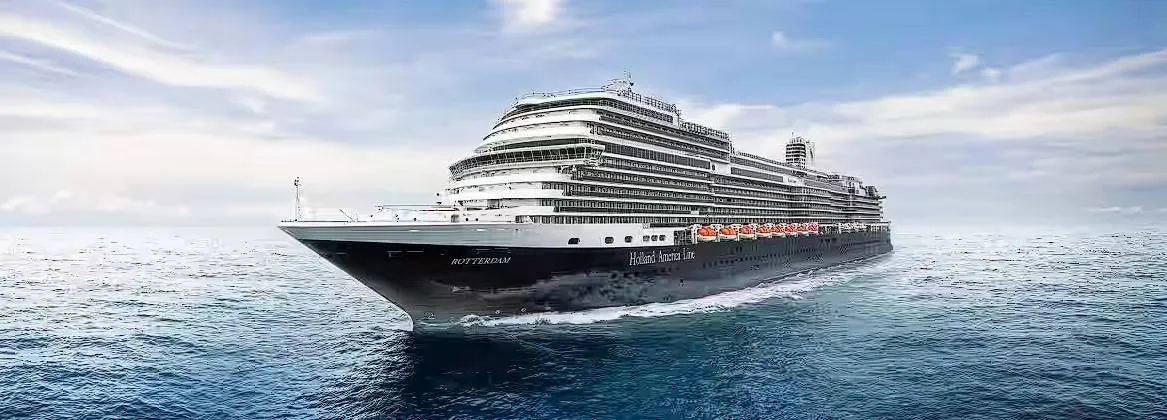
Holland America Line was founded in Rotterdam in 1873 as the Nederlandsch-Amerikaansche Stoomvaart Maatschappij — a transatlantic shipping company that spent its first century carrying more than 850,000 emigrants from Europe to the Americas. That heritage is not marketing gloss. The current ship named Rotterdam is the seventh to bear the name, and the line's Dutch maritime legacy runs through every vessel in the fleet, from the Grand Dutch Cafe serving stroopwafels and proper coffee to the Delft blue tile accents and the tradition of naming every ship with the -dam suffix. Few cruise lines can claim over 150 years of continuous operation, and Holland America wears that history with understated confidence.
Since 1989, Holland America has been a wholly owned subsidiary of Carnival Corporation, sitting alongside Princess, Cunard, Seabourn, and the Carnival brand itself within the world's largest cruise group. Within that portfolio, Holland America occupies the premium middle ground — more polished and destination-focused than the mainstream lines, more traditional in character than Celebrity or Viking, and more accessible in price than the luxury tier. The fleet of eleven mid-size ships spans four classes, from the intimate R-class veterans built around the turn of the millennium to the Pinnacle-class flagships that debuted between 2016 and 2021. There are no new ships on order, which is a notable departure from competitors like Viking and Princess who continue to build aggressively. Holland America's investment is going into refurbishment and programming rather than expansion.
What makes Holland America genuinely distinctive is the combination of live music, enrichment, and itinerary depth. The Music Walk concept — a collection of dedicated live-music venues including B.B. King's Blues Club, Rolling Stone Lounge, and Billboard Onboard — has no equivalent on any other cruise line. The enrichment programme brings destination experts, wildlife naturalists, cooking demonstrations, and cultural ambassadors aboard to give sea days real substance. And the line's Alaska expertise, built over more than 55 years including company-owned lodges and cruisetour packages, remains the benchmark for that region. This is a cruise line with genuine character, not a floating resort that happens to move between ports.
Holland America's base fare covers the essentials and covers them well. The main dining room serves breakfast, lunch, and dinner with open seating during the day and assigned or flexible seating at dinner. The Lido Market operates as a food-hall-style venue for casual meals. Dive-In serves poolside burgers, New York Pizza and Deli does exactly what the name suggests, and the Grand Dutch Cafe provides complimentary coffee and Dutch treats throughout the day. All entertainment is included — Music Walk, production shows, enrichment lectures, the fitness centre, pools, and hot tubs. Room service runs around the clock, though lunch and dinner items carry a small service charge.
What is not included in the base fare is where Holland America differs meaningfully from lines like Viking or Windstar. Alcoholic beverages, Wi-Fi, shore excursions, specialty dining, and crew gratuities at US$16 per person per day are all additional. This is where the Have It All package enters the picture. Priced at approximately US$55 per person per day, it bundles the Signature Beverage Package covering drinks up to US$12 each, a shore excursion credit ranging from US$100 to US$300 depending on voyage length, one to three specialty dinners, and Surf-tier Wi-Fi for basic browsing and messaging. Guests who book early receive the Early Booking Bonus, which adds prepaid gratuities and upgrades the Wi-Fi to Premium.
The honest assessment of Have It All is that it represents decent value for moderate drinkers who would purchase specialty dining and Wi-Fi regardless — the break-even sits at around four to five drinks per day. For non-drinkers or guests who prefer to eat exclusively in the main dining room, the package is poor value and you are better off buying individual items. The shore excursion credits are modest, particularly on longer voyages where US$200 per person does not stretch far. Compared to Viking's inclusive base fare or Princess's Plus and Premier packages, Have It All is competitive but not a standout. Budget-conscious travellers should factor in roughly US$70 to US$75 per person per day beyond the base fare to account for Have It All plus gratuities — this is the real cost of a Holland America cruise with reasonable inclusions.
The main dining room aboard Holland America ships is a traditional, multi-course affair that operates above the standard you would expect from a mainstream line. Menus rotate nightly with continental and international dishes, and destination-inspired specials appear on longer itineraries. The Made Fresh Daily programme — an initiative that brought handmade pasta, fresh-baked baguettes, and regionally sourced ingredients to the kitchen — has lifted the culinary offering measurably. Breakfast and lunch in the dining room follow an open-seating format; dinner is either assigned or flexible depending on your preference. The Grand Dutch Cafe, available on every ship, is a genuine highlight — complimentary Dutch coffee, stroopwafels, and light bites served in a warm, convivial space that becomes a favourite gathering spot for many passengers.
The specialty dining roster across the fleet is notably strong for the premium segment. Pinnacle Grill, the signature steakhouse operating in partnership with David Burke, is widely regarded as one of the best at sea, serving 28-day wet-aged USDA Prime beef on Bvlgari china with Riedel stemware. Rudi's Sel de Mer channels French brasserie cooking with a seafood focus. Tamarind offers pan-Asian cuisine on the Signature-class ships with panoramic upper-deck views. Canaletto provides authentic Italian with handmade pastas. Nami Sushi is a small but well-executed sushi bar on the Pinnacle-class ships. And Morimoto By Sea, a partnership with Iron Chef Masaharu Morimoto, brings innovative Japanese fusion to Rotterdam with plans to expand across the fleet. Cover charges range from US$15 at Canaletto and Nami Sushi to US$49 at Sel de Mer and Morimoto By Sea.
Wine is not included in the base fare. The Signature Beverage Package bundled in Have It All covers wines up to US$12 per glass, which is adequate for everyday drinking but limits you to entry-level selections. The wine list has reasonable depth for the segment, with sommelier service available in the dining room and Pinnacle Grill. Holland America handles dietary requirements competently — vegetarian, vegan, gluten-free, and dairy-free options are available with advance notice — though the range is not as comprehensive as Oceania's wellness-focused Aquamar Kitchen or Azamara's standalone vegan menu.
Holland America's passenger profile skews significantly older than most premium competitors, and being straightforward about this is important. The average age on most sailings sits between 68 and 72. Grand Voyages trend higher still. Guests under 50 are uncommon outside of Alaska family sailings during the northern summer, and guests under 40 are genuinely rare. The passenger base is predominantly American at around 70 to 80 per cent, with British, Canadian, and Australian travellers making up the balance. On Australian and New Zealand deployments, the local contingent rises considerably. The repeat rate is among the highest in the industry — Holland America's loyal guests come back year after year, and many have accumulated deep Mariner Society status.
The atmosphere is best described as traditional, refined, and unhurried. Holland America ships feel like classic grand hotels at sea — think polished brass, teak promenade decks, museum-quality art collections, and a well-stocked library with puzzle tables rather than innovation labs and virtual reality. The dress code reinforces this tone. Most evenings are smart casual, but Gala Nights call for genuine formality — suits and ties or dinner jackets for men, cocktail dresses or gowns for women. A seven-night cruise has one Gala Night; longer voyages have two or three. Enforcement has relaxed somewhat, but the tradition matters to the regulars and guests who dislike dressing up should be aware. After dinner, evenings revolve around Music Walk — B.B. King's Blues Club packs a genuine energy that can feel electric on a good night — the production show, or quiet drinks in the Crow's Nest observation lounge. The ship generally quiets down by half past ten.
Holland America is not the right choice for everyone, and I would rather be honest about that upfront. Younger couples seeking a vibrant social scene, families wanting waterslides and kids' programming, tech-forward travellers expecting keyless cabin entry and mobile food ordering, or anyone looking for a party atmosphere past ten in the evening will be better served elsewhere. Celebrity appeals to a younger premium demographic, Princess offers stronger technology and family facilities, and Viking's Scandinavian-modern aesthetic attracts a somewhat younger crowd. Holland America works best for the well-travelled, curious guest over 55 who values substance over spectacle, live music over laser shows, and time in port over time at the pool.
The Mariner Society is Holland America's five-tier loyalty programme, and it rewards long-term commitment in a very traditional way. Membership begins automatically after your first cruise, with one Cruise Day credit earned per day at sea. Suite guests earn double credits, and an additional credit accrues for every US$300 spent onboard. The tiers progress through One-Star, Two-Star, Three-Star, Four-Star, and Five-Star, with benefits escalating at each level.
At One-Star, the rewards are modest — a collectible gift, onboard spending money, and a cocktail voucher. Two-Star at 30 credits adds enhanced onboard credit. The programme becomes meaningfully valuable at Three-Star, which requires 75 credits and unlocks a 25 per cent discount on specialty dining, spa discounts, complimentary laundry and pressing, priority check-in and disembarkation, and free third and fourth guest fares. Four-Star at 200 credits increases the specialty dining discount to 50 per cent. Five-Star at 500 credits — a substantial commitment representing roughly 50 to 70 seven-night cruises — adds complimentary Thermal Suite day passes, complimentary specialty dinners, and the highest priority for upgrades and reservations.
The Mariner Society is moderately generous by premium-segment standards. The specialty dining discounts and complimentary laundry at Three-Star provide tangible value, and Five-Star benefits are genuinely meaningful for guests who have accumulated that history. Holland America does not publicly offer status matching from other lines, though individual requests have occasionally been honoured. There is no cross-brand recognition within the broader Carnival Corporation portfolio — your Princess or Cunard loyalty status does not carry over.
Holland America typically deploys one ship to Australian and New Zealand waters during the Southern Hemisphere summer, generally from November through March, with primary departures from Sydney and Auckland. Itineraries cover the Australian coast, New Zealand, and the South Pacific, with repositioning voyages linking to Southeast Asia at either end of the season. The line operates a dedicated Australian website quoting fares in AUD, and the Have It All package is priced in local currency — a genuine advantage that removes foreign exchange uncertainty. The Australian contact number is 1300 987 322.
For Australian travellers looking to sail Holland America's signature routes beyond the local deployment, flight routing is straightforward but requires independent arrangement — the line does not offer an included airfare programme. Alaska sailings typically require a flight to Vancouver or Seattle via Los Angeles or with a Pacific routing. European embarkation points connect through Middle Eastern hub carriers to Barcelona, Rome, or Amsterdam. Caribbean departures route through Los Angeles to Fort Lauderdale or Miami. Grand World Voyage segments that touch Australian ports offer an interesting option for travellers who want to experience the extended-voyage programme without committing to the full circumnavigation.
Holland America's appeal to the Australian market rests on its classic atmosphere, enrichment focus, and itinerary depth — qualities that resonate with the experienced Australian cruiser who has graduated from the mainstream lines and wants something more considered without jumping to ultra-luxury pricing. The line is well represented in the Australian travel trade through CLIA Australasia, and booking through a local specialist agent often secures consortium benefits including shipboard credit and cabin upgrades that are not available through the website.
Holland America's per-diem pricing positions it squarely in the premium segment — above mainstream lines like Carnival and Royal Caribbean, roughly comparable to Princess, and below Viking Ocean and Oceania. A seven-night Alaska or Caribbean cruise in a verandah stateroom typically starts from around US$150 to US$320 per night per person at double occupancy before Have It All, gratuities, or extras. Longer Mediterranean and Northern European itineraries range higher, and Grand Voyage per-diems carry a premium that reflects the comprehensive nature of those extended sailings. These are directional ranges that shift with season, ship class, and how far in advance you book.
The critical number for Australian travellers budgeting a Holland America cruise is the all-in daily cost. The base fare is only the starting point. Adding Have It All at approximately US$55 per day and crew gratuities at US$16 per day brings the true per-diem to around US$70 to US$75 above the advertised rate. When you layer those additions onto a verandah fare, the total cost begins to approach what Viking or Oceania charges with significantly more included from the outset. This does not make Holland America poor value — the live music programme, Alaska expertise, and classic atmosphere are things those competitors do not replicate — but it does mean the price advantage over higher-tier lines narrows once you account for the real cost of a comfortable sailing.
Solo travellers benefit from the dedicated Single Ocean View staterooms on Pinnacle-class ships, which carry no supplement and are a genuine rarity in the premium market. On other ships and categories, the solo supplement runs between 50 and 100 per cent, with occasional reductions on select sailings. Deposits and cancellation terms follow a tiered structure: full refunds apply well in advance, with penalties escalating closer to departure. Wave season from January through March consistently delivers the strongest promotional offers, and booking six to twelve months ahead secures the Early Booking Bonus with prepaid gratuities and upgraded Wi-Fi. For Australian travellers, engaging a specialist agent who can quote in AUD and apply consortium benefits remains the most practical path to the best overall value.
Share your dates and preferences and we will come back with Holland America Line cabin options, pricing, and insider tips.