Ambassador Cruise Line and Holland America Line share an unexpected connection — Ambassador's Renaissance is the former HAL Maasdam — yet the two brands could hardly be further apart in scale, positioning, and Australian relevance. Jake Hower unpacks the product gap, what each line includes, and why this comparison matters for Australians planning UK or Asia-Pacific cruises.
| Ambassador Cruise Line | Holland America Line | |
|---|---|---|
| Category | Premium | Premium |
| Rating | ★★★★☆ | ★★★★☆ |
| Fleet size | 3 ships | 11 ships |
| Ship size | Mid-size (1,000-2,500) | Mid-size (1,000-2,500) |
| Destinations | Northern Europe, Mediterranean, Caribbean, Canary Islands | Caribbean, Alaska, Northern Europe, Mediterranean |
| Dress code | Smart casual | Smart casual |
| Best for | Value-focused British no-fly cruisers | Classic cruise enthusiasts and mature travellers |
Holland America Line is the stronger product by a wide margin. It offers a younger, purpose-built fleet of 11 ships, celebrity-chef dining overseen by a Culinary Council, the signature Music Walk entertainment district, BBC Earth in Concert, a well-established Mariner Society loyalty programme, and genuine global deployment — including seasonal homeporting from Sydney with two ships for 2026/27. Ambassador Cruise Line fills a specific niche: affordable, traditional, no-fly cruising from regional UK ports for budget-conscious British travellers aged 50-plus. It does this well at a remarkably low price point, with strong solo traveller provision and itineraries through the Norwegian fjords and British Isles. But for Australian travellers, the choice is clear. Holland America deploys to Sydney, prices in AUD, and offers local itineraries purpose-built for the Australian market. Ambassador has no Australian presence whatsoever. The only realistic scenario for an Australian to consider Ambassador is as an add-on to a UK-based holiday — and even then, the product gap is substantial.
The core difference
Ambassador Cruise Line and Holland America Line share a curious piece of maritime history that most travellers would never guess: Ambassador’s third ship, Renaissance, is the former Holland America Maasdam — built in 1993 for HAL’s S-class fleet and retired after 30 years of service. The ship that once carried HAL guests through the Mediterranean, Alaska, and around the world now operates Caribbean fly-cruises from Barbados under the Ambassador banner. It is a neat illustration of how different these two lines are. One builds its fleet by acquiring and refurbishing pre-loved tonnage at budget prices. The other sailed that tonnage for three decades and moved on to purpose-built modern vessels.
Ambassador was founded in 2021 by Christian Verhounig, the former CEO of Cruise & Maritime Voyages, which entered administration during the pandemic in 2020. The line was created explicitly to fill the gap left by CMV in the UK budget cruise market — targeting loyal British travellers aged 50 and over who valued affordable, traditional, no-fly cruising from regional UK ports. Ambassador operates three ships, all built between 1991 and 1999, carrying 1,100 to 1,400 guests each. It describes itself as offering “premium value” — though industry observers generally accept the value part more readily than the premium claim. The line is independent, privately held, and serves an almost exclusively British clientele.
Holland America Line was founded on 18 April 1873 in Rotterdam as the Netherlands-America Steamship Company. It has over 150 years of continuous maritime heritage — a span that makes it one of the oldest operating cruise brands in the world. Acquired by Carnival Corporation in stages between 1989 and 1999, HAL is now headquartered in Seattle, Washington, and operates 11 ships across four classes, ranging from the older R-class vessels of 1999 to the Pinnacle-class ships delivered between 2016 and 2021. The line positions itself squarely in the premium tier — more refined than Carnival or Princess, less formal than Cunard or Seabourn. Its brand campaign, “Savour the Journey,” reflects a focus on cultural enrichment, culinary excellence, and longer voyages that reward depth over speed.
The gap between these two lines is not subtle. It spans fleet age, dining quality, entertainment investment, destination coverage, and — critically for Australian readers — regional accessibility. Holland America homeports from Sydney each summer and is doubling its Australian capacity for 2026/27. Ambassador has never homeported from an Australian city and has no plans to do so. Understanding this gap clearly is the purpose of this comparison.
What is actually included
Both lines operate on a base-fare-plus-extras model, but the scope and cost of those extras differ meaningfully.
Ambassador includes in the base fare: full-board dining across main restaurants and the buffet — breakfast, lunch, dinner, afternoon tea, and late-night snacks. All entertainment including theatre shows, live music, enrichment lectures, and port talks. Swimming pool and gymnasium access. Fitness classes including yoga and dance sessions. Port charges and port taxes. This is a clean, traditional cruise fare: meals, a bed, and a show.
Ambassador does not include: gratuities, which are auto-charged at GBP 7 per person per night for cruises of 14 nights or fewer, and GBP 6 per person per night for longer sailings. Alcoholic and most non-alcoholic drinks beyond water, tea, and coffee at meals. Specialty dining supplements. Shore excursions. Wi-Fi. Spa treatments. Travel insurance. Transport to and from the UK departure port. Port parking.
Ambassador offers two main fare tiers. The Saver Fare is the stripped-back base. The Ambassador Fare bundles in a drinks package and gratuities for approximately GBP 25 per person per day above the Saver price. Standalone drinks packages range from the non-alcoholic Experience Package at approximately GBP 21 per person per night to the premium Expedition Package at approximately GBP 50 per person per night, which includes all spirits, cocktails, and specialty coffees. All packages include the gratuity contribution, and alcoholic drinks are capped at 15 per 24-hour period.
Holland America includes in the base fare: three meals daily in the main Dining Room with rotating multi-course menus. The Lido Market buffet for breakfast, lunch, dinner, and late-night snacks. Casual complimentary dining at Dive-In for poolside burgers, New York Pizza and Deli, and the Grand Dutch Cafe for light bites, stroopwafels, and Dutch coffee. Afternoon tea service. Complimentary 24-hour room service with a basic menu — one of the last non-luxury lines to maintain free room service. Self-service launderettes on most ships. Fitness centre and basic stretch classes. Main pool and hot tubs. World Stage productions, Music Walk live music, BBC Earth in Concert screenings, and enrichment lectures including America’s Test Kitchen cooking shows and EXC Talks destination programming.
Holland America does not include: gratuities at USD 17 per person per day for standard cabins and USD 19 for suites. Specialty dining supplements ranging from USD 19 for a Pinnacle Grill lunch to USD 55 for Nami Sushi or Rudi’s Sel de Mer, plus 18 per cent service fees. Alcoholic beverages. Spa treatments and thermal suite access. Wi-Fi, which runs from approximately USD 18 per day for basic surf to USD 36 for streaming. Shore excursions.
Holland America’s Have It All premium package, priced from approximately USD 55 per person per day when pre-purchased, bundles a Signature Beverage Package covering drinks up to USD 11 each, one to three specialty dining experiences depending on voyage length, a Wi-Fi Surf package, and shore excursion credit starting at USD 100 per person. It does not include gratuities. The Have It All Early Booking Bonus periodically enhances this with free gratuity prepayment and upgrades to the Elite Beverage and Premium Wi-Fi packages.
The practical distinction: Holland America’s base fare is more generous than Ambassador’s, with complimentary room service, more casual dining options, and a substantially broader entertainment programme included from the outset. The Have It All package creates a more genuinely inclusive daily experience when purchased, bundling drinks, dining, excursion credits, and connectivity. Ambassador’s upgrade options focus narrowly on drinks and gratuities. Neither line is truly all-inclusive at the entry level, but HAL delivers more for the base price and offers a more comprehensive upgrade path.
Dining and culinary experience
The dining comparison reveals the most tangible product gap between these two lines. Ambassador serves competent, traditional meals at a budget price point. Holland America operates a culinary programme with genuine gastronomic ambition.
Ambassador’s dining centres on traditional British fare. The Buckingham main dining room features open seating for breakfast and lunch and offers multi-course British and international cuisine. Gala night menus appear on select evenings. Borough Market is the buffet venue with themed stations including international flavours and hot and cold options. Ambition has a second main restaurant, Holyrood, with more sophisticated menus. Afternoon tea with finger sandwiches, scones, and pastries is complimentary — a genuine highlight that suits the line’s British identity. Late-night snacks are also included. Specialty restaurants carry modest surcharges: Saffron for Indian cuisine at approximately GBP 17 per person, Lupino’s for Mediterranean fare on Ambition at approximately GBP 15, and Sea & Grass on Ambience, which delivers a seven-act tasting menu with optional wine pairings. The Chef’s Table offers a VIP multi-course experience with a galley tour hosted by the Executive Chef. Food quality is generally well-regarded for the price — hearty, satisfying, and traditional without pretension.
Holland America’s dining is overseen by its Culinary Council — an eight-member panel of world-renowned chefs led by Master Chef Rudi Sodamin, the Austrian-born, French-trained culinary director who has shaped the line’s food identity for over two decades. Council members include Jonnie Boer of De Librije in the Netherlands, which holds three Michelin stars; Andy Matsuda, a Japanese sushi master; Jacques Torres, known internationally as “Mr. Chocolate”; and Elizabeth Falkner, David Burke, and Ethan Stowell. These chefs design menus across all dining venues and make guest appearances on select Culinary Cruises for demonstrations, dinners, and meet-and-greets.
The main Dining Room features an elegant multi-course dinner menu with open or fixed seating options, curated with Council input. The Lido Market is a modern buffet marketplace with themed action stations. Specialty dining carries supplements but delivers experiences that rival land-based restaurants: Pinnacle Grill is HAL’s flagship steakhouse at USD 46 for dinner; Tamarind serves pan-Asian cuisine spanning Southeast Asian, Chinese, and Japanese traditions at USD 35, praised by Conde Nast Traveler; Canaletto offers Italian trattoria dining at USD 29; Rudi’s Sel de Mer — recently refreshed as a casual Mediterranean bistro concept — runs USD 55; and Nami Sushi delivers Japanese omakase at USD 55. All specialty venues add an 18 per cent service fee. America’s Test Kitchen provides complimentary live cooking shows and hands-on workshops fleet-wide — a unique enrichment element that connects dining to education.
The difference is not just about the food on the plate — it is about the culinary infrastructure behind it. Holland America has a Michelin-star chef designing its Italian menus, a sushi master overseeing its Japanese restaurant, and a dedicated pastry authority shaping its dessert programme. Ambassador has a competent kitchen team producing good traditional meals for a budget-conscious demographic. Both approaches are valid for their respective markets, but they are not in the same league.
Suites and accommodation
Ambassador and Holland America take different approaches to cabin design, largely dictated by the age and origin of their respective fleets.
Ambassador’s cabin categories follow a straightforward hierarchy across its three ships. Inside cabins on Ambience range from 96 to 172 square feet — genuinely small, even by budget cruise standards. Oceanview cabins at 162 to 190 square feet are the largest category, accounting for 436 of Ambience’s 798 staterooms. Balcony cabins offer approximately 215 square feet including the balcony. Junior Suites on Deck 11 provide 377 square feet of interior space plus a 46-square-foot balcony, with a separate seating area, twin beds convertible to double, en-suite bathroom with bath and shower, and two flat-screen TVs. De Luxe Suites — 14 on Ambience — offer 558 square feet plus a 67-square-foot balcony, with a two-room layout including a separate sitting and dressing area. Suite benefits include priority boarding, complimentary room service breakfast, upgraded bathroom amenities, preferred restaurant reservations, welcome sparkling wine, and a fresh fruit basket. All cabins across both UK-departure ships feature tea and coffee making facilities, UK 3-pin plug sockets, USB charging (USB-C being added to Ambience during the January 2026 refit), a fridge, and a personal safe.
A distinctive feature is Ambassador’s dedicated sole-occupancy cabin programme — 89 on Ambience and 78 on Ambition, spanning five categories from inside to balcony. These are genuine single cabins with no single supplement, not merely twin cabins sold at a premium. Solo welcome cocktail parties, dedicated dining tables, and meet-up events are standard on sailings of six nights or longer.
Holland America’s stateroom range is broader, newer, and more refined. Inside staterooms run from 143 to 225 square feet — noticeably larger than Ambassador’s entry level. Ocean View staterooms offer 175 to 282 square feet with windows or portholes. Verandah staterooms range from 228 to 405 square feet including the verandah, with sub-categories including standard, obstructed, and aft-view configurations. Spa Verandah staterooms are positioned near the Greenhouse Spa with yoga mats and upgraded bath amenities. Lanai staterooms on Pinnacle-class ships offer a unique concept: direct access to the Promenade Deck, essentially turning the public walkway into an extended private outdoor space.
At the suite level, HAL offers substantially more space and exclusivity. Vista Suites provide 260 to 356 square feet with a private verandah, sitting area, and whirlpool bath. Neptune Suites at 465 to 502 square feet include dual-sink bathrooms, whirlpool bathtubs, and a separate living area. The Pinnacle Suite — one per ship at approximately 1,290 square feet — is the crown accommodation, with a large living room, dining area, king bed, dressing room, and a private verandah with whirlpool. Neptune and Pinnacle Suite guests receive access to the exclusive Neptune Lounge with library, refreshments, and a dedicated concierge. Complimentary laundry and pressing, priority embarkation, Club Orange dining benefits, and enhanced room service breakfasts are also included.
The hardware gap is significant. Even Holland America’s entry-level inside cabin is larger than Ambassador’s, and HAL’s suites offer a level of exclusivity — private lounge, dedicated concierge, complimentary laundry — that Ambassador’s suite programme does not approach. Ambassador’s solo cabin provision is genuinely superior, however, and represents a real strength for that specific market segment.
Pricing and value
Pricing is where Ambassador’s proposition becomes clearest — and where the trade-off between cost and product quality is most stark.
Ambassador is one of the most affordable ocean cruise lines in the market. The 2026/27 season advertises full-board sailings from less than GBP 60 per person per night. A 7-night Norwegian Fjords cruise starts from approximately GBP 630 per person in an inside cabin — roughly GBP 90 per night. A 31-night Classical Mediterranean on Ambition from London Tilbury is offered from GBP 3,389 per person. The line frequently runs “second guest free” promotions that effectively halve the per-person rate for couples on longer voyages — a 40-night Caribbean sailing from GBP 4,949 per person becomes approximately GBP 62 per night per person when the second guest travels free. Adding the Ambassador Fare upgrade for drinks and gratuities increases costs by approximately GBP 25 per person per day. Even with this upgrade, Ambassador’s total daily cost sits well below most competitors.
Holland America operates at a premium tier with correspondingly higher fares. A 7-night Mediterranean cruise starts from approximately USD 115 to 150 per person per night for an inside cabin, rising to USD 175 to 230 for a verandah. A 14-night Mediterranean sailing typically runs USD 100 to 135 per night for an inside, reflecting the per-night savings on longer voyages. Adding Have It All at approximately USD 55 per day plus gratuities at USD 17 per day means a total daily outlay approaching USD 180 to 250 per person for a verandah cabin with full inclusions. The 133-day Grand World Voyage on Volendam starts from USD 30,354 per person for an inside cabin, rising to USD 235,054 for the Pinnacle Suite.
The directional comparison for a 7-night European cruise in an inside cabin: Ambassador runs approximately AUD 1,200 to 1,600 per person with a drinks package and gratuities. Holland America runs approximately AUD 2,600 to 3,500 per person with Have It All and gratuities. That is a gap of roughly 50 to 80 per cent — significant by any measure.
However, context matters. Ambassador’s lower fare buys a berth on a ship built in 1991 or 1999, with limited specialty dining, traditional entertainment, and no Culinary Council, Music Walk, or BBC Earth programming. Holland America’s higher fare buys a purpose-built modern vessel with chef-designed menus, four live music venues, complimentary room service, and a substantially more polished onboard experience. The price difference is not arbitrary — it reflects a genuine product differential. For travellers who prioritise absolute cost above all else, Ambassador delivers remarkable value. For travellers who want quality and breadth of experience, Holland America’s premium is justified.
For Australian travellers specifically, the value equation shifts further in HAL’s favour. Ambassador’s low fares become less compelling once you add the cost of return flights to the UK (AUD 1,500 to 2,500 or more) plus transport to a regional port. Holland America sails from Sydney, eliminating international airfare entirely for local itineraries. Australian market pricing for HAL starts from approximately AUD 82 per day.
Spa and wellness
Neither line positions wellness as a core differentiator, but both offer serviceable spa facilities that reflect their respective price points.
Ambassador operates the Green Sea Spa & Wellness Centre on its ships. Facilities include individual treatment rooms for massage, facials, and body treatments; a hair salon; nail services for manicures and pedicures; and complimentary sauna and steam room access. The gymnasium is fully equipped with modern cardio and weight machines, with complimentary access and group fitness classes including yoga, chair yoga, and dance sessions. Multiple swimming pools, splash pools, and exterior walking and jogging tracks are available. All spa treatments carry surcharges. The Green Sea Spa on Ambience received a refresh during the January 2026 drydock with new flooring, tiling, artwork, and greenery. Chair yoga for guests with mobility considerations is a thoughtful inclusion. The spa experience is functional and pleasant, consistent with Ambassador’s broader product philosophy of delivering the essentials without extravagance.
Holland America operates the Greenhouse Spa & Salon across its fleet — named for its natural, earth-inspired wellness philosophy using premium, naturally sourced ingredients. The signature facility is the Thermal Suite, featuring a hydrotherapy pool with specialty jets, heated ceramic lounge chairs, a steam room, an aromatherapy steam room, a dry sauna, rain showers, and full-length ocean-view windows. Unlike Ambassador’s complimentary sauna, the Greenhouse Spa Thermal Suite requires a separate pass — approximately USD 49 for a day pass or USD 149 to 299 for a voyage pass. It is not included with individual treatments. Five-Star Mariner Society members receive one complimentary thermal suite day pass per cruise.
The Greenhouse Spa treatment menu is broader and more varied than Ambassador’s, with signature botanical treatments, massage therapies, facials, body wraps, and salon services. A 50-minute massage starts from approximately USD 159 — considerably more than Ambassador’s equivalent. The fitness centre offers cardio equipment, free weights, and complimentary basic classes, with specialty classes such as spinning, yoga, Pilates, and boot camp carrying surcharges. Spa Staterooms and Suites positioned near the Greenhouse Spa include wellness amenities such as yoga mats and upgraded bath products.
Holland America’s spa is the more comprehensive facility — the hydrotherapy pool and heated ceramic loungers provide a thermal experience that Ambassador’s sauna and steam room cannot match. However, the access model is less generous, with the Thermal Suite requiring a paid pass rather than complimentary entry. For travellers who value spa facilities, HAL offers the better product at a higher cost. Ambassador’s complimentary sauna and steam room deliver honest value for guests who simply want a warm room to relax in without signing a bill.
Entertainment and enrichment
Entertainment is one of the sharpest differentiators between these two lines — and it extends beyond the theatre to encompass the entire approach to keeping guests engaged.
Ambassador partners with Peel Entertainment for its onboard show programme. The main tiered theatre hosts nightly performances including West End-style musical revues, cabaret acts, comedy shows, classical music recitals, and original Theatre@Sea productions. Past original shows have included gothic thrillers, French farce, and cultural dance spectacles. Murder mystery evenings add interactive programming. Celebrity guest speakers appear on rotation. The Dome Observatory offers panoramic views with live performances, and the Piano Bar provides evening ambience. Daytime activities include enrichment lectures covering wildlife, geology, history, and photography; port talks and destination briefings; arts, crafts, and photography workshops; fitness classes and deck games; and sail-away deck parties. Themed cruises — 80s parties, crafting workshops with television personalities, marine wildlife conservation sailings with ORCA conservationists — add variety to the programme. The entertainment is competent, warm, and aimed squarely at traditional British tastes. There is no casino. The atmosphere skews towards conversation, live music, and intimate shows rather than high-energy nightlife.
Holland America’s entertainment operates at a fundamentally different scale, anchored by its signature Music Walk — a purpose-built entertainment district with distinct live music venues. B.B. King’s Blues Club features an eight-piece band performing authentic Memphis blues on five ships. The Rolling Stone Rock Room delivers classic and contemporary rock on Pinnacle-class vessels. The Rolling Stone Lounge offers a seven-piece band with an expanded repertoire of R&B, rock, and pop across six ships. Billboard Onboard is an interactive piano bar featuring chart-topping hits with audience participation, available on nine ships. Lincoln Center Stage brings classical chamber music curated by Lincoln Center’s Chief Artistic Officer. These are not background performers — they are branded, high-production-value music experiences unique to Holland America and available every evening at no additional charge.
The World Stage on Pinnacle-class ships seats over 700 guests with 270-degree floor-to-ceiling LED screens and a descending spherical dome — a theatrical space that matches or exceeds many land-based venues. BBC Earth in Concert screens breathtaking wildlife footage with live orchestral accompaniment across the fleet. America’s Test Kitchen provides complimentary live cooking demonstrations. The Explorations Central programme delivers EXC Talks, EXC Encounters with local cultural representatives boarding before port, and EXC Port Guides in partnership with AFAR Media. A 2025 regional soloist programme brings culturally inspired live performances specific to each itinerary region — folk guitar in Alaska, steel pan in the Caribbean, mariachi in Mexico.
Holland America also operates a full casino — Ambassador does not.
The entertainment gap is not about quality alone but about variety, investment, and branded intellectual property. Music Walk, BBC Earth in Concert, and America’s Test Kitchen are proprietary experiences that no other cruise line offers. Ambassador provides pleasant traditional entertainment suited to its demographic, but it operates in a different category entirely.
Fleet and destination coverage
The fleet comparison reveals different strategies, different scales, and different levels of investment in hardware.
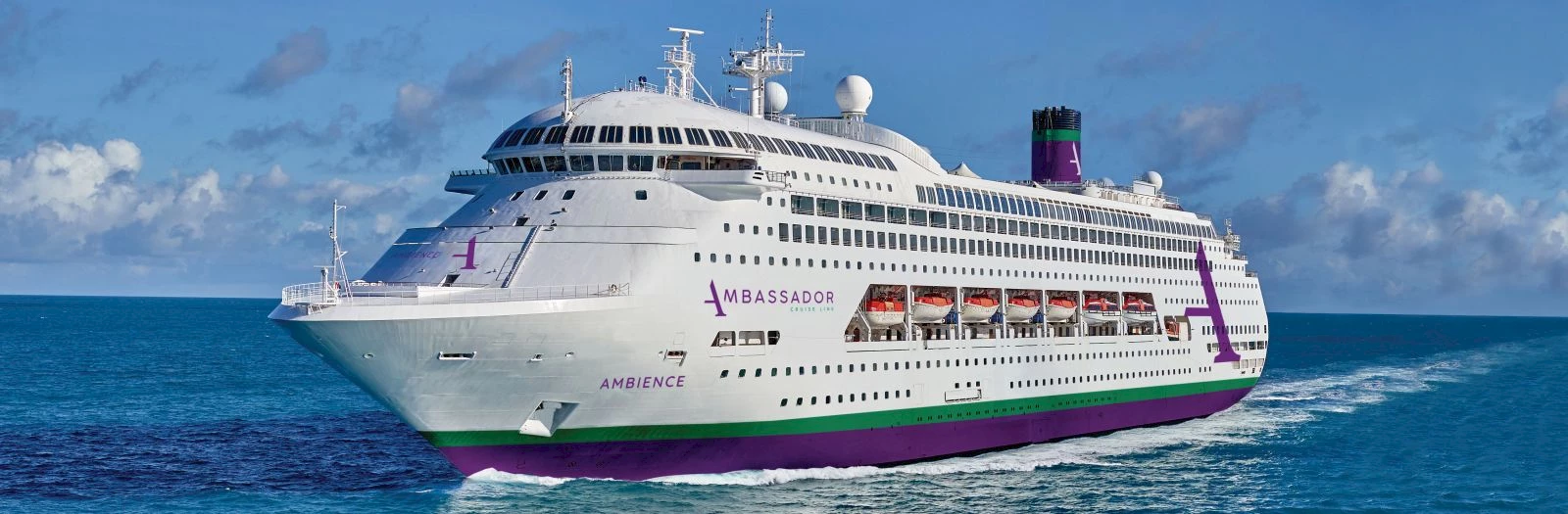
Ambassador operates three ships following the January 2025 merger with Compagnie Francaise de Croisieres. Ambience, the flagship, was built in 1991 as Regal Princess for Princess Cruises and has sailed under numerous names including Pacific Dawn for P&O Cruises Australia. At 70,285 gross tonnes with approximately 1,400 passengers, it is the largest ship in the fleet. Ambition, built in 1999 as MS Mistral for Festival Cruises, carries approximately 1,200 guests at 48,123 gross tonnes — deliberately limited from its maximum capacity of 1,500 to maintain a higher space ratio. Renaissance, built in 1993 as Maasdam for Holland America Line, carries approximately 1,100 guests at 55,575 gross tonnes. The average fleet age is approximately 33 years. All three ships are acquired second-hand tonnage, extensively refurbished but fundamentally constrained by their original construction. No newbuilds are on order — Ambassador’s strategy is to grow through acquisition and refurbishment.
Ambassador sails primarily from eight UK ports — London Tilbury, Newcastle, Dundee, Edinburgh Leith, Liverpool, Bristol, Belfast, and Falmouth — with Portsmouth added as a new departure point for the 2026/27 season. Core itineraries cover the Norwegian fjords, British Isles, Mediterranean, Canary Islands, Iceland, Scandinavia, and the Baltic. The Caribbean fly-cruise programme, launched in the 2025/26 winter season on Renaissance, operates from Barbados, Martinique, and Curacao. World cruises occasionally reach Australian waters — Ambience called at Sydney, Melbourne, and Fremantle during its 120-day world cruise in 2024 — but these are transit stops, not regular deployment. The 2026/27 season encompasses 84 itineraries visiting 146 ports in 48 countries across three continents.
Holland America operates 11 ships across four classes. The three Pinnacle-class vessels — Rotterdam, Nieuw Statendam, and Koningsdam, delivered between 2016 and 2021 at approximately 99,500 gross tonnes — are the flagships, carrying 2,650 guests each with purpose-built Music Walk entertainment districts, Rudi’s Sel de Mer restaurants, and Club Orange dedicated dining. Two Signature-class ships (Eurodam and Nieuw Amsterdam, 2008-2010) at 86,700 tonnes. Four Vista-class ships (2002-2006) at approximately 82,000 tonnes. Two R-class ships (Volendam and Zaandam, 1999-2000) at approximately 61,000 tonnes. The average fleet age is approximately 17 years — significantly younger than Ambassador’s. No new ships are currently on order, but the existing fleet is maintained through regular drydock refurbishments — Zuiderdam, Oosterdam, and Zaandam all underwent significant upgrades in 2025.
Holland America’s destination coverage is genuinely global. Alaska is the signature region — HAL has sailed Alaska for over 75 years, deploying six ships in the 2026 season with more departures from US ports than any other cruise line. Glacier Bay National Park permits, available only to select lines, are a genuine competitive advantage. The Caribbean sees three Pinnacle-class ships plus others during the winter season. Mediterranean and Northern Europe deployments span three ships with 28 Collectors’ Voyages ranging from 14 to 27 days and four new ports added for 2026. Asia, South America, Hawaii, and Panama Canal itineraries provide year-round global coverage. The 133-day Grand World Voyage on Volendam visits 51 ports in 23 countries across five continents, including an Antarctica experience.
The fleet and destination gap is perhaps the most fundamental difference in this comparison. Holland America offers 11 ships with global reach, including regions — Alaska, the Caribbean from US ports, Asia, Antarctica — that Ambassador simply cannot serve from UK departure points. Ambassador offers three heritage ships serving a UK-centric programme with genuine depth in the Norwegian fjords and British Isles but limited global range.
Where each line excels
Ambassador Cruise Line excels in:
- Budget value. Full-board sailings from less than GBP 60 per person per night, with “second guest free” promotions that can reduce effective rates to GBP 40 to 60 per night on longer voyages. No other ocean cruise line operating from the UK consistently undercuts Ambassador on price.
- Solo traveller provision. Dedicated sole-occupancy cabins with no single supplement, welcome events, solo dining tables, and meet-up programmes represent one of the strongest solo offerings in the cruise industry at any price point.
- No-fly convenience from the UK. Eight regional departure ports mean UK-based travellers can drive to their ship without airports, luggage restrictions, or transfer hassles. For travellers who dislike flying, this is Ambassador’s fundamental value proposition.
- Traditional British cruise atmosphere. Afternoon tea, gala nights, enrichment lectures, quizzes, and a warm, unpretentious service style deliver exactly what the target demographic wants. The line does not try to be something it is not.
- Norwegian fjords access. Ambassador’s ships hold eco-credentials allowing entry to UNESCO Heritage fjords — a genuine itinerary strength for the no-fly programme.
- Themed and special interest cruises. Crafting workshops, marine wildlife conservation sailings, solar eclipse cruises, and multi-generational summer sailings add variety beyond standard itineraries.
Holland America Line excels in:
- Culinary excellence. The Culinary Council’s celebrity-chef oversight, seven or more dining venues per ship, America’s Test Kitchen cooking demonstrations, and partnerships with institutions like the three-Michelin-star De Librije create a dining programme that operates at a fundamentally different level.
- Music Walk entertainment. B.B. King’s Blues Club, Rolling Stone Rock Room, Billboard Onboard, and Lincoln Center Stage provide branded, high-production live music experiences that no other cruise line offers.
- Alaska. Over 75 years of Alaska deployment, six ships in the 2026 season, Glacier Bay permits, and cruisetours extending to the Yukon Territory make HAL the undisputed leader in this destination.
- Australian accessibility. Sydney homeporting, two ships deployed for 2026/27, 26 itineraries purpose-built for the Australian market, and a local sales office with dedicated support infrastructure.
- Longer voyage expertise. Collectors’ Voyages, Legendary Voyages, and the 133-day Grand World Voyage reflect a genuine strength in extended itineraries for well-travelled repeat guests.
- Loyalty programme depth. The five-tier Mariner Society rewards repeat cruisers with escalating benefits from specialty dining discounts through complimentary laundry and thermal suite passes.
Standout itineraries for Australian travellers
Holland America Line
35-Day Legendary Australia Circumnavigation (Noordam, departing 15 November 2026, roundtrip Sydney). A full loop of the Australian coast with four ports in Papua New Guinea, overnights in Fremantle (Perth) and Hobart, and late-night stops in Adelaide, Phillip Island, and Melbourne. This is one of the most comprehensive Australia circumnavigation itineraries available in the premium segment, and it sails from Sydney with no flights required.
28-Day Legendary Coral Triangle & Great Barrier Reef (Westerdam, Singapore to Sydney). A deep-dive voyage through the Philippines, Indonesia, Papua New Guinea, and the Great Barrier Reef — a genuinely distinctive routing that covers ground few premium ships sail regularly. Available from September 2026.
14-Day Australia & New Zealand (Noordam, open-jaw Auckland to Sydney or reverse, January to March 2027). The core Australian season itinerary covering both countries with stops including Melbourne, Hobart, and key New Zealand ports. HAL’s included enrichment programme, EXC Talks, and destination speakers provide cultural context at each stop.
133-Day Grand World Voyage (Volendam, departing 4 January 2026, Fort Lauderdale roundtrip). Fifty-one ports, 23 countries, five continents including an Antarctica experience, the Great Barrier Reef, Singapore, and the Maldives. Bookable in segments of 21 to 55 days for travellers who cannot commit to the full voyage. World cruise early booking incentives include up to USD 2,000 onboard credit per guest.
45-Day Ultimate Mediterranean & Atlantic Passage (Volendam, New York roundtrip). Twenty-one ports in 12 countries with overnights in Alexandria and Istanbul. For Australian travellers combining a US holiday with an extended cruise, this is a compelling option accessible via flights to New York.
Ambassador Cruise Line
40-Night Jewels of the Caribbean (Ambience, departing London Tilbury, January 2026). From GBP 4,949 per person with the second guest free — effectively GBP 62 per night per person. A long-haul voyage from the UK to the Caribbean via the Atlantic, suitable for Australian travellers already in the UK who want an extended budget voyage.
120-Day World Cruise (Ambience, roundtrip London Tilbury). Ambassador’s first world cruise in 2024 visited 34 destinations including Sydney, Melbourne, and Fremantle — the only regular Ambassador programme that touches Australian waters. Future world cruises may include similar routing, making this the most relevant Ambassador itinerary for Australians who want to experience the line without flying to the UK.
7-Night Norwegian Fjords (Ambience or Ambition, multiple UK departure ports, spring to autumn). From approximately GBP 630 per person. Ambassador’s bread-and-butter itinerary and arguably its strongest product — short enough to add to a UK holiday, departing from convenient regional ports, and visiting fjords that larger ships cannot access due to environmental restrictions.
Ship-by-ship recommendations
Holland America Line
Koningsdam or Nieuw Statendam — The best introduction to Holland America for first-time guests. These Pinnacle-class ships deliver the full HAL experience: Music Walk with B.B. King’s Blues Club and Rolling Stone Rock Room, the World Stage with 270-degree LED screens, Rudi’s Sel de Mer as a standalone restaurant, Club Orange dedicated dining, and the line’s largest suites. Koningsdam is the top-rated ship in the fleet on Cruise Critic for service, food, and entertainment. Currently deployed to the Mediterranean and Caribbean.
Rotterdam — The newest ship in the fleet (2021) and the current flagship. Same Pinnacle-class experience as Koningsdam and Nieuw Statendam with the most recently fitted hardware. A fine choice for Mediterranean and Northern European itineraries.
Noordam — The primary ship for Australian and New Zealand seasons. If you want to sail Holland America from Sydney without flying internationally, Noordam is your ship. It is a Vista-class vessel from 2006 — well maintained through regular drydock refurbishments but showing its age compared to the Pinnacle-class ships. Reviewers note the signs of wear. Set expectations for a good but not top-tier HAL experience.
Westerdam — The second ship deployed to Australia for 2026/27, also a Vista-class vessel from 2004. It brings the Coral Triangle and Great Barrier Reef itinerary and transpacific positioning voyages. Similar expectations to Noordam — solid, well-maintained, but a generation behind the Pinnacle class in entertainment technology and public space design.
Volendam — The Grand World Voyage ship. At 61,214 gross tonnes and built in 1999, Volendam is the oldest and most intimate vessel in the fleet. Recent Zaandam-class refurbishments have refreshed the library, spa, and Neptune Lounge. Choose this for the itinerary rather than the ship — the 133-day world cruise is the draw.
Ambassador Cruise Line
Ambience — The flagship and the ship most Australian travellers might recognise, having sailed as Pacific Dawn for P&O Cruises Australia until 2020. The largest Ambassador vessel at 70,285 gross tonnes, Ambience carries the broadest range of facilities including Sea & Grass tasting restaurant and the fullest solo cabin programme with 89 dedicated sole-occupancy cabins. The January 2026 drydock brought propulsion upgrades, USB-C ports, new windows, and a spa refresh. Best for longer voyages and world cruises.
Ambition — Based in Newcastle with expansion to Portsmouth for 2026/27, Ambition is the smaller, more intimate ship at 48,123 gross tonnes. The deliberate cap at 1,200 passengers versus the 1,500 maximum capacity creates a higher space ratio comparable to many premium ships. Lupino’s Mediterranean restaurant is exclusive to this ship. Best for Norwegian fjords and shorter European sailings.
Renaissance — The former Holland America Maasdam. Currently dedicated to the Caribbean fly-cruise programme operating from Barbados, Martinique, and Curacao. Not available for UK-departure sailings. Relevant for travellers who want to experience Ambassador in the Caribbean rather than from British ports, though fly-cruise packages include flights from the UK, France, and the Netherlands — not from Australia.
For Australian travellers specifically
This is the section that makes this comparison straightforward for most Australian readers. The two lines occupy fundamentally different positions in terms of Australian accessibility, and understanding that gap matters more than any onboard product comparison.
Holland America has an established, growing Australian presence. The line has deployed ships to Australian waters seasonally since the 1990s. For 2025/26, Noordam is homeported from Sydney with roundtrip itineraries to New Zealand and the South Pacific, including 14-day Australia and New Zealand voyages between Sydney and Auckland and a 42-day South Pacific Islands and New Zealand roundtrip from Sydney. For 2026/27, HAL is doubling its Australian capacity by deploying both Noordam and Westerdam — 26 itineraries ranging from 13 to 35 days from September 2026 to April 2027. The 2027/28 season has been announced with deep exploration from the Great Barrier Reef to Fiji. Holland America maintains a dedicated Australian sales office at 171 Clarence Street, Sydney, operated through the Carnival Australia umbrella alongside Princess and Cunard. The POLAR Online booking engine is available to Australian travel agents. Pricing is available in AUD. The Mariner Society loyalty programme is recognised for Australian members. HAL even lined Sydney’s Overseas Passenger Terminal with tulips for the 2025/26 season launch — a nod to the line’s Dutch heritage and a signal of genuine investment in the Australian market.
Ambassador has effectively zero Australian infrastructure. The line has no homeport in Australia, no regular Australian sailings, and no dedicated Australian sales office in the traditional sense. The core product — no-fly cruising from regional UK ports — is designed for British travellers who want to drive to their embarkation point and avoid airports entirely. This is the antithesis of the Australian cruise proposition, which relies on either domestic departures or fly-cruise packages with international air. Ambassador does have a dedicated Australia and New Zealand sales team headed by Dean Brazier, and the line is bookable through CruiseAway, Australia’s cruise specialist. A dedicated page on the Ambassador website serves Australian and New Zealand travellers. But the product being sold is still a UK-departure cruise — Australians would need to fly to London, travel to Tilbury or another regional port, and join a ship sailing British waters. The 2024 world cruise on Ambience called at Sydney, Melbourne, and Fremantle as part of a 120-day global itinerary, but this was a transit, not homeporting. Future world cruises may include similar Australian port calls, offering Australians the possibility of boarding for a segment without flying to the UK — but these are infrequent opportunities, not a regular programme.
The practical implication: an Australian traveller considering a cruise holiday has two very different paths. With Holland America, you drive to Sydney, board a ship at the Overseas Passenger Terminal, and sail to New Zealand, the South Pacific, Papua New Guinea, or around Australia — no international flights, no jet lag, no connecting transfers. With Ambassador, you book international flights to London (AUD 1,500 to 2,500 or more return), arrange transport to a port that may be two or more hours from the airport, and board a ship sailing European waters. The flight cost alone can equal or exceed the entire Ambassador cruise fare, eliminating the budget advantage that defines the line’s value proposition. Ambassador makes sense for Australians already planning extended time in the UK who want to add an affordable cruise as part of a broader trip. It does not make sense as a primary cruise holiday choice for Australian travellers when Holland America offers comparable itinerary lengths from their doorstep.
The onboard atmosphere
The atmosphere on these two lines is shaped by different demographics, different price expectations, and different cultural identities — and understanding this helps set realistic expectations.
Ambassador’s atmosphere is traditional, warm, and unapologetically British. The passenger base is almost exclusively British, aged 50 and over, with a strong core of retirees and semi-retirees. Many are former CMV loyalists who lost their preferred cruise line in 2020 and found a spiritual successor in Ambassador. The onboard language, cuisine, entertainment, and cultural touchpoints are all British — afternoon tea with scones, full English breakfasts, roast dinners, quiz nights, and variety show entertainment. The dress code is smart casual with optional gala nights that carry no strict enforcement. There is no casino, no nightclub in the modern sense, and no children’s programme on most sailings. Evening entertainment winds down relatively early. The line describes itself as “sophisticated but relaxed, not stuffy” — an accurate characterisation. Crew members are consistently described as friendly, diverse, and genuine. The atmosphere appeals to guests who prefer conversation, live music, and enrichment lectures over high-energy nightlife and spectacle. Solo travellers are particularly well catered for, with dedicated dining arrangements and social events that reduce the isolation that can affect single cruisers on larger ships.
Holland America’s atmosphere is refined, mature, and gently cosmopolitan. The passenger base is predominantly American, with a growing international mix including Australian, Canadian, British, and European guests — particularly on Australian-season departures and world cruises. The average guest age ranges from 57 to 64. Passengers tend to be affluent retirees or pre-retirees who are culturally curious, destination-focused, and loyal to the Mariner Society programme. The atmosphere has been described as “structured yet not overly formal” — more polished than Ambassador but less rigid than Cunard. Daytime is resort casual. Evenings transition to smart casual most nights with one to three Gala Nights per cruise where suits, cocktail dresses, and optional tuxedos are encouraged. Casual dining alternatives in the Lido Market and room service are available for those who prefer not to dress up. The casino operates nightly. Music Walk creates a genuine late-evening social scene with multiple live music venues — B.B. King’s Blues Club and the Rolling Stone Rock Room generate energy that Ambassador’s piano bar cannot match. The mid-sized ships — 1,400 to 2,650 guests depending on the class — are large enough to offer variety without the overwhelming scale of mega-ships.
The atmosphere distinction matters. Ambassador’s onboard world is intimate, familiar, and very British — it can feel like a floating community centre in the best sense. Holland America’s world is broader, more culturally diverse, and more professionally polished — it feels like a well-run premium hotel at sea. Neither atmosphere is wrong; they serve different expectations. An Australian joining Ambassador would need to be comfortable as a conspicuous minority in an overwhelmingly British environment. An Australian joining Holland America would find a more international guest mix and a ship accustomed to welcoming travellers from multiple nationalities and cultural backgrounds.
The bottom line
Ambassador Cruise Line and Holland America Line are not genuine competitors. They occupy different tiers, serve different markets, and deliver fundamentally different products at fundamentally different price points. Comparing them is useful primarily to help Australian travellers understand what each line offers and whether either fits their particular needs.
Choose Holland America if you want a well-established premium cruise experience with genuine global deployment. Choose it for the Culinary Council dining programme, the Music Walk entertainment district, BBC Earth in Concert, and the Mariner Society loyalty programme. Choose it for Alaska — no other line has HAL’s 75-year heritage and Glacier Bay permit access. Choose it for Australian departures — two ships homeporting from Sydney for 2026/27, with 26 itineraries ranging from 13 to 35 days. Choose it for world cruises and Legendary Voyages that cover five continents in a single sailing. Accept that Have It All adds meaningful cost on top of the base fare, that gratuities at USD 17 per day are not optional in practice, that specialty dining supplements accumulate, and that the Vista-class ships deployed to Australia — while well maintained — are a generation behind the Pinnacle class in entertainment technology and public space design.
Choose Ambassador if you are planning a UK holiday and want to add an affordable cruise from a regional British port without flying. Choose it for the remarkably low price point — full-board sailings from less than GBP 60 per person per night, with “second guest free” deals that can halve the cost for couples. Choose it for Norwegian fjords access from convenient UK departure points. Choose it for the solo traveller programme — dedicated single cabins with no supplement, welcome events, and dedicated dining tables. Choose it for the warm, traditional British atmosphere and the simplicity of a no-fly cruise where you drive to the port and drive home again. Accept that the ships are 25 to 35 years old, that the dining and entertainment programme cannot approach Holland America’s breadth or investment, that the fleet is limited to three vessels, and that Australian accessibility is effectively nil for regular sailings.
For Australian travellers considering their next cruise, Holland America is the practical, accessible choice — a line that sails from Sydney, prices in AUD, and offers itineraries purpose-built for the Australian market. Ambassador is a niche option for a very specific circumstance: an affordable add-on to a UK-based holiday for travellers who value budget over product quality. The Maasdam-to-Renaissance connection is a charming piece of maritime trivia, but it does not change the fundamental reality that these two lines serve different worlds.