Ambassador Cruise Line
Premium Cruising
Ambassador is the line I suggest for clients based in the UK who want a traditional, grown-up cruise without the price tag of Saga or the scale of P&O. The ships are older — there's no hiding that — but the food punches well above the fare, the adults-only atmosphere is genuinely relaxed, and sailing from Tilbury or a regional UK port means no flights, no airport stress. It's honest, good-value British cruising.
Ambassador Cruise Line launched in April 2022 as the first new British cruise line in over a decade, built from the foundations of the collapsed Cruise and Maritime Voyages by industry veteran Christian Verhounig. It arrived with a clear proposition: adults-only, no-fly cruising from UK ports at a price point that undercuts the established British names. In a remarkably short time the line has expanded to three mid-size ships, won multiple British Travel Awards, and cultivated a loyal following among passengers who previously sailed with CMV, Fred. Olsen, or Saga and wanted something familiar but fresh.
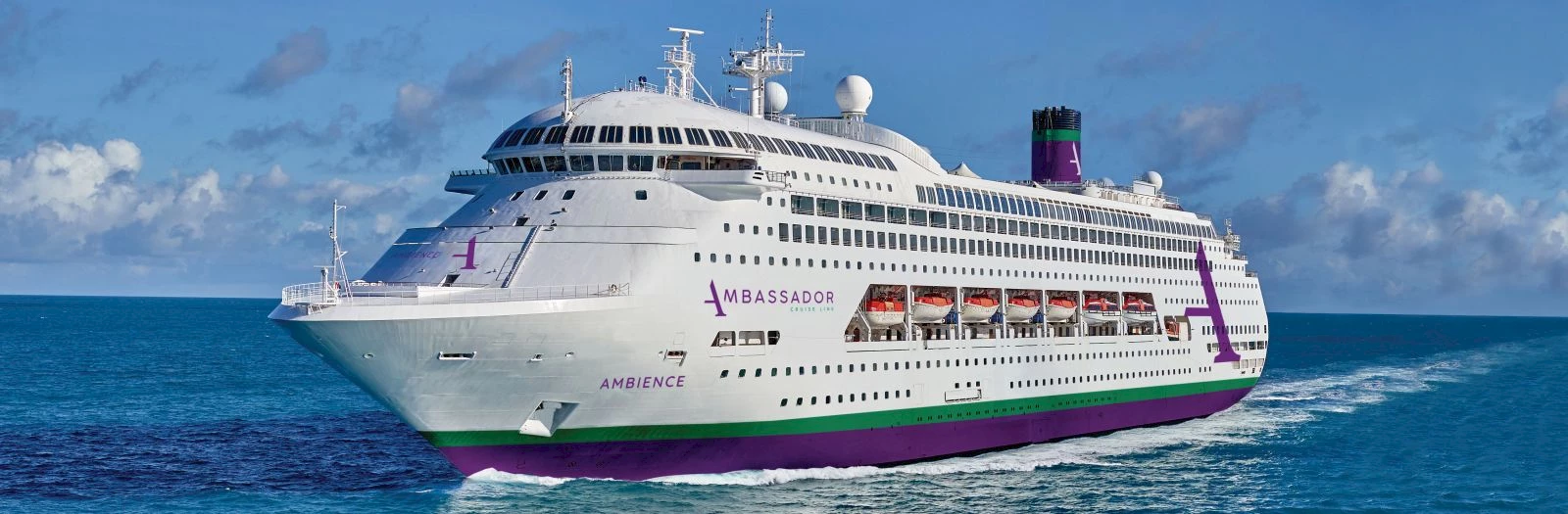
The fleet comprises refreshed heritage vessels rather than new-builds, and that is a deliberate choice. The ships were originally built in the early 1990s for the likes of Princess Cruises, Festival Cruises, and Holland America, then acquired and refurbished with a distinctly British character — venues named Buckingham, Brontë's, and The Cavern, a nod to Liverpool. The mid-size scale of roughly 1,000 to 1,400 guests per ship strikes a balance that larger lines cannot replicate: enough variety in dining and entertainment to fill a week comfortably, but small enough that you recognise faces by the third morning at breakfast. A 2025 merger with French operator Compagnie Francaise de Croisieres brought a third vessel and the line's first Caribbean fly-cruise programme, signalling that Ambassador's ambitions extend beyond the English Channel.
What makes Ambassador distinctive is not any single feature but a combination: the adults-only policy that creates a genuinely peaceful atmosphere, the no-fly convenience of stepping aboard at Tilbury or a regional UK port, the dining quality that consistently exceeds expectations for the fare, and a crew that reviewers praise with near-universal enthusiasm. It is not luxury cruising and does not pretend to be. But for the market it serves — predominantly British, over-50, value-conscious, and traditional in taste — Ambassador delivers a product that feels honest and well-judged.
Ambassador operates a two-tier fare structure, and understanding the difference matters. The base Saver Fare covers your cabin, full-board dining across the main restaurant and buffet, breakfast through to dinner with afternoon tea in between, the complete evening entertainment programme of theatre shows and live music, daytime activities and enrichment lectures on longer voyages, use of the pool and gym, and porterage between the port and your cabin. That is a solid foundation — you will not go hungry or bored without spending a penny beyond the fare.
The premium Ambassador Fare wraps in the top-tier Expedition drinks package, which covers premium wines, spirits, cocktails, beers, soft drinks, and speciality coffees without limit. It also pre-pays gratuities and secures preferential dinner seating. Whether the upgrade is worth it depends on your drinking habits — at roughly an additional fifty pounds per person per night, moderate drinkers may find the standalone Saver Fare plus occasional bar purchases more economical.
What is not included on either fare: shore excursions, Wi-Fi packages, speciality dining surcharges, spa treatments, travel insurance, and laundry. Gratuities on the Saver Fare are added automatically at a modest daily rate. Wi-Fi is powered by Starlink across the fleet and sold in tiered packages from basic email access through to streaming capability. These are standard extras for the premium cruise market, and nothing here will surprise experienced cruisers.
Ambassador's culinary approach is traditional British full-board dining, and it is one of the areas where the line consistently outperforms its price point. The included main restaurant serves a multi-course dinner with several choices per course — expect Sunday roasts with all the trimmings, properly cooked steaks, fish of the day, and classic Continental dishes alongside British staples. Breakfast offers a full English alongside lighter options, and afternoon tea with finger sandwiches, scones, and cakes is a daily ritual. The buffet provides an alternative for all three meals with carving stations and themed evenings. Portions are generous, presentation is tidy, and the overall standard sits comfortably in the dinner-party-quality bracket.
The speciality restaurants are where Ambassador quietly impresses. Saffron, the South Asian venue available on both ships, has earned a loyal following for its quality and its modest surcharge. Lupino's on the smaller ship offers Mediterranean and Spanish-influenced dishes at an equally reasonable cover charge. On the flagship, Sea and Grass delivers a seven-course European tasting menu that represents the closest the line comes to fine dining. A bookable Chef's Table experience includes a galley tour and personally guided courses from the Executive Chef. These venues are not afterthoughts — they are genuinely worthwhile, and the surcharges are low enough that most guests visit at least once per sailing.
Dietary requirements including vegetarian, vegan, and gluten-free are accommodated with advance notice, and guests should advise at booking rather than waiting until embarkation. The speciality menus offer natural options for various dietary needs. Where Ambassador's dining does draw occasional criticism is the buffet, which can be inconsistent, and breakfast on longer voyages, where repetition sets in. These are fair observations. But the main restaurant dinner service and the speciality restaurants consistently earn praise that would flatter a line charging considerably more.
The passenger profile on Ambassador skews older and almost exclusively British. The typical guest is aged somewhere between 55 and 80, retired or semi-retired, middle-income, and drawn to traditional cruising values: formal nights, enrichment lectures, afternoon tea, and ballroom dancing. A significant proportion are former CMV passengers who migrated to Ambassador when that line collapsed, bringing with them a strong sense of community and expectation. Solo travellers are well represented, aided by the extensive inventory of dedicated single cabins, and couples make up the majority of bookings. The atmosphere is best described as a floating British village — sociable, unpretentious, and warm.
Entertainment follows the traditional British pattern: pre-dinner drinks, a two-sitting dinner, then a theatre show from Ambassador's in-house company or cabaret in one of the ship's lounges. Live music, classical interludes, guest speakers on longer voyages, quizzes, and dance classes fill the daytime programme. The ships quiet down relatively early — by eleven most guests are in their cabins. The casino is small and low-key. This is not a line for anyone seeking a vibrant late-night scene, a younger demographic, or cutting-edge entertainment. But for its target audience, the programme is well-pitched and the communal atmosphere genuinely appealing.
The dress code maintains traditional standards with formal or gala evenings twice per week on a typical sailing, smart evenings as the default, and relaxed casual on in-port nights. Dinner jackets and evening dresses are encouraged but not compulsory — guests who prefer to dress down can always dine in the buffet. The overall tone is one of gentle formality rather than rigid enforcement, and that balance suits the demographic well. Who is this line not for? Anyone seeking luxury hardware, families with children, tech-forward travellers, foodies chasing gastronomic innovation, or guests with significant mobility requirements on these heritage-era ships.
Ambassador is a niche proposition for Australians, and it is important to be upfront about that. The line has no Australian office, no local trade representation, no departures from Australian ports, and no included air programme covering flights from Australian gateways. All standard itineraries depart from UK ports, and all pricing is denominated in British pounds. This is, fundamentally, a British cruise line built for British passengers sailing from British shores.
That said, there is a genuine use case for Australians who are already planning a trip to the United Kingdom. If you are visiting family, spending a few weeks in England or Scotland, or building a broader European itinerary, adding a short Ambassador cruise from London Tilbury — or from a regional port like Newcastle, Liverpool, or Edinburgh — can be an excellent and affordable way to see the Norwegian Fjords, British Isles, or Canary Islands without the cost and complexity of a separate flight. The no-fly convenience that defines Ambassador for its British passengers translates, for an Australian visitor, into a seamless extension of a UK holiday.
Booking is straightforward through selected Australian online agencies or directly via Ambassador's website, though you will be paying in GBP and managing the exchange rate accordingly. Travel insurance should be arranged through an Australian provider rather than relying on any UK-centric cover. For Australians seeking their primary cruise holiday, the long-haul flight to London and the exclusively UK-focused departure ports make Ambassador hard to recommend over lines with Australian or regional departures. But as an add-on to a British trip, it offers something distinctive: a genuinely traditional, adults-only, good-value British cruise experience that you simply cannot find closer to home.
Ambassador positions itself as the value leader in the British no-fly cruise market, and the pricing supports that claim. On a per-night basis, expect base Saver Fares starting from roughly sixty to one hundred pounds per person for an inside cabin on a standard week-long voyage, rising through ocean view and balcony grades to suites in the one hundred and fifty to two hundred and eighty pound range per night. Longer voyages and grand voyages of forty or more nights bring the per-diem down further, with inside cabins sometimes falling below fifty pounds per night. These are directional figures in GBP and will vary by season, itinerary, and how far ahead you book.
Solo travellers benefit from a pricing structure that is among the most generous in the industry. Dedicated single-occupancy cabins are priced at a single rate with no supplement whatsoever, and if you prefer a double cabin to yourself, reduced supplements start from around 25 to 30 per cent. Ambassador's website includes a solo pricing toggle that makes comparison shopping straightforward — a small but telling detail that shows the line takes its solo market seriously.
Deposits are required at booking, with balance payment due 90 days before departure. Cancellation charges escalate from deposit forfeiture through to the full fare as the departure date approaches, which is standard for the sector. Ambassador also offers a Price Promise — if you find the same cabin on the same sailing at a lower published price elsewhere, they will match it or offer equivalent value. For first-time guests, the Ambassador Guarantee provides a full refund and return transport if you notify the Hotel Director within 24 hours of embarkation that the cruise is not for you. Wave Season between January and March typically delivers the strongest promotional offers, including half-price drinks packages, cabin upgrades, and reduced single supplements.
Share your dates and preferences and we will come back with Ambassador Cruise Line cabin options, pricing, and insider tips.