Paul Gauguin
Luxury Cruising
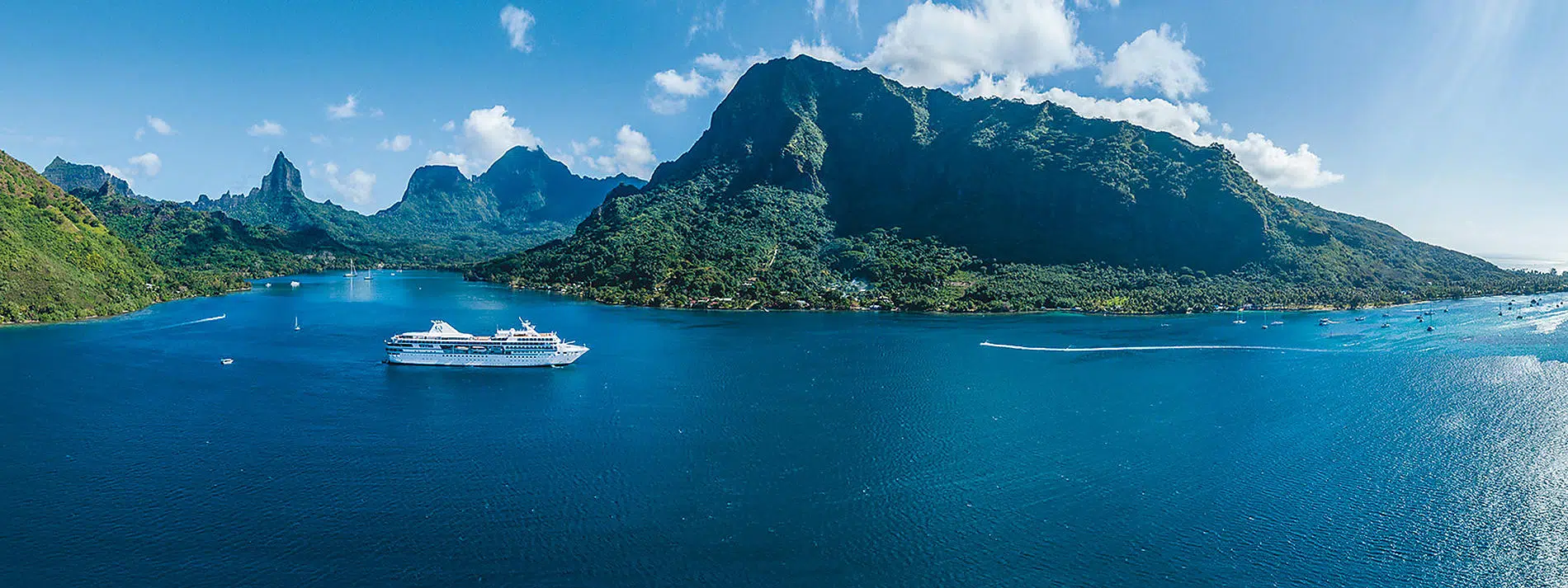
There is simply no better way to experience French Polynesia than aboard the Paul Gauguin. The ship was purpose-built for these waters — her shallow draft lets her slip into lagoons and tiny ports that larger ships cannot reach. Now owned by Ponant, she has had a thorough refurbishment and the onboard standard has noticeably risen, with included drinks, watersports from the marina platform, and a private island day on Motu Mahana that is genuinely magical. If your clients dream of Bora Bora and Moorea, this is the only ship I would recommend.
Paul Gauguin Cruises is something genuinely unusual in the cruise industry: a single-ship, single-destination luxury line devoted almost entirely to French Polynesia and the wider South Pacific. The m/s Paul Gauguin has been sailing year-round from Papeete, Tahiti, since 1998, purpose-built with a shallow draft that allows her to slip into lagoons and reef-fringed anchorages that no other cruise ship can reach. Now owned by Ponant Explorations Group — the luxury arm of the Pinault family's Artemis holding company, which also controls Kering and its portfolio of fashion houses — the line has seen meaningful investment in recent years without losing the relaxed, destination-focused identity that defines it.
What makes a single-destination specialist different from a global cruise line is depth. The crew, many of whom are local Polynesians, know these islands intimately. The resident cultural hosts — Les Gauguines and Les Gauguins — are not performers flown in for a themed evening but Tahitians who live aboard the ship and weave Polynesian culture into the daily experience. The itineraries do not treat French Polynesia as one stop among many; they are built to explore it properly, island by island, from the iconic lagoons of Bora Bora to the remote archaeological sites of the Marquesas. For travellers whose goal is a deep, immersive South Pacific experience rather than ticking off ports across multiple continents, there is nothing else quite like it.
The Ponant acquisition in 2019 brought tangible improvements — better wine, real French butter in the kitchen, sustainability upgrades, and a comprehensive 2025 refurbishment that modernised the pool deck, redesigned the Le Grill restaurant, and added connecting staterooms for families. The ship retains her own brand identity and booking systems, operating as a distinct entity within the Ponant Explorations Group alongside Ponant's expedition fleet and Aqua Expeditions.
Paul Gauguin's all-inclusive fare is genuinely comprehensive for the South Pacific market. It covers all onboard dining across three restaurants and 24-hour room service, select wines and spirits, beers, soft drinks, bottled water, and hot beverages throughout the ship. Gratuities for room stewards, dining staff, and bar staff are pre-paid. Complimentary Wi-Fi is available throughout the vessel. The retractable watersports marina at the stern provides kayaking, paddleboarding, and windsurfing at no extra charge, and snorkel gear is issued for use throughout the voyage. Entertainment, cultural workshops led by Les Gauguines, and enrichment lectures by guest naturalists and historians are all bundled in. On most Society Islands sailings, a full day on Motu Mahana — the line's private islet off Taha'a — is included, complete with barbecue, floating bar, and Polynesian entertainment. From Category B staterooms upward, butler service is also part of the fare.
The notable exclusions are shore excursions (aside from the private island and Bora Bora beach access), the onboard SCUBA diving programme, spa treatments at the Deep Nature Spa, premium wines and spirits from the Connoisseur List, airfare to Tahiti, and travel insurance. Shore excursions being excluded while the line markets itself as all-inclusive is a fair criticism and a frequent point of guest feedback. That said, when you compare the total inclusions against Windstar's base fare in the same region — which excludes drinks, Wi-Fi, and gratuities — Paul Gauguin delivers materially more value per diem even at a higher headline price point. The daily stocked minibar in every stateroom is a small touch that reinforces the resort-like feel.
The dining programme operates across three venues, all included without surcharges and all on an open-seating basis — no assigned tables, no fixed times. L'Etoile is the main dining room, serving dinner nightly with a menu that typically features four appetisers, soups, salads, pastas, an intermezzo sorbet, and several entree specialities paired with wines selected by the onboard sommelier. It is consistently rated the culinary highlight of the ship. La Veranda serves casual buffet-style breakfast and lunch during the day, then transforms into a reservation-only restaurant in the evening with a more intimate French-leaning menu — foie gras, escargot, truffle-mushroom risotto. Le Grill, located poolside and completely redesigned during the 2025 refurbishment, handles casual breakfast and lunch plus Polynesian specialities at dinner in a contemporary al fresco setting.
The Ponant influence is most evident in the kitchen. French butter is now used throughout, the cheese selection at lunch and dinner has been expanded significantly, and the wine programme features French bottles prominently alongside the complimentary selection. Fresh local fish is a genuine highlight — mahi-mahi, tuna, and other South Pacific catches appear on menus most days, and the French-Polynesian fusion approach blends metropolitan French technique with local ingredients including tropical fruits, coconut, vanilla, and Polynesian spices. The mango mousse made with local fruit is mentioned by enough returning guests to qualify as something of a signature.
I should be straightforward about the limitations. Three dining venues is fewer than some competitors offer, and while L'Etoile is genuinely strong, a minority of reviewers have found the broader dining experience inconsistent — particularly at Le Grill before the 2025 refit. This is not the same calibre of culinary programme you would find aboard a Regent or Silversea ship, but it is very good for the segment, and the integration of local Polynesian ingredients gives it a character that those larger lines cannot replicate. Dietary requirements including vegetarian, vegan, low-sodium, and heart-healthy options are accommodated with advance notice.
With a maximum of 332 guests and a crew-to-guest ratio of roughly one to 1.5, the m/s Paul Gauguin feels closer to a boutique island resort than a conventional cruise ship. The typical guest is 45 to 65, well-travelled, and affluent, though a significant honeymooner contingent in the 25 to 40 bracket is drawn by the romantic South Pacific setting. The nationality mix leans predominantly North American on the core seven-night sailings, with a notable French presence thanks to the Ponant connection, and Australian, British, and European guests more visible on longer voyages and repositioning crossings.
The dress code is among the most relaxed in luxury cruising. There are no formal nights, no black-tie evenings, no requirement for a tie at any point. Daytime is casual resort wear; evenings call for country club casual — linen trousers, sundresses, open-collar shirts. The atmosphere is warm, informal, and unmistakably Polynesian. Les Gauguines contribute enormously to this: their daily presence, cultural workshops, evening performances of traditional Tahitian song and dance, and their role as island hosts on Motu Mahana create an ambience that is genuinely unique to this ship. Reviewers consistently describe it as a "happy ship" where guests and crew mingle easily around the pool, at Le Grill, and during beach days.
It is equally important to be clear about who this ship is not for. If you want a large-ship experience with production shows, waterslides, and a serious casino, this is the wrong vessel. If you want diverse global itineraries rather than French Polynesia on repeat, this is not your line. If spacious entry-level cabins are a priority, the 200-square-foot base categories will feel tight by luxury standards. And if you are travelling with very young children, the lack of babysitting and the absence of a dedicated kids' programme on most sailings means this is effectively an adults' ship outside school holidays. For everyone else — couples, honeymooners, solo travellers who enjoy a sociable atmosphere, and anyone who wants a multi-island South Pacific experience without the logistical complexity of resort-hopping — it is genuinely difficult to beat.
French Polynesia is closer to Australia than most people realise. The standard routing is via Auckland on Air Tahiti Nui, with total travel time from Sydney or Melbourne running around nine to eleven hours including the connection — considerably shorter than the flight to Europe and roughly comparable to Bali. There are no direct flights from Australia to Tahiti as of early 2026, but the Auckland connection is straightforward, and Air New Zealand feeds conveniently into the Air Tahiti Nui schedule. Paul Gauguin offers flight credits of up to US$1,500 per person on select sailings, which help offset the airfare.
All voyages depart from Papeete, Tahiti, so a pre-cruise night is worth building into your plans — it cushions against flight delays, lets you adjust to the time zone, and Papeete's central market is worth a morning in its own right. Occasional repositioning crossings connect Tahiti with Fiji, Australia, or Southeast Asia, and these are worth watching for Australian guests who want to board or disembark closer to home. The 2027 programme includes a 17-night Crossing Melanesia voyage from Australia to Fiji via Darwin, Papua New Guinea, the Solomon Islands, and Vanuatu, which removes the need for a long-haul flight entirely.
Seasonally, the dry season from May to October is generally considered the best time to visit French Polynesia — cooler, less humid, and with lower rainfall — though the ship operates year-round and the wet season brings warmer water temperatures and lush landscapes. Ponant's Asia-Pacific office in Sydney supports Paul Gauguin bookings for Australian agents, and several Australian cruise specialists quote the line in AUD with packaged airfare options. For a travel experience that combines genuine luxury, cultural depth, and world-class natural beauty within a relatively short flying radius, Paul Gauguin is a product that makes particular sense for the Australian market.
Directional per-diem pricing for a seven-night Society Islands voyage sits in the range of roughly AUD $600 to $900 per person per night at entry and mid-tier categories, climbing higher for suites with butler service. That positions Paul Gauguin at the upper end of luxury cruising, though it is important to remember how much is bundled into that figure — drinks, gratuities, Wi-Fi, watersports, cultural programming, and the Motu Mahana private island day. When you compare the all-in cost against Windstar's Star Breeze in the same waters, where drinks, Wi-Fi, and gratuities are all additional, the effective gap narrows considerably despite the higher headline fare.
The more revealing comparison, though, is against independent resort-hopping in French Polynesia. A week at a luxury overwater bungalow in Bora Bora alone can exceed what the cruise costs, and that covers a single island without meals, activities, or inter-island flights. Paul Gauguin visits four to six islands in seven nights, includes all meals and most activities, and eliminates the cost and complexity of Air Tahiti domestic flights — which are limited in schedule, restrictive on luggage, and surprisingly expensive. For first-time visitors to French Polynesia in particular, the cruise delivers a breadth of experience that is logistically difficult and financially prohibitive to replicate from land.
Solo travellers face a standard single supplement of 100 per cent of the per-person fare, which is steep. However, Paul Gauguin is more active than most luxury lines in promoting reduced supplements — zero per cent on select categories and sailings, 50 per cent on others — and all solo bookings receive a US$500 shipboard credit. Deposits are 25 per cent within 72 hours of booking, with final payment due 90 days before sailing. Travel insurance is not included and is strongly recommended given the remoteness of the destination. Prices are broadly consistent whether booked directly or through an agent, but an Australian cruise specialist who can quote in AUD, package flights from local gateways, and coordinate pre-cruise accommodation in Papeete will generally deliver the best overall outcome.
Share your dates and preferences and we will come back with Paul Gauguin cabin options, pricing, and insider tips.