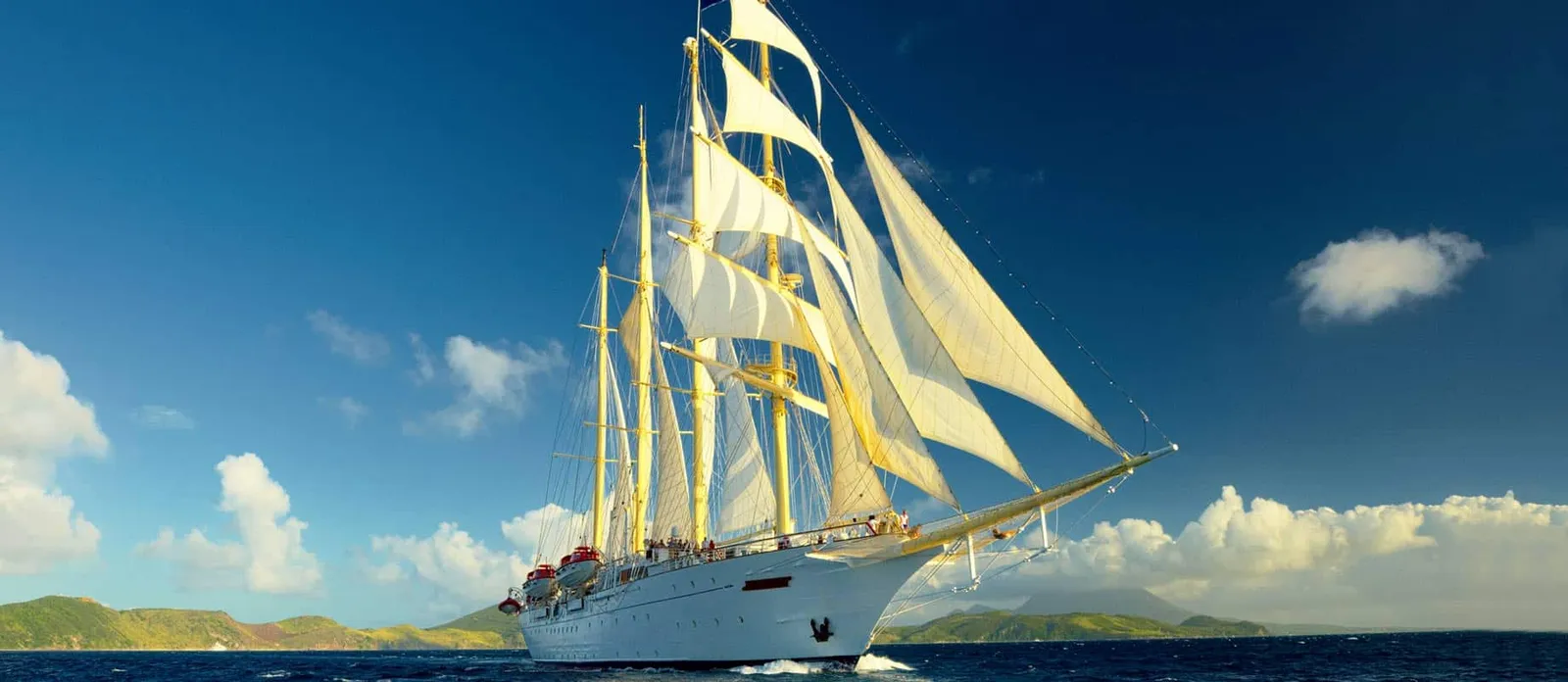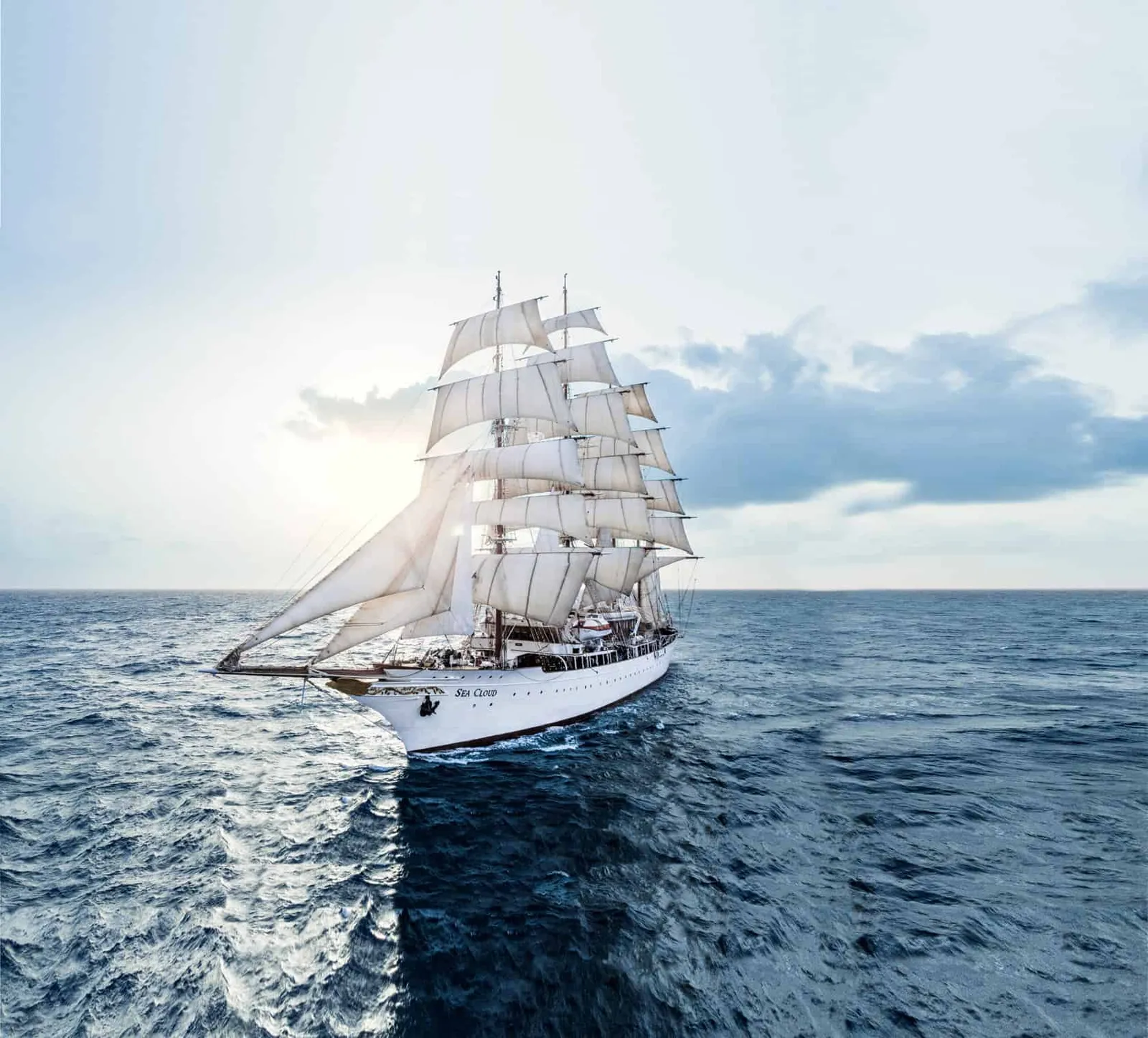
Sea Cloud Cruises and Variety Cruises both deliver genuinely intimate small-ship experiences for under 140 guests — but the comparison ends there. One is a luxury tall sailing ship with hand-set sails and 1930s heritage cabins. The other is a fleet of Greek motor yachts carrying an average of 50 guests through harbours the big ships cannot reach. Jake Hower compares two of cruising's most distinctive niche operators for Australian travellers.
| Sea Cloud Cruises | Variety Cruises | |
|---|---|---|
| Category | Yacht-Style | Yacht-Style |
| Rating | ★★★★☆ | ★★★★☆ |
| Fleet size | 3 ships | 10 ships |
| Ship size | Yacht (under 140) | Yacht (under 72) |
| Destinations | Mediterranean, Caribbean, Northern Europe | Greek Islands, Mediterranean, West Africa, Seychelles |
| Dress code | Elegantly casual | Casual |
| Best for | Tall-ship sailing romantics | Small-ship Greek Island explorers |
Sea Cloud is for travellers who want sailing heritage, five-star refinement, and the romance of a 1931 tall ship with hand-set sails — a once-in-a-lifetime experience for those drawn to maritime history and European elegance. Variety Cruises is for travellers who want authentic Greek island-hopping at yacht scale — tiny harbours, village tavernas, swimming off the back of the boat, and a crew whose warmth defines the voyage. For Australians wanting luxury sailing with historical provenance, choose Sea Cloud. For Australians wanting an accessible, unpretentious small-ship Greek Islands experience that feels like chartering a friend's yacht, choose Variety.
The core difference
Sea Cloud Cruises and Variety Cruises occupy the same end of the intimacy spectrum — both carry fewer guests than a suburban restaurant — but they arrive at that intimacy from entirely different directions and at entirely different price points.
Sea Cloud is a Hamburg-based luxury sailing company operating the world’s only fleet of tall sailing ships. The original Sea Cloud, built in 1931 as the world’s largest private yacht for Marjorie Merriweather Post, carries just 64 guests in cabins that retain their original mahogany panelling, marble fireplaces, and gold-plated fixtures. The crew hand-sets 29 sails across 3,000 square metres of canvas — real sailing, not decorative. Sea Cloud II (2001, 94 guests) and Sea Cloud Spirit (2021, 136 guests) expanded the fleet while preserving the windjammer philosophy. The atmosphere is refined, the dining is silver service, and the heritage is irreplaceable.
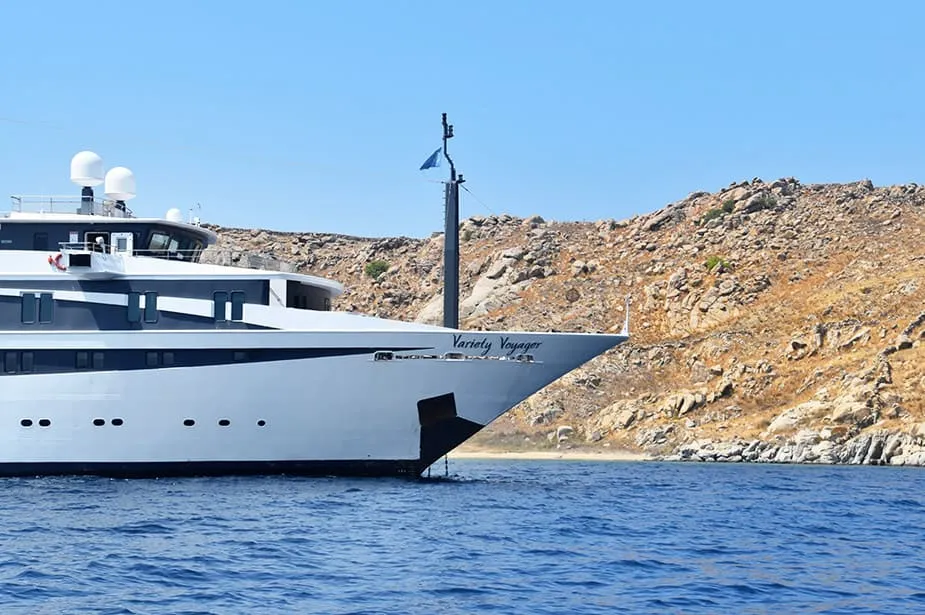
Variety Cruises is a third-generation family-owned Greek company operating 11 motor yachts carrying an average of just 50 guests each. There are no sails, no heritage cabins, no marble fireplaces. The ships are compact and unpretentious — comfort and character take priority over glitz. The real draw is the itineraries: shallow-draft vessels slip into tiny harbours, quiet coves, and lesser-known Greek islands that mainstream cruise ships cannot access. Extended evening stays in port allow guests to wander village streets and find a harbourside taverna after the day-trippers have gone. The half-board arrangement — breakfast and one main meal included, with the other left free — is deliberate, encouraging guests to eat ashore and experience local cuisine firsthand.
For Australian travellers, this comparison is less about choosing between competitors and more about understanding two fundamentally different travel philosophies. Sea Cloud offers a luxury sailing experience steeped in history. Variety offers an authentic Greek island experience at yacht scale. Both are intimate. Both are memorable. They serve entirely different desires.
What is actually included
The inclusion models reflect radically different approaches to the relationship between ship and shore.
Sea Cloud’s fare covers all dining — breakfast, lunch, afternoon tea, and multi-course dinners with complimentary table wines at dinner. A daily cocktail hour with open bar is included. Sea Cloud Spirit adds a swimming platform and spa, with treatments at extra cost. Gratuities are at guests’ discretion. Premium wines outside the cocktail hour are charged. Shore excursions are priced separately. The model assumes you will spend most of your time aboard, with the ship as the primary experience.
Variety’s half-board fare covers breakfast and one main meal — typically lunch or dinner, rotating based on the port schedule. The deliberate omission of the second meal is a feature, not a limitation: when your ship is moored in a tiny Greek harbour until late evening, walking ten minutes to a village taverna for grilled octopus and local wine at a fraction of restaurant prices is the point. Soft drinks, water, and coffee are included. Alcoholic beverages are additional but very reasonably priced. Snorkelling gear and fishing equipment are provided. Swim stops in open water are standard. Shore excursions are optional.
The net effect for Australian travellers is a meaningful cost difference. Sea Cloud’s more comprehensive inclusion reflects its luxury positioning and higher fare. Variety’s half-board model keeps the base fare low and puts the choice of how much to spend ashore in guests’ hands. A Greek taverna dinner for two — fresh fish, salad, local wine — might cost EUR 40 to 60. The flexibility to choose your own dinner in port is a genuine advantage that many Variety guests cite as a highlight rather than a shortcoming.
Dining and culinary experience
The dining experiences aboard these two lines could hardly be more different — and both are excellent on their own terms.
Sea Cloud’s dining follows the European tradition of elegant multi-course meals. A single restaurant serves regionally inspired cuisine with complimentary table wines at dinner, with menus changing daily and ingredients sourced at ports of call. On the original Sea Cloud, dining for 64 guests in a room with 1930s fixtures is a private dinner party by any measure. Sea Cloud Spirit’s expanded restaurant maintains the standard for 136 guests. Afternoon tea is a daily ritual. The atmosphere is refined, the presentation immaculate, and the wine service attentive.
Variety’s dining is half the story — the other half happens ashore. Meals aboard are prepared by the Greek crew with a focus on fresh, local ingredients: grilled seafood, Greek salads with tomatoes that taste of sunshine, regional cheeses, and olive oils from the islands the ship visits that day. The quality is honest rather than elaborate — think exceptional home cooking rather than silver service. But the real culinary programme is the freedom to eat ashore. Variety’s itineraries are designed to keep the ship in port until late evening, and the crew will point you to the tavernas the locals actually use — not the tourist traps by the ferry terminal. Dining in a harbourside taverna in a village of 200 people as the sun sets over the Aegean is an experience no onboard restaurant can replicate.
Sea Cloud wins on onboard dining refinement — the setting, the service, the multi-course progression. Variety wins on culinary authenticity — the combination of honest Greek cooking aboard and the freedom to eat ashore in places that tourists rarely find. For food-motivated travellers, the question is whether you want your culinary experience curated for you or discovered by you.
Suites and accommodation
The accommodation comparison reveals the widest gap in this pairing — and it is important to set expectations accordingly.
Sea Cloud’s cabins span the full range of its fleet’s history. The 1931 original’s owner’s cabins with mahogany panelling, marble fireplaces, and gold-plated fixtures are museum-quality interiors. Sea Cloud II offers contemporary accommodation across 47 cabins. Sea Cloud Spirit’s 2021 launch brought balcony cabins, modern suites, and a wellness area to the fleet. Across all three ships, the build quality and finishing reflect a luxury price point.
Variety’s cabins are functional rather than luxurious — and the company is transparent about this. Cabins across the fleet are compact, simply furnished, and nautically themed. The ships show their age in places. Bathrooms are small. Storage is limited. There are no balconies, no suites in the conventional sense, and no five-star finishing. What Variety’s accommodation delivers is cleanliness, comfort, and the privacy of a small ship where your cabin is steps from the sun deck, the dining room, and the swimming platform at the stern.
The gap is significant and deliberate. Sea Cloud charges a luxury fare and delivers luxury accommodation — particularly on the original vessel and Sea Cloud Spirit. Variety charges an accessible fare and delivers accommodation that is entirely adequate for a voyage where you spend your days on deck, in the water, and ashore. Prospective guests who measure a cruise by cabin quality will be disappointed by Variety. Those who measure it by the quality of the ports and the warmth of the crew will find the cabins perfectly sufficient.
Pricing and value
The pricing gap is the largest in this comparison and reflects genuinely different market positions.
Sea Cloud’s pricing places it in the luxury segment. The original vessel’s owner’s cabins can reach AUD $1,200 to $1,500 per person per night. Standard cabins across the fleet range from approximately AUD $600 to $900 per person per night. Sea Cloud Spirit’s broader cabin range offers more price points. Fares include dining with table wines, afternoon tea, and the cocktail hour.
Variety’s pricing places it among the most accessible small-ship experiences available. Entry-level pricing starts from approximately AUD $200 to $400 per person per night for seven-night Greek Islands itineraries. The half-board model means some meals are taken ashore at your own expense, but Greek taverna dining is remarkably affordable. Wine and beer aboard are very reasonably priced. The total daily cost — cruise fare plus onboard spending plus meals ashore — typically remains well below AUD $400 per person per day.
For Australian travellers, the total cost comparison is striking. A seven-night Variety Greek Islands cruise might cost AUD $1,400 to $2,800 per person for the cruise, plus AUD $300 to $500 for meals ashore and onboard drinks — a total of approximately AUD $1,700 to $3,300 before flights. A seven-night Sea Cloud Mediterranean sailing starts from approximately AUD $4,200 to $6,300 per person before flights. Flights to Athens from Australian gateways — the gateway for both lines’ Mediterranean programmes — cost roughly AUD $2,000 to $3,500 return. The total outlay for Variety is roughly half that of Sea Cloud for comparable duration, though the experiences are so different that direct value comparison is misleading.
Spa and wellness
Neither line is a spa-focused operation — both are too small and too sailing-oriented for that — but the wellness offering has diverged with Sea Cloud Spirit’s arrival.
Sea Cloud’s wellness evolved significantly in 2021. The original Sea Cloud and Sea Cloud II have minimal spa facilities — the deck, the sea air, and the rhythm of sailing are the wellness programme. Sea Cloud Spirit introduced a dedicated wellness and spa area with treatment rooms, a swimming platform for direct ocean access, and an ocean-view fitness centre. The swimming platform is a notable addition that brings active water engagement to the fleet for the first time.
Variety’s wellness is entirely experiential. Swim stops in open water are a daily feature on most itineraries — the ship anchors in a sheltered cove, the swimming platform at the stern lowers, and guests swim and snorkel directly from the yacht. Snorkelling gear and fishing equipment are provided. The sun deck is the fitness centre. The warmth of the Aegean is the spa. There are no treatment rooms, no fitness equipment, and no structured wellness programmes.
Both lines deliver wellness through their relationship with the sea — but Sea Cloud Spirit offers structured spa options that Variety does not. For travellers who want both sailing heritage and a proper spa, Sea Cloud Spirit is the clear choice. For travellers who define wellness as swimming in a cove so quiet you can hear cicadas on the hillside above, Variety delivers something no spa can bottle.
Entertainment and enrichment
Both lines operate at scales too small for conventional entertainment — and both have found compelling alternatives.
Sea Cloud’s enrichment is destination-focused and intellectually stimulating. Guest lecturers cover maritime history, regional culture, and the extraordinary history of the ships themselves. The original Sea Cloud’s journey from Marjorie Merriweather Post’s private yacht to World War II service to its current incarnation provides compelling narrative material. Classical music performances suit the ship’s heritage atmosphere. The daily spectacle of watching the crew hand-set 29 sails is the signature entertainment — many guests describe it as the single most memorable moment of their voyage. Evenings in the ship’s public rooms have the feel of a cultured country house party.
Variety’s entertainment is generated by the destinations and the people. Extended evening stays in port — often until 10 or 11 pm — mean the harbour village itself becomes the evening programme. Guests walk to a taverna, linger over dinner, watch the sunset from a harbour wall, and return to the ship when they choose. On board, the Greek crew’s warmth and hospitality create an atmosphere that guests consistently describe as a house party. The Captain’s briefing each evening covers the next day’s ports and swim stops. Music might appear spontaneously from the crew. The international passenger mix and the intimacy of 50 guests generate the kind of easy conversation that formal programmes cannot manufacture.
The distinction is between curated enrichment and organic discovery. Sea Cloud provides lectures, music, and history that frame the voyage intellectually. Variety provides the freedom to discover each port on your own terms, with the ship as a comfortable base rather than the main event.
Fleet and destination coverage
The fleet comparison reveals dramatically different scales of operation.
Sea Cloud operates three ships across a focused geography. Sea Cloud (64 guests), Sea Cloud II (94 guests), and Sea Cloud Spirit (136 guests) deploy seasonally between the Caribbean (winter) and the Mediterranean, Canary Islands, and Northern Europe (summer). All three are tall sailing ships with hand-set sails. Itineraries range from four to nineteen nights. The ships access small harbours unreachable by larger vessels.
Variety Cruises operates 11 motor yachts — one of the largest small-ship fleets in the industry by vessel count. The ships carry an average of 50 guests each, with some as small as 34 guests. The fleet deploys primarily in the Greek Islands and broader Mediterranean, with seasonal itineraries to West Africa and the Seychelles. Itineraries in the Greek Islands include the Classical Greece route through the Cyclades, Jewels of the Cyclades, and the Ionian Odyssey. Extended deployments reach the Adriatic, Turkey, and the eastern Mediterranean.
For Australian travellers, the destination overlap is limited to the Mediterranean. Sea Cloud adds Northern Europe and the Caribbean. Variety adds West Africa and the Seychelles — though its core strength remains the Greek Islands, where its fleet’s local knowledge and shallow-draft access create itineraries that no other line can replicate. The 11-ship fleet means more departure dates and itinerary variety in Greece than Sea Cloud can offer with a single vessel in the region at any given time.
Where each line excels
Sea Cloud excels in:
- Heritage and provenance. The 1931 original is a maritime treasure — a vessel you sail on that also happens to be a floating museum with irreplaceable 1930s appointments.
- Authentic sailing. Hand-set sails across 3,000 square metres of canvas, with the ship moving under wind power. No other cruise experience offers this combination of luxury and authentic square-rigger sailing.
- Luxury finishing. Silver service dining, complimentary wines, afternoon tea, and cabin appointments that range from historical originals to modern balcony suites on Sea Cloud Spirit.
- Cultural enrichment. Guest lectures, maritime history, and classical music create intellectual depth that complements the sailing experience.
- Modern expansion. Sea Cloud Spirit’s 2021 arrival brought balcony cabins, a spa, and a swimming platform without compromising the sailing heritage.
Variety Cruises excels in:
- Greek Islands expertise. A third-generation Greek family company with unmatched local knowledge. The crew know which harbours to visit, which tavernas to recommend, and which coves are perfect for swimming.
- Fleet scale in Greece. Eleven ships mean more departure dates, more itinerary options, and more flexibility than any other small-ship operator in the Greek Islands.
- Half-board freedom. The deliberate inclusion of only one main meal frees guests to discover local cuisine ashore — a feature that transforms every port into a culinary adventure.
- Accessibility and value. Entry-level pricing from approximately AUD $200 per person per night puts intimate small-ship cruising within reach of travellers who cannot afford luxury pricing.
- Harbour access. Shallow-draft yachts slip into tiny harbours and coves that even Sea Cloud’s sailing vessels may not enter — the hidden side of the Greek Islands that tourists on larger ships never see.
- Extended port stays. Evening stays until late in port mean guests experience each destination as residents, not visitors.
Standout itineraries for Australian travellers
Sea Cloud
Sea Cloud: Caribbean under Canvas (7-10 nights, winter season) — The original 1931 vessel under sail through the Caribbean with just 64 guests. Owner’s cabins with 1930s appointments make this a bucket-list voyage. Fly via the United States from Australian east coast cities.
Sea Cloud Spirit: Mediterranean Discovery (7-14 nights, summer season) — The modern flagship with balcony cabins and spa exploring the Italian and French Rivieras, Greek Islands, and Adriatic. At 136 guests, the most accessible entry to the fleet. Fly to Mediterranean ports from Australian gateways via the Middle East or Singapore.
Variety Cruises
Classical Greece: Athens, Cyclades, and Peloponnese (7 nights, roundtrip Athens) — The signature Variety itinerary threading through Santorini, Mykonos, Delos, Monemvasia, and the Peloponnese with approximately 50 guests. Extended evening stays in port for taverna dining. Swimming stops in sheltered coves. Fly to Athens from Australian cities via Singapore Airlines, Emirates, or Qatar Airways — approximately 20 to 22 hours.
Jewels of the Cyclades (7 nights, roundtrip Athens) — A deeper exploration of the Cycladic islands, visiting lesser-known gems beyond Santorini and Mykonos. Paros, Naxos, Amorgos, and the small Cyclades reveal a Greece that most tourists never see. The shallow-draft yacht accesses harbours where the ferry stops but the cruise ships do not.
Ionian Odyssey (7 nights) — The western Greek coast and Ionian Islands — Corfu, Kefalonia, Zakynthos, and Ithaca. Greener, quieter, and less touristed than the Cyclades, with swimming in turquoise bays and dining in harbourside villages where English is rarely heard. A compelling alternative for Australians who have already visited the Cyclades.
Ship-by-ship recommendations
Sea Cloud
Sea Cloud (64 guests, 1931) — The irreplaceable original. Book for owner’s cabins and the ultimate heritage sailing experience. A once-in-a-lifetime voyage.
Sea Cloud II (94 guests, 2001) — Purpose-built with contemporary comforts and traditional sailing. A middle ground between heritage and modernity.
Sea Cloud Spirit (136 guests, 2021) — Balcony cabins, spa, and swimming platform with authentic sailing. The best entry point for first-time Sea Cloud guests.
Variety Cruises
Variety’s 11-ship fleet means individual vessel choice is less critical than itinerary selection — the ships deliver a consistent standard across the fleet. Guests should choose by itinerary and departure date rather than specific vessel. All ships carry approximately 50 guests and offer the same half-board model, swimming platform, and Greek crew hospitality. Newer vessels in the fleet offer slightly more polished accommodation, while older vessels deliver the same itinerary and crew experience at a lower fare.
For Australian travellers specifically
Both lines require international flights from Australia, but the destination relevance differs meaningfully.
Sea Cloud’s position for Australians is as a luxury European sailing experience. The Hamburg-based company draws its clientele predominantly from German-speaking Europe and the United Kingdom. Australian representation is limited. Booking through specialist Australian agents like Pan Australian Travel provides flight routing expertise and navigates European booking systems. The European passenger base creates an onboard atmosphere with Continental sensibility.
Variety’s position for Australians is as the definitive Greek Islands small-ship experience. Greece is among the most popular European destinations for Australian travellers, and Variety’s itineraries access the islands at a scale and depth that no other operator matches. Athens is well-connected from Australian gateways via Singapore, Dubai, or Doha, with total journey times of approximately 20 to 22 hours. The international passenger mix includes Australians, and the crew’s warmth transcends language and cultural barriers.
The practical comparison for an Australian planning a Greek Islands holiday is whether to spend the budget on a Sea Cloud Spirit Mediterranean sailing with luxury accommodation and complimentary wines, or a Variety Greek Islands cruise at a fraction of the cost with the savings allocated to extra time in Greece, better flights, or a longer holiday. Both deliver intimate access to Greek harbours. Sea Cloud adds luxury finishing, sailing heritage, and cultural enrichment. Variety adds local authenticity, half-board freedom, and a price point that makes the trip more accessible.
The onboard atmosphere
The atmospheres aboard these two lines are as different as a country estate and a fishing village — and both are wonderful in their own right.
Sea Cloud’s atmosphere is refined and reverential. Guests board a vessel of genuine historical significance and the collective mood reflects that awareness. The predominantly European passenger base brings a cultured, well-travelled sensibility. Dinners are elegant. Conversation revolves around history, sailing, and the ports. The dress code is elegantly casual — no formal nights, but a natural sophistication. When the crew hand-sets the sails, the deck falls silent in shared wonder. The mood is contemplative, romantic, and quietly luxurious.
Variety’s atmosphere is convivial and unpretentious. The Greek crew sets the tone — warm, welcoming, and genuinely hospitable in the way that Greek culture at its best always is. With just 50 guests, anonymity is impossible and friendships form within hours. The sun deck becomes the social centre, with guests reading, talking, and watching the islands pass. Swim stops create shared experiences — jumping from the platform into crystal-clear water bonds strangers quickly. The dress code is casual to the point where barefoot on the sun deck is expected. The feeling is of chartering a friend’s yacht rather than boarding a cruise ship.
The distinction is cultural as much as commercial. Sea Cloud offers the refinement of a European luxury tradition. Variety offers the warmth of Greek hospitality at its most authentic. Both create deep connections among guests — but through very different means.
The bottom line
Sea Cloud Cruises and Variety Cruises serve fundamentally different purposes — and recognising that is the key to choosing correctly. This is not a comparison of better or worse but of entirely different travel philosophies that happen to share intimacy as a common trait.
Choose Sea Cloud for a luxury sailing experience unlike anything else afloat. Choose it for the 1931 original with its hand-set sails and owner’s cabins, for silver service dining with complimentary wines, for guest lectures and classical music, and for Sea Cloud Spirit’s modern balcony cabins and spa. Choose it for the traveller who wants maritime heritage and five-star refinement combined — and who values the sailing itself as the centrepiece of the voyage. Accept the premium pricing, the European-centric atmosphere, and the compact cabins on the older vessels.
Choose Variety for the most authentic Greek Islands experience available by sea. Choose it for tiny harbours that larger ships cannot reach, for extended evening stays that let you dine in village tavernas the locals use, for swimming off the stern in coves so quiet you can hear the wind in the olive trees. Choose it for a third-generation Greek family company whose crew treat you as a guest in their country rather than a customer on their ship. Choose it for a price point that makes intimate small-ship cruising accessible rather than aspirational. Accept functional cabins, ships that show their age, limited onboard entertainment, and a half-board model that requires you to eat ashore — and recognise that the last of these is a feature disguised as a limitation.
For the Australian traveller planning a Greek Islands cruise, Variety is the local expert at a price that leaves room in the budget for flights, hotels in Athens, and extra days ashore. For the Australian traveller planning a once-in-a-lifetime sailing experience, Sea Cloud is in a category of one. Both are worth the flight from Australia — and both deliver memories that mass-market cruising simply cannot.