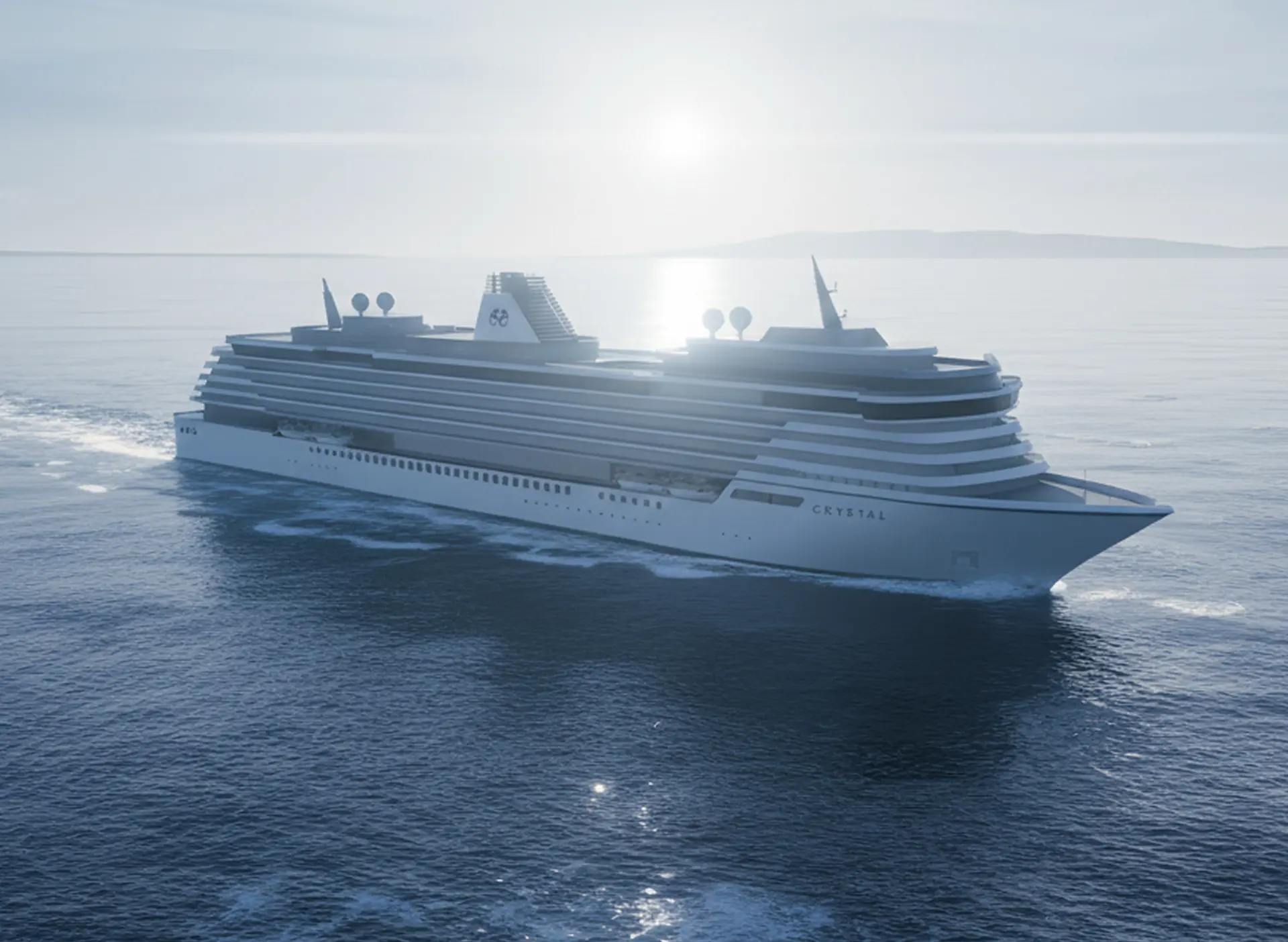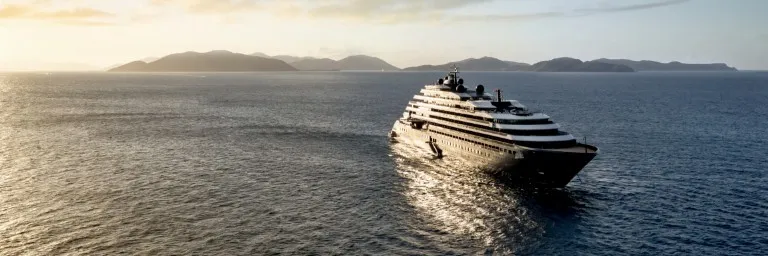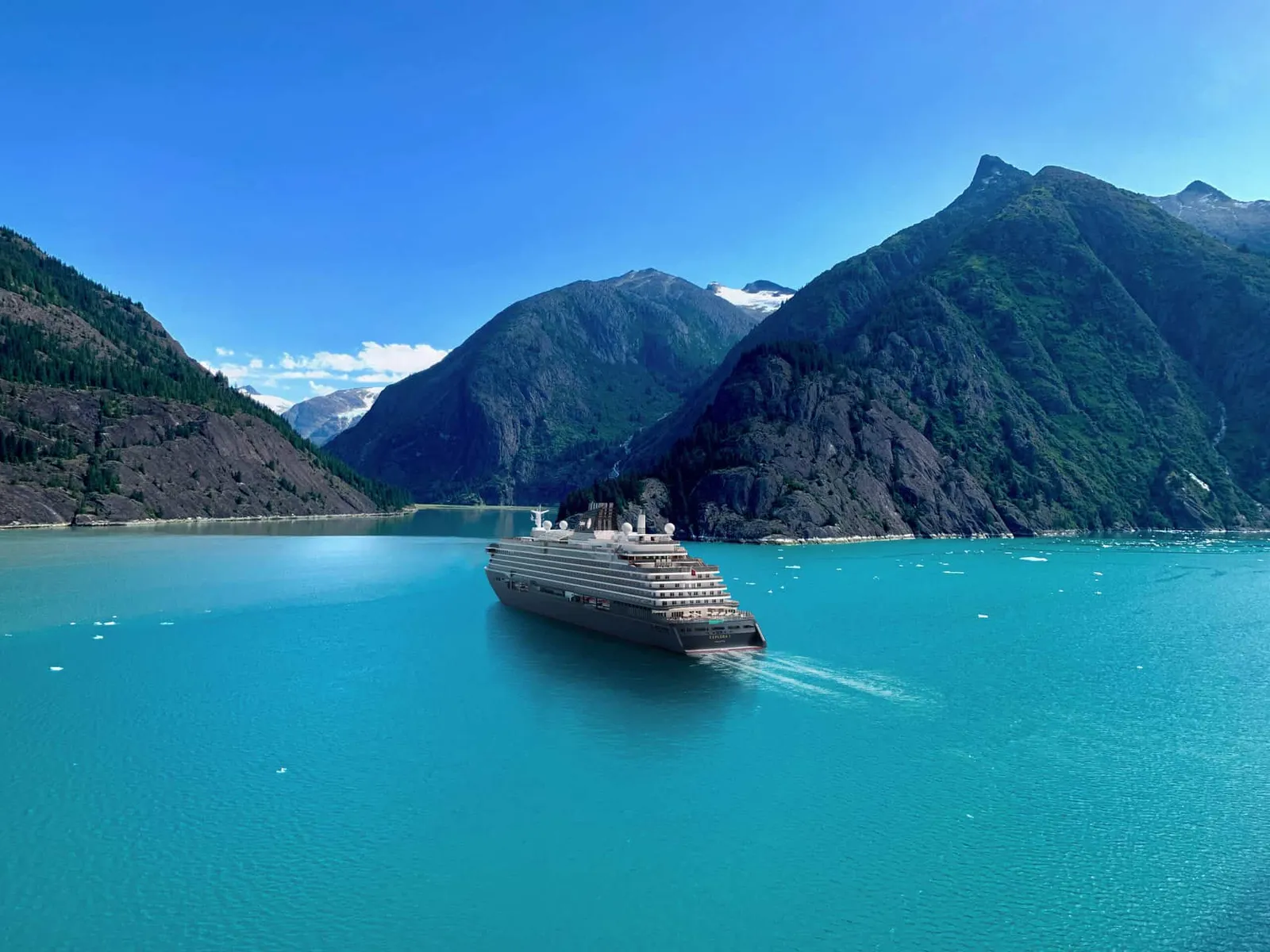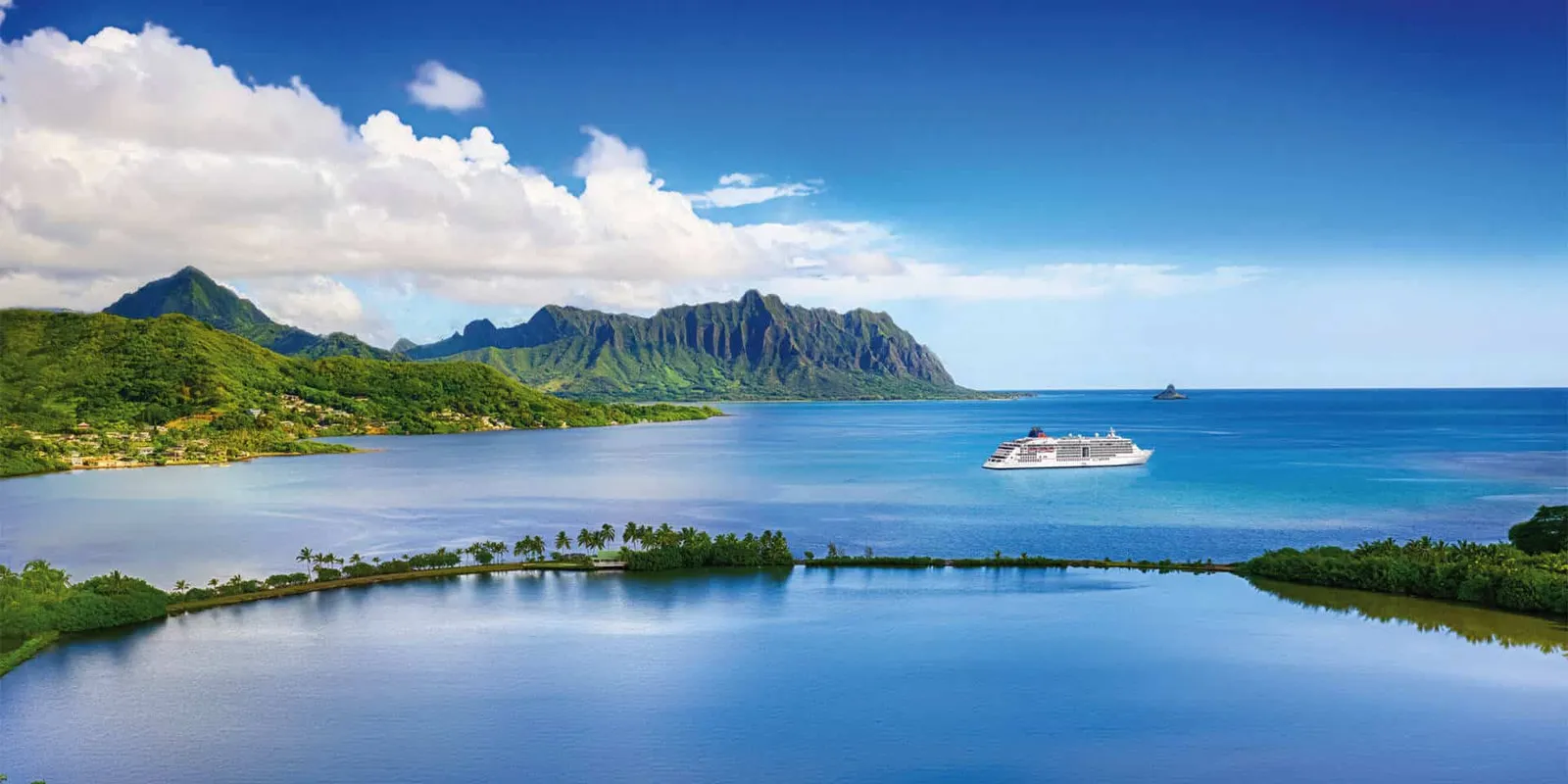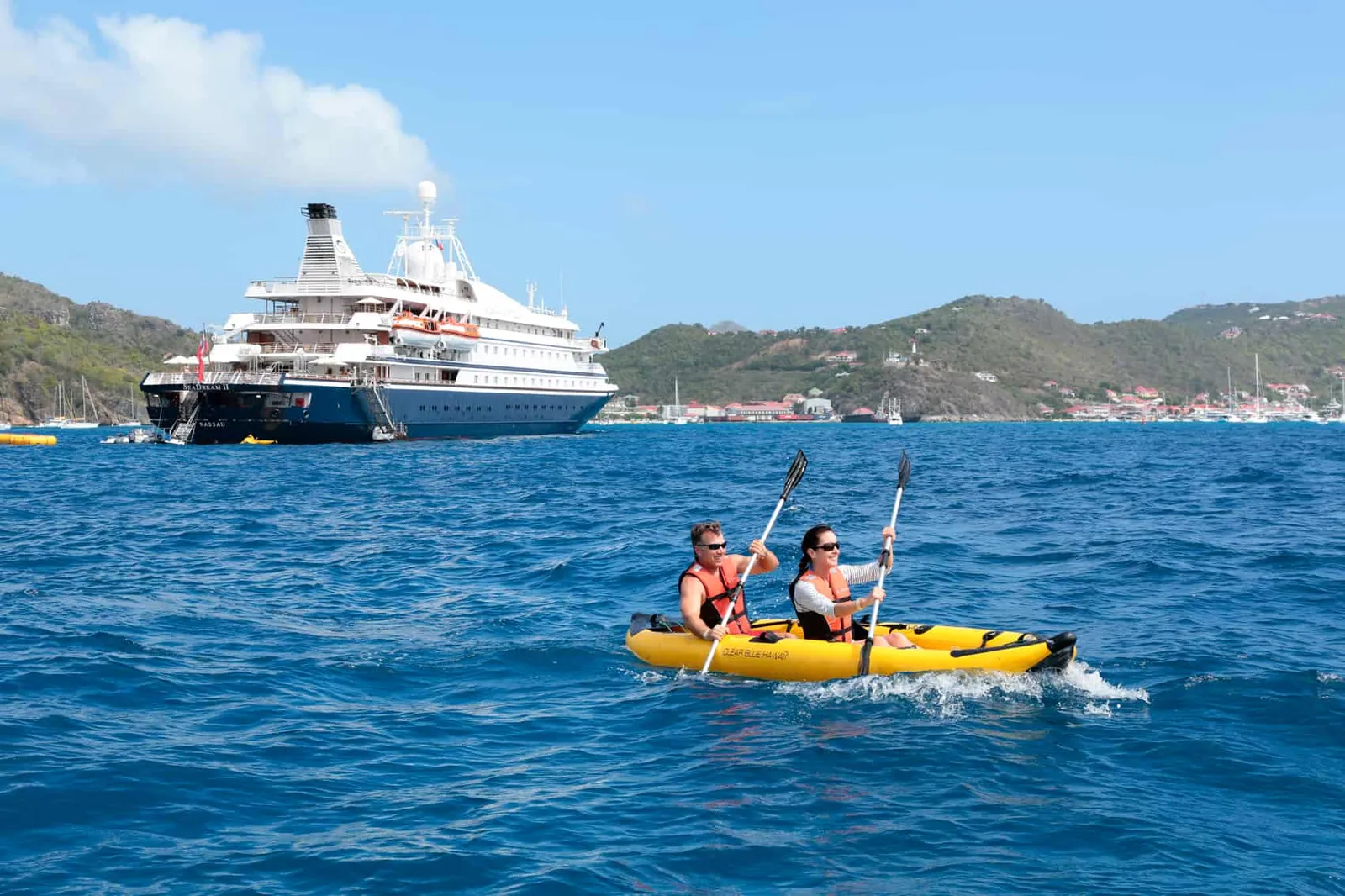
| SeaDream Yacht Club | The Ritz-Carlton Yacht Collection | |
|---|---|---|
| Category | Yacht-Style / Ultra-Luxury | Yacht-Style / Ultra-Luxury |
| Rating | ★★★★☆ | ★★★★★ |
| Fleet size | 2 ships | 3 ships |
| Ship size | Yacht (under 120) | Yacht (under 300) |
| Destinations | Caribbean, Mediterranean, Northern Europe | Mediterranean, Caribbean, Northern Europe, Central America |
| Dress code | Casual elegance | Casual elegance |
| Best for | Ultra-intimate yacht lifestyle travellers | Ultra-luxury yacht lifestyle travellers |
This is yacht-style cruising's most fascinating generational contrast — the segment's oldest vessels against its newest. SeaDream's twin 1984-built yachts carry just 112 guests each with a near 1:1 crew ratio, the legendary Champagne and Caviar Splash, Balinese Dream Beds under the stars, and a retractable watersports marina with jet skis. Ritz-Carlton's three purpose-built superyachts (2022–2025) carry 298 to 452 guests with the highest space-per-guest ratio at sea, Forbes Five-Star recognition, S.E.A. by a three-Michelin-starred chef, and Marriott Bonvoy integration. Both champion casual elegance over formality — no formal nights, no cruise director on Ritz-Carlton, no PA announcements on SeaDream. Neither sails from Australia. For Australians wanting the most intimate yacht experience afloat with an all-inclusive open bar and first-name crew recognition from day one, choose SeaDream. For those wanting brand-new hardware, a contemporary hotel-at-sea atmosphere, and Marriott Bonvoy rewards, choose Ritz-Carlton.
The core difference
SeaDream Yacht Club and the Ritz-Carlton Yacht Collection both reject the word “cruise” in favour of “yachting” — and both mean it. Neither operates a cruise director. Neither enforces formal dress codes. Both carry watersports marinas that lower into the ocean. Both attract well-travelled couples who want intimate ships, exceptional food, and the feeling that they have boarded something fundamentally different from a cruise ship. And yet these two lines represent yacht-style cruising’s starkest generational divide: the segment’s heritage vessels against its most modern hardware.
SeaDream is the original mega-yacht. Founded in 2001 by Atle Brynestad — the Norwegian entrepreneur who also created Seabourn — SeaDream purchased the former Sea Goddess I and Sea Goddess II (built 1984 and 1985 for Sea Goddess Cruises, later operated by Cunard and then Seabourn) and reimagined them as the only true mega-yachts in the passenger cruise market. Two identical twins, SeaDream I and SeaDream II, each carry a maximum of 112 guests served by 95 crew — a near-perfect 1:1 crew-to-guest ratio that neither Ritz-Carlton nor any other line can match at scale. The founding philosophy — “It’s yachting, not cruising” — manifests in every detail: no fixed dinner seating, no PA announcements, no production shows, no casino, no queues. The open bar runs from morning to the small hours with premium wines, champagne, spirits, and cocktails. The retractable marina platform deploys jet skis, kayaks, paddleboards, Hobie Cat catamarans, and snorkelling gear. Balinese Dream Beds on the top deck invite guests to sleep under the stars. At 4,253 gross tonnes, these yachts access harbours and marina berths that even Ritz-Carlton’s smallest ship cannot enter.
Ritz-Carlton is the luxury hotel transplanted to water. Launched in 2022 with Evrima, the Ritz-Carlton Yacht Collection brought the Forbes Five-Star hotel standard to the ocean for the first time. Ilma followed in 2024 and Luminara in 2025 — three purpose-built superyachts carrying 298 to 452 guests, all designed as floating extensions of the world’s most recognised luxury hotel brand. Ilma achieved the cruise industry’s first Forbes Travel Guide Five-Star rating. The water sports marina — a hydraulic platform lowering from the stern for paddleboarding, kayaking, Seabobs, and electric foiling — shares SeaDream’s philosophy of ocean engagement but executes it with brand-new technology. Five restaurants per ship include S.E.A. by three-Michelin-starred chef Sven Elverfeld on Evrima and Seta su Ilma by Fabio Trabocchi on Ilma. There is no cruise director, no casino, no buffet, and no public announcements. Marriott Bonvoy integration means hotel loyalists earn elite night credits and points at sea.
For Australian travellers, the practical question is that neither line sails from Australian waters. SeaDream requires flights to the Caribbean or Mediterranean. Ritz-Carlton’s nearest embarkation is Singapore (7.5 hours from Sydney on Luminara) or French Polynesia (Evrima from winter 2026–2027). The choice hinges on what kind of yacht experience you value — the world’s most intimate luxury vessel with heritage charm and a legendary crew culture, or the world’s newest luxury yacht with contemporary design and a major hotel brand behind it.
What is actually included
Both lines market a comprehensive all-inclusive model, but the specifics differ in ways that matter when calculating total holiday cost.
SeaDream includes: an open bar with premium wines, champagne, spirits, and cocktails available at all hours — from the Top of the Yacht Bar to your sun lounger by the pool. All dining in both the Dining Salon and Topside Restaurant without restriction or surcharge. Crew gratuities are fully covered. The marina platform’s entire complement of watersports equipment — jet skis, kayaks, paddleboards, wakeboards, Hobie Cat catamarans, snorkelling gear, and the floating trampoline — is complimentary. What SeaDream does not include: Wi-Fi (charged at USD 35 per day or USD 99 per week), shore excursions, spa treatments, and flights.
Ritz-Carlton includes: premium spirits, wines, cocktails, and champagne throughout the ship; high-speed Starlink Wi-Fi; all gratuities; Personal Concierge service in every suite; 24-hour in-suite dining; the complimentary water sports marina; and four of five dining venues without surcharge. The signature restaurant — S.E.A. on Evrima or Seta su Ilma — carries a USD 250–260 surcharge per person. What Ritz-Carlton does not include: shore excursions, flights, airport transfers, spa gratuities, and laundry (included only for Marriott Bonvoy Titanium and Ambassador members).
The meaningful differences: SeaDream’s open bar is genuinely premium and genuinely all-hours without signing a single chit — on a seven-night voyage, a couple ordering freely could consume AUD 1,500–2,500 in beverages that SeaDream includes at the base fare. Ritz-Carlton includes comparable drinks but adds complimentary Wi-Fi that SeaDream charges for. The dining surcharge gap is significant: SeaDream has no surcharges whatsoever, while Ritz-Carlton charges USD 250–260 for its pinnacle dining experience. For a couple wanting to experience the headline restaurant once, that is an AUD 800 difference. SeaDream’s jet skis and Hobie Cats give it an edge in marina equipment variety, while Ritz-Carlton’s Seabobs and electric foiling represent more modern technology.
Dining and culinary experience
Both lines deliver exceptional cuisine, but through entirely different models — a private kitchen cooking for 112 versus a multi-venue restaurant programme with celebrity chef partnerships.
SeaDream operates a single culinary team preparing everything a la minute — made to order, fresh, with no batch cooking or pre-preparation — for a maximum of 112 guests. The Dining Salon on Deck 2 seats 110 for multi-course dinners, and the Topside Restaurant offers al fresco dining where all guests can eat outdoors simultaneously. SeaDream holds the Forbes Travel Guide four-star dining rating and was named the “Highest Rated Restaurant at Sea” by Conde Nast Johansens. The signature Le Menu de Degustation presents a multi-course tasting menu with wine pairings — highlights include the celebrated 24-carat gold-leaf-topped fondant au chocolat with vanilla ice cream. Wine pairings at dinner are included in the fare, drawn from a curated list of Old and New World selections. A raw food menu — entirely plant-based, nothing heated above 48 degrees Celsius — is the only one at sea. Dietary accommodations span vegetarian, vegan, gluten-free, pescatarian, and keto-friendly menus. There are no surcharges for any dining experience.
Ritz-Carlton offers five restaurants per ship. On Ilma and Luminara: Tides is the included main dining room with destination-inspired seasonal menus. Beach House by James Beard Award-winning chef Michael Mina delivers pan-Latin and Caribbean cuisine with live music. Memori is a 12-seat sushi bar. Mistral serves poolside Mediterranean. The pinnacle is Seta su Ilma by Fabio Trabocchi — modern Italian fine dining with a seven-course tasting menu for 28 guests at USD 250 per person (wine pairings USD 80–160 extra). On Evrima: S.E.A. by Sven Elverfeld (three Michelin stars at Aqua, Wolfsburg) serves European tasting menus at a comparable surcharge. Talaat Nam offers contemporary Thai cuisine. The Evrima Room is designed as ten intimate alcoves.
The verdict: SeaDream wins on made-to-order precision and the intimacy of a single kitchen cooking for 112 guests — and the fact that every dining experience is included without any surcharge. Ritz-Carlton wins on variety (five venues versus two), the prestige of celebrity chef partnerships, and the contemporary dining room design. But the surcharge contrast is telling: SeaDream’s finest meal costs nothing extra; Ritz-Carlton’s finest meal costs USD 250 plus wine pairings.
Suites and accommodation
The accommodation comparison reveals the age and philosophy of each line — SeaDream’s compact yacht staterooms reflect a life lived on deck, while Ritz-Carlton’s modern suites reflect a life lived in the room.
SeaDream’s accommodation reflects the yachts’ 1984 origins and their comprehensive USD 10-million-per-yacht refurbishment in 2022. Yacht Club Staterooms average 195 square feet across Decks 2, 3, and 4 — no balconies in any category, but ocean views through picture windows or portholes. The 2022 renovation rebuilt everything: 55-inch flat-screen televisions, USB charging, marble-lined bathrooms, Elm Organics bath products, and luxury robes. Commodore Suites combine two Yacht Club Staterooms into approximately 390 square feet with two full bathrooms. The Admiral’s Suite (375 square feet) features three picture windows, a separate living area, and a soaking tub. The Owner’s Suite (447 square feet) includes a separate master bedroom and ocean-view soaking tub. No SeaDream stateroom offers a private outdoor space — the entire yacht is your balcony.
Ritz-Carlton’s entry-level Terrace Suite on Ilma is 294 square feet plus a 52–108-square-foot private terrace — every single suite across the fleet has a private outdoor terrace with no exceptions. Signature Suites measure 409 square feet plus terrace. Grand Suites offer 560 square feet with a dining table for four. Owner’s Suites reach 1,033 square feet with private hot tubs on the terrace. On Evrima, the unique two-storey Loft Suite (611 square feet plus terrace) offers a split-level layout found nowhere else at sea. Interior design uses a contemporary neutral palette — grey, taupe, sandstone — with granite-clad bathrooms.
The tradeoff: Ritz-Carlton’s smallest suite is 50 per cent larger than SeaDream’s standard stateroom and includes a private terrace. Ritz-Carlton’s Owner’s Suite (1,033 square feet) is more than double SeaDream’s largest (447 square feet). The hardware gap is decisive for anyone who values in-suite living space. But SeaDream’s philosophy is that with only 112 guests, the communal decks — pool, Dream Beds, Top of the Yacht Bar, marina platform — are the primary living spaces. Guests spend their days on deck, in the water, or ashore, returning to the stateroom to sleep and refresh. If a private balcony is essential, Ritz-Carlton is the only choice. If you intend to spend every waking hour on the open decks of a 112-guest yacht, the stateroom size is genuinely irrelevant.
Pricing and value
SeaDream is the more accessible option on per-night pricing, though Ritz-Carlton’s Wi-Fi inclusion and Marriott Bonvoy earning potential complicate the comparison.
SeaDream’s per-diem runs approximately USD 650–950 per person per night for Yacht Club Staterooms, with seven-night Caribbean voyages from roughly USD 4,500–7,000 per person and Mediterranean sailings from approximately USD 5,500 per person. Norwegian fjord voyages command a 15–25 per cent premium. These fares include the open bar, all dining, gratuities, and watersports — meaningful add-ons are limited to Wi-Fi, shore excursions, and spa treatments.
Ritz-Carlton’s per-diem runs approximately USD 700–1,100 per person per night for Terrace Suites on Ilma and Luminara. Caribbean sailings sit at USD 700–900. A seven-night Mediterranean voyage costs roughly USD 5,000–7,000 per person. The fare includes drinks, Wi-Fi, gratuities, and the marina but excludes the USD 250–260 signature dining surcharge.
Total cost for an Australian couple on a seven-night Mediterranean voyage:
SeaDream (Yacht Club Stateroom): approximately AUD 13,000–18,000 for the cruise fare (open bar, all dining, gratuities, watersports included). Add business-class flights from Sydney to Europe (AUD 10,000–18,000), Wi-Fi for two (AUD 700), and shore excursions (AUD 1,000–2,500). Total: approximately AUD 25,000–39,000.
Ritz-Carlton Ilma (Terrace Suite): approximately AUD 16,000–22,000 for the cruise fare (drinks, Wi-Fi, marina included). Add business-class flights from Sydney to Europe (AUD 10,000–18,000), one Seta dinner for two (AUD 800), and shore excursions (AUD 1,000–2,500). Total: approximately AUD 28,000–43,000.
The price gap for a comparable Mediterranean holiday is approximately AUD 3,000–4,000 per couple in favour of SeaDream — buying a dramatically different experience: 112 guests versus 448, a near 1:1 crew ratio, Balinese Dream Beds, jet skis, and access to harbours Ritz-Carlton cannot reach. Ritz-Carlton’s premium buys modern suites with private terraces, five restaurants, Marriott Bonvoy points, and the Forbes Five-Star pedigree.
Spa and wellness
Both lines offer spa facilities proportionate to their size, with wellness philosophies rooted in their broader identities.
SeaDream’s Asian Spa and Wellness Centre is the only Thai-certified spa service at sea — trained Thai-certified therapists offer Traditional Thai Massage, Sisley Paris facial treatments, detoxifying body wraps, and aroma massages. Two treatment rooms, three steam showers, a sauna, and an open-air deck massage area where treatments are delivered with ocean breezes. The Fitness Centre on Deck 4 has treadmills, ellipticals, and free weights. Complimentary sunrise yoga and tai chi sessions are offered daily on deck — with six participants rather than sixty. The therapist-to-guest ratio on a 112-passenger yacht means availability is rarely an issue.
Ritz-Carlton’s Spa by The Ritz-Carlton on Ilma features 11 treatment rooms, including five with outdoor treatment terraces overlooking the sea. Products are by ESPA, 111SKIN, and Pisterzi. Separate male and female saunas and steam rooms, a relaxation lounge, and a full-service salon. Daily wellness classes operate in three tiers — Renewal (sunrise stretch, meditation), Balanced (moderate activity), and Power (circuits, high-intensity). Personal training starts from USD 75.
Both lines charge for hands-on treatments at broadly similar prices. Ritz-Carlton has the clear advantage in spa scale — 11 treatment rooms versus two — and the unique offering of ocean-view treatment terraces. SeaDream compensates with Thai-certified authenticity and the intimacy of a spa where the therapist knows you by name. The watersports marina on both lines provides active wellness — swimming, kayaking, paddleboarding — that supplements the traditional spa offering.
Entertainment and enrichment
Both lines reject traditional cruise entertainment — and this shared philosophy is precisely what draws the same type of traveller to both. The difference is one of degree.
SeaDream’s evening atmosphere is intentionally minimal. A pianist in the Piano Bar, occasional guitarists and singers at the Top of the Yacht Bar, late-night DJ sets on warmer evenings, and a blackjack table in the Casino. The signature SeaDream evening is unstructured — champagne and conversation at the Top of the Yacht Bar with 360-degree views, stargazing from the open deck, or retreating to a Balinese Dream Bed with a nightcap and falling asleep as the yacht sails to her next port. The Champagne and Caviar Splash — Dom Perignon on a secluded beach or the marina platform — is the signature organised event. There are no enrichment lectures, no production shows, and no scheduled programming that demands attendance.
Ritz-Carlton’s approach is equally understated but more curated. There is no cruise director, no PA system, no casino, and no production shows. The Living Room features a resident pianist and visiting musicians. The Observation Lounge hosts late-night dancing and cocktails with panoramic views. La Rumba on Ilma provides Latin-influenced poolside music with DJs. Themed evenings — En Blanc, Havana Nights — add gentle social structure without formality. Wine tastings, culinary demonstrations, and art-focused experiences provide enrichment. A Johanna Ortiz fashion collaboration sails on Ilma in 2026, and a Sotheby’s auction voyage launches in winter 2026–2027.
The key distinction: SeaDream makes the setting and the company the entertainment — 112 guests who feel like co-conspirators on a private voyage. Ritz-Carlton curates more structured experiences and brand partnerships while maintaining the quiet, hotel-like atmosphere. Neither line will satisfy travellers wanting production shows or Broadway entertainment. Both will satisfy travellers who consider the absence of those things a feature.
Fleet and destination coverage
The fleet comparison is straightforward: two heritage yachts against three modern superyachts.
SeaDream operates two identical twins — SeaDream I (1984) and SeaDream II (1985), each 4,253 gross tonnes, 112 guests, 95 crew. They deploy seasonally: Caribbean from November through April, Mediterranean from May through September, and Norwegian fjords in summer. Transatlantic repositioning voyages connect the seasons. At 355 feet, the yachts access downtown Venice via the historic waterway, overnight in Capri’s harbour, dock directly in the Corinth Canal, and anchor in intimate Grenadines coves. The limitation is absolute — two ships means limited availability, narrow seasonal windows, and no presence in the Pacific, Alaska, Asia, or Australian waters.
Ritz-Carlton operates three ships — Evrima (2022, 298 guests), Ilma (2024, 448 guests), and Luminara (2025, 452 guests). The fleet covers the Mediterranean, Caribbean, and Northern Europe, with Luminara deployed seasonally to Asia-Pacific from Singapore and Evrima debuting in French Polynesia and Hawaii from winter 2026–2027. Luminara’s inaugural Alaska season launches in 2026. Plans for eight to ten yachts are confirmed, with ships four and five in the planning phase.
Ritz-Carlton’s three ships offer more concurrent deployment across more regions than SeaDream’s two — and the geographic expansion into Asia-Pacific, French Polynesia, and Alaska is rapid. SeaDream’s advantage is harbour access: at 4,253 gross tonnes, the yachts reach ports that Ritz-Carlton’s 26,500–46,750-tonne ships cannot physically enter.
Where each line excels
SeaDream excels in:
- Intimacy. Ninety-five crew for 112 guests creates a near 1:1 ratio unmatched by any ocean-going vessel. Crew learn your name on the first day and remember your drink by the second. Seventy to eighty per cent of guests are repeat travellers — the highest loyalty rate in the industry.
- All-inclusive beverages. The open bar is genuinely premium and genuinely all-hours — champagne with breakfast, cocktails by the pool, wine pairings at dinner. No signing, no packages, no limits.
- Harbour access. At 4,253 gross tonnes, SeaDream’s yachts access downtown Venice, overnight in Capri, the Corinth Canal, and Norwegian fjord villages where even Ritz-Carlton’s smallest ship cannot go.
- Balinese Dream Beds. Sleeping under the stars on the top deck is unique in cruising. No other line offers the experience.
- Heritage and character. Forty-two years of history, a crew culture built over decades, and a founder who also created Seabourn. The yachts carry stories that new ships cannot replicate.
Ritz-Carlton excels in:
- Fleet modernity. Every ship built between 2022 and 2025. Contemporary design, brand-new hardware, no ship-class lottery.
- Suite quality and private terraces. Every suite has a private outdoor terrace. Entry-level suites are 50 per cent larger than SeaDream’s standard staterooms. The two-storey Loft Suite on Evrima is a design feature unique in the industry.
- Space per guest. Ilma’s approximately 104 gross tonnes per guest is among the highest ratios afloat, creating exceptionally uncrowded public spaces.
- Celebrity chef dining. Five restaurants per ship with partnerships including three-Michelin-starred Sven Elverfeld and James Beard Award-winning Michael Mina.
- Marriott Bonvoy integration. Points, elite night credits, and redemptions that create genuine value for the hotel-loyal traveller.
Standout itineraries for Australian travellers
SeaDream
SeaDream I or II: Grand Mediterranean and Adriatic Explorer (14 nights, 2026) — SeaDream’s extended Mediterranean itineraries visiting St Tropez, Corsica, Taormina, Valletta, Dubrovnik, and overnight in Capri. At 112 guests, you will call at harbours Ritz-Carlton bypasses entirely. The marina deploys at virtually every warm-water anchorage. Fly to Barcelona or Athens from Australian gateways via Singapore Airlines, Emirates, or Qatar Airways.
SeaDream II: Best of the Secluded Caribbean (10 nights, San Juan to Barbados) — The quintessential SeaDream voyage through the US and British Virgin Islands, St Barts with an overnight in Gustavia, and the Grenadines. The Champagne and Caviar Splash with Dom Perignon on a secluded beach. Marina deployment at almost every stop. Fly to San Juan via Dallas or Miami.
SeaDream: Norwegian Fjords (7 nights, July–August 2026) — The programme that sells out years in advance. Oslo, Bergen, Alesund, and secluded fjord villages. Kayaking through Ulvesundet, RIB adventures in the Sognefjord. The yacht penetrates deep into fjord channels where Ritz-Carlton cannot follow.
Ritz-Carlton
Luminara: Singapore departures (7–10 nights, from 2025) — The most accessible Ritz-Carlton experience for Australians. Fly Sydney to Singapore direct (7.5 hours), embark the brand-new Luminara, and cruise through Southeast Asia with the marina deployed at tropical anchorages.
Evrima: French Polynesia (7–12 nights, winter 2026–2027) — Thirteen voyages through Bora Bora, Moorea, Huahine, and Raiatea. Accessible via Auckland and Papeete. The intimate 298-guest Evrima with the marina deployed in lagoon waters.
Ilma: Mediterranean (7–10 nights, summer 2026) — The Forbes Five-Star flagship in its signature territory. Seta su Ilma, the marina at Croatian and Greek anchorages, and the most spacious public areas in ultra-luxury cruising.
Ship-by-ship recommendations
SeaDream
SeaDream I or SeaDream II (112 guests each, 1984/1985, refurbished 2022) — The twin yachts deliver an identical experience. Choose by itinerary rather than ship. For a first SeaDream voyage, the Caribbean is ideal — calmer seas suit the yacht’s 4,253-tonne displacement, the marina gets maximum use, and the Champagne and Caviar Splash on a Grenadines beach is the signature experience. For the Owner’s Suite (447 square feet, mid-ship) or Admiral’s Suite (375 square feet) — the only categories with soaking tubs — book early. With a 70–80 per cent repeat guest rate, top categories sell out rapidly.
Ritz-Carlton
Ilma (448 guests, 2024) — The Forbes Five-Star flagship and the recommended first Ritz-Carlton experience. Five restaurants, an 11-treatment-room spa, and the highest space-per-guest ratio in ultra-luxury cruising. Currently deployed to the Mediterranean and Caribbean.
Luminara (452 guests, 2025) — Near-identical to Ilma. The best option for Australians due to Singapore embarkation. Choose Luminara for Asia-Pacific; choose Ilma for the Mediterranean.
Evrima (298 guests, 2022) — The smallest and most intimate — and the closest to SeaDream’s yacht philosophy in terms of scale. The unique two-storey Loft Suite. S.E.A. by Sven Elverfeld. Best for guests who prioritise intimacy over facilities. Avoid as a first Ritz-Carlton experience; start with Ilma.
For Australian travellers specifically
Neither line sails from Australian waters, which places both at a disadvantage compared to Silversea, Regent, or Ponant for Australian-based travellers. The critical comparison is which line is easier to reach.
SeaDream’s embarkation ports — Barcelona, Athens, Dubrovnik, San Juan, Barbados, Oslo — all require international flights of 20 to 30 hours from Australian gateways. Caribbean departures route through the United States (Dallas, Los Angeles, or Miami). Mediterranean departures connect through Singapore, the Middle East, or London. Norwegian fjord departures embark from Oslo or Bergen. SeaDream offers an Australian freephone number (+61 1800 290 785) and has appointed APAC sales leadership, but has no local office or Australian sailings.
Ritz-Carlton’s nearest embarkation is Singapore — a 7.5-hour direct flight from Sydney and Melbourne on Singapore Airlines or Qantas. This is a transformative difference for Australians. Luminara’s Asia-Pacific deployment from Singapore requires no long-haul flight and no US transit, making it dramatically more accessible than any SeaDream embarkation. Evrima’s French Polynesia debut (winter 2026–2027) adds another relatively accessible option via Auckland. Ritz-Carlton opened its Asia-Pacific headquarters in Sydney’s Australia Square Tower in 2025, led by VP Seb Seward, with Australian Dollar pricing implemented and up to twelve local staff planned.
The loyalty factor: Ritz-Carlton’s Marriott Bonvoy integration creates genuine value for Australians in the Marriott ecosystem — points earned at hotels and on credit cards can be redeemed for cruise fare discounts. SeaDream’s Club is standalone with no hotel or airline partnerships. Neither line offers a Qantas Frequent Flyer partnership.
For most Australians, Ritz-Carlton is the more accessible choice thanks to Singapore embarkation. SeaDream requires longer travel to every departure port. However, the SeaDream experience — 112 guests, near 1:1 crew ratio, the open bar, the Dream Beds — is categorically different from what Ritz-Carlton offers at nearly four times the guest count.
The onboard atmosphere
Both lines attract affluent couples seeking refinement over spectacle, but the texture of daily life aboard is recognisably different.
SeaDream’s atmosphere is the private yacht. With 112 guests maximum, intimacy is immediate and inescapable. The Captain dines with guests and walks with them ashore. Crew call you by name from the first morning. The passenger mix is well-travelled and international — American, European, and Scandinavian — with a core demographic of couples aged 45 to 65. Seventy to eighty per cent are repeat guests, creating a community that feels like a reunion of well-travelled friends. The dress code is resort casual — no jacket expectations, no formal evenings. The evening rhythm is organic: champagne at the Top of the Yacht Bar as the sun sets, dinner al fresco at Topside, a nightcap with new friends, and a Balinese Dream Bed for the adventurous. The atmosphere is often described as a house party on a yacht owned by a generous friend. With only 112 guests, anonymity is impossible and genuine connection is inevitable.
Ritz-Carlton’s atmosphere is a floating luxury hotel — contemporary, understated, and self-assured. Wide corridors, quiet public spaces, no buffet. The median passenger age is approximately 53 — younger than SeaDream’s core demographic. Roughly half the guests have never cruised before, drawn by the Ritz-Carlton brand name rather than cruise industry marketing. The demographic includes professionals who would otherwise book villa rentals or safari lodges. The dress code is “Yacht Sophisticated” — not enforced, no formal nights. The absence of traditional cruise conventions creates an environment that feels more like a private members’ club than a cruise ship. The social dynamic is pleasant but more reserved than SeaDream’s — the larger guest count (298–452) creates more space for gentle anonymity.
The core distinction is one of social intensity. On SeaDream, you will know every guest aboard by the third evening. On Ritz-Carlton, you will recognise familiar faces but retain the option of privacy. Both are valid — and which you prefer says everything about which line is right for you.
The bottom line
SeaDream and Ritz-Carlton both deliver yacht-style cruising at the highest level, but they optimise for fundamentally different things — and choosing correctly matters.
Choose SeaDream for the most intimate luxury experience afloat. Choose it for 112 guests maximum, a near 1:1 crew ratio, an open bar included from the base fare without add-ons, and first-name crew recognition from day one. Choose it for the Champagne and Caviar Splash with Dom Perignon, the Balinese Dream Beds under the stars, the Forbes four-star dining where everything is prepared a la minute, and the harbours — downtown Venice, Capri overnight, the Norwegian fjords — that no other yacht in this comparison can reach. Choose it for heritage and character built over four decades. Accept that staterooms are compact with no balconies, that Wi-Fi costs extra, that ships are the oldest in ultra-luxury, and that every embarkation port requires a long-haul flight from Australia.
Choose Ritz-Carlton for the newest ships in ultra-luxury cruising, the highest space-per-guest ratio on the ocean, private terraces in every suite, and five-restaurant dining with celebrity chef partnerships. Choose it for the Forbes Five-Star recognition, the contemporary hotel-at-sea atmosphere, and Marriott Bonvoy integration. Choose it if you have never cruised before and want a luxury hotel on water rather than a traditional cruise. Choose it for Singapore embarkation — 7.5 hours from Sydney with no long-haul flight required. Accept fewer watersports options than SeaDream, a USD 250 surcharge for the pinnacle dining experience, a less intense crew-to-guest ratio, and a larger guest count that trades SeaDream’s house-party intimacy for hotel-like privacy.
For Australian travellers specifically: Ritz-Carlton from Singapore is the more accessible option. SeaDream from the Caribbean or Mediterranean is the more transformative experience. One is easier to reach. The other is harder to forget.