Ponant and Quark Expeditions represent two fundamentally different approaches to polar expedition cruising — French luxury heritage versus adventure-first polar specialism. Both operate ships under 200 passengers, both reach Antarctica and the North Pole, and both field expert expedition teams. Jake Hower compares their icebreakers, helicopters, guide ratios, dining, inclusions, and total value for Australian travellers choosing between champagne and crampons.
| Ponant | Quark Expeditions | |
|---|---|---|
| Category | Luxury / Expedition | Expedition |
| Rating | ★★★★★ | ★★★★☆ |
| Fleet size | 13 ships | 4 ships |
| Ship size | Small (under 500) | Small (under 500) |
| Destinations | Antarctica, Mediterranean, Arctic, South Pacific | Antarctica, Arctic, Greenland, Svalbard |
| Dress code | Smart casual | Relaxed |
| Best for | French-inspired luxury expedition travellers | Polar expedition adventure travellers |
Ponant is the luxury expedition fleet — thirteen ships spanning the Kimberley to the Geographic North Pole, Ducasse-trained cuisine on Le Commandant Charcot, an included open bar pouring Henri Abelé champagne, the Blue Eye underwater lounge on six Explorer-class ships, and the world's only luxury PC2 icebreaker capable of reaching destinations no other passenger vessel can. Quark Expeditions counters as the polar purist — exclusively Arctic and Antarctic for over three decades, twin Airbus H145 helicopters on Ultramarine enabling Snow Hill Emperor penguin access and included flightseeing, a claimed 1:6 guide ratio (industry-best), complimentary drinks fleet-wide, and North Pole voyages aboard a nuclear icebreaker. For Australians wanting global expedition range, French culinary finesse, a Sydney APAC office, and the deepest polar penetration afloat, choose Ponant. For Australians wanting helicopter capability, the most dedicated polar expertise in the industry, included bar service, and adventure-forward expedition culture, choose Quark.
The core difference
Ponant and Quark Expeditions occupy opposite ends of the expedition cruising philosophy — and yet both reach the same ice. One pours Ducasse-curated menus in an underwater lounge while Zodiac-cruising the Lemaire Channel. The other launches twin helicopters to land passengers on ice shelves that no Zodiac can reach. The ships are different. The dining is different. The languages are different. The only thing they share absolutely is the destination — and even there, each line can take you somewhere the other cannot.
Ponant is French luxury expedition at global scale. Founded in 1988 by Jean-Emmanuel Sauvée and a dozen French Merchant Navy officers, the company now operates thirteen ships — from the 32-guest sailing yacht Le Ponant to the world’s only luxury PC2 icebreaker, Le Commandant Charcot. Owned by Groupe Artémis (the Pinault family holding that controls Kering, the luxury group behind Gucci, Yves Saint Laurent, and Balenciaga), Ponant is architecturally, culturally, and gastronomically French. The Alain Ducasse Conseil partnership curates dining aboard Charcot. The open bar pours Henri Abelé Brut champagne across the entire fleet. Six Explorer-class ships carry the Blue Eye underwater multi-sensory lounge — a feature without equivalent on any other cruise ship. The fleet deploys simultaneously to Antarctica, the Arctic, the Kimberley, French Polynesia, the Mediterranean, Papua New Guinea, and beyond. Ponant’s APAC headquarters in Sydney generates approximately twenty per cent of global revenue, and Le Commandant Charcot made its Australian debut in Hobart in February 2026. This is expedition cruising filtered through the lens of a Parisian luxury house.
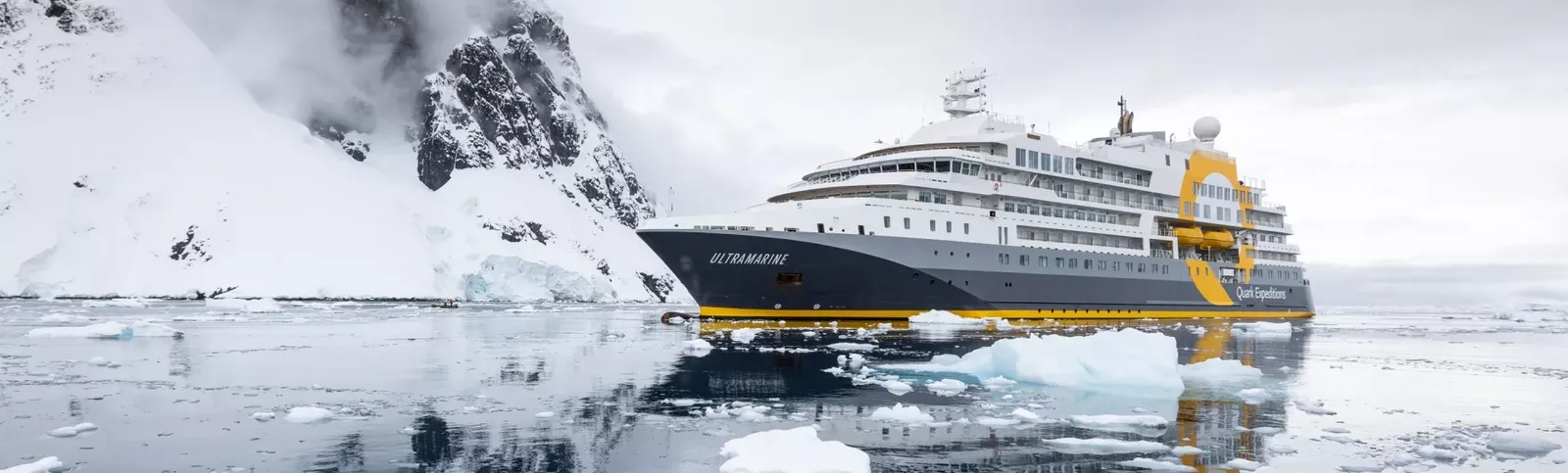
Quark Expeditions is the polar purist. Founded in 1991 by Mike McDowell and Lars Wikander — who led the first commercial voyage to the Geographic North Pole aboard a nuclear icebreaker — Quark has operated exclusively in polar waters for over three decades. Headquartered in Seattle and owned by Travelopia (backed by private equity firm KKR), Quark was one of the seven founding members of IAATO. The company’s defining asset is Ultramarine — a 199-passenger purpose-built expedition ship carrying twin Airbus H145 helicopters that enable Snow Hill Emperor penguin colony access, included flightseeing over glacial landscapes, and heli-landings that no other sub-200-passenger polar ship can offer. Quark also charters the nuclear icebreaker 50 Years of Victory for Geographic North Pole voyages — one of only two operators in the world offering this journey. Since November 2024, all Quark voyages include complimentary drinks and Wi-Fi fleet-wide. This is expedition cruising built around the ice itself, with every asset pointed at getting passengers closer to polar wilderness.
For Australian travellers weighing these two lines, the choice comes down to this: Ponant offers French luxury, global destination range, a Sydney office, Kimberley departures, and the deepest polar penetration afloat via Charcot. Quark offers helicopter capability that unlocks otherwise unreachable destinations, the most dedicated polar-only expertise in the industry, a claimed industry-best guide ratio, and an adventure-forward culture where the parka matters more than the dress code. Both deliver exceptional polar expeditions. The question is whether you want your Antarctic whisky served in a crystal glass with a cheese course to follow, or whether you want it after stepping off a helicopter onto an ice shelf that no other tourist has ever touched.
Expedition team and guides
The expedition team is the single most important element of any polar voyage — more important than the ship, the food, or the cabin. The quality of the naturalists who stand beside you on the Zodiac, explain the behaviour of the leopard seal hauled out on the ice floe, and brief you on tomorrow’s landing plan defines the expedition experience far more than the thread count on the sheets. On this measure, both Ponant and Quark invest seriously — but the depth and structure of their teams diverge.
Quark’s expedition team operates at a claimed ratio of approximately 1:6 expedition staff to guests — on a reported Greenland voyage aboard Ultramarine, 37 expedition guides sailed with approximately 199 passengers. This is among the best ratios in the industry, and Quark states it explicitly as a differentiator. Teams draw from marine biologists, glaciologists, geologists, ornithologists, cetologists, polar historians, and outdoor educators, many holding PhD-level qualifications. The Quark Academy — the only proprietary polar training programme in expedition cruising — ensures all staff pass both IAATO and AECO examinations before deployment. Specialist whale researchers from the Friedlaender Lab at UC San Diego and HappyWhale sail on select itineraries, conducting genuine field research alongside guests. Expedition team members routinely dine with passengers, breaking down the barrier between expert and guest in a way that more formal lines deliberately avoid. Photography workshops are offered on most voyages, though Quark does not place a dedicated staff photographer on every sailing.
Ponant’s expedition team operates at a ratio of approximately 1:15 to 1:18 on Explorer-class ships — 10 to 12 naturalist guides and experts for 184 passengers. On Le Commandant Charcot, the team doubles to approximately 20 specialists for 200 to 245 guests, giving a ratio of roughly 1:10 to 1:12. Teams include marine biologists, ornithologists, historians, geologists, botanists, underwater diving instructors, cultural specialists, and photographers on select voyages. All expedition staff are bilingual in French and English — a distinctive feature reflecting Ponant’s heritage. Briefings, lectures, and landing instructions are delivered in both languages. On Le Commandant Charcot, visiting scientists engage guests in data collection across dedicated wet and dry laboratories — in a recent season, 70 scientists participated in 23 research projects across Charcot voyages. Ponant’s approach is more brand-driven than personality-driven — specific expedition leaders are not prominently publicised in the way that some competitors market individual guides.
The practical difference: Quark’s deeper bench of guides becomes tangible when simultaneous activities are running — helicopter operations, Zodiac cruises, shore landings, and kayaking all happening at once require more guides than sequential programming. On a standard shore landing, the difference between Ponant’s 1:15 and Quark’s 1:6 means your Zodiac group might contain 15 guests with one guide on a Ponant Explorer-class ship, versus 7 guests with one guide on Ultramarine. That is a genuinely different experience — more personal attention, more questions answered, more wildlife spotted by experienced eyes scanning the water. On Charcot, Ponant’s ratio narrows significantly to 1:10 or 1:12, closer to Quark’s level, and the presence of visiting scientists adds intellectual depth that few competitors can match. But for the core expedition team measure, Quark holds a clear structural advantage.
Ships and expedition hardware
This is where the comparison becomes most consequential — the hardware each line deploys shapes every day of the expedition.
Fleet scale and diversity: Ponant operates thirteen ships across four distinct classes plus the Le Ponant sailing yacht and the Paspaley Pearl superyacht — the largest fleet of any luxury expedition cruise line globally. Six identical Explorer-class ships (184 passengers, 2018 to 2020), four Boreal-class ships (264 passengers, 2010 to 2015), and the singular Le Commandant Charcot (200 to 245 passengers, 2021). Quark operates four vessels: the purpose-built Ultramarine (199 passengers, 2021), the chartered Ocean Explorer (138 passengers, 2021), the chartered World Voyager (168 passengers, 2020), and the chartered nuclear icebreaker 50 Years of Victory (128 passengers, 1993). Quark owns only Ultramarine; Ponant owns its entire fleet. The fleet diversity gap is enormous — Ponant can deploy ships simultaneously to eight or more regions, while Quark operates exclusively in polar waters.
Ice class — the critical specification: Le Commandant Charcot holds PC2 ice class — the highest ice-class rating of any luxury passenger vessel afloat. PC2 means Charcot can break through multi-year ice up to 2.5 metres thick, reaching the Geographic North Pole, deep into the Weddell Sea pack ice for emperor penguin colonies at Snow Hill Island, Peter I Island, the East Antarctic coast, and the North Pole of Inaccessibility (reached in September 2024, the first passenger vessel ever). Ponant’s Explorer and Boreal class ships hold only Ice Class 1C — light first-year ice capability suitable for Antarctic Peninsula and standard Arctic operations, but significantly below the polar capability of many competitors. Quark’s Ultramarine holds Ice Class 1A+ / PC6 — a stronger rating than Ponant’s Explorer and Boreal ships but far below Charcot’s PC2. Ocean Explorer holds 1A / PC6, and World Voyager holds 1B. Quark’s 50 Years of Victory, the nuclear icebreaker, matches Charcot’s ice-breaking capability but offers expedition comfort rather than luxury. The net picture: Ponant has the best single ice-class ship in the industry (Charcot) and some of the weakest standard expedition ships (Explorer/Boreal at 1C). Quark has consistently strong ice class across its core fleet.
Passenger capacity and IAATO implications: All Ponant Explorer-class ships carry 184 passengers, sitting just below the IAATO Category C1 threshold of 200. Le Commandant Charcot reduces to 200 passengers for Antarctic sailings to remain within C1. The four Boreal-class ships carry 264 passengers — exceeding the 200-passenger threshold and falling into IAATO Category C2, meaning more complex landing rotations and restricted access at some sensitive sites. All Quark ships carry fewer than 200 passengers, placing them firmly in IAATO Category C1. Ultramarine at 199, Ocean Explorer at 138, and World Voyager at 168 all benefit from the most efficient landing rotations. For standard Antarctic Peninsula operations, Quark’s consistent sub-200 capacity is structurally advantageous; Ponant’s Boreal-class ships face restrictions that the Explorer class and Charcot avoid.
Helicopters — Quark’s signature advantage: Ultramarine carries two twin-engine Airbus H145 helicopters, the fastest and most fuel-efficient in their category. Every passenger on an Ultramarine voyage receives at least two complimentary 15-minute flightseeing excursions and one heli-landing per voyage for groups of 12 (maximum 48 guests per landing). The helicopters unlock destinations no Zodiac can reach — most critically, the Emperor penguin colony at Snow Hill Island, accessible only by helicopter transfer across sea ice. Quark also offers heli-hiking and heli-skiing on select Arctic itineraries. Ponant’s Le Commandant Charcot carries a single helicopter, but it is used exclusively for expedition team operations and scientific reconnaissance — scouting landing sites, supporting research, and monitoring ice conditions. It is not available for passenger excursions. For helicopter access, flightseeing over glacial landscapes, or Snow Hill Emperor penguins, the choice is Quark alone. This is Quark’s single biggest differentiator — no other sub-200-passenger polar expedition operator offers twin passenger helicopters as standard.
Blue Eye underwater lounge — Ponant’s unique feature: All six Explorer-class ships carry the Blue Eye, a multi-sensory underwater lounge designed by French architect Jacques Rougerie. Located 2.5 metres below the waterline, it features two whale-eye-shaped glass portholes (1.6 by 3.4 metres each), three underwater cameras projecting live feeds, a hydrophone audio system designed by Michel Redolfi capturing marine sounds across a three-mile radius, and Body Listening Sofas that vibrate in unison with underwater acoustics. It seats 40 guests and serves champagne. This is entirely unique in the cruise industry — no competitor offers anything remotely comparable. While the Blue Eye is not expedition hardware in the traditional sense, it is a genuinely extraordinary way to experience the marine environment, particularly in warmer-water destinations like the Kimberley and French Polynesia.
Zodiac operations: Ponant’s Explorer-class carries a full fleet of Zodiacs launched from a retractable marina platform at the stern. Le Commandant Charcot carries 16 Zodiacs. Quark’s Ultramarine carries 20 Zodiacs stored in a water-level internal hangar with four embarkation points enabling simultaneous loading — a purpose-built system that enables ultra-rapid deployment. Faster deployment means more time at landing sites and less time queuing at the gangway. Ultramarine’s Zodiac hangar is a genuine engineering achievement that gives Quark a practical edge in shore-time efficiency.
Unique expedition vehicles on Charcot: Beyond standard Zodiac operations, Le Commandant Charcot carries a Sherp all-terrain vehicle for snow and ice operations, a hovercraft for excursions over ice and open water, a tethered hot-air balloon for aerial polar views, snowmobiles for ice shelf transport, and kayaks. These unique vehicles — particularly the hovercraft and balloon — offer experiences available on no other expedition ship.
Landing experience and shore programme
Both lines deliver the core expedition promise — daily landings with expert guides in some of the most remote landscapes on Earth — but the details differ in ways that shape the daily experience.
Landings per day: Both Ponant and Quark typically conduct one to two landings per day, weather and ice permitting, plus Zodiac cruises. Ponant’s Explorer-class Zodiac groups run at approximately 10 passengers per boat, and the 184-passenger capacity allows all guests to visit a landing site efficiently under the IAATO 100-ashore-at-any-time rule. Quark’s Ultramarine, with 199 passengers, requires slightly more rotation at each landing site, though the four-point Zodiac deployment system compensates with faster loading times. On Quark’s Ocean Explorer (138 passengers), rotations are smaller and time ashore can be marginally longer.
Activity options — the range gap: Ponant’s standard expedition programme includes Zodiac landings and cruises, hiking and walking ashore, wildlife observation, polar plunge, and expert-led lectures. Active options available on select itineraries include sea kayaking and snowshoeing — some at extra cost. Le Commandant Charcot adds tethered hot-air balloon rides, hovercraft excursions, snowmobile rides, polar diving (PADI certified), and participation in scientific research on ice floes. Quark includes Zodiac cruises, guided hikes, snowshoeing, polar plunge, and — on Ultramarine — complimentary helicopter flightseeing and heli-landing. Available at extra cost: sea kayaking (approximately USD 1,995 for the voyage-length programme), stand-up paddleboarding (approximately USD 295), and Antarctic camping (approximately USD 295 for one night, limited to 50 participants). Quark also offers heli-hiking and heli-skiing on select Arctic itineraries.
The activity comparison turns on priorities. Ponant’s Charcot offers experiences available on no other luxury vessel — the hovercraft on pack ice, the hot-air balloon over Antarctic landscapes, the snowmobile on an ice shelf. These are extraordinary, one-of-a-kind expedition moments wrapped in luxury. Quark’s helicopter programme offers something equally singular — the aerial perspective of the polar landscape, the heli-landing on an otherwise inaccessible ice shelf or mountain, and the Snow Hill Emperor penguin colony that cannot be reached any other way. On the Explorer-class ships, however, Ponant’s activity programme is narrower than Quark’s — no camping, no stand-up paddleboarding, and the kayaking programme is less developed. For activity diversity at the standard expedition level (not Charcot), Quark offers more.
Le Commandant Charcot’s deep-ice access: The PC2 hull gives Charcot access to destinations no other luxury vessel — and no Quark ship — can reach under its own luxury banner. Deep into the Weddell Sea pack ice to approach emperor penguin colonies at Snow Hill Island (which Quark reaches via helicopter from Ultramarine — a different approach to the same colony). Peter I Island, one of the most remote islands on Earth. The East Antarctic coast — Adelie Land, Wilkes Land, Shackleton Ice Shelf, Queen Mary Land. The full 62-day Antarctic Circumnavigation departing January 2028. The North Pole of Inaccessibility. And the McClure Strait transit of the Northwest Passage. These are not marketing superlatives — these are places that physically cannot be reached by any other luxury passenger vessel afloat.
What is actually included
Both lines have moved toward all-inclusive models, but the composition and generosity of their inclusions differ — and the differences compound over the course of a voyage.
Ponant’s all-inclusive model is among the most comprehensive in expedition cruising. Included in the fare: all meals at all onboard restaurants, an open bar with wines, spirits, beer, Henri Abelé Brut champagne, cocktails, soft drinks, and mineral water at all times. A minibar restocked daily in every stateroom. Unlimited Wi-Fi (Starlink-enhanced on Charcot). All Zodiac excursions and shore landings. Daily expert-led lectures. A polar parka to keep on polar voyages. Expedition boots on loan. Port taxes and fees. On most Antarctic Peninsula sailings, an overnight hotel stay in Buenos Aires and a charter flight to Ushuaia are included — a significant logistical and financial inclusion that many competitors charge separately for or leave passengers to arrange independently.
Quark’s inclusion model covers shipboard accommodation with daily housekeeping, all meals, complimentary alcoholic beverages (beer, wine, spirits, cocktails — introduced November 2024), complimentary Wi-Fi (also introduced November 2024), shore landings and Zodiac excursions, expert-led lectures and workshops, a complimentary 3-in-1 parka to keep, loaned waterproof boots, a reusable water bottle, and — on Ultramarine — flightseeing helicopter excursions (minimum two per guest) and one heli-landing experience. International flights are not included. A charter and hotel package from Ushuaia to Buenos Aires is available for approximately USD 595 — a useful addition but not part of the base fare.
The champagne question: Ponant includes Henri Abelé Brut champagne as part of the standard open bar — available at any time, in any lounge, without surcharge. Quark’s complimentary bar covers beer, wine, spirits, and cocktails but does not specifically market champagne as a standard pour. Both lines reserve a small selection of ultra-premium labels at additional cost. For the passenger who considers champagne a non-negotiable part of the expedition experience, Ponant delivers it as standard.
The logistics inclusion: Ponant’s inclusion of a Buenos Aires hotel night and charter flight to Ushuaia on most Antarctic Peninsula departures is a genuinely significant value add. These logistics can easily cost AUD 800 to 1,200 per person when arranged independently — flights to Ushuaia from Buenos Aires are not cheap, and the pre-voyage hotel eliminates the stress of same-day connections to a ship departing from one of the southernmost cities on Earth. Quark does not include comparable logistics in the base fare for Ushuaia-departing voyages.
The helicopter inclusion (Quark only): On Ultramarine, the included helicopter flightseeing and heli-landing represent substantial experiential value. Comparable helicopter experiences on other expedition operators — where available at all — cost USD 695 or more per flight. Receiving a minimum of two flights and a heli-landing as part of the fare is a meaningful inclusion that partially offsets Quark’s higher entry-level pricing versus Ponant’s Explorer-class.
What is not included on either line: International flights from Australia. Travel insurance (mandatory on both). Gratuities — Ponant describes them as optional (with an anonymous envelope provided), while Quark recommends USD 10 to 15 per person per day collected anonymously at voyage end. Spa treatments. Optional adventure activities at extra cost. Personal laundry.
Destination coverage and itinerary depth
This is where the comparison becomes a study in philosophy. Ponant goes everywhere. Quark goes to the poles and nowhere else.
Ponant’s destination range is the broadest of any luxury expedition line. Antarctica: Peninsula voyages from Ushuaia, deep Antarctic from Charcot (Weddell Sea emperor penguins, Peter I Island, East Antarctica, Ross Sea, full circumnavigation), South Georgia, and the Falklands. Arctic: North Pole from Longyearbyen (five departures in 2026), Svalbard, Greenland, Northwest Passage transit, and Iceland. Kimberley: 16 departures between Broome and Darwin with two ships and the Paspaley Pearl superyacht. French Polynesia, Papua New Guinea, Mediterranean, Northern Europe, Caribbean, Alaska, Japan, Central America. Le Commandant Charcot reaches destinations no other luxury vessel can — the Geographic North Pole, the North Pole of Inaccessibility, deep Weddell Sea, Peter I Island, East Antarctic coast, and the McClure Strait. Ponant offers more than 300 departures per year across eight or more regions simultaneously.
Quark’s destination range is exclusively polar — the Arctic and Antarctic, with no exceptions in over three decades. Antarctica: Peninsula voyages from Ushuaia, South Georgia and Falklands combinations, Antarctic Circle crossings, Snow Hill Emperor penguins (helicopter-accessed from Ultramarine), Essential Patagonia, Fly-the-Drake from Punta Arenas, and the dedicated science-focused Antarctic Marine Mammals itinerary co-developed with the Friedlaender Lab. Arctic: Svalbard circumnavigation, Greenland (east, south, and west coast), Northwest Passage, Iceland transits, multi-destination Arctic voyages, and the North Pole aboard 50 Years of Victory. Quark’s 2025-2026 Antarctic season offers 41 departure dates across five destination regions.
The polar depth argument: Quark’s exclusive polar focus is both its greatest strength and its limitation. Everything — every dollar of investment, every staff training programme, every ship charter decision — is directed at polar operations. There is no Mediterranean repositioning cruise, no Kimberley shoulder season, no French Polynesia diversion. The Quark Academy trains guides exclusively for polar deployment. The ship design, the Zodiac hangars, the helicopter programme — all optimised for ice. When you board Ultramarine for an Antarctic voyage, you are on a ship and with a team whose entire existence is calibrated for this destination. Ponant’s broader fleet means individual ships rotate between polar and non-polar deployments — the same Explorer-class vessel doing the Kimberley in May might be doing Antarctica in November. This is operationally efficient, but it means the ship, the crew, and the expedition team are generalists by necessity.
For Australian travellers specifically — the geography matters: Ponant deploys ships to Australia. Two vessels and the Paspaley Pearl superyacht operate the Kimberley season between Broome and Darwin. Le Commandant Charcot visited Hobart in February 2026, establishing the Australian city as a gateway to East Antarctica. Ponant’s APAC headquarters in Sydney provides local booking support, AUD pricing, and an understanding of Australian school holiday timing and flight routing. Quark has no Australian deployments, no Australian office, and prices exclusively in USD. Every Quark voyage requires international travel to reach the embarkation port. For the Australian who wants expedition cruising without leaving Australian waters — or who values the option of combining a Kimberley expedition with an Antarctic voyage on the same cruise line — Ponant is the only option in this pairing.
Cabins and accommodation
The cabin experience reveals the fundamental positioning difference between these two lines. Ponant designs staterooms as French boutique hotel rooms at sea. Quark designs expedition bases where you rest between landings.
Ponant Explorer-class cabins across all six identical ships offer 92 all-balcony staterooms ranging from the Prestige Stateroom (200 square feet interior plus 43-square-foot balcony) to the Owner’s Suite (580 square feet plus 85-square-foot balcony). No inside cabins exist on any Ponant ship. Jean-Philippe Nuel and Jean-Michel Wilmotte designed the interiors — polar-inspired whites and blues in public areas, warmer tones in staterooms. Butler service is available in Privilege Suite and above. The aesthetic is distinctly French — understated, refined, and materially rich without ostentation.
Le Commandant Charcot’s cabins are the most extravagant in expedition cruising. All 135 staterooms have private balconies. The range spans from the Prestige Stateroom (215 square feet plus 53-square-foot balcony) to the Owner’s Suite — 1,240 square feet of interior space with a 2,000-square-foot private terrace featuring a Jacuzzi, personal telescope, separate dining room, dressing room, and master and guest bathrooms. The Duplex Suite is a two-level apartment at 1,010 square feet with a private terrace Jacuzzi. Even the entry-level Prestige Stateroom on Charcot is 15 square feet larger than on the Explorer class, with a larger balcony. Butler service begins at the Privilege Suite level.
Quark’s cabin range on Ultramarine spans from the Solo Panorama (132 square feet, floor-to-ceiling windows) and Explorer Suite (285 square feet — the largest entry-level cabin in polar expedition cruising) to the Ultra Suite (563 square feet with two walk-in closets and three distinct living zones). The popular Balcony Suite offers 226 square feet of interior plus a 52-square-foot balcony. Ocean Explorer features Scandinavian design across 72 cabins with the distinctive X-BOW housing a two-storey library. World Voyager provides 84 all-balcony cabins.
Entry-level space comparison: Quark’s Explorer Suite at 285 square feet is substantially larger than Ponant’s Explorer-class Prestige Stateroom at 200 square feet — though Ponant’s entry cabin includes a private balcony while Quark’s Explorer Suite has large windows without a walk-out balcony. At the balcony level, both lines offer comparable interior space. At the top end, Ponant’s Charcot Owner’s Suite at 1,240 square feet plus 2,000 square feet of terrace dwarfs Quark’s Ultra Suite at 563 square feet. The comparison at the pinnacle is not close — Charcot’s Owner’s Suite is the most extravagant accommodation in the expedition cruise industry.
Solo cabins: Quark offers 6 Solo Panorama Suites on Ultramarine and 7 solo cabins on Ocean Explorer. Ponant has waived the single supplement on more than 160 voyages across the fleet — a remarkable policy that positions Ponant as arguably the best luxury expedition line for solo travellers. Quark operates a cabin-share programme that waives the supplement if no match is found, and periodically waives solo supplements entirely on select sailings.
The accommodation verdict: If the cabin is important to you — if the prospect of returning from a Zodiac landing to a French-designed suite with champagne in the minibar and a butler drawing a bath matters — Ponant is in a different category. If you view the cabin as a functional base and would rather the money go toward expedition hardware and guides, Quark’s comfortable-to-very-good cabins deliver everything you need without the luxury premium.
Pricing and value
The pricing comparison between Ponant and Quark requires careful attention to what is actually included at each price point — the headline fare tells only part of the story.
Ponant Explorer-class Antarctic Peninsula (10 to 11 nights): From approximately AUD 11,000 to 13,000 per person for an entry-level Deluxe Stateroom with balcony. This includes the open bar with champagne, daily-restocked minibar, unlimited Wi-Fi, parka, boots, and — on most sailings — a Buenos Aires hotel night and charter flight to Ushuaia. Ponant’s all-inclusive model means the fare is close to the true cost of the voyage.
Le Commandant Charcot Antarctic (Emperor Penguins of the Weddell Sea, approximately 14 nights): From approximately AUD 18,000 to 22,000 per person for a Prestige Stateroom. Prices escalate significantly for suites. The 62-day Antarctic Circumnavigation departing January 2028 starts from approximately USD 147,360 per person.
Le Commandant Charcot North Pole (approximately 15 nights from Longyearbyen): From approximately USD 46,450 per person for a Prestige Stateroom.
Quark Ultramarine Antarctic Peninsula (11 days): From approximately USD 10,000 to 13,000 per person for an Explorer Triple or Explorer Suite (with early booking discounts of up to 30 per cent), translating to approximately AUD 16,000 to 20,000 at current exchange rates. Includes complimentary drinks, Wi-Fi, parka, boots, and helicopter flights. Does not include Buenos Aires hotel or charter flight.
Quark Antarctic Express Fly-the-Drake (8 days): From approximately USD 14,370 per person. Charter flights included; helicopter programme not available on Fly-the-Drake departures (operates on Ocean Explorer and World Voyager, not Ultramarine).
Quark North Pole aboard 50 Years of Victory (14 days): Pricing varies by departure; historically among the most expensive expedition voyages available, comparable to Charcot’s North Pole fares.
The total cost picture: Ponant’s Explorer-class entry point for an Antarctic Peninsula voyage is lower than Quark’s Ultramarine at headline rate — AUD 11,000 to 13,000 versus AUD 16,000 to 20,000. Adding Ponant’s included Buenos Aires hotel and charter flight (worth AUD 800 to 1,200 independently) widens the gap further. Quark counters with included helicopter flights on Ultramarine (experiential value difficult to price but comparable flights cost USD 695-plus on other operators) and a larger entry-level cabin (285 versus 200 square feet). For the budget-conscious Australian traveller, Ponant’s Explorer class currently offers the lower entry point with comprehensive inclusions. For the traveller who prioritises helicopter access and a deeper expedition team, Quark’s premium is justified by capabilities Ponant’s Explorer class cannot match.
Booking timing and promotions: Both lines offer significant early-booking discounts — up to 30 per cent on select sailings when booked 12 to 18 months ahead. Ponant regularly runs early-bird savings and the 2026 Kimberley Fly, Stay and Cruise package from AUD 13,670 per person represents strong bundled value. Quark’s Shackleton Club offers USD 1,500 off the next voyage if rebooked within 14 days of disembarking — a clever onboard conversion incentive. Both lines reward advance commitment.
Onboard enrichment and science
Both lines invest in onboard enrichment, but their approaches reflect fundamentally different institutional philosophies — Ponant partners with prestige cultural institutions, while Quark partners with active polar researchers.
Ponant’s enrichment programme draws on partnerships with The Explorers Club (21-plus voyages feature Club programming, with scientists, filmmakers, and explorers including mountaineer Peter Hillary), Smithsonian Journeys (30 itineraries in 2025, expanding to 35 ocean cruise departures in 2027, featuring museum curators, geologists, and archaeologists), and National Geographic on select Le Commandant Charcot voyages. The Ponant Science Expedition Grants programme, in collaboration with The Explorers Club, provides multi-week research berths aboard Charcot for scientists affiliated with research institutions. In a recent season, 70 scientists participated across Charcot voyages with 23 research projects, supported by the ship’s purpose-built wet and dry laboratories. These partnerships lend intellectual prestige — a Smithsonian geologist explaining volcanic formation as you cruise past a caldera, or an Explorers Club filmmaker sharing footage from a previous Charcot expedition in the ship’s theatre.
Quark’s enrichment programme centres on active polar research. The exclusive Friedlaender Lab partnership with UC San Diego places whale researchers onboard select voyages, where portable hydrophones allow guests to listen to live underwater whale sounds — a profoundly moving experience that connects passengers directly to the marine environment. HappyWhale research associates guide guests in fluke photography for global whale tracking. Seabird surveys run during Drake Passage crossings in collaboration with the Polar Collective. The dedicated Antarctic Marine Mammals itinerary, co-developed with the Friedlaender Lab, is the most science-focused commercial polar voyage available. Quark commits USD 2.5 million to conservation and community partnerships between 2025 and 2027, with in-kind berths valued at USD 440,000 annually for researchers. The Ambassador Theatre on Ultramarine features a high-resolution LED screen for lectures and daily recap presentations.
The comparison: Ponant’s enrichment is institution-led and culturally broad — Explorers Club, Smithsonian, National Geographic. It suits passengers who value intellectual prestige and interdisciplinary perspectives. Quark’s enrichment is researcher-led and polar-focused — the Friedlaender Lab, HappyWhale, Polar Collective. It suits passengers who want to participate in active science rather than observe curated programming. Charcot’s dedicated laboratories and scientist capacity (up to 20 per voyage) give Ponant a genuine scientific infrastructure advantage on that single ship. Across the broader fleet, Quark’s consistent polar-only focus means every lecture, every daily recap, and every evening briefing is calibrated to the specific polar environment outside the window.
Dining on expedition
This is where the gap between the two lines is widest. Not just a difference in quality — a difference in category.
Ponant’s dining programme is a core differentiator and arguably the finest in expedition cruising. On Le Commandant Charcot, NUNA is the only Alain Ducasse restaurant at sea — menus personally designed by the Ducasse Conseil team, included in the cruise fare at no extra charge. Ashore, a Ducasse dinner commands several hundred dollars per person; at sea, it is part of your evening. The ship’s three dining venues (NUNA for fine dining, Sila for buffet and themed dinners, Inneq for casual poolside grill) are complemented by 24-hour room service — all included. On Explorer-class ships, Le Nautilus serves French and European cuisine with open seating, while Le Nemo offers poolside casual dining. The culinary DNA across the fleet is genuinely French — French chefs, classic French technique, a cheese course at dinner as standard, butter croissants at breakfast, and a curated French wine list. The wine programme features Henri Abelé Brut champagne as the house pour. Select premium labels are available at additional cost. This is not French-influenced cuisine served by international hotel staff — this is French cuisine prepared by French chefs who trained in French kitchens.
Quark’s dining programme on Ultramarine features Balena Restaurant (main dining with open seating and floor-to-ceiling bow windows) and Bistro 487 (lighter fare, afternoon tea, late-night snacks). Ocean Explorer adds a 36-seat private dining room. The cuisine is international expedition fare — professional chefs emphasising freshness, variety, and creativity across three-course nightly dinners with rotating menus. Reviewers consistently praise the food as a highlight, with variety and quality that surprises guests given the extreme remoteness. The signature Tundra to Table experience — a four-course Inuit fusion dinner developed with Greenlandic culinary collective Igapall — is the only exclusively Inuit culinary experience in expedition cruising. Available at additional cost on select Arctic voyages, it is a genuinely distinctive cultural dining moment.
The honest comparison: These two dining programmes operate in different categories. Ponant’s Charcot dining — Ducasse-curated, included, with a dedicated cheese course and French wine list — is world-class fine dining at sea. Ponant’s Explorer-class dining, while not Ducasse-affiliated, maintains French culinary standards that exceed most expedition competitors. Quark’s dining is solidly good expedition fare — well above average for the segment, praised in reviews, and perfectly adequate for the purpose. But Quark does not claim to compete on culinary grounds, and it does not need to. The Tundra to Table programme is culturally richer than anything on Ponant’s menu — an indigenous culinary tradition brought to life at sea. For the passenger who considers dining a primary criterion, however, Ponant occupies a different tier.
Standout itineraries for Australian travellers
Ponant
Kimberley: Broome to Darwin or reverse (10 nights, May to September, Explorer or Boreal class) — Ponant’s signature Australian itinerary with 16 departures in 2026. Zodiac excursions to waterfalls, ancient rock art, and wildlife-rich coastline. Blue Eye underwater lounge on Explorer-class ships. The Fly, Stay and Cruise package from AUD 13,670 per person includes return economy airfares from Australian and New Zealand cities, one-night hotel stay, and transfers. No international travel required — domestic flights only.
Explorer-class Antarctic Peninsula (10 to 11 nights, Ushuaia round trip, November to March) — The classic Antarctic introduction with French luxury. All-inclusive with champagne bar, 184 passengers, Blue Eye lounge, Buenos Aires hotel and charter flight to Ushuaia included on most sailings. From approximately AUD 11,000 per person. Fly Sydney or Melbourne to Buenos Aires (approximately 15 to 17 hours), then charter flight to Ushuaia.
Le Commandant Charcot: Emperor Penguins of the Weddell Sea (approximately 14 nights, from Punta Arenas) — Access emperor penguin colonies at Snow Hill Island through heavy pack ice that no other luxury vessel can penetrate. Ducasse dining, hovercraft excursions, snowmobile rides, tethered hot-air balloon. From approximately AUD 18,000 per person. A bucket-list expedition in the truest sense.
Le Commandant Charcot: North Pole (approximately 15 nights, from Longyearbyen, July to August) — The Geographic North Pole aboard the world’s only luxury icebreaker. Five departures in 2026. From approximately USD 46,450 per person. Fly to Oslo or London, then connect to Longyearbyen, Svalbard.
Le Commandant Charcot: East Antarctica from Hobart — Charcot’s Australian debut voyage in February 2026 linked Hobart to East Antarctica via Adelie Land, Wilkes Land, Shackleton Ice Shelf, and Queen Mary Land. Future Hobart departures would eliminate the South American routing entirely for Australian travellers — watch for future seasons.
Quark Expeditions
Classic Antarctic Explorer on Ultramarine (11 days, Ushuaia round trip) — Quark’s signature voyage with the full helicopter programme. Twin H145 flightseeing over glaciers and penguin colonies (minimum two flights included), heli-landing on an otherwise unreachable ice shelf, plus standard Zodiac landings with a 1:6 guide ratio. Included drinks throughout. From approximately AUD 16,000 per person. Fly to Buenos Aires or Santiago, then connect to Ushuaia.
Emperor Penguin Quest: Snow Hill Island (14 days, Ultramarine) — The rarest wildlife encounter in expedition cruising. Helicopter transfer across sea ice to the Emperor penguin colony — a destination no Zodiac can reach. Limited departures in October to November. Sells out early. For the wildlife-obsessed Australian, this is the holy grail of polar travel.
Ultimate Arctic Adventure: North Pole (14 days, aboard 50 Years of Victory nuclear icebreaker, June to July) — The Geographic North Pole with 75,000 horsepower of nuclear propulsion. One of only two operators worldwide offering this journey. From Murmansk (complex routing from Australia via Helsinki or Oslo). Refreshed interiors and two new jacuzzis for the 2025-2026 season.
Antarctic Express: Fly the Drake (8 days, from Punta Arenas) — Quark’s time-efficient Antarctica option. Charter flights eliminate the Drake Passage entirely, maximising Peninsula time in just 8 days. From approximately USD 14,370 per person. Operates on Ocean Explorer or World Voyager (no helicopter programme). Ideal for time-pressed Australian travellers.
Falklands, South Georgia and Antarctica (18 to 23 days, Ushuaia) — The comprehensive polar voyage combining the Falklands, South Georgia’s king penguin colonies and Shackleton’s grave, and the Antarctic Peninsula. Extended itinerary for those with the time and budget.
For Australian travellers specifically
Getting to the ship: For Ponant’s Kimberley voyages, Australian travellers fly domestically to Broome or Darwin — no international routing required. For Ponant’s Antarctic Peninsula sailings, the routing mirrors Quark’s: Sydney or Melbourne to Buenos Aires (approximately 15 to 17 hours via Qantas, LATAM, or Aerolineas Argentinas), then to Ushuaia — though Ponant includes the Buenos Aires hotel and charter flight on most sailings. For Ponant’s Charcot East Antarctica voyages, Hobart is the gateway — domestic flights only, a profound advantage for eastern seaboard Australians. For Quark, Antarctic routing goes through Buenos Aires or Santiago to Ushuaia, with all logistics independently arranged (or the approximately USD 595 charter and hotel package from Ushuaia to Buenos Aires). For Fly-the-Drake on either line, routing goes through Santiago to Punta Arenas. For Arctic voyages with either line, routing goes through European hubs to Longyearbyen or Reykjavik — 22 to 24-plus hours from Australia. Universal advice: arrive a day early. A missed expedition ship due to a flight delay is unrecoverable.
Australian office and booking support: Ponant’s APAC headquarters in Sydney is a genuine advantage. The office is led by CEO Asia Pacific Deb Corbett, offers a local phone number (1300 737 178), accepts bookings via [email protected], regularly publishes AUD pricing, runs annual Discovery Sessions across five Australian cities with exclusive cruise offers, and understands the Australian market — school holiday timing, flight routing from Australian cities, visa requirements for South American gateways. Approximately twenty per cent of Ponant’s global revenue comes from the APAC region. Quark has no Australian office, no local phone number, and no AUD pricing. Australian travellers book through Quark’s global team (Seattle and Toronto) or through Australian-based expedition cruise specialists such as Expedition Cruise Specialists, Chimu Adventures, and World Expeditions. For the Australian who values local support, booking during Australian business hours, and a company that speaks the language of the Australian travel market, Ponant has a clear structural advantage.
Travel insurance: Standard travel insurance policies often exclude Antarctic and expedition cruise activities. Specialist expedition insurance with minimum AUD 500,000 medical coverage and AUD 250,000 evacuation coverage is strongly recommended for voyages with either line. Both Ponant and Quark require mandatory travel insurance. Adequate medical facilities can be 72-plus hours away from any polar position — the insurance must cover helicopter evacuation from polar regions.
Currency and pricing: Ponant regularly offers AUD pricing through Australian trade partners and its own Sydney office. Kimberley packages are marketed in AUD. Quark prices exclusively in USD globally. At current exchange rates, the currency difference adds approximately 55 to 60 per cent to Quark’s published USD fares when converting to Australian dollars — a significant mental adjustment when comparing pricing.
Loyalty programmes: Ponant’s Yacht Club offers lifetime status across four tiers (Major, Admiral, Grand Admiral, Commodore) with 5 to 12.5 per cent cruise fare discounts, onboard credits, and complimentary cabin upgrades. Cross-brand recognition extends to Paul Gauguin Cruises and Aqua Expeditions within the Ponant Explorations Group. Quark’s Shackleton Club offers USD 750 off any expedition, USD 1,500 off the next voyage if rebooked within 14 days of disembarkation, USD 150 shipboard credit, and automatic cabin upgrades 60 days before departure. Both programmes reward loyalty meaningfully. Quark’s 14-day rebooking bonus is a particularly effective incentive when you are still buzzing from the Antarctic experience.
The onboard atmosphere
The atmosphere aboard these two lines could not be more different. This is not a subtle distinction that requires careful discernment — it is immediately and completely apparent from the moment you step aboard.
Ponant’s atmosphere is distinctly French — in language, in aesthetics, in the rhythm of the day, and in the social culture. French officers command the bridge. French chefs command the kitchen. Announcements are made in French first, then English. Menus, signage, and safety briefings are bilingual. The passenger mix on any given voyage includes a substantial French contingent alongside a growing Australian, European, and North American clientele. The Jacques Garcia interiors — understated, material-rich, in muted tones — feel like a Parisian boutique hotel transplanted to the Southern Ocean. After 6pm, the dress code shifts to “Casual Chic” — long trousers and a collared shirt for men, smart casual for women. One or two gala evenings per sailing call for a dark suit or blazer. French passengers tend to dress more formally than Anglo guests — women in heels and designer clothing, men in jackets. The Soiree Blanche (White Party) is a signature Ponant evening event on warmer-water itineraries. The wine flows continuously. The cheese course at dinner is not optional — it is woven into the rhythm of the meal. The social energy is refined, conversational, and aesthetically conscious. The average passenger age is early sixties.
Quark’s atmosphere is entirely informal, international, and adventure-focused. There are no formal nights. Sweatpants, hoodies, and Gore-Tex pants at dinner are the norm — not the exception. A jacket or collared shirt is suggested for the Captain’s Welcome and Farewell dinners, but not enforced. The demographic spans 25 to 80-plus, with the strongest cohorts in the 35 to 44 and 55 to 64 brackets — an educated, well-travelled crowd united by polar ambition rather than luxury preference. Expedition team members routinely dine with passengers, creating organic social connections that erase the boundary between staff and guest. Evenings centre on the Panorama Lounge — glass-enclosed with unobstructed views, a dance floor for later evenings, board games alongside complimentary cocktails. The Ambassador Theatre hosts daily recaps and lectures. There is no casino, no Broadway show, no production entertainment. The entertainment is the ice outside the window and the conversation with the marine biologist at the next table.
The bilingual factor: For Australian travellers, Ponant’s bilingual operations are worth careful consideration. Every briefing, every safety announcement, every lecture, every landing instruction is delivered in French first, then English. This roughly doubles the time for every presentation. English-speaking passengers consistently note this as either charmingly atmospheric (if you appreciate the French cultural immersion) or mildly frustrating (if you are waiting through a 15-minute French briefing before hearing the English version). On landing days, passengers typically split into French-speaking and English-speaking Zodiac groups, which works well. At dinner, English-speaking table assignments can be requested. But the social environment will always be bilingual, and some interactions — particularly with French-speaking fellow passengers — may naturally occur in a language you do not speak. Quark operates entirely in English. For Australians who want an uncomplicated English-language expedition environment, Quark removes the language variable entirely.
Where each line sits on the spectrum:
Ponant Explorer/Boreal class sits firmly in the luxury-expedition middle — more refined than Quark, with superior cuisine, higher design standards, and more comprehensive inclusions, but with less expedition team depth and weaker ice class than Quark’s core vessels. Le Commandant Charcot occupies a category of its own — combining the most extreme adventure capability in the industry (PC2, North Pole, deep ice) with the highest luxury standard (Ducasse dining, 1,240-square-foot Owner’s Suite). Quark sits at the adventure-forward end of expedition cruising — industry-leading hardware (helicopters, Zodiac fleet), the deepest guide team, the most dedicated polar expertise, and a casual atmosphere where the expedition itself is the point, not the ship.
The bottom line
Ponant and Quark Expeditions are not competitors in the traditional sense — they serve different travel philosophies that happen to converge at the same ice. Choosing between them is not a question of which is better. It is a question of which version of the expedition experience matches your priorities.
Choose Ponant when you want the most comprehensive luxury expedition experience afloat. Thirteen ships reaching every corner of the expedition world — from the Kimberley to the Geographic North Pole. French culinary excellence with Ducasse-curated dining on Charcot included in the fare. An all-inclusive open bar pouring champagne from embarkation to disembarkation. The Blue Eye underwater lounge — a feature without peer in the cruise industry. Le Commandant Charcot’s PC2 icebreaker capability reaching destinations that no other luxury vessel can touch — deep Weddell Sea emperor penguins, Peter I Island, the North Pole of Inaccessibility. A Sydney APAC office with local support, AUD pricing, and 16 Kimberley departures. Lower entry-level Antarctic pricing than Quark’s comparable voyages. The single supplement waived on more than 160 voyages for solo travellers. Accept that the bilingual environment will double briefing times, that the Explorer and Boreal class ice ratings are below Quark’s, that no passenger helicopter service is available, and that the guide-to-guest ratio on Explorer-class ships is roughly half of Quark’s.
Choose Quark when helicopter access is a priority — twin Airbus H145s on Ultramarine unlock Snow Hill Emperor penguins, included flightseeing over glacial landscapes, and heli-landings that no other sub-200-passenger polar ship can offer. Choose Quark when the deepest polar-only expertise in the industry matters — over three decades exclusively in Arctic and Antarctic waters, a claimed 1:6 guide ratio, and the only proprietary polar training academy in expedition cruising. Choose Quark when complimentary drinks throughout the day, the Geographic North Pole aboard a nuclear icebreaker, the industry’s fastest Zodiac deployment from a water-level hangar, and an entirely English-speaking, entirely informal expedition atmosphere align with your expectations. Accept that Quark has no Australian office, no Kimberley or warm-water itineraries, no Ducasse-level dining, no champagne in the open bar, and that the conventional bow on Ultramarine does not match the X-BOW comfort of some competitors for Drake Passage crossings.
For the Australian traveller who values both approaches, the most rewarding path may be to sail both — a Ponant Kimberley voyage or Explorer-class Antarctic Peninsula sailing for the French luxury, Blue Eye lounge, and all-inclusive champagne, followed by a Quark Ultramarine Antarctic Peninsula voyage for the helicopter programme, the 1:6 guide ratio, and the adventure-forward atmosphere. Or, for the ultimate polar experience: Ponant’s Le Commandant Charcot to the North Pole for unmatched luxury in the most extreme environment on Earth, and Quark’s Ultramarine to Snow Hill for the Emperor penguin colony that only helicopters can reach. Together, these two lines represent the full spectrum of what expedition cruising can be — from the Ducasse cheese course to the helicopter touchdown on an untouched ice shelf — and choosing both is the privilege of living in a country with a deep and abiding connection to the polar regions.