HX Expeditions and Scenic Ocean Cruises both sail Antarctic waters and both welcome Australian travellers — but the resemblance ends there. One is a Norwegian-heritage, science-driven operator carrying 500 passengers on hybrid-electric ships at accessible prices. The other is an Australian-owned ultra-luxury line with helicopters, a submarine, and butler service in every suite. Jake Hower compares two fundamentally different approaches to expedition cruising.
| HX Expeditions | Scenic Ocean Cruises | |
|---|---|---|
| Category | Expedition | Expedition / Luxury |
| Rating | ★★★★☆ | ★★★★☆ |
| Fleet size | 10 ships | 2 ships |
| Ship size | Small (under 1,000) | Yacht (under 300) |
| Destinations | Norwegian Coast, Arctic, Antarctica, Greenland | Mediterranean, Antarctica, Arctic, Northern Europe |
| Dress code | Relaxed | Casual elegance |
| Best for | Coastal and expedition nature lovers | Ultra-luxury all-inclusive ocean travellers |
HX Expeditions is the accessible expedition at scale — hybrid-electric ships with genuine sustainability credentials, a deep citizen science programme backed by the University of Tasmania, all-inclusive fares from approximately AUD 1,100 per day, and the largest Antarctic programme of any operator with around 50 departures per season. Scenic Ocean Cruises is the ultra-luxury Discovery Yacht experience — 200 passengers maximum, the only expedition ships carrying both helicopters and a submarine, ten dining venues, butler service in every suite, and an Australian-owned pedigree stretching back to Glen Moroney's 1986 coach tours. Choose HX when expedition credibility, environmental responsibility, and value matter most. Choose Scenic when luxury hardware, culinary breadth, and all-suite comfort are the priority — and you are prepared to pay roughly fifty per cent more per night for them.
The core difference
HX Expeditions and Scenic Ocean Cruises both take Australians to Antarctica. Both are IAATO members. Both sail through the Drake Passage from Ushuaia. Both provide expedition parkas, rubber boots, and daily Zodiac landings. And there the similarities end — because these two companies have built fundamentally different products for fundamentally different travellers.
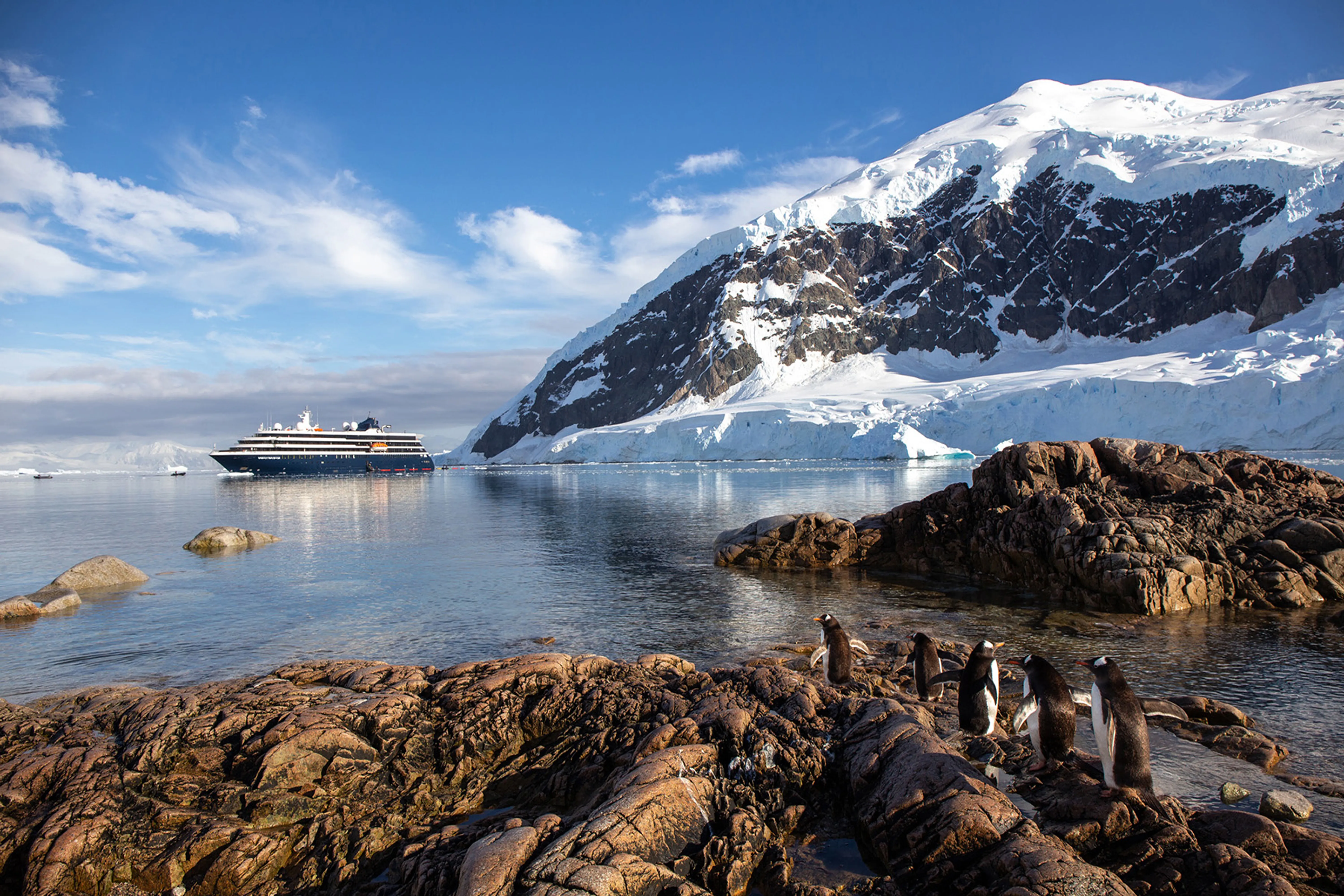
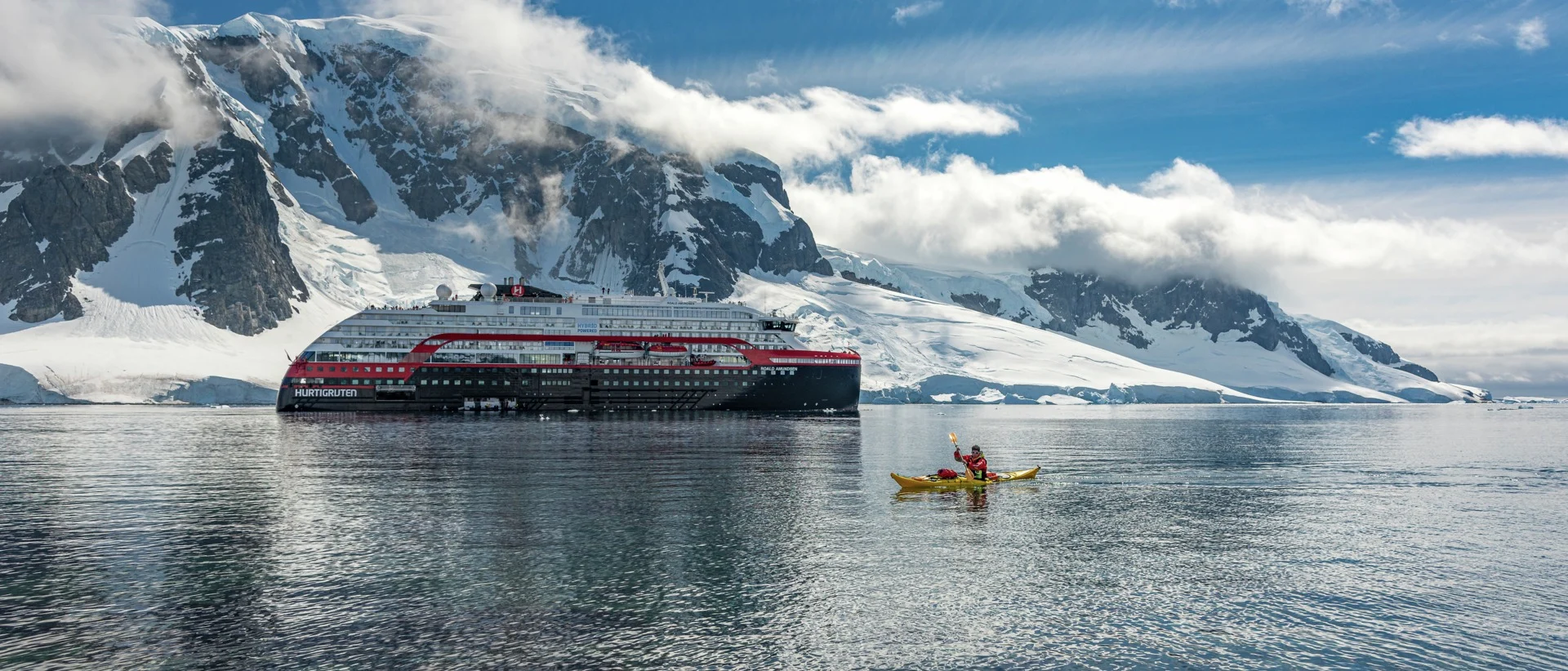
HX Expeditions is the descendant of Norway’s 1893 coastal steamship tradition. Rebranded from Hurtigruten Expeditions in late 2023 and acquired by a consortium led by Arini Capital Management in February 2025, HX operates five expedition vessels including the world’s first hybrid battery-powered cruise ships — MS Roald Amundsen and MS Fridtjof Nansen. These are large ships by expedition standards, carrying up to 500 passengers in polar waters, and they are designed to deliver genuine expedition experiences at an accessible price point. HX runs approximately 50 Antarctic departures per season — more than any other operator — and since November 2024, has operated on an all-inclusive fare model covering drinks, Wi-Fi, gratuities, and expedition activities. The company partners with the University of Tasmania’s Institute for Marine and Antarctic Studies, runs over twenty citizen science projects per season, and holds the distinction of being the first cruise line to ban single-use plastics and heavy fuel oil fleet-wide. HX is not a luxury line. It is an expedition line with Scandinavian design sensibility, serious environmental credentials, and fares that start from approximately AUD 1,100 per person per day.
Scenic Ocean Cruises is the creation of Glen Moroney — an Australian entrepreneur from Newcastle, New South Wales, who started a coach tour company in 1986 and built it into one of Australia’s most recognised luxury travel brands. Scenic’s two Discovery Yachts — Scenic Eclipse (2019) and Scenic Eclipse II (2023) — are not expedition ships in the traditional sense. Scenic deliberately calls them “Discovery Yachts” because the proposition is luxury-first with expedition capability, not expedition-first with luxury amenities. These are the only vessels in the world carrying both helicopters and a submarine on every voyage. They offer up to ten dining venues, butler service in every suite category, a wine programme curated by a Master of Wine, a 550-square-metre spa, and an all-inclusive fare that covers premium spirits, daily-restocked mini-bars, and complimentary laundry. At a maximum of 200 passengers in polar waters, the ships are intimate and refined. Scenic’s per-diem pricing typically runs AUD 1,600 to 2,400 — roughly fifty per cent more than HX at entry level and considerably more in upper suite categories.
The choice between these two lines is not a close call in the way that choosing between Aurora and Quark or Ponant and Silversea might be. HX and Scenic occupy different worlds. HX is for the traveller who wants to reach Antarctica on a genuine expedition ship with environmental credibility, expert science programming, and a fare that does not require remortgaging. Scenic is for the traveller who wants to reach Antarctica without surrendering a single comfort — who values a butler drawing the curtains to reveal icebergs, a helicopter flight over glacial peaks, and a sushi counter that seats eighteen. Understanding which world you belong to is the first step in making the right booking.
Expedition team and guides
The quality and ratio of the expedition team shapes every shore landing, every Zodiac cruise, and every evening lecture. Both HX and Scenic field capable teams — but the structures differ materially.
HX’s expedition team is multi-disciplinary: marine biologists, wildlife biologists, ornithologists, glaciologists, oceanographers, historians, photographers, and cultural interpreters. On the hybrid ships carrying approximately 500 passengers, the team typically numbers 15 to 20 members — yielding an estimated guide-to-guest ratio of approximately 1:25 to 1:30. This is notably lower than expedition-focused competitors such as Aurora Expeditions (1:8) or Quark Expeditions (1:10). On MS Fram, which carries 200 passengers in polar waters, the ratio improves to approximately 1:15. HX compensates partly through team calibre — Tudor Morgan brings nearly three decades of polar leadership, Karin Strand chairs AECO’s Executive Committee, and the company operates a Princess Royal Training Award-winning in-house polar guide academy. HX also deploys cultural interpreters unique to its programme, including Greenlandic Inuit ambassadors on Arctic voyages. Every voyage includes a professional photographer providing a complimentary digital photo album.
Scenic’s Discovery Team deploys up to 20 specialists on Expedition Voyages (polar regions) — marine biologists, historians, geologists, glaciologists, ornithologists, naturalists, and photographers. With 200 passengers in polar waters, this yields an approximate guide-to-guest ratio of 1:10 — competitive with Quark and significantly better than HX’s hybrid ships. Scenic’s team is led by experienced specialists such as Mike Cusack, who brings over thirty years of guiding experience in Australia’s northwest for Kimberley voyages. Discovery Team members are IAATO and AECO trained. However, Scenic does not operate a publicly disclosed formal training academy comparable to HX’s award-winning programme, and the team structure is geared toward a luxury-expedition hybrid rather than pure science-driven exploration.
The practical difference is tangible. On an HX hybrid ship, you share your expedition guide with roughly 25 to 30 other guests. On Scenic, your group is roughly 10. During a shore landing, this means smaller groups moving through penguin colonies, more personalised attention from naturalists, and more opportunity for individual questions. Where HX compensates is in the depth of its science programme — the citizen science projects, the University of Tasmania partnership, and the structured educational content that runs through every voyage. Scenic’s team delivers expert interpretation of what you see; HX’s team invites you to contribute to research while you see it.
Ships and expedition hardware
The hardware gap between HX and Scenic is where the comparison becomes most consequential — and most interesting. These are genuinely different ships built for genuinely different purposes.
HX’s flagship vessels — MS Roald Amundsen (2019) and MS Fridtjof Nansen (2020) — are 20,889-gross-tonne, 140-metre hybrid battery-powered expedition ships. They carry 500 passengers in polar waters across 265 outside-facing cabins (no inside cabins), with 50 per cent featuring private balconies. The hybrid propulsion system — four Rolls-Royce Bergen diesel engines supplemented by Corvus Energy lithium-ion battery packs totalling approximately 1.25 MWh — can operate on battery power alone for 30 to 60 minutes, reducing CO2 emissions by approximately twenty per cent compared to conventional diesel. Ice class is PC6, suitable for summer operations in medium first-year ice. The ships carry 17 inflatable Explorer Boats (Zodiacs) stored in a tender pit on Deck 3 for rapid deployment — no crane required. MS Fram (2007, refurbished 2025) offers a more intimate experience at 200 passengers with 1B ice class, and MS Spitsbergen (rebuilt 2016, refurbished 2025) operates at 150 passengers. HX carries no helicopter, no submarine, and no ROV — though Blueye underwater drones provide live video feeds to Science Centre screens.
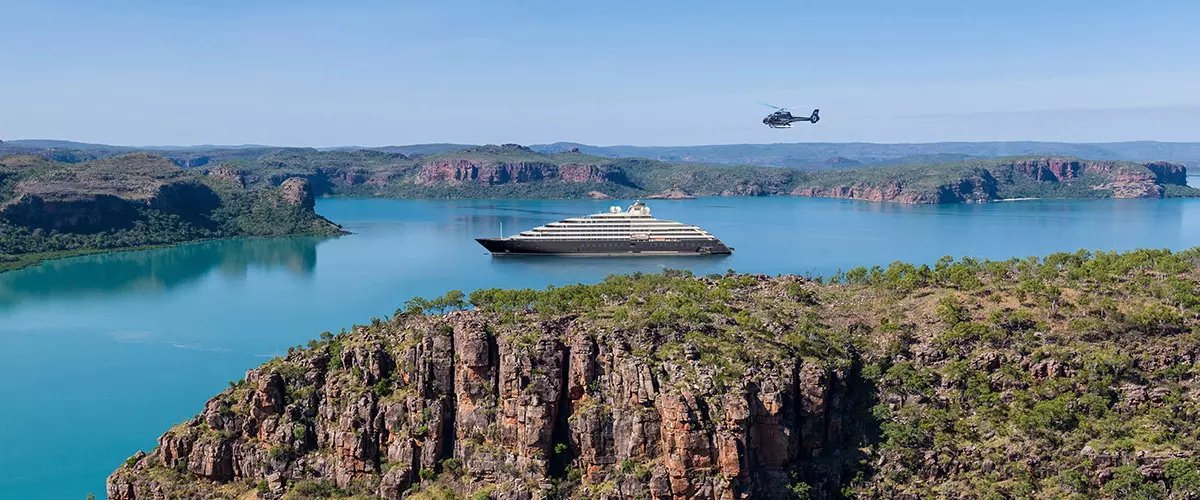
Scenic’s Discovery Yachts — Scenic Eclipse (2019) and Scenic Eclipse II (2023) — are 17,545-gross-tonne, 166-metre vessels featuring the patented Ulstein X-BOW inverted hull design, which significantly reduces slamming, spray, and vibration in heavy seas. They carry 200 passengers in polar waters across 114 all-suite, all-veranda cabins. Propulsion is conventional diesel-electric with ABB Azipod D thrusters and oversized zero-speed stabiliser fins. Ice class is 1A-Super (equivalent to PC6). And then there is the expedition hardware that no other operator can match: two Airbus H130 helicopters per ship (pilot plus six guests, Bose noise-cancelling headsets, floor-to-ceiling windows) and a U-Boat Worx Cruise Sub 7 submarine (six guests plus pilot, rated to 300 metres, ultra-clear acrylic viewing spheres). Scenic also carries 12 Zodiacs, eight tandem kayaks, e-bikes, stand-up paddleboards, snorkelling gear, and snowshoes.
The hardware comparison exposes the fundamental philosophical divide. HX has invested in propulsion technology — hybrid-electric systems that represent a genuine step toward sustainable expedition cruising. Scenic has invested in exploration technology — helicopters and a submarine that unlock perspectives no Zodiac can provide. A 30-minute helicopter flight over Antarctic glaciers or a submarine dive to 300 metres beneath polar ice are experiences that no amount of Zodiac cruising can replicate. Equally, HX’s hybrid propulsion represents a tangible commitment to reducing the environmental footprint of polar tourism in a way that Scenic’s conventional diesel-electric system does not.
Both ship classes hold PC6 ice class — adequate for standard Antarctic Peninsula operations but not sufficient for heavy multi-year ice. Neither line can reach the deep interior ice that Ponant’s Le Commandant Charcot (PC2) can access. For the typical Antarctic Peninsula itinerary, both are equally capable in terms of ice navigation.
Landing experience and shore programme
Landing logistics differ dramatically between these two operations, driven primarily by the passenger count gap.
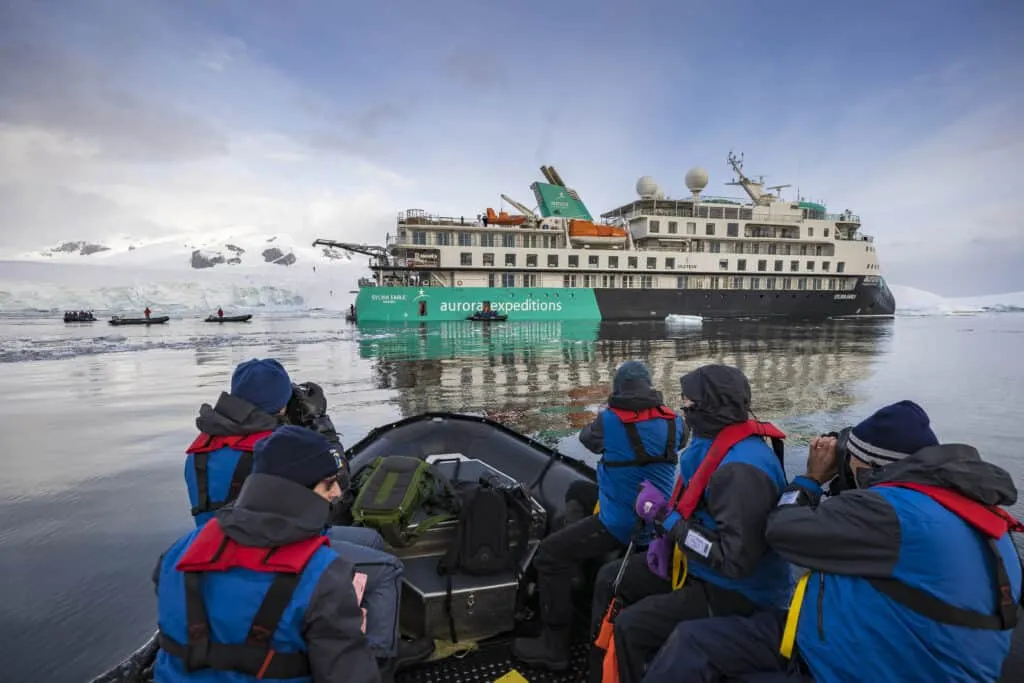
HX’s landing operations on the hybrid ships are governed by IAATO Category C2 rules — vessels carrying 201 to 500 passengers may make landings, but only 100 guests can be ashore at any one site at any time. With approximately 500 passengers, this means five rotation groups of roughly 100 passengers each. The practical effect: landing days involve extended rotation schedules where you might not reach shore until the afternoon, depending on your assigned group. This is the most significant competitive disadvantage of sailing on HX’s large ships versus any sub-200-passenger competitor. On MS Fram (200 passengers in polar waters), HX falls into the more desirable IAATO Category C1, requiring only two rotation groups — a markedly more efficient operation. Each day in expedition territory typically features two excursions: one water-based (Zodiac cruising, kayaking) and one land-based (hiking, wildlife observation, snowshoeing).
Scenic’s landing operations benefit from IAATO Category C1 classification — at 200 passengers maximum in Antarctic waters, all passengers are permitted to land. Split landings are straightforward: 100 ashore while 100 on Zodiac cruises, then swap. Landing time per group is typically two to three hours. The smaller passenger count means faster embarkation and disembarkation from Zodiacs, less time queuing at the mudroom, and a more fluid daily rhythm. Scenic also supplements its landing programme with helicopter excursions — flightseeing over glaciers, heli-hiking to remote locations, and Emperor penguin colony visits that are inaccessible by Zodiac. Submarine dives add an entirely different dimension, though both helicopter flights and submarine dives are weather-dependent and never guaranteed.
Included activities on HX: All nature landings, Zodiac cruising, polar plunge, extended hikes, lectures, Science Centre access, and citizen science participation. Paid add-ons include Sea Explorer Kayaking (EUR 199), Discovery Kayaking (EUR 129), bivvy bag camping (EUR 350), tent camping (EUR 429), and snowshoeing.
Included activities on Scenic: All Zodiac excursions, guided nature walks, kayaking (eight tandem kayaks, twice daily), paddleboarding, snowshoeing, e-bikes, snorkelling (warm-water itineraries), photography walks, and all lectures. Paid add-ons include helicopter flights (from USD 695) and submarine dives (from USD 775).
The landing experience comparison ultimately favours Scenic for two reasons: the smaller ship processes landings more efficiently, and the helicopter and submarine offer exploration modes that HX simply cannot provide. HX counters with the sheer volume of its programme — 50 Antarctic departures per season means more itinerary variety, more departure date flexibility, and the ability to choose MS Fram for a smaller-ship experience at an HX price point.
What is actually included
Both lines market all-inclusive fares, but the scope of what “all-inclusive” means differs in important ways.
HX’s all-inclusive fare (from November 2024) covers full-board dining at Restaurant Aune and Fredheim, house wine, beer, spirits and cocktails throughout the day, complimentary Starlink Wi-Fi, gratuities, all daily expedition landings and Zodiac cruising, an expedition jacket (yours to keep), rubber boot and trekking pole loans, a professional digital photo album, lectures, Science Centre access, citizen science participation, and use of sauna, hot tubs, fitness room, and lounges. Not included: international flights (except charter flights Buenos Aires to Ushuaia on Antarctic voyages), travel insurance, paid adventure activities (kayaking, camping, snowshoeing), premium drinks, spa treatments, Restaurant Lindstrom surcharge for non-suite guests, and laundry. Suite guests receive complimentary Lindstrom dining and priority embarkation.
Scenic’s all-inclusive fare covers all meals across up to ten dining venues with no surcharges or reservation fees, 24-hour in-suite dining, all beverages including premium spirits, wines, champagnes and cocktails, over 100 whiskies at the Whisky Bar, a daily-restocked mini-bar personalised to guest preference, butler service in every suite, all shore excursions and Zodiac excursions, kayaking, paddleboarding, e-bikes, snorkelling, Wi-Fi, all gratuities (onboard and onshore), complimentary self-service laundry, transfers on embarkation and disembarkation days, charter flights Buenos Aires to Ushuaia (Antarctic voyages), and pre-cruise hotel nights on select itineraries. Not included: helicopter excursions (USD 695 to 1,500 per person), submarine dives (USD 775 per person), spa treatments, Chairman’s Cellar wines, international flights, and travel insurance.
The net inclusion picture tilts toward Scenic when measured purely by what the fare covers. Butler service in every cabin, complimentary laundry, a restocked mini-bar, premium spirits rather than house-level drinks, and ten dining venues without any surcharge represent a genuinely more comprehensive inclusion. HX’s offering is strong for the expedition essentials — drinks, Wi-Fi, gratuities, expedition gear — but does not approach Scenic’s breadth of luxury inclusions.
However, the inclusion picture changes when you consider the headline-grabbing elements that are not included on Scenic. Many guests booking a “truly all-inclusive” luxury expedition yacht reasonably expect that the helicopters and submarine — the hardware that defines Scenic’s marketing identity — would be part of the package. They are not. A couple seeking a helicopter flight and a submarine dive on the same voyage will pay an additional USD 1,470 or more per person on top of the all-inclusive fare. This expectation gap is one of the most consistent sources of guest complaint on Scenic.
Destination coverage and itinerary depth
Both lines operate seasonal migration patterns between the poles, but their geographic footprints and deployment philosophies diverge.
HX’s destination coverage is the broadest of any expedition operator. Antarctica is the flagship programme — approximately 50 departures per season, the largest Antarctic programme in the industry, covering Highlights of Antarctica (12 days), Antarctic Circle (17 days), Iconic Antarctica (15 days), and Antarctica combined with South Georgia and the Falklands (22 to 24 days). Three of HX’s five ships deploy to Antarctica. Beyond the southern continent, HX sails to Svalbard, Greenland (its largest-ever programme in 2025-2026 with a fourth vessel added), Arctic Canada and the Northwest Passage, Alaska, the Galapagos Islands (year-round on the 90-passenger MV Santa Cruz II), West Africa (Cape Verde and the Bissagos Islands — the sole cruise line offering these routes), South America, Iceland, British Isles, and Atlantic repositioning voyages. This breadth is unmatched in the expedition sector.
Scenic’s destination coverage spans both hemispheres across a wider range of voyage types. Antarctic Peninsula, South Georgia, and Falklands form the southern programme, with select Ross Sea itineraries. Arctic sailings include Svalbard, Greenland, Iceland, Norwegian Fjords, the Faroe Islands, and select Northwest Passage voyages. The Kimberley coast between Broome and Darwin is a significant Australian-market programme — Scenic Eclipse II is the only ship in the Kimberley carrying two onboard helicopters. Beyond expedition regions, Scenic’s Discovery Yachts sail the Mediterranean, Japan, South Pacific (New Zealand, Papua New Guinea), and the Americas including Panama Canal transits. Combined across both ships, Scenic calls at over 500 ports across 63 countries. However, Scenic’s expedition-specific programme is smaller than HX’s — fewer Antarctic departures, fewer polar itineraries, and a significant portion of the annual schedule dedicated to non-polar Discovery Voyages.
For the Australian traveller specifically interested in Antarctica, HX’s volume advantage is significant. More departures mean more flexibility in dates, more options for shoulder-season savings, and greater availability of preferred cabin categories. Scenic’s Antarctic programme is smaller but supplemented by the hardware — helicopter and submarine — that adds an exploration dimension HX cannot offer. Scenic’s Kimberley programme is also uniquely relevant to Australian travellers — an Australian-owned ship exploring Australia’s own remote coastline with helicopters is a compelling proposition.
Neither line offers departures from Australian ports for Antarctic voyages. Both embark from Buenos Aires or Ushuaia. Neither offers a fly-over-Drake option — all Antarctic sailings involve the full Drake Passage crossing by sea.
Cabins and accommodation
The accommodation gap between HX and Scenic is substantial — this is where the price difference shows most clearly.
HX’s cabin range on the hybrid ships spans Polar Outside cabins (17 to 23 square metres, windows only, no balcony) through Arctic Superior cabins (15 to 27 square metres, most with private balconies) to Expedition Suites in six sub-categories ranging from 19 square metres to the Extra-Large Forward Suite at 46 to 48 square metres with sweeping forward-facing views. All 265 cabins on the hybrid ships are outside-facing — there are no inside cabins. Fifty per cent have private balconies. Interiors follow Scandinavian design principles: natural materials including granite, oak, birch, and wool, clean lines, and functional storage. Standard amenities include bathroom with shower, TV, safe, minibar (charges apply), European two-pin sockets, and tea and coffee facilities. MS Fram and MS Spitsbergen also offer inside cabins at lower price points — the most economical way to sail with HX.
Scenic’s suite range starts where HX’s finishes. Every cabin on both Discovery Yachts is classified as a suite with a private veranda — there are no interior, oceanview-only, or non-balcony accommodations. The entry-level Verandah Suite provides 32 square metres of interior space with a private veranda, king bed convertible to twins, complimentary daily-restocked mini-bar, illy coffee machine, Dyson hairdryer, L’Occitane amenities, and a dedicated butler. From there, the range ascends through Deluxe Verandah Suites (34 square metres), Grand Deluxe Verandah Suites (40 square metres), Spa Suites (46 to 50 square metres with Philippe Starck spa bath and four-poster king bed), Panorama Suites (62 square metres interior plus 48 square metres of wraparound balcony), and the Owner’s Penthouse Suite (135 square metres interior with private spa pool on terrace and dual steam showers). The Two-Bedroom Penthouse Suite connecting an Owner’s Penthouse with a Spa Suite creates 247 square metres of accommodation — the largest in expedition cruising.
The accommodation comparison is not competitive in the traditional sense — it is categorical. HX’s best suite occupies the space that Scenic’s mid-range Grand Deluxe fills. Scenic’s entry-level Verandah Suite at 32 square metres exceeds HX’s most common suite category (ME Standard Suite at 20 to 28 square metres) while also providing a butler, a daily-restocked mini-bar, an illy coffee machine, and L’Occitane toiletries. The gap in soft product is equally pronounced: every Scenic guest has a butler; HX guests do not. Every Scenic guest has a heated veranda; many HX guests have windows only. Every Scenic guest has a Dyson hairdryer and a complimentary mini-bar; HX guests have a standard hairdryer and a pay-as-you-go minibar.
For travellers who view the cabin as a resting place between landings, HX’s accommodation is more than adequate — clean, comfortable, well-designed, and functional. For travellers who view the cabin as part of the experience — who want to wake up, have the butler deliver coffee, open the veranda doors to icebergs, and order breakfast in-suite — Scenic delivers a product that HX does not attempt to match.
Pricing and value
The price gap between HX and Scenic is the widest in this comparison series — wider even than the gulf between budget and ultra-luxury in mainstream cruising.
HX’s directional pricing for a 12-day Highlights of Antarctica voyage on MS Roald Amundsen starts from approximately AUD 13,355 per person for a Polar Outside cabin. Arctic Superior cabins begin from approximately AUD 15,856, and Expedition Suites from approximately AUD 18,901. This translates to a per-diem of approximately AUD 1,100 to 1,575 depending on cabin category. The all-inclusive fare covers drinks, Wi-Fi, gratuities, and expedition gear — eliminating most onboard spending beyond optional activities (kayaking at EUR 129 to 199, camping at EUR 350 to 429). Flight-inclusive packages from Buenos Aires with charter flights to Ushuaia start from approximately AUD 13,977 for 15 days. International flights from Australia add AUD 2,000 to 4,000 return.
Scenic’s directional pricing for comparable Antarctic Peninsula itineraries starts from approximately AUD 15,000 per person for a 13-night voyage in an entry-level Verandah Suite. Depending on duration, suite category, and departure date, fares can reach AUD 30,000 or more per person. The per-diem for a typical Antarctic voyage ranges from approximately AUD 1,600 for entry-level suites to AUD 2,400 or higher for premium categories. Scenic regularly offers promotional savings of AUD 3,000 or more per person, fly-free offers, and reduced single supplements on select sailings.
The total cost picture for a hypothetical 13-day Antarctic Peninsula voyage for two travellers sharing an entry-level cabin, including international flights from Sydney:
HX (Polar Outside cabin): approximately AUD 15,000 per person cruise fare plus AUD 3,000 flights = AUD 18,000 per person, or AUD 36,000 per couple. Optional add-ons (two kayaking sessions and one camping night) add approximately AUD 1,200 per couple. Total: approximately AUD 37,200.
Scenic (Verandah Suite): approximately AUD 18,000 to 22,000 per person cruise fare plus AUD 3,000 flights = AUD 21,000 to 25,000 per person, or AUD 42,000 to 50,000 per couple. Optional add-ons (one helicopter flight and one submarine dive per person) add approximately AUD 4,500 per couple. Total: approximately AUD 46,500 to 54,500.
The gap is AUD 10,000 to 17,000 per couple — the price of a separate holiday. Whether that gap represents fair value depends entirely on what you value. Scenic’s premium buys you 300 fewer passengers, butler service, ten dining venues, a helicopter, a submarine, a wine programme from a Master of Wine, a spa three times the size of anything on HX, and the knowledge that you are sailing on an Australian-owned yacht. HX’s lower price buys you the world’s first hybrid-electric expedition ships, a citizen science programme with genuine research partnerships, and the satisfaction of visiting Antarctica at a more responsible environmental cost — with enough savings to fund a return voyage.
Solo travellers face supplements on both lines. HX releases limited no-supplement cabins on select sailings (first-come-first-served) and charges from 25 per cent when these sell out — among the most competitive solo policies in expedition cruising. Scenic periodically offers 55 to 75 per cent off the single supplement on entry-level suites, with a maximum of two reduced cabins per departure. Neither line offers dedicated solo cabins.
Onboard enrichment and science
The enrichment programmes reflect the philosophical divide between these two operators — HX prioritises participatory science, Scenic prioritises expert-led luxury discovery.
HX’s enrichment programme is built around citizen science. At least one citizen science project runs on every voyage, drawing from a portfolio that includes eBird and iNaturalist (wildlife sighting logging), Happywhale (whale fluke photography for migration tracking), FjordPhyto (phytoplankton sampling), the Secchi Disk Programme (water clarity measurement for ocean health monitoring), and partnerships supporting NASA and NOAA research. The institutional anchor is HX’s partnership with the University of Tasmania’s Institute for Marine and Antarctic Studies (IMAS). During the 2025-2026 Antarctic season, HX donated over 1,100 cabins to science, supported more than 20 research projects, and planned over 16,000 data submissions from guests and staff. Dedicated Science Centres on all expedition ships — new or upgraded on Fram and Spitsbergen during the 2025 refurbishments — feature microscopes, touch screens, and Blueye underwater drone footage. The daily lecture programme covers wildlife, culture, history, geology, and glaciology, with multilingual interpretation available on many voyages.
Scenic’s enrichment programme centres on the Discovery Team’s expertise rather than participatory research. Expedition Voyages carry up to 20 specialists who deliver lectures in the theatre, lead guided walks with naturalist interpretation, and provide informal briefings throughout the day. Scenic lists citizen science as an included activity, but the programme is informal and guide-led rather than institutionalised — there are no publicly disclosed research partnerships, no dedicated citizen science centres, and no published data contribution outcomes comparable to HX’s structured programme. Where Scenic’s enrichment shines is in the exclusive discovery experiences that the hardware enables: a submarine dive to 300 metres offers a perspective on polar marine ecosystems that no amount of shipboard lectures can replicate. Helicopter flights provide a landscape-level understanding of glacial systems. These are enrichment experiences of a different kind — visceral rather than participatory.
For the traveller who wants to leave Antarctica feeling they contributed something to polar science — not just observed it — HX is the clear choice. For the traveller who wants to experience Antarctica from perspectives that most expedition ships cannot physically provide — from 300 metres below the surface or 600 metres above — Scenic’s hardware delivers what no lecture programme can.
Dining on expedition
Dining is one of the starkest contrasts in this comparison — HX offers three solid venues, Scenic offers up to ten.
HX’s dining programme features three venues on the hybrid ships. Restaurant Aune serves buffet breakfast and lunch with plated dinner service — regional dishes, international cuisine, Scandinavian-influenced menus that change daily. Restaurant Lindstrom is the fine-dining option, named after the chef who fed Norway’s polar explorers — included for suite guests, surcharge for others — offering intimate, refined Scandinavian-inspired menus with premium wine pairings. Fredheim provides casual dining and quick bites throughout the day. The culinary approach emphasises HX’s “Norway’s Coastal Kitchen” programme with sustainable, locally sourced ingredients. There is no named chef partnership. The dress code is relaxed at all times, including Lindstrom. Reviewers consistently rate the food as “very good” for an expedition line but acknowledge the buffet format at breakfast and lunch as a step below fully plated service.
Scenic’s dining programme operates across up to ten dining experiences in seven distinct venues. Elements is the main restaurant offering a la carte Italian fare, steaks, and seafood. Lumiere delivers French fine dining with dishes including frog legs, lobster with cream sauce, and lamb chops — consistently praised for attentive service. Koko’s Asian Fusion houses three concepts within one venue: the main Asian fusion restaurant, Sushi at Koko’s (seating only 18 guests at a counter where chefs prepare fresh sushi — frequently cited as guests’ single favourite dining experience), and Night Market at Koko’s (teppanyaki grill with night market dishes from Asia, India, and the Middle East). Chef’s Table (or Chef’s Garden at Epicure on Eclipse II) is an invitation-only degustation for eight to ten guests — molecular gastronomy-influenced multi-course menus described as “part molecular gastronomy, part whimsy.” Azure Bar and Cafe provides relaxed all-day grazing and tapas. Yacht Club offers poolside grilling and buffet. In-suite dining delivers full 24-hour room service via butler. The wine programme, curated by Keith Isaac — one of only approximately 400 Master of Wine holders globally — features 50 wines on the pouring programme, Champagnes including Grand Cru Blanc de Blancs, and the Chairman’s Cellar with Penfolds Grange and first-growth Bordeaux available for purchase.
The dining comparison is not close. Scenic’s ten venues and Master of Wine-curated programme represent a culinary offering that belongs in the ultra-luxury category alongside Silversea and Seabourn, not the expedition sector. HX’s three venues are appropriate for its positioning and price point — solid, well-executed expedition dining without pretension. It is worth noting, however, that Scenic’s food reviews are polarised — some luxury cruise veterans describe dishes as “unimaginative” and compare unfavourably to Silversea and Seabourn. The breadth of venues is undeniable; the consistency of execution is debated.
Standout itineraries for Australian travellers
HX Expeditions
Highlights of Antarctica (12 days, Roald Amundsen or Fridtjof Nansen, from approximately AUD 13,355 per person) — The most accessible Antarctic itinerary in the market. Includes charter flights Buenos Aires to Ushuaia and a pre-cruise night at a five-star Buenos Aires hotel. The hybrid ships deliver a comfortable Drake Passage crossing at 20,889 gross tonnes. All-inclusive fare covers drinks, Wi-Fi, and gear. For the Australian traveller wanting an Antarctic tick at the best price-to-quality ratio available, this is the benchmark.
Antarctic Circle (17 days, from approximately AUD 17,000 per person) — Crosses latitude 66 degrees 33 minutes south into waters that most Antarctic voyages never reach. Longer, more adventurous, with more remote landing sites and fewer other ships. The passage through the Lemaire Channel alone justifies the additional days. Weather and ice dependent but made more likely by HX’s ice-capable ships.
Antarctica, South Georgia and the Falklands (22 to 24 days) — The comprehensive southern expedition combining the Antarctic Peninsula with South Georgia’s staggering king penguin colonies and the Falklands’ British colonial character. More expensive but delivers three distinct ecosystems and wildlife encounters in a single voyage. MS Fram’s 200-passenger complement on this route offers the more intimate HX experience.
Scenic Ocean Cruises
Antarctic Peninsula on Scenic Eclipse II (13 to 17 nights, from approximately AUD 15,000 per person for entry Verandah Suite) — The full Discovery Yacht experience in polar waters. Two hundred passengers, butler service, ten dining venues, and the possibility of a helicopter flight over glacial peaks or a submarine dive beneath polar ice. Eclipse II is the newer ship with an expanded spa including salt therapy lounge and Sky Deck pool. The all-suite, all-veranda concept means every guest has a private balcony for iceberg-watching at midnight.
Falklands, South Georgia and Antarctica (21 nights) — The comprehensive southern programme with the added dimension of Scenic’s hardware. Helicopter excursions over South Georgia’s king penguin colonies — hundreds of thousands of penguins viewed from above — are a perspective that no Zodiac-only operator can provide.
The Kimberley: Broome to Darwin on Eclipse II (10 to 11 nights) — Uniquely relevant to Australian travellers and uniquely Scenic. Eclipse II is the only ship in the Kimberley carrying two onboard helicopters, enabling heli-fishing for barramundi, aerial approaches to Horizontal Falls, and remote beach picnics. Led by expedition specialist Mike Cusack with over thirty years in Australia’s northwest. Scenic Eclipse II returns to the Kimberley in 2028 after a gap in 2026-2027.
For Australian travellers specifically
Australian ownership and connection: This is one of the few expedition comparisons where both operators have genuine Australian connections, though the nature of those connections is fundamentally different. Scenic is Australian-owned — founded, headquartered, and controlled from Newcastle, New South Wales, with Glen Moroney as Chairman. The company built its brand through decades of Australian marketing, starting with Great Ocean Road coach tours and growing through European river cruises before entering expedition cruising. Scenic’s Australian pedigree resonates particularly on Kimberley voyages — an Australian company sailing Australia’s own remote coastline.
HX is Norwegian in origin and now London-headquartered under its new ownership, but the company made a significant commitment to the Australian market in March 2025 by establishing a dedicated sales and marketing team for Australia and New Zealand. A Guest Excellence team based in Melbourne handles both sales and service calls during AEST business hours. Approximately 70 per cent of HX’s Asia-Pacific bookings come through Australian travel advisors. The Australian website at travelhx.com displays pricing in AUD.
Getting to the ship: Both lines embark Antarctic voyages from Buenos Aires or Ushuaia. Both include charter flights between Buenos Aires and Ushuaia plus a pre-cruise hotel night in Buenos Aires. International flights from Sydney or Melbourne to Buenos Aires route via Santiago (Qantas or LATAM, approximately 18 to 22 hours total) or via Auckland (LATAM). Both routings use oneworld alliance carriers, enabling Qantas Frequent Flyer point earning. Neither line includes international airfare as standard, though Scenic periodically offers fly-free promotions. Budget AUD 2,000 to 4,000 per person for return international flights.
Pricing currency: Scenic’s Australian website prices exclusively in AUD — a natural advantage for budgeting and eliminating exchange rate uncertainty. HX’s Australian website also displays AUD pricing. Onboard accounts on HX settle in EUR and on Scenic in the local shipboard currency, so foreign transaction fees may apply to credit card charges on both lines.
Passenger mix: Expect a significant Australian contingent on most Scenic sailings, particularly Kimberley and Antarctica departures marketed through Australian channels. HX’s passenger mix is more internationally diverse — predominantly European (the brand’s German-speaking market is substantial) with growing Australian representation following the Melbourne office establishment.
Loyalty programmes: HX’s four-tier Explorers programme offers a five per cent cruise discount at Bronze level with room upgrades at Platinum (500-plus points). Scenic’s newly launched (February 2026) Scenic and Emerald Rewards programme provides four tiers, with Chairman’s Club members receiving complimentary suite upgrades, enhanced private transfers, and — from April 2028 — one complimentary helicopter or flightseeing experience on select departures. Scenic’s programme benefits from cross-brand recognition with its river cruise division, rewarding loyal river cruise passengers who step up to the ocean product.
The onboard atmosphere
The atmosphere aboard these two lines could hardly be more different — and both get it right for their target traveller.
HX’s atmosphere is Scandinavian expedition: clean, understated, and centred on the natural world outside the windows rather than the interior design. The hybrid ships are large by expedition standards — 500 passengers create a different social dynamic to a 130-passenger Aurora or a 200-passenger Scenic. You will not know every passenger by name. But the expedition programme creates community within the larger group: your landing rotation becomes your social unit, shared Zodiac cruises build connection, and evening lectures in the Science Centre draw those with genuine curiosity rather than those seeking entertainment. There are no formal nights, no casino, no production shows. The dress code is relaxed throughout — the same waterproof trousers you wore on the afternoon’s Zodiac cruise are perfectly acceptable at dinner. The hot tubs, sauna, and fitness room provide between-landing relaxation. Sea days on the Drake Passage are structured around lectures and Science Centre workshops. The passenger demographic skews 40-plus, internationally mixed, and united by genuine interest in polar exploration rather than luxury travel as a lifestyle. HX feels like what it is — an expedition ship that prioritises the destination over the vessel.
Scenic’s atmosphere is boutique luxury hotel: refined, intimate, and designed to make guests feel they have not sacrificed an ounce of comfort to reach the ends of the earth. With 200 passengers maximum and nearly one crew member per guest, the ship feels personal and unhurried. The Observation Lounge with its 270-degree views is the gathering point for sundowner drinks and expedition briefings — more wine bar than lecture hall. Multiple intimate bars and lounges invite pre-dinner cocktails. Butler-delivered canapes and petit fours arrive in premium suites each evening. Live music plays in select venues. There is no casino, no Broadway-style shows, and no midnight buffets — the entertainment is the expedition and the conversation it inspires. The dress code is “elegant casual” for evening dining — collared shirts and slacks for men, dresses or smart separates for women — though in practice, the atmosphere is relaxed by luxury cruise standards. The spa at 550 square metres is disproportionately generous for the ship’s size, featuring ESPA treatments, a salt therapy lounge, a Vitality Pool, and yoga and Pilates classes. The passenger demographic is predominantly well-travelled couples aged 50-plus, heavily Australian, accustomed to luxury, and seeking comfort combined with adventure. Scenic feels like what it is — a luxury yacht that happens to visit expedition destinations.
The atmosphere test is simple. If your ideal post-landing moment involves a hot chocolate in the Science Centre while reviewing your citizen science data contributions, HX is your ship. If your ideal post-landing moment involves a butler-delivered champagne on your private veranda while a 550-square-metre spa awaits, Scenic is your yacht.
The bottom line
HX Expeditions and Scenic Ocean Cruises do not compete for the same traveller. They compete for the same destination — and their approaches to reaching it reveal everything about the spectrum of modern expedition cruising.
Choose HX Expeditions when the expedition itself is the priority. When you want to sail on the world’s first hybrid battery-powered cruise ships and feel the tangible difference of a vessel that can operate under battery power in pristine polar waters. When you want to contribute to citizen science projects in partnership with the University of Tasmania’s Institute for Marine and Antarctic Studies. When you want the largest Antarctic programme of any operator — 50 departures per season — giving you the flexibility to find the dates, duration, and pricing that work. When an all-inclusive fare from approximately AUD 1,100 per day delivers drinks, Wi-Fi, gratuities, expedition gear, and daily Zodiac landings without the financial anxiety of hidden extras. When a Scandinavian design philosophy, relaxed atmosphere, and casual dress code suit your temperament better than butler service and elegant evening wear. Accept that 500 passengers mean longer landing rotations on the hybrid ships, that a guide-to-guest ratio of 1:25 cannot match Scenic’s 1:10, that there are no helicopters or submarines, and that the dining programme is solid rather than spectacular. Consider MS Fram for a more intimate 200-passenger HX experience with stronger ice capability.
Choose Scenic Ocean Cruises when the experience must be extraordinary from the moment you step aboard to the moment you leave. When the only expedition ships in the world carrying both helicopters and a submarine represent capabilities you cannot find anywhere else — and a 30-minute helicopter flight over Antarctic glaciers or a submarine dive to 300 metres beneath polar ice justifies a premium that no Zodiac-only ship can match. When ten dining venues, a Master of Wine-curated programme, Sushi at Koko’s with its counter seating for eighteen, and an invitation-only Chef’s Table matter as much as the penguins. When butler service in every suite, a 550-square-metre spa, a daily-restocked complimentary mini-bar, and an Owner’s Penthouse with a private spa pool on the terrace represent the standard you expect. When the Australian ownership of Glen Moroney’s Newcastle-born company adds a layer of personal connection. Accept that the per-diem runs roughly fifty per cent higher than HX at entry level, that the helicopters and submarine cost extra and are never guaranteed, that food quality reviews are polarised among luxury cruise veterans, and that the Discovery Yacht concept positions luxury ahead of expedition in the balance.
For the Australian traveller who can afford both, the most illuminating path may be to sail HX first — experience the purity of an expedition-led programme, contribute to citizen science, and discover whether Antarctica itself is enough. Then sail Scenic — and discover whether viewing the same continent from a helicopter at altitude and a submarine at depth, with a butler waiting in your suite, transforms the experience into something more. The answer will tell you more about yourself as a traveller than any comparison article can.