Aurora Expeditions and Swan Hellenic represent two fundamentally different philosophies of expedition cruising — one built on adventure and the other on intellect. Both operate purpose-built ships under 200 passengers, both hold IAATO membership, and both deliver genuine expedition programmes with expert guides. Jake Hower compares what happens when an Australian adventure pioneer meets a British cultural expedition icon.
| Aurora Expeditions | Swan Hellenic | |
|---|---|---|
| Category | Expedition | Expedition |
| Rating | ★★★★☆ | ★★★★☆ |
| Fleet size | 3 ships | 3 ships |
| Ship size | Small (under 500) | Small (under 200) |
| Destinations | Antarctica, Arctic, Patagonia, Japan | Polar, Mediterranean, South America, Asia |
| Dress code | Relaxed | Relaxed |
| Best for | Small-ship polar expedition adventurers | Cultural expedition and enrichment travellers |
Aurora Expeditions is the Australian-owned adventure specialist — three purpose-built X-BOW ships carrying a maximum of 130 passengers, a 1:8 guide ratio, seven citizen science programmes, B Corp certification, Hobart departures, and the widest adventure activity menu in expedition cruising including kayaking, camping, diving, climbing, and snowshoeing. Swan Hellenic is the cultural-intellectual expedition line — three Finnish-built ships with PC5 ice class, a SETI Institute partnership bringing space science to sea, truly all-inclusive pricing with house drinks, gratuities, and a shore excursion per port, the highest Cruise Critic ratings in its class, and a 70-year heritage of expert-led cultural enrichment. Choose Aurora when you want an adventure-first expedition with Australian DNA. Choose Swan Hellenic when you want an intellectually rich, all-inclusive cultural expedition across seven continents.
The core difference
Aurora Expeditions and Swan Hellenic are both genuine expedition cruise lines — purpose-built ships, under 200 passengers, Zodiac-based landings, expert guides, IAATO membership. But the similarity in format masks a profound difference in philosophy. These two companies answer fundamentally different questions about what expedition cruising should be.
Aurora Expeditions answers the question: what can you do out there? Founded in 1991 by Greg Mortimer OAM — the first Australian to summit Everest without supplementary oxygen — and Margaret Werner, Aurora is headquartered in Sydney and named after Sir Douglas Mawson’s legendary Antarctic vessel. The company operates three purpose-built Infinity-class ships (Greg Mortimer, Sylvia Earle, and the brand-new Douglas Mawson), all featuring the Ulstein X-BOW inverted hull, all capped at 130 passengers on polar expeditions. Aurora pioneered ice camping, kayaking, commercial climbing, and SCUBA diving in Antarctica. It holds B Corp certification with an impact score of 87.5, runs seven citizen science programmes, has banned salmon from all menus, and carries the distinctly Australian DNA of egalitarianism, unpretentiousness, and adventure obsession. The brand was built by a mountaineer, and it still feels like it.
Swan Hellenic answers the question: what can you understand out there? The brand traces its heritage to the 1950s, when “Swan’s Tours” carried guests to historical sites in the Aegean with onboard academic enrichment — inventing cultural cruising decades before the modern expedition industry existed. The contemporary Swan Hellenic, revived in 2020 by CEO Andrea Zito (a former Silversea executive who won Seatrade Cruise Personality of the Year 2025), operates three Finnish-built expedition ships — SH Minerva, SH Vega, and the larger SH Diana — carrying 152 to 192 passengers across seven continents. The defining features are an exclusive SETI Institute partnership bringing space science to sea, guest lecturers drawn from Oxford and other leading universities, a truly all-inclusive pricing model, and an intellectual atmosphere that passengers describe as a “floating university.” Swan Hellenic’s tagline is “The World’s Most Intriguing Cruise” — and the emphasis on intrigue rather than adrenaline is deliberate.
For Australian travellers, the choice is not about which line is better. It is about which kind of expedition speaks to you. If you want to kayak among icebergs at dawn, camp on Antarctic ice under the midnight sun, dive beneath polar waters, and climb a peak on the Peninsula — Aurora is built for you. If you want to understand the geological forces that carved the landscape, listen to a SETI scientist explain astrobiology under a southern sky, hear an Oxford historian contextualise the whaling stations of South Georgia, and return home with a deeper intellectual framework for what you witnessed — Swan Hellenic is built for you.
Both will show you Antarctica. The difference is what you do with the experience once you are there.
Expedition team and guides
The expedition team is the single most important element of any expedition voyage — more important than the ship, the food, or the cabin. Both Aurora and Swan Hellenic understand this, and both invest heavily in their guide programmes. But the composition of those teams reveals the philosophical divide.
Aurora’s expedition team operates at a ratio of approximately 1:7 to 1:8 — with 15 to 20 specialists sailing alongside 130 passengers. This is among the best ratios in the expedition cruise industry. Team members include marine biologists, glaciologists, ornithologists, historians, photographers, and critically, activity leaders for kayaking, diving, climbing, and snowshoeing. Many have been with Aurora for over a decade; several for more than twenty years. Hayley Shephard, a New Zealand-born expedition leader, splits her seasons between Antarctic and Arctic operations. Richard I’Anson — Canon Master, twelve published books, Netflix documentary Tales By Light — sails as a guest photographer on select voyages. Aurora places a dedicated Photography Guide on every expedition, not just special departures. The team’s longevity and deep institutional knowledge are notable — these are career expedition professionals who know Aurora’s ships, itineraries, and passengers intimately. The focus is overwhelmingly on nature, wildlife, and adventure — the guides exist to get you off the ship and into the wilderness safely and meaningfully.
Swan Hellenic’s expedition team carries 12 to 15 members per ship, yielding a guide-to-guest ratio of approximately 1:10 to 1:12 based on typical sailing numbers of 120 to 150 guests. This is competitive with Quark Expeditions and Ponant, though not quite at Aurora’s level. Where Swan Hellenic’s team composition differs fundamentally is in its breadth beyond pure polar biology. The team includes naturalists and marine biologists for polar itineraries, but also historians, archaeologists, anthropologists, and regional cultural experts — particularly on Mediterranean, African, and Asia-Pacific sailings. On designated voyages, SETI Institute scientists join the team, delivering lectures on astronomy, astrophysics, and the search for extraterrestrial life. Guest lecturers are drawn from Oxford and other leading universities — published authors, acclaimed archaeologists, and subject-matter experts tailored to each specific itinerary. This is not supplementary entertainment; it is a core part of the daily programme.
The practical difference on a polar voyage: With Aurora, you might spend a morning landing with a glaciologist who explains ice formation while you hike a ridgeline, then an afternoon kayaking alongside a marine biologist who identifies the whale species surfacing beside your inflatable. With Swan Hellenic, you might spend a morning landing with a naturalist who guides you through a penguin colony, then an afternoon in the Observation Lounge listening to a historian contextualise the heroic age of Antarctic exploration, followed by an evening stargazing session with a SETI scientist using the onboard telescope. Aurora’s team is deeper on adventure facilitation. Swan Hellenic’s is broader on intellectual enrichment. Neither is objectively better — they serve different kinds of curiosity.
Ships and expedition hardware
Both lines operate purpose-built expedition fleets, but the ships differ meaningfully in design philosophy, capacity, and capability.
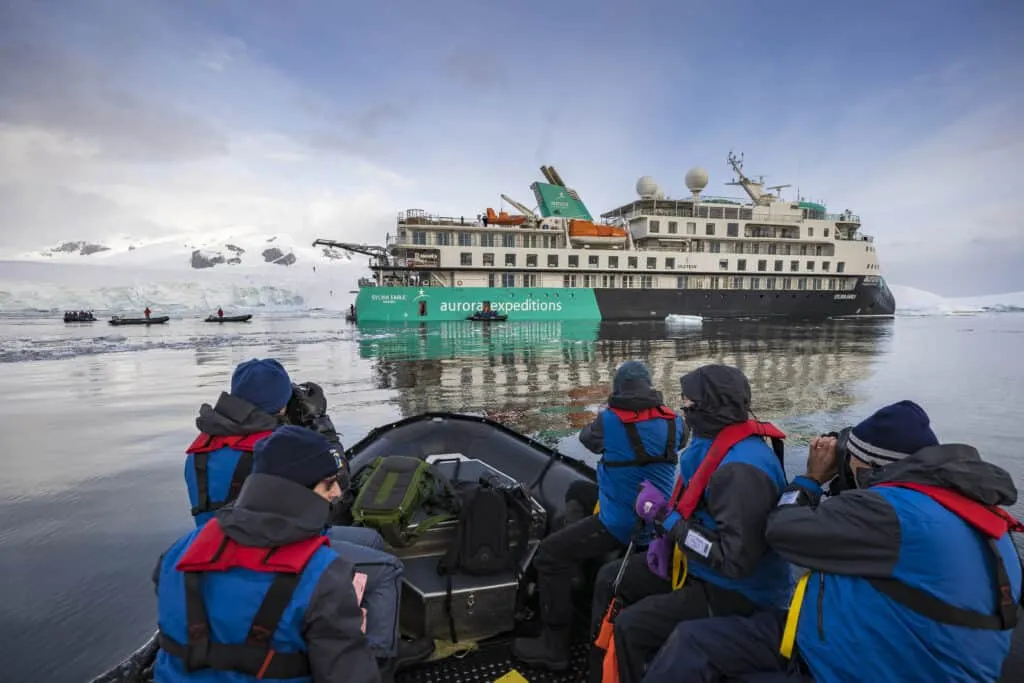
Aurora’s fleet comprises three Infinity-class vessels built at China Merchants Heavy Industry: Greg Mortimer (2019), Sylvia Earle (2022), and Douglas Mawson (2025). All three feature the revolutionary Ulstein X-BOW inverted hull design — Aurora was the first to use this technology on an expedition passenger ship. The X-BOW splits wave energy rather than punching through it, delivering measurably reduced slamming, vibration, and seasickness on rough-sea crossings. All three ships carry a maximum of 130 passengers on polar expeditions (154 on the Douglas Mawson’s non-polar Small Ship Cruises), hold Ice Class 1A / Polar Code 6, and carry 15 Zodiacs with four dedicated boarding doors. The fleet is entirely consistent — every ship shares the same hull technology, similar layouts, and the same expedition ethos. The Douglas Mawson, christened in Sydney Harbour in November 2025, adds a heated outdoor swimming pool, two-storey atrium, panoramic forward-facing lounge, microplastic filtration capturing 99 per cent of microfibres, and CounterCurrent AI navigation — the most technologically advanced expedition ship in the fleet. Approximately 85 per cent of staterooms across all three ships have balconies.
Swan Hellenic’s fleet comprises three ships built at Helsinki Shipyard in Finland — SH Minerva (2021), SH Vega (2022), and SH Diana (2023). Interiors are by Tillberg Design of Sweden. SH Minerva and SH Vega are sister ships carrying 152 passengers in 76 cabins with the higher PC5 ice class — capable of year-round operation in medium first-year ice including old ice inclusions. This is a genuinely higher polar rating than most expedition ships, including Aurora’s PC6 vessels. SH Diana is the larger ship at 192 passengers in 96 cabins with PC6 ice class. All three ships feature hybrid diesel-electric propulsion, dynamic positioning, and are battery-ready for future upgrades. Each ship carries 10 to 14 Zodiacs plus, on SH Diana, two dedicated 48-seat tender boats for port transfers. The signature observation feature is the Swan’s Nest — a circular glass-enclosed platform at the very front of the bow, allowing guests to stand directly over the water. Eighty per cent of cabins across the fleet feature private balconies.
The capacity comparison matters enormously. Aurora’s 130 passengers versus Swan Hellenic’s 152 to 192 passengers. Both fall within IAATO Category C1 (under 200 passengers), meaning all passengers can go ashore. But fewer passengers means faster Zodiac deployment, more time ashore, and a more intimate atmosphere. Aurora’s smaller complement is a genuine structural advantage for landing efficiency — with 130 passengers and 15 Zodiacs, everyone can be on the ground within minutes. Swan Hellenic’s ships, sailing at typical loads of 100 to 150 guests, achieve similar efficiency in practice, but the maximum capacity is higher.
Ice class — Swan Hellenic’s edge: SH Minerva and SH Vega carry PC5 ice class, which is a meaningfully higher rating than Aurora’s fleet-wide PC6. Only a handful of expedition cruise ships in the market carry PC5 or above — Ponant’s Le Commandant Charcot (PC2) and a few others. The practical implication is that Minerva and Vega can navigate more challenging ice conditions and operate later into polar seasons with greater safety margins. For most standard Antarctic Peninsula and Arctic itineraries, the difference between PC5 and PC6 is academic — but for ambitious Weddell Sea penetrations or late-season polar voyages, PC5 provides additional capability.
Hull comfort — Aurora’s advantage: The X-BOW hull technology across Aurora’s entire fleet delivers a noticeably smoother ride in rough seas. This is not marketing — captains and repeat passengers consistently confirm reduced slamming and vibration on Drake Passage crossings. Swan Hellenic’s ships use conventional hull designs with large stabiliser fins. For passengers who are nervous about the Drake Passage (and many are), Aurora’s fleet-wide X-BOW is a significant comfort differentiator. Every Aurora ship benefits, not just one.
Neither line carries helicopters or submarines. Aurora’s approach is Zodiac-based exploration with an extensive adventure activity hardware set (kayaks, diving equipment, climbing gear, camping equipment). Swan Hellenic’s approach is Zodiac-based exploration with cultural enrichment as the primary complement. Neither competes with the hardware of Scenic Eclipse (helicopter and submarine) or Ponant’s Le Commandant Charcot (helicopter).
Landing experience and shore programme
Both lines deliver the core expedition promise — multiple daily landings with expert guides — but the character of what happens on shore is where the philosophical divide becomes tangible.
Landings per day and time ashore: Both Aurora and Swan Hellenic typically conduct two landings or Zodiac excursions per day when conditions permit — one morning, one afternoon. In favourable conditions, a third activity may be added. Aurora’s 130 passengers can typically be landed in a single efficient rotation, yielding 2 to 3 hours per landing. Swan Hellenic’s ships, with 152 to 192 maximum capacity but typically sailing with 100 to 150 guests, achieve comparable shore time. Neither line requires the multiple rotations that plague larger expedition ships with 300-plus passengers.
Aurora’s shore programme is adventure-first. The activity menu is the widest in expedition cruising. Included at no extra charge: daily Zodiac cruises, guided hikes, camping on Antarctic ice (selected voyages), snowshoeing, polar plunge, bird watching, the photography programme, and citizen science participation. Available at additional cost: sea kayaking, SCUBA diving (Aurora has pioneered polar diving for over 20 years), snorkelling, stand-up paddleboarding, ski and snowboard touring, alpine trekking and climbing, rock climbing, and the legendary Shackleton’s Crossing multi-day trek across South Georgia. On a typical landing day with Aurora, passengers choose between a gentle guided walk, a moderate hike to a penguin colony viewpoint, or something genuinely strenuous — paddling past icebergs in an inflatable kayak, descending beneath the surface in a drysuit, or roping up for an Antarctic peak ascent. The range is remarkable.
Swan Hellenic’s shore programme blends expedition with culture. In polar regions, Zodiac cruises and guided hikes are the primary activities, comparable to what Aurora offers at the base level. The distinguishing inclusion is one escorted shore excursion per port of call — built into the fare on every voyage. On cultural itineraries through the Mediterranean, Asia-Pacific, or Africa, this means guided visits to archaeological sites, UNESCO heritage locations, and cultural landmarks led by the onboard historians and regional experts. In Antarctica, it means contextualised landings where the guide is as likely to explain the history of the whaling station as the biology of the penguin colony. Swan Hellenic also offers optional kayaking (pre-booked at additional cost, with 8 kayaks carried on SH Vega) and snowshoeing on polar itineraries. The line does not offer SCUBA diving, climbing, camping, ski touring, or Shackleton’s Crossing.
The camping comparison illustrates the divide. Aurora includes overnight camping on Antarctic ice on selected voyages — no extra charge, sleeping under the midnight sun in one of the most pristine environments on Earth. Swan Hellenic does not offer camping at all. If sleeping on Antarctic ice is on your list, Aurora is the only option between these two lines. If the idea of sleeping on ice holds zero appeal and you would rather spend the evening listening to a SETI scientist discuss exoplanet habitability in a warm lounge with a glass of included wine, Swan Hellenic designed the evening for you.
What is actually included
Inclusions differ meaningfully between these two lines — and Swan Hellenic’s more comprehensive all-inclusive model is one of its strongest selling points.
Drinks — Swan Hellenic’s clear advantage: Swan Hellenic includes complimentary house wines, beer, and selected spirits throughout the day, available 24 hours. Aurora includes house wine and beer with dinner only — tea, coffee, soft drinks, and juices are available all day, but spirits, cocktails, and drinks outside dinner hours are charged to the onboard account. On an 11-day Antarctic voyage, this difference can amount to several hundred dollars per person, and it fundamentally changes the daily social rhythm. On Swan Hellenic, you return from a morning landing and order a glass of wine in the Observation Lounge without reaching for a cabin card. On Aurora, that same drink goes on the tab (unless you are in a Junior Suite or Captain’s Suite, where a mini bar is stocked complimentary).
Gratuities — Swan Hellenic includes them. All onboard gratuities are included in Swan Hellenic’s fare. Aurora charges USD 15 per person per day, automatically added to the onboard account (included in Junior Suite and Captain’s Suite fares only). On an 11-day voyage, that is approximately USD 165 per person — not insignificant.
Shore excursions — Swan Hellenic includes one per port. One escorted shore excursion per port of call is included in Swan Hellenic’s fare. Aurora does not include structured shore excursions — the expedition programme of Zodiac landings and guided walks is the shore experience. On polar itineraries, this distinction is minimal (both lines are about Zodiac-based exploration, not coach tours). On Swan Hellenic’s cultural itineraries — Mediterranean, Asia-Pacific, Africa — the included excursion represents genuine added value.
Charter flights — Swan Hellenic includes them on Antarctic voyages. Charter flights between Buenos Aires and Ushuaia are included in Swan Hellenic’s Antarctic cruise fares (both directions), along with group airport-to-port transfers. Aurora does not include charter flights to Ushuaia — passengers arrange their own travel, though Aurora does include one night’s pre-voyage accommodation and airport transfer on Antarctic departures from Ushuaia.
Pre-cruise hotel — both include one night. Swan Hellenic includes one night in a 4/5-star hotel with breakfast on Cruise Plus voyages. Aurora includes one night’s pre-voyage accommodation on Antarctic voyages from Ushuaia.
Parka and boots: Both lines provide a complimentary expedition parka that passengers keep, plus waterproof muck boots on loan. Swan Hellenic additionally provides a branded waterproof backpack and refillable water bottle — small touches that reflect the all-inclusive ethos.
Wi-Fi: Both include complimentary Wi-Fi, though with different tiers. Aurora includes Starlink Wi-Fi across the fleet. Swan Hellenic includes entry-level Silver Connect (messaging apps only) — upgraded tiers for browsing (USD 25 per day) and streaming (USD 37 per day) are available at additional cost. Aurora’s included Wi-Fi is more functional at the base level.
Room service: Swan Hellenic includes complimentary 24-hour room service — the full Swan Restaurant menu during dining hours and a limited menu otherwise. Aurora is not positioned as a room-service line.
Self-service laundry: Swan Hellenic includes 24/7 self-service laundry — a genuinely practical inclusion on longer voyages. Aurora charges for laundry services.
The net inclusion picture: Swan Hellenic’s all-inclusive model is more comprehensive at the base fare level — drinks, gratuities, shore excursions, charter flights, room service, and laundry all built in. Aurora’s inclusions are more selective, with the adventure activity programme (particularly included camping, snowshoeing, and the photography programme) as the primary value differentiator. For travellers who prefer to pay once and not think about extras, Swan Hellenic delivers a cleaner all-inclusive experience. For travellers who value adventure activities over beverage packages, Aurora’s inclusions are better aligned.
Destination coverage and itinerary depth
Both lines visit Antarctica, but their global footprints diverge dramatically — and Swan Hellenic’s geographical range is vastly broader.
Aurora’s destination coverage centres on the poles with selective extensions. In Antarctica: Peninsula voyages from Ushuaia, Antarctic Circle crossings, South Georgia and Falklands combinations, Weddell Sea expeditions, East Antarctica and Ross Sea departures from Hobart (rare and premium), sub-Antarctic islands (Auckland, Campbell, Macquarie), and Fly-the-Drake options from Punta Arenas. In the Arctic: Svalbard, Greenland, Northwest Passage, Iceland, Norway, and the Faroe Islands. Beyond the poles: Kimberley Coast (Aurora has sailed the Kimberley since 1998), Indonesia (Raja Ampat, Borneo — three new itineraries for 2026), Costa Rica, Scotland, British Isles, Tasmania circumnavigation, and Mediterranean cultural voyages through the Vantage Explorations subsidiary. Aurora’s 2025-2026 Antarctic season offers 32 voyages across three ships with 8 new routes. The destination mix is polar-dominant with growing warm-water diversity.
Swan Hellenic’s destination coverage spans seven continents and is defined by cultural depth rather than adventure focus. In Antarctica: Peninsula voyages from Ushuaia (9 to 11 nights), South Georgia and Falklands combinations (18 to 19 nights including the “In Shackleton’s Footsteps” itinerary), Weddell Sea expeditions for emperor penguin sightings, and 12 expedition cruises across the 2025-2026 season. In the Arctic: Svalbard circumnavigation, Iceland, Greenland, Norwegian coast, Lofoten, and the Northwest Passage. In the Mediterranean: cultural expedition cruises through Sicily, Croatia, Montenegro — Swan Hellenic’s heritage heartland since the 1950s. In Africa: West Africa (Ghana, Gabon, Angola), South Africa (maiden call to Hermanus — no other cruise line visits), and East Africa. In Asia-Pacific (new for 2026): seven itineraries aboard SH Minerva covering Solomon Islands, Papua New Guinea, Indonesia, Philippines, and Japan — combinable into a 55-day grand voyage with no repeated ports. In South America: Amazon River exploration, Atlantic crossings, Patagonia. Swan Hellenic emphasises maiden calls to destinations no other cruise line visits — 34 exclusive locations across the 2025-2026 programme.
The scope difference is stark. Aurora is an expedition company that primarily goes to cold places, with warm-water seasons between polar deployments. Swan Hellenic is a cultural expedition company that goes everywhere — and the cultural itineraries through the Mediterranean, Africa, and Asia-Pacific are not filler between polar seasons. They are the heritage heartland of the brand. For the Australian traveller who wants one expedition line for both Antarctica and the Mediterranean, or Antarctica and Japan, Swan Hellenic covers the full range. Aurora serves polar and adventure-focused warm-water destinations.
The critical difference for Australian travellers: Aurora offers Hobart departures for East Antarctica and sub-Antarctic voyages — a unique Australian gateway that eliminates the need to fly to South America. Aurora also operates Kimberley seasons between Darwin and Broome, and Tasmania circumnavigations. Swan Hellenic has no Australian departures, though SH Minerva’s 2026 Asia-Pacific deployment through Papua New Guinea, Indonesia, and the Philippines positions the fleet in the region for the first time. For eastern seaboard Australians, Aurora’s Hobart departure is an unmatched convenience.
Cabins and accommodation
Both lines offer comfortable expedition accommodation designed as places to rest, dry gear, and review photographs — not as destinations in themselves. But the details differ in layout, finish, and amenity level.
Aurora’s cabin range across the Greg Mortimer and Sylvia Earle spans from the Aurora Stateroom Twin (approximately 170 to 245 square feet on Deck 3, porthole or obstructed view) to the Captain’s Suite (approximately 479 square feet with walk-in wardrobe and large lounge area). Approximately 85 per cent of staterooms have balconies. The newest ship, Douglas Mawson, introduces 10 different cabin types — the widest variety in the fleet — including three solo cabin configurations (porthole, porthole, and French balcony on Deck 7), 58 connecting balcony staterooms for families and groups, and expanded suite amenities. Junior Suite and Captain’s Suite guests receive a complimentary stocked mini bar, champagne, binoculars, and included gratuities. The interiors across the fleet are clean, functional, and expedition-focused — comfortable without aspiring to ultra-luxury opulence.
Swan Hellenic’s cabin range on the sister ships SH Minerva and SH Vega spans from the Oceanview stateroom (205 square feet with large fixed windows) to the Premium Suite (527 square feet with separate living area and 130-square-foot terrace). SH Diana adds a Junior Suite category (376 square feet) and slightly larger Oceanview cabins (215 square feet). Standard Balcony staterooms across all ships offer 300 square feet of interior plus a 65-square-foot balcony — generous by expedition standards. Eighty per cent of cabins have private balconies. All cabins feature an espresso machine, pillow menu, premium toiletries, faux holographic fireplace, safe, minibar, and individual climate control. Suites include separate living and sleeping areas with 130-square-foot terraces. ADA-accessible cabins are available on all ships.
The space comparison at entry level is interesting. Swan Hellenic’s Oceanview at 205 square feet is slightly smaller than Aurora’s entry-level Aurora Stateroom Twin at 170 to 245 square feet (the range depends on specific cabin location). At the balcony level, Swan Hellenic’s standard at 300 square feet of interior plus 65-square-foot balcony is notably more generous than Aurora’s Balcony Stateroom C at 225 to 267 square feet. At the suite level, Swan Hellenic’s Premium Suite at 527 square feet with 130-square-foot terrace exceeds Aurora’s Captain’s Suite at 479 square feet. The balcony-level comparison is where the difference is most felt — Swan Hellenic’s standard balcony cabins are spacious for the category.
In-cabin amenities favour Swan Hellenic. The espresso machine in every cabin is a genuine daily luxury — particularly at 5am when the expedition leader announces a whale sighting and you want caffeine before racing to the observation deck. The pillow menu, 24-hour room service, and faux fireplace add touches of comfort that Aurora’s more utilitarian cabins do not match. Aurora’s cabins are well-designed and functional, but the finish and amenity level sit below Swan Hellenic’s Tillberg Design interiors.
Solo cabins — Aurora leads. Aurora offers 10 dedicated solo cabins per ship across three configurations on the Douglas Mawson, including French balcony options on Deck 7, and has waived solo supplements across 2025-2026 seasons. Approximately 30 per cent of Aurora passengers travel solo. Swan Hellenic has no dedicated solo cabins on any ship — solo travellers book a double-occupancy cabin with a variable supplement of 0 to 75 per cent, though the line frequently runs no-supplement promotions on selected departures. For the solo traveller who wants a purpose-designed cabin rather than half of a double, Aurora is the clear choice.
Pricing and value
Both lines sit in the mid-range of expedition cruising — more accessible than ultra-luxury operators like Silversea and Seabourn, but Antarctica is an expensive destination regardless of which ship you choose.
Swan Hellenic’s directional pricing for a 9-night Antarctic Peninsula voyage starts from approximately USD 11,000 per person in an Oceanview cabin on SH Minerva. Longer voyages including South Georgia and the Falklands range from approximately USD 22,000 to 25,000 per person for 18 to 19-night itineraries. Mediterranean cultural expeditions start from approximately USD 5,000 to 7,000 per person for 10-night voyages. The 2026 Asia-Pacific Cruise Plus packages, including charter flights and hotels for remote embarkation ports, are expected in the USD 8,000 to 15,000 range. Frequent promotional discounts of 20 to 30 per cent off brochure rates are available, plus onboard credit offers. At current exchange rates, an entry-level Swan Hellenic Antarctic Peninsula voyage translates to approximately AUD 17,000 to 18,000 per person before promotions.
Aurora’s directional pricing for an 11-day Antarctic Peninsula voyage (Spirit of Antarctica) ranges from approximately USD 13,000 to 14,000 per person for an Aurora Stateroom Twin to approximately USD 35,000 to 42,000 for the Captain’s Suite. Longer voyages including South Georgia and the Falklands range from USD 19,000 to 60,000-plus depending on cabin and duration. Aurora regularly runs promotional sales of up to 35 per cent off published fares. At current exchange rates, an entry-level Aurora Antarctic Peninsula voyage translates to approximately AUD 20,000 to 22,000 per person before promotions.
The total cost comparison for Antarctic Peninsula voyages: Swan Hellenic’s entry cabin is approximately USD 2,000 to 3,000 cheaper than Aurora’s at headline rate — and Swan Hellenic’s fare includes house drinks throughout the day, all gratuities, charter flights between Buenos Aires and Ushuaia, and a shore excursion per port. When you account for these inclusions, the effective value gap widens further. A moderate drinker on Aurora might add USD 500 to 800 in bar charges over an 11-day voyage, plus USD 165 in gratuities, plus the cost of flights to Ushuaia — expenses already covered in Swan Hellenic’s fare.
Aurora counters with different value propositions. Seventy fewer passengers means more time ashore and a more intimate experience. The X-BOW hull delivers measurably more comfort on the Drake Passage. The adventure activity menu — particularly included camping, snowshoeing, and the photography programme — provides experiences Swan Hellenic does not offer at any price. Hobart departures eliminate the need to fly to South America. B Corp certification and seven citizen science programmes may carry weight for values-driven travellers. The value is real — it is simply different in kind.
Solo traveller value: Aurora’s waived solo supplement promotion across 2025-2026 seasons is exceptional — any stateroom at double-occupancy rate, plus 10 dedicated solo cabins with no supplement on the Douglas Mawson. Swan Hellenic’s solo supplement varies from 0 to 75 per cent, with frequent waived-supplement promotions on selected departures. Check current offers at time of booking — both lines use solo-friendly pricing as a promotional tool.
Onboard enrichment and science
Both lines invest genuinely in onboard enrichment — but their approaches reflect the core philosophical divide between adventure science and cultural intellect.
Aurora’s enrichment programme centres on citizen science and photography. Seven active citizen science projects run across the fleet: HappyWhale (whale identification through fluke photography), eBird (bird observation recording for the world’s largest biodiversity database), NASA GLOBE Cloud (cloud documentation for climate modelling), Secchi Disk Study (water clarity measurement), Snow Algae Study (supported by the National Snow and Ice Data Center), FjordPhyto (phytoplankton sampling), and Thermal Imaging of Polar Ice — a pioneering programme where Aurora is the first expedition company to facilitate thermal measurement of ice conditions. The Sylvia Earle and Douglas Mawson both feature dedicated Citizen Science Centres — purpose-built onboard spaces for data analysis and science briefings. Research partnerships include the Polar Citizen Science Collective, Oceanites (penguin colony counts), Reef Life Survey, and New Scientist Discovery Tours for special science-themed voyages. The photography programme is a standout: a dedicated Photography Guide or Special Guest Photographer sails on every expedition, with workshops, composition sessions, and informal one-on-one tuition during landings. Richard I’Anson leads dedicated Antarctic photography workshop voyages.
Swan Hellenic’s enrichment programme centres on cultural lectures and space science. The SETI Institute partnership — announced in December 2022 and branded “Explore Space at Sea” — places SETI scientists onboard designated voyages to deliver lectures on astronomy, astrophysics, astrobiology, and the search for extraterrestrial life. An advanced telescope is installed for guest stargazing sessions. Nine SETI voyages run across the 2025-2026 programme, covering destinations from Chile and Peru to Iceland. Beyond SETI, the lecture programme is the beating heart of the brand — guest lecturers include professors from Oxford and other leading universities, published authors, archaeologists, and subject-matter experts curated for each specific itinerary. Lectures are held daily in the Observation Lounge and cover history, geography, natural science, astronomy, and cultural topics tailored to upcoming ports and landing sites. This is not optional background entertainment — it is a core part of the daily programme and the primary reason many passengers choose Swan Hellenic.
The comparison reveals different enrichment philosophies. Aurora’s citizen science programme is participatory — passengers actively collect data, photograph whales, sample phytoplankton, and measure water clarity, contributing to genuine research. It is hands-on science, consistent with the adventure-first ethos. Swan Hellenic’s enrichment programme is intellectual — passengers listen, question, discuss, and contextualise. The SETI lectures, university professors, and archaeological briefings provide a framework for understanding what you witness on landings. Aurora says: help us study it. Swan Hellenic says: let us explain it to you.
Neither approach is superior. For a retired marine biologist who wants to contribute to research, Aurora’s citizen science programme is more fulfilling. For a retired professor of history who wants to understand the human and geological context of Antarctic exploration, Swan Hellenic’s lecture programme is more rewarding. For most travellers, both would be enriching — but the tone is different, and the tone matters across a 10 to 20-day voyage.
Dining on expedition
Dining is a secondary consideration on expedition ships — the food needs to be good, sustaining, and flexible enough to accommodate the unpredictable expedition schedule. Both lines deliver solid expedition dining, but Swan Hellenic has invested more heavily in the culinary experience.
Aurora’s dining programme features two restaurants per ship: Gentoo (main restaurant with buffet breakfast and lunch, a la carte dinner) and a secondary venue — Tuscan Grill on Greg Mortimer, Rockhopper on Sylvia Earle, and two restaurants plus two bars on the Douglas Mawson. The cuisine sits in the “hearty expedition fare with aspirational touches” category. Aurora runs a Sustainable Food Programme sourcing organic produce, free-range chicken, and Argentinian grass-fed beef where possible. Starting the 2025-2026 season, Aurora banned all salmon from menus due to the environmental impact of salmon farming — a distinctive and bold sustainability stance that no other expedition line has matched. Open seating at all meals encourages socialising. House wine and beer are included with dinner. The Captain’s Farewell reception includes house cocktails, beer, and wine. Food quality is consistently described as good but not on the level of ultra-luxury lines — which is appropriate for the price point and expedition positioning.
Swan Hellenic’s dining programme features three venues on all ships: the Swan Dining Room (main restaurant, 152 seats on Minerva and Vega, with menus created by renowned Italian chef Andrea Ribaldone and Korean chef Sang Keun Oh), the Club Lounge (all-day social space with light lunches, afternoon tea, Piemonte-style pizza, tapas, and family-style evening dining around a feature fireplace), and the Pool Grill (al fresco poolside dining). Dinner in the Swan Restaurant is a more formal seated service with white tablecloths — a step above Aurora’s casual expedition style. The JRE-Jeunes Restaurateurs partnership creates the Maris culinary programme on designated voyages: a different JRE chef sails onboard, serving a nightly signature dish, hosting cooking demonstrations, and leading gastronomic shore excursions, culminating in a gala dinner. Room service is complimentary 24 hours — the full Swan Restaurant menu during dining hours. Multiple Cruise Critic reviewers have described Swan Hellenic’s food as among the best they have experienced on any cruise line.
The comparison: Swan Hellenic’s dining programme is a step above Aurora’s — better finishes, dual-chef-curated menus, the Maris programme, complimentary room service, and wine quality that passengers praise as better than expected for an included beverage programme. Aurora’s dining is good, solid expedition food with a sustainability conscience — the salmon ban and organic sourcing programme reflect values that matter to environmentally conscious travellers. The practical daily difference is the drinks policy: Swan Hellenic’s all-day included house wines, beer, and spirits versus Aurora’s dinner-only house wine and beer. Over the course of a voyage, this shapes the social atmosphere meaningfully.
Standout itineraries for Australian travellers
Aurora Expeditions
East Antarctica and the Ross Sea (approximately 28 days, departing Hobart) — The expedition that only Aurora offers from an Australian port. Visit Mawson’s Huts at Commonwealth Bay, the Ross Ice Shelf, and sub-Antarctic islands. Departing from Hobart eliminates the South American routing entirely — domestic flights only for eastern seaboard Australians. Rare, premium, and definitively Australian.
Spirit of Antarctica (11 days, Ushuaia round trip, multiple departures November to March) — The classic Antarctic Peninsula introduction. Two landings per day, X-BOW comfort through the Drake, 130 passengers, included camping on selected departures. From approximately AUD 20,000 per person. Aurora includes one night’s pre-voyage accommodation and transfer.
Kimberley Coast: Darwin to Broome (11 days, June to July) — Aurora has sailed the Kimberley since 1998. Small-ship access to remote gorges, waterfalls, and Indigenous rock art that no road can reach. Not a polar voyage, but demonstrates Aurora’s expedition range and direct Australian relevance.
Wild Antarctica: South Georgia and Falklands (approximately 20 days, Ushuaia) — The comprehensive Antarctic voyage including the cathedral penguin colonies of South Georgia and the British character of Stanley. Optional Shackleton’s Crossing trek. From approximately AUD 30,000 per person.
Across the Antarctic Circle: Fly the Drake (Fly/Fly from Punta Arenas) — Skip the Drake Passage entirely with charter flights to King George Island. Maximum time in Antarctica. Ideal for Australians short on leave time or concerned about seasickness.
Swan Hellenic
In Shackleton’s Footsteps: Falklands, South Georgia and Antarctica (18 to 19 nights, from Buenos Aires) — Swan Hellenic’s comprehensive polar voyage. Charter flights to Ushuaia included, pre-cruise hotel included, all-inclusive drinks and gratuities throughout. The lecture programme contextualises every landing site — Shackleton’s grave, the king penguin colonies, the whaling history — with intellectual depth that pure adventure operators cannot match.
Antarctic Peninsula (9 nights, from Buenos Aires via Ushuaia) — Swan Hellenic’s entry-level Antarctic offering. All-inclusive from approximately AUD 17,000 per person including charter flights, drinks, and gratuities. PC5 ice class on SH Minerva and Vega provides strong ice capability. SETI Institute scientists sail on designated departures.
Asia-Pacific Hidden Heritage (2026, SH Minerva) — Seven itineraries across Solomon Islands, Papua New Guinea, Indonesia, Philippines, and Japan, combinable into a 55-day grand voyage with no repeated ports. The closest Swan Hellenic deployment to Australian waters — accessible from Brisbane or Sydney to Honiara, or standard connections to Manila and Hiroshima. Cultural expedition cruising at its finest, in a region Australian travellers can reach with relative ease.
Mediterranean Cultural Expedition (various itineraries, SH Diana) — Sicily, Croatia, Montenegro — Swan Hellenic’s heritage heartland. Guest lecturers from Oxford, archaeological site visits, the Maris culinary programme. From approximately AUD 8,000 to 11,000 per person. For the Australian who wants expedition-style exploration without polar temperatures.
West Africa: Ghana, Gabon, and Angola (repositioning voyages) — One of the most unusual expedition itineraries available anywhere. Elmina Castle, Loango National Park, maiden calls to ports no other cruise line visits. For the well-travelled Australian who has exhausted conventional destinations.
For Australian travellers specifically
Getting to the ship: For Aurora’s Antarctic Peninsula voyages, Australian travellers fly to Buenos Aires or Santiago (approximately 14 to 16 hours from Sydney or Melbourne via Qantas, LATAM, or Aerolineas Argentinas), then connect to Ushuaia (approximately 3.5 hours domestic). For Aurora’s East Antarctica and sub-Antarctic voyages, the departure is Hobart — domestic flights only, a genuinely significant advantage. For Swan Hellenic’s Antarctic voyages, the primary gateway is Buenos Aires — accessible via direct flights from Sydney (Qantas, LATAM) in approximately 14 to 15 hours. Charter flights from Buenos Aires to Ushuaia are included in the fare. For Swan Hellenic’s 2026 Asia-Pacific itineraries, embarkation ports include Honiara (accessible from Brisbane or Sydney via Solomon Airlines or Fiji Airways), Manila, and Hiroshima — all readily reachable from Australian cities. Universal advice for either line: arrive a day early. A missed expedition ship due to a flight delay is unrecoverable, and the financial loss is total.
Australian office presence: Aurora Expeditions is headquartered in Sydney — Australian-owned, Australian-staffed, with a deep understanding of the Australian market, Australian school holiday timing, and Australian flight routing. The company has an extensive Australian travel advisor network and offers Hobart departures that no other expedition line provides. Swan Hellenic has a Sydney office at 123 Clarence Street, Suite 14b — serving the Australian and New Zealand markets with growing local investment. VP of Global Marketing Patrizia Iantorno has noted that Australia “has grown very fast” for Swan Hellenic. Both lines are accessible through Australian travel advisors, but Aurora’s home-ground advantage in local knowledge and market presence is substantial.
Currency considerations: Aurora prices in multiple currencies with strong Australian market awareness. Swan Hellenic prices primarily in USD and GBP. Both accept bookings from Australian agents. The AUD-to-USD exchange rate can significantly affect the relative value of each line — monitor rates when booking and consider locking in fares early.
Travel insurance: Standard travel insurance policies often exclude Antarctic and expedition cruise activities. Specialist expedition insurance with minimum AUD 500,000 medical coverage and AUD 250,000 evacuation coverage is strongly recommended for either line. Both require mandatory travel insurance. Adequate medical facilities can be 72-plus hours away from any Antarctic position.
Loyalty programmes: Aurora’s three-tier loyalty programme (Bronze Adventurer after one voyage, Silver Explorer after two, Gold Pioneer after three-plus) offers 5 per cent off future voyages, onboard credits of USD 100 to 500 per person, complimentary stateroom upgrades, and early access to new seasons. Membership never expires. Swan Hellenic does not currently operate a formal loyalty programme — repeat guests may receive preferential offers informally, and the line partners with Virtuoso for onboard credits of up to USD 150 per person. For the Australian traveller planning multiple expedition cruises, Aurora’s structured loyalty programme provides tangible ongoing value.
Pre and post extensions: For Aurora and Swan Hellenic’s Antarctic voyages from Ushuaia, Patagonia is the natural extension — Torres del Paine, Perito Moreno Glacier, and the Lake District. Buenos Aires offers two to three days of cultural immersion. For Aurora’s Hobart departures, Tasmania itself is the extension — a week exploring the Tarkine, Cradle Mountain, and Bruny Island before boarding the ship. For Swan Hellenic’s Asia-Pacific voyages, the Solomon Islands, Japan, and the Philippines offer extraordinary pre and post options.
The onboard atmosphere
Both lines create the atmosphere that expedition travellers seek — intimate, informal, intellectually stimulating, and structured around discovery rather than onboard entertainment. Neither has a casino, a Broadway show, or a formal dress code. But the character of the intimacy differs.
Aurora’s atmosphere is distinctly Australian. With 130 passengers maximum, everyone knows each other by day two. The expedition team mingles with guests at meals and drinks. There is no formal social hierarchy — the captain mixes with passengers, expedition leaders wear parkas rather than white uniforms, and the general tone is egalitarian and unpretentious. Greg Mortimer himself — the genuine mountaineer, not a corporate figurehead — still joins special voyages. The passenger mix includes a strong Australian and New Zealand contingent alongside growing international clientele. Approximately 30 per cent travel solo. The typical Aurora passenger is more likely to be a bushwalker than a black-tie diner. Evenings are low-key: drinks at the bar, sharing the day’s stories, enrichment lectures, and expedition briefings for tomorrow. No organised entertainment in the traditional cruise sense. The dress code is casual expedition — most passengers wear the same clothes from the day’s adventures to dinner. The atmosphere feels like a well-run bushwalking club that happens to operate a ship.
Swan Hellenic’s atmosphere is culturally intellectual. Passengers describe it as “refreshingly adult” — no poolside games, no midnight deck parties. Conversations naturally gravitate toward the day’s discoveries and the upcoming lecture programme. The Observation Lounge is the social and intellectual hub — lectures by day, cocktails and piano music by evening, with a white baby grand piano setting the tone. The Club Lounge offers a living-room atmosphere with a feature fireplace. The demographic is predominantly 55-plus — well-travelled, well-educated, intellectually curious. “Readers, museum-goers” who prioritise learning over entertainment. Solo travellers report finding it easy to connect with like-minded passengers due to shared intellectual curiosity. The vibe is more “floating university” than “floating hotel.” Evenings feature a pianist and singer performing in the Observation Lounge, along with documentary screenings and discussions. The dress code is smart casual in the evenings — collared shirts and casual dresses — but emphatically no formal nights. The atmosphere feels like the common room of a particularly good Cambridge college that happens to be at sea.
The difference in feel: Aurora’s 130 passengers and adventure-first ethos create a genuine expedition community where the shared experience of physical challenge bonds passengers together. You return from a morning kayak paddling through brash ice and share the experience over coffee with someone who was camping on the ice the night before. The energy is active and outward-facing. Swan Hellenic’s 120 to 150 typical passengers and intellectual ethos create a community of inquiry. You return from a morning landing at a historical site and share observations over included wine with someone who attended the same pre-landing lecture by an Oxford historian. The energy is contemplative and inward-looking — processing what you have seen rather than planning the next physical challenge. Both foster the camaraderie that only expedition travel creates. The flavour of that camaraderie differs.
The bottom line
Aurora Expeditions and Swan Hellenic are both genuine expedition cruise lines delivering exceptional experiences on purpose-built ships — but they are built for different kinds of travellers pursuing different kinds of discovery.
Choose Aurora when you want an Australian company founded by a genuine explorer, purpose-built X-BOW ships that deliver the smoothest Drake Passage crossing available, the widest adventure activity menu in expedition cruising (camping, diving, climbing, skiing, kayaking, and Shackleton’s Crossing), seven citizen science programmes supported by dedicated onboard science centres, B Corp certification with genuine sustainability credentials, a 1:8 guide-to-guest ratio with career expedition professionals, 10 dedicated solo cabins with waived supplements, and the unique option of departing from Hobart for East Antarctica — eliminating the South American routing entirely. Choose Aurora when physical engagement with the wilderness is the point, when contributing to real scientific research matters, and when supporting an Australian-owned and Australian-headquartered company is part of the decision. Accept that drinks beyond dinner are extra, that gratuities are additional, that the cabins are functional rather than luxurious, and that the enrichment programme is science-focused rather than broadly cultural.
Choose Swan Hellenic when you want the most intellectually rich expedition experience afloat — a SETI Institute partnership that brings space science to sea-level exploration, guest lecturers from Oxford and leading universities, and a 70-year heritage of cultural enrichment that no competitor can replicate. Choose Swan Hellenic when truly all-inclusive pricing matters — house drinks throughout the day, all gratuities, charter flights to Ushuaia, a shore excursion per port, 24-hour room service, and self-service laundry all built into the fare. Choose Swan Hellenic when PC5 ice class on the sister ships provides the confidence to push deeper into challenging polar waters, when spacious Tillberg-designed cabins with espresso machines and fireplaces elevate the daily experience, when destination coverage across seven continents means one expedition line can serve you from Antarctica to the Mediterranean to Japan. Accept that there are no Australian departures, no dedicated solo cabins, fewer adventure activities, and a conventional hull that does not match the X-BOW’s Drake Passage comfort.
For the Australian traveller who cannot decide, the most rewarding path may be both. An Aurora East Antarctica voyage departing from Hobart — for the X-BOW comfort, Australian heritage, citizen science, and a destination that Swan Hellenic cannot reach from Australian waters — followed by a Swan Hellenic cultural expedition through the Mediterranean or Asia-Pacific, where the intellectual enrichment programme and all-inclusive model deliver their greatest value. Together, these two lines represent the full breadth of what expedition cruising can be: adventure and intellect, wilderness and culture, the body and the mind.