Aurora Expeditions and Quark Expeditions are the two purest adventure-first expedition lines operating in polar waters — both under 200 passengers, both IAATO pioneers, both built around Zodiac landings and expert guides rather than luxury trimmings. Jake Hower compares their ships, hardware, guide ratios, inclusions, and value for Australian travellers choosing between these polar specialists.
| Aurora Expeditions | Quark Expeditions | |
|---|---|---|
| Category | Expedition | Expedition |
| Rating | ★★★★☆ | ★★★★☆ |
| Fleet size | 3 ships | 4 ships |
| Ship size | Small (under 500) | Small (under 500) |
| Destinations | Antarctica, Arctic, Patagonia, Japan | Antarctica, Arctic, Greenland, Svalbard |
| Dress code | Relaxed | Relaxed |
| Best for | Small-ship polar expedition adventurers | Polar expedition adventure travellers |
Aurora Expeditions is the Australian-owned polar specialist — three purpose-built X-BOW ships carrying a maximum of 130 passengers, a 1:8 guide ratio, seven citizen science programmes, B Corp certification, and Hobart departures for East Antarctica. Quark Expeditions counters with the broadest polar hardware in the industry — twin Airbus H145 helicopters on Ultramarine enabling Snow Hill Emperor penguin access and included flightseeing, a claimed 1:6 guide ratio, complimentary drinks and Wi-Fi fleet-wide, and the only commercial North Pole voyages aboard a nuclear icebreaker. Choose Aurora when you want an Australian company, the smoothest Drake Passage crossing, the widest adventure activity menu, and genuine sustainability credentials. Choose Quark when you want helicopter access, the North Pole, included bar service, and the most dedicated polar-only operator afloat.
The core difference
Aurora Expeditions and Quark Expeditions sit closer together on the expedition spectrum than almost any other pairing in this series. Neither is a luxury line that happens to visit Antarctica. Neither carries butlers, submarines, or champagne bars. Both are genuine, adventure-first polar expedition operators where the ship is the platform and the ice is the point.
The distinction is not about adventure versus luxury — both are firmly adventure. The distinction is about heritage, hardware, and what each company has chosen as its defining edge.
Aurora Expeditions is the Australian expedition company. Founded in 1991 by Greg Mortimer OAM — the first Australian to summit Everest without supplementary oxygen — and Margaret Werner, Aurora is headquartered in Sydney and named after Sir Douglas Mawson’s legendary Antarctic vessel. The company operates three purpose-built Infinity-class ships (Greg Mortimer, Sylvia Earle, and the brand-new Douglas Mawson), all featuring the Ulstein X-BOW inverted hull, all capped at 130 passengers on polar expeditions. Aurora pioneered ice camping, kayaking, commercial climbing, and SCUBA diving in Antarctica. It holds B Corp certification with an impact score of 87.5, runs seven citizen science programmes, and has banned salmon from all menus. The brand DNA is distinctly Australian — egalitarian, unpretentious, adventure-obsessed, and environmentally conscious. Greg Mortimer himself still joins special voyages. For Australian travellers, Aurora is a home-grown success story in a category dominated by European and American operators.
Quark Expeditions is the polar purist. Also founded in 1991 — by Mike McDowell and Lars Wikander, who led the first commercial voyage to the North Pole aboard a nuclear icebreaker — Quark has operated exclusively in polar waters for over three decades. Headquartered in Seattle and owned by Travelopia (itself owned by private equity firm KKR), Quark was one of the seven founding members of IAATO. The company’s defining asset is Ultramarine — a 199-passenger purpose-built expedition ship carrying twin Airbus H145 helicopters that enable Snow Hill Emperor penguin colony access, included flightseeing, and heli-landings that no other sub-200-passenger polar ship can offer. Quark also operates the nuclear icebreaker 50 Years of Victory for Geographic North Pole voyages — one of only two operators in the world offering this journey. Since November 2024, all Quark voyages include complimentary drinks and Wi-Fi fleet-wide, bringing the line closer to an all-inclusive model.
For Australian travellers weighing these two lines, the choice comes down to this: Aurora offers Australian ownership, the smoothest ships in the Drake Passage, the widest adventure activity menu, and departures from Hobart. Quark offers helicopter capability that unlocks otherwise unreachable destinations, included bar service, the North Pole, and a claimed industry-best guide ratio. Both deliver exceptional polar expeditions. Neither will disappoint. The question is which set of strengths matters most to you.
Expedition team and guides
The expedition team is the single most important element of any polar voyage — more important than the ship, the food, or the cabin. Both Aurora and Quark understand this, and both invest heavily in their guide programmes.
Aurora’s expedition team operates at a ratio of approximately 1:7 to 1:8 — with 15 to 20 specialists sailing alongside 130 passengers. Team members include marine biologists, glaciologists, ornithologists, historians, photographers, and activity leaders for kayaking, diving, climbing, and snowshoeing. Many have been with Aurora for over a decade; several for more than twenty years. Hayley Shephard, a New Zealand-born expedition leader, splits her seasons between Antarctic and Arctic operations. Mario, a historian and firearms master, has lived in Longyearbyen, Svalbard since 2014. Richard I’Anson — Canon Master, twelve published books, Netflix documentary Tales By Light — sails as a guest photographer on select voyages. Aurora places a dedicated Photography Guide on every expedition, not just special departures. The team’s longevity and deep institutional knowledge are notable — these are not rotating contract guides but career expedition professionals who know Aurora’s ships, itineraries, and passengers intimately.
Quark’s expedition team claims a ratio of approximately 1:6 — on a reported Greenland voyage aboard Ultramarine, 37 expedition guides sailed with approximately 199 passengers. This is among the best in the industry. Quark’s team draws from marine biologists, glaciologists, geologists, ornithologists, cetologists, polar historians, and outdoor educators, many holding PhD-level qualifications. The Quark Academy — the only proprietary polar training programme in expedition cruising — ensures all staff pass IAATO and AECO examinations before deployment. Specialist whale researchers from the Friedlaender Lab (UC San Diego) and HappyWhale sail on select itineraries. Expedition team members routinely dine with passengers, breaking down the barrier between expert and guest. Photography workshops are offered on most voyages, though Quark does not place a dedicated staff photographer on every sailing.
Both teams are exceptional. The practical difference between a 1:6 and 1:8 ratio is modest when groups are already this small — on a shore landing, you might be in a group of eight with Aurora or seven with Quark. Where Quark’s larger team becomes tangible is during simultaneous activities: when helicopter operations, Zodiac cruises, and shore landings are running concurrently, more guides means more simultaneous programming. Where Aurora’s advantage shows is in team continuity and the dedicated photography guide on every voyage — not just select departures.
Ships and expedition hardware
This is where the comparison becomes most consequential — the hardware each line deploys shapes the entire expedition experience.
Passenger capacity and IAATO implications: Aurora’s three ships carry a maximum of 130 passengers on polar expeditions (154 on non-polar Small Ship Cruises for the Douglas Mawson). Quark’s Ultramarine carries 199, Ocean Explorer carries 138, and World Voyager carries 168. All ships from both lines fall within IAATO Category C1 (13 to 200 passengers), meaning all passengers are permitted to land. IAATO limits shore landings to 100 passengers at a time — Aurora’s 130 passengers can be landed in a single efficient rotation (or at most two quick Zodiac runs), while Ultramarine’s 199 passengers require two full rotations. The practical effect is that Aurora passengers typically spend more cumulative time ashore per landing. This is one of the most important distinctions in expedition cruising, and Aurora’s smaller ships have a genuine structural advantage here.
Hull design and Drake Passage comfort: All three Aurora ships feature the Ulstein X-BOW — a patented inverted bow design that splits wave energy rather than punching through it. Aurora was the first to use the X-BOW on an expedition passenger ship (Greg Mortimer, 2019). The benefits are measurable: reduced bow slamming, less vibration, lower seasickness rates, and higher transit speeds through rough seas. Captains consistently report noticeably smoother Drake Passage crossings. Quark’s Ocean Explorer also features the X-BOW (it is a SunStone Infinity-class sister ship to Aurora’s vessels), but the flagship Ultramarine uses a conventional bow design built by Brodosplit in Croatia. For passengers who dread the Drake Passage, Aurora’s fleet-wide X-BOW is a significant comfort advantage — every ship benefits, not just one.
Ice class: All Aurora ships hold Ice Class 1A / Polar Code 6. Quark’s Ultramarine holds the slightly higher Ice Class 1A+ / PC6, while Ocean Explorer holds 1A / PC6 and World Voyager holds 1B (a lower rating). The practical difference between 1A and 1A+ is negligible for standard Antarctic Peninsula and Arctic operations — both can handle first-year ice in summer conditions. Quark’s 50 Years of Victory, the nuclear icebreaker used for North Pole voyages, can smash through 2.5 metres of multi-year ice — but this is a chartered vessel, not a Quark-owned ship.
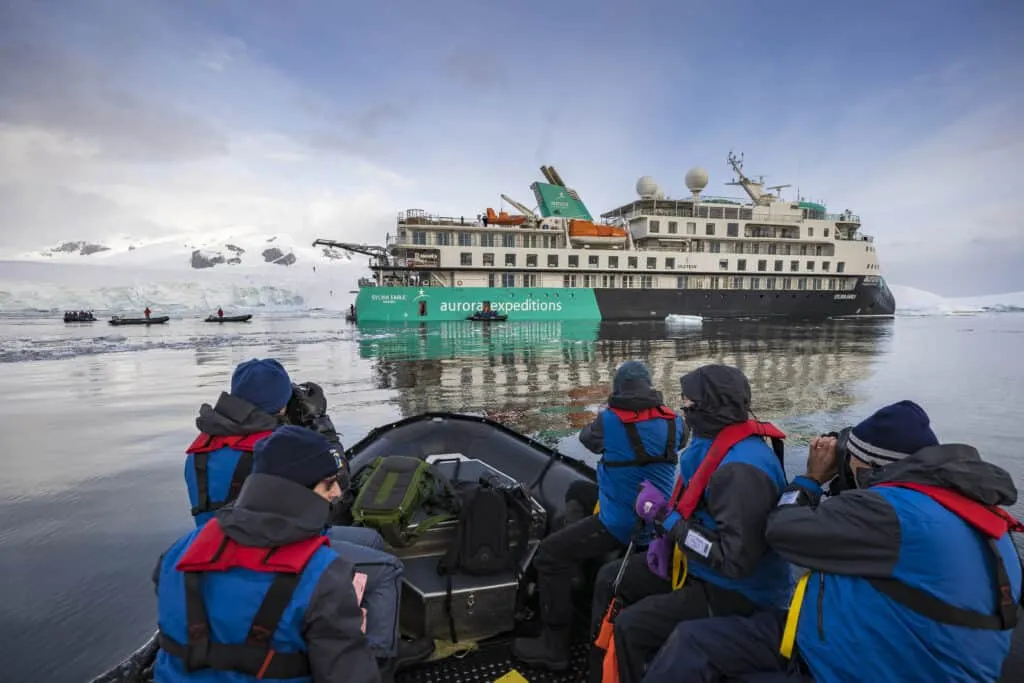
Zodiac fleet and deployment: Aurora carries 15 Zodiacs per ship with four dedicated boarding doors enabling simultaneous loading. Quark’s Ultramarine carries 20 Zodiacs stored in a water-level internal hangar with four embarkation points (starboard, port, stern, and hangar) — a purpose-built system that enables ultra-rapid deployment. Ocean Explorer carries 15 Zodiacs, World Voyager carries 18. Ultramarine’s Zodiac hangar is a genuine engineering achievement — faster deployment means more time at landing sites and less time queuing at the gangway.
Helicopters — Quark’s defining advantage: Ultramarine carries two twin-engine Airbus H145 helicopters — the fastest and most fuel-efficient in their category. Every passenger on an Ultramarine voyage receives at least two complimentary 15-minute flightseeing excursions (where regulations allow), plus one heli-landing per voyage for groups of 12 (maximum 48 guests per landing). The helicopters unlock destinations no Zodiac can reach — most critically, the Emperor penguin colony at Snow Hill Island, accessible only by helicopter transfer across sea ice. Quark also offers heli-hiking and heli-skiing on select Arctic itineraries. This is Quark’s single biggest differentiator — no other sub-200-passenger polar expedition operator offers twin helicopters as standard. Aurora does not carry helicopters on any ship. If helicopter access, flightseeing over glacial landscapes, or Snow Hill Emperor penguins are priorities, the choice is Quark alone.
Other hardware: Neither line carries a submarine (unlike Scenic Eclipse or Seabourn). Neither operates ROVs or underwater cameras as a guest-facing feature. Aurora carries kayaks, SCUBA diving equipment, climbing and mountaineering gear, and camping equipment. Quark carries kayaks and camping equipment. Aurora’s broader activity hardware — particularly the diving and climbing gear — reflects its positioning as the more activity-diverse operator.
Fleet size and new builds: Aurora operates three ships (Greg Mortimer 2019, Sylvia Earle 2022, Douglas Mawson 2025) — all purpose-built, all Infinity-class, all X-BOW. No fourth ship has been announced. Quark operates four vessels: Ultramarine (2021, purpose-built), Ocean Explorer (2021, chartered from SunStone), World Voyager (2020, chartered from Mystic Cruises for three Antarctic seasons from 2026-27), and 50 Years of Victory (1993 nuclear icebreaker, chartered for North Pole voyages). Quark owns only Ultramarine; the rest are charters. Aurora’s fleet is newer on average and entirely consistent in design — every ship shares the same hull technology and general layout. Quark’s fleet is more varied, with each ship offering a distinct experience.
Landing experience and shore programme
Both lines deliver the core expedition promise — multiple daily landings with expert guides — but the details differ in ways that matter.
Landings per day: Both Aurora and Quark typically conduct two landings or Zodiac excursions per day when conditions permit — one morning, one afternoon. In favourable conditions, a third activity may be added. The key difference is time ashore per landing. Aurora’s 130 passengers can be on the ground faster with fewer Zodiac rotations, typically yielding 2 to 3 hours per landing. Quark’s Ultramarine at 199 passengers requires more rotations, with typical landing time of 1.5 to 2.5 hours. On Ocean Explorer (138 passengers), timing is comparable to Aurora.
Activity options — Aurora’s breadth advantage: Aurora pioneered several Antarctic expedition activities and offers the widest activity menu of any polar operator. Included at no extra charge: daily Zodiac cruises, guided hikes, camping on Antarctic ice (selected voyages), snowshoeing, polar plunge, bird watching, photography programme, and citizen science participation. Available at additional cost: sea kayaking, SCUBA diving (Aurora has pioneered polar diving for over 20 years), snorkelling, stand-up paddleboarding, ski and snowboard touring, alpine trekking and climbing, rock climbing, and the legendary Shackleton’s Crossing multi-day trek across South Georgia. The range is remarkable — from gentle Zodiac cruising to backcountry ski touring on Antarctic peaks.
Quark’s activity programme includes Zodiac cruises, guided hikes, snowshoeing, and the polar plunge at no extra charge. On Ultramarine, complimentary helicopter flightseeing (at least two flights per guest) and one heli-landing per voyage are included — a genuinely significant inclusion. Available at extra cost: sea kayaking (approximately USD 1,995 for the full voyage programme), stand-up paddleboarding (approximately USD 295), and Antarctic camping (approximately USD 295 for one night, limited to 50 participants, early season only). Quark does not offer SCUBA diving, ski touring, climbing, or Shackleton’s Crossing.
The camping comparison: Aurora includes camping on selected voyages at no extra charge — passengers sleep overnight on Antarctic ice. Quark charges approximately USD 295 per person for camping, limits it to 50 participants per night, and offers it only once per voyage in early season. Aurora’s included camping and broader availability give it the edge for this particular bucket-list experience.
Physical fitness: Both lines require passengers to be confident on their feet, able to board and exit Zodiacs independently, and capable of walking on uneven, wet, and icy terrain. Neither line is wheelchair accessible for expedition activities. Aurora’s minimum age is 8 years; Quark restricts adventure options to guests aged 16 and over. Both carry expedition doctors and onboard medical facilities, but adequate medical evacuation can be 72-plus hours away — a reality of polar expedition travel.
What is actually included
Inclusions differ meaningfully between these two lines, and the differences compound over the course of a voyage.
Parka: Both lines provide a complimentary 3-in-1 polar expedition parka — waterproof outer shell with removable insulated liner — that passengers keep after the voyage. Both are well-made and functional. No meaningful difference here.
Boots: Both provide insulated waterproof muck boots on loan for the duration of the voyage. Returned at disembarkation.
Drinks — Quark’s advantage: Since November 2024, Quark includes complimentary beer, wine, spirits, and cocktails at all bars and during dinner throughout the voyage. Aurora includes house wine and beer with dinner only — tea, coffee, soft drinks, and juices are available all day, but spirits, cocktails, and drinks outside dinner hours are charged to the onboard account. On an 11-day Antarctic voyage, this difference can amount to several hundred dollars per person — and it changes the daily atmosphere. On Quark, you can order a whisky in the Panorama Lounge after a landing without reaching for a cabin card. On Aurora, that drink goes on the tab (unless you are in a Junior Suite or Captain’s Suite, where a mini bar is stocked complimentary).
Wi-Fi: Both lines include complimentary Starlink Wi-Fi. Both are satellite-based and subject to degradation in deep polar regions — this is a limitation of geography, not either company. Quark’s complimentary Wi-Fi was introduced in November 2024; Aurora has included it across its fleet.
Gratuities: Quark recommends discretionary gratuities of USD 10 to 15 per person per day, collected anonymously at voyage end — not included in the fare. Aurora also charges gratuities of USD 15 per person per day, automatically added to the onboard account (included in Junior Suite and Captain’s Suite fares). On an 11-day voyage, gratuities add approximately USD 165 per person on both lines — a wash.
Charter flights: Neither line routinely includes international flights from Australia. Both offer Fly-the-Drake charter flight options between Punta Arenas and King George Island (approximately 1 hour 45 minutes to 2 hours). Aurora includes one night’s pre-voyage accommodation and airport transfer on Antarctic voyages departing from Ushuaia. Quark offers a post-voyage charter and hotel package from Ushuaia to Buenos Aires for approximately USD 595.
Helicopter flights (Quark only): On Ultramarine, complimentary helicopter flightseeing (minimum two 15-minute flights per guest) and one heli-landing per voyage are included in the base fare. This is a significant value inclusion — comparable helicopter experiences with other operators (such as Scenic Eclipse) come at additional cost. Aurora does not carry helicopters.
The net inclusion picture: Quark’s complimentary drinks and included helicopter flights give it the edge on total inclusions at the base fare level. Aurora’s included camping, snowshoeing, and broader activity menu (even accounting for paid add-ons) give it the edge on activity diversity. For a traveller who values an open bar and helicopter access, Quark includes more. For a traveller who values adventure activities and sustainability-forward operations, Aurora includes what matters.
Destination coverage and itinerary depth
Both lines are polar specialists, but their geographic scope differs — and Quark’s commitment to polar exclusivity is absolute.
Aurora’s destination coverage extends well beyond the poles. In Antarctica: Peninsula voyages from Ushuaia, Across the Antarctic Circle crossings, South Georgia and Falklands combinations, Weddell Sea expeditions, East Antarctica and Ross Sea departures from Hobart (rare and premium), sub-Antarctic islands (Auckland, Campbell, Macquarie), and Fly-the-Drake options from Punta Arenas. In the Arctic: Svalbard, Greenland, Northwest Passage, Iceland, Norway, and the Faroe Islands. Beyond the poles: Kimberley Coast (Aurora has sailed the Kimberley since 1998), Indonesia (Raja Ampat, Borneo — three new itineraries for 2026), Costa Rica, Scotland, British Isles, Tasmania circumnavigation, and Mediterranean cultural voyages through the Vantage Explorations subsidiary. Aurora’s 2025-2026 Antarctic season offers 32 voyages across three ships with 8 new routes.
Quark’s destination coverage is exclusively polar — the Arctic and Antarctic, full stop. In Antarctica: Peninsula voyages from Ushuaia, South Georgia and Falklands combinations, Antarctic Circle crossings, Snow Hill Emperor penguin colony (helicopter-accessed from Ultramarine), Essential Patagonia, Antarctic Express Fly-the-Drake from Punta Arenas, and dedicated science-focused itineraries including Antarctic Marine Mammals co-developed with the Friedlaender Lab. In the Arctic: Svalbard circumnavigation, Greenland (east, south, and west coast), Northwest Passage, Iceland transits, and multi-destination Arctic voyages. The crown jewel: North Pole voyages aboard the nuclear icebreaker 50 Years of Victory — 14 days to the Geographic North Pole, one of only two operators in the world offering this journey. Quark’s 2025-2026 Antarctic season offers 41 departure dates across five destination regions.
The critical difference for Australian travellers: Aurora offers Hobart departures for East Antarctica and sub-Antarctic voyages — a unique Australian gateway that eliminates the need to fly to South America. Aurora also operates Kimberley seasons and Tasmania circumnavigations. Quark has no Australian deployments whatsoever — every voyage requires international travel to reach the embarkation port.
Fly-the-Drake comparison: Both lines offer Fly-the-Drake options to skip the notorious Drake Passage crossing. Aurora offers Fly/Cruise and Fly/Fly configurations from Punta Arenas. Quark’s Antarctic Express is an 8-day Fly-the-Drake programme from approximately USD 14,370 per person, with 11 departures scheduled between March 2026 and February 2028 — using Ocean Explorer and World Voyager (not Ultramarine, so no helicopter programme on Fly-the-Drake sailings). Both note that charter flights are weather-dependent; delays of 1 to 2 days are not uncommon.
Cabins and accommodation
Both lines offer comfortable expedition accommodation without the butler service or suite grandeur of ultra-luxury competitors. The cabins are designed as places to rest, dry gear, and review photographs — not as destinations in themselves.
Aurora’s cabin range across the Greg Mortimer and Sylvia Earle spans from the Aurora Stateroom Twin (approximately 170 to 245 square feet, Deck 3, porthole or obstructed view) to the Captain’s Suite (approximately 479 square feet with walk-in wardrobe and large lounge area). Approximately 85 per cent of staterooms have balconies. The newest ship, Douglas Mawson, introduces 10 different cabin types including three solo cabin configurations (porthole, porthole, and French balcony on Deck 7), 58 connecting balcony staterooms for families, and a heated outdoor swimming pool — a fleet first. Suites (Junior Suite and Captain’s Suite) include complimentary stocked mini bar, champagne, binoculars, and included gratuities. The Douglas Mawson features a two-storey atrium, panoramic forward-facing lounge, and Nordic-inspired interiors.
Quark’s cabin range on Ultramarine spans from the Solo Panorama (132 square feet, floor-to-ceiling windows) and Explorer Suite (285 square feet, the largest entry-level cabin in polar expedition cruising) to the Ultra Suite (563 square feet with two walk-in closets and three distinct living zones). Ultramarine carries 102 suites across 9 categories, with the popular Balcony Suite at 226 square feet of interior plus a 52-square-foot balcony. Ocean Explorer offers 72 cabins across 8 categories with Scandinavian design aesthetic, and World Voyager provides 84 all-balcony cabins across 5 categories.
The space comparison at entry level favours Quark. Ultramarine’s Explorer Suite at 285 square feet is substantially larger than Aurora’s entry-level Aurora Stateroom Twin at 170 to 245 square feet. At the balcony level, Quark’s Balcony Suite at 278 total square feet is comparable to Aurora’s Balcony Stateroom C at 225 to 267 square feet. At the top end, Quark’s Ultra Suite at 563 square feet exceeds Aurora’s Captain’s Suite at 479 square feet, though Aurora’s Captain’s Suite pricing is substantially lower.
Solo cabins: Aurora offers 10 dedicated solo cabins per ship across three configurations on Douglas Mawson, including French balcony options on Deck 7 — and has waived solo supplements across 2025-2026 seasons. Approximately 30 per cent of Aurora passengers travel solo, a remarkably high proportion. Quark offers 6 Solo Panorama Suites on Ultramarine and 7 solo cabins on Ocean Explorer. Both lines operate cabin-share programmes that waive the supplement if no match is found.
The balcony question on expedition: Is a balcony worth the premium when you will spend most of your time on deck or ashore? On polar voyages, a private balcony gives you your own silent observation platform at 2am when the midnight sun illuminates the ice — a genuinely magical experience that no shared observation deck can replicate. Both lines offer substantial balcony cabin options. Whether the premium is worth it depends on personal temperament — some guests never open the balcony door, while for others it defines the voyage.
Pricing and value
Both Aurora and Quark sit in the mid-range of expedition cruising — more accessible than ultra-luxury operators like Silversea, Seabourn, and Ponant, but not budget by any measure. Antarctica is an expensive destination regardless of which ship you choose.
Aurora’s directional pricing for an 11-day Antarctic Peninsula voyage (Spirit of Antarctica) ranges from approximately USD 13,000 to 14,000 per person for an Aurora Stateroom Twin to approximately USD 35,000 to 42,000 for the Captain’s Suite. Longer voyages including South Georgia and the Falklands range from USD 19,000 to 60,000-plus depending on cabin and duration. Aurora regularly runs promotional sales of up to 35 per cent off published fares — early booking is strongly advised. At time of writing, that translates to approximately AUD 20,000 to 22,000 per person for an entry-level Antarctic Peninsula voyage at current exchange rates, before promotional discounts.
Quark’s directional pricing for an 11-day Antarctic Peninsula voyage on Ultramarine ranges from approximately USD 10,000 to 13,000 per person for an Explorer Triple or Explorer Suite (with early booking discounts of up to 30 per cent) to approximately USD 30,000 to 40,000-plus for the Ultra Suite. Ocean Explorer entry-level fares start from approximately USD 10,000 to 12,000. The 8-day Antarctic Express Fly-the-Drake starts from approximately USD 14,370. At time of writing, that translates to approximately AUD 16,000 to 20,000 per person for an entry-level Ultramarine sailing.
Total cost comparison for an 11-day Antarctic Peninsula voyage: Quark’s entry cabin is approximately USD 2,000 to 3,000 cheaper than Aurora’s at headline rate. Adding Quark’s included drinks (worth approximately USD 500 to 800 per person on an 11-day voyage based on moderate consumption) and included helicopter flights on Ultramarine (a comparable experience would cost USD 695-plus on Scenic Eclipse), the value gap widens further. Aurora counters with included camping, a broader activity programme, the X-BOW comfort advantage on all ships, and 70 fewer passengers — which translates to more time ashore and a more intimate experience.
Solo traveller value: Aurora’s waived solo supplement promotion across 2025-2026 seasons is exceptional — any stateroom at double-occupancy rate, or 10 dedicated solo cabins with no supplement on Douglas Mawson. Quark periodically waives solo supplements on select sailings (e.g., all Ultramarine Arctic 2026 departures on Balcony Suites). Both represent strong value for the growing solo expedition market. Check current promotions at time of booking — these offers change seasonally.
Booking timing: Both lines offer the best selection 6 to 12 months before departure and the best discounts during wave season (January to February). Shoulder season Antarctic departures — November and March — can be 20 to 40 per cent cheaper than peak December-January sailings, with the trade-off of shorter daylight hours and different wildlife patterns (November for pristine snow and courtship; March for whale feeding and adolescent penguin behaviour).
Onboard enrichment and science
Both lines invest genuinely in onboard enrichment — but their approaches reflect different philosophies.
Aurora’s enrichment programme centres on citizen science. Seven active projects run across the fleet: HappyWhale (whale identification through fluke photography), eBird (bird observation recording), NASA GLOBE Cloud (cloud documentation for climate modelling), Secchi Disk Study (water clarity measurement), Snow Algae Study (supported by the National Snow and Ice Data Center), FjordPhyto (phytoplankton sampling), and Thermal Imaging of Polar Ice — a pioneering programme where Aurora is the first expedition company to facilitate thermal measurement of ice conditions. The Sylvia Earle and Douglas Mawson both feature dedicated Citizen Science Centres — purpose-built onboard spaces for data analysis and science briefings. Research partnerships include the Polar Citizen Science Collective, Oceanites (penguin counts), Reef Life Survey, and New Scientist Discovery Tours for special science-themed voyages. The photography programme is a standout: a dedicated Photography Guide or Special Guest Photographer sails on every expedition, with workshops, composition sessions, and informal one-on-one tuition during landings. Richard I’Anson — Canon Master, Netflix Tales By Light — leads dedicated Antarctic photography workshop voyages.
Quark’s enrichment programme focuses on cetacean research and polar history. The exclusive Friedlaender Lab partnership with UC San Diego places whale researchers onboard select voyages, where portable hydrophones allow guests to listen to underwater whale sounds — a genuinely transformative experience. HappyWhale research associates guide guests in fluke photography for global whale tracking. Seabird surveys run during Drake Passage crossings in collaboration with the Polar Collective, and Seabird Watch uses time-lapse cameras to monitor colonies in Arctic waters. The Ambassador Theatre on Ultramarine features a high-resolution LED screen for lectures, documentaries, and daily recap presentations. A media lab supports photograph downloading and processing. The dedicated “Antarctic Marine Mammals: The World of Whales and Seals” itinerary, co-developed with the Friedlaender Lab, represents the most science-focused commercial polar voyage available.
The comparison: Aurora’s citizen science programme is broader — seven projects versus Quark’s handful — and supported by physical infrastructure (dedicated science centres) that make participation a daily ritual rather than an occasional opportunity. Quark’s Friedlaender Lab partnership is deeper in its specific niche — the hydrophone whale listening experience is unique and profoundly moving. Aurora’s photography programme is more robust, with a guaranteed dedicated photographer on every voyage. Both deliver evening lecture programmes that are the primary entertainment — expert presentations on wildlife, glaciology, history, and destinations. Neither ship carries production entertainment, casinos, or theatre shows. The entertainment is Antarctica itself.
Dining on expedition
Dining is a secondary consideration on adventure expedition ships — the food needs to be good, sustaining, and flexible enough to accommodate the unpredictable expedition schedule. Neither Aurora nor Quark positions itself as a culinary destination.
Aurora’s dining programme features two restaurants per ship: Gentoo (main restaurant with buffet breakfast and lunch, a la carte dinner) and a secondary venue — Tuscan Grill on Greg Mortimer, Rockhopper on Sylvia Earle, and two restaurants plus two bars on the Douglas Mawson. The cuisine sits firmly in the “hearty expedition fare with aspirational touches” category. Aurora runs a Sustainable Food Programme sourcing organic produce, free-range chicken, and Argentinian grass-fed beef where possible. Starting the 2025-2026 season, Aurora banned all salmon from menus due to the environmental impact of salmon farming — a distinctive sustainability stance. Open seating at all meals encourages socialising. House wine and beer are included with dinner. The Captain’s Farewell reception includes house cocktails, beer, and wine. Food quality is consistently described as good but not on the level of ultra-luxury lines — which is appropriate for the price point and expedition positioning.
Quark’s dining programme on Ultramarine features Balena Restaurant (main dining, open seating, floor-to-ceiling windows at the bow, international cuisine) and Bistro 487 (lighter fare, healthy options, afternoon tea, late-night snacks). Ocean Explorer adds a private dining room seating 36 for more intimate meals. Quark’s signature culinary experience is Tundra to Table — an Inuit culinary programme developed with Greenlandic collective Igapall, featuring a four-course modern fusion dinner hosted by Inuit or Icelandic chefs. Available on select Arctic voyages at additional cost, this is the only exclusively Inuit culinary experience in expedition cruising. All alcoholic beverages are now complimentary throughout the day — beer, wine, spirits, and cocktails. Food quality is consistently praised as a highlight, with variety and freshness that surprises guests given the remoteness.
The comparison: Both lines deliver solid expedition dining — good food, flexible scheduling, open seating, and no pretension. Aurora’s sustainable sourcing programme and salmon ban reflect its environmental commitment. Quark’s Tundra to Table programme is a genuinely distinctive cultural dining experience unavailable anywhere else. The meaningful daily difference is the drinks policy: Quark’s all-day complimentary bar versus Aurora’s dinner-only house wine and beer. Over an 11-day voyage, this shapes the social atmosphere — Quark’s included bar encourages more spontaneous post-landing drinks and pre-dinner socialising without the mental calculation of running a tab.
Standout itineraries for Australian travellers
Aurora Expeditions
Spirit of Antarctica (11 days, Ushuaia round trip, multiple departures November to March) — The classic Antarctic Peninsula introduction. Two landings per day, X-BOW comfort through the Drake, 130 passengers, included camping on selected departures. From approximately AUD 20,000 per person. Fly Sydney or Melbourne to Buenos Aires via Santiago (approximately 14 to 16 hours), then domestic connection to Ushuaia (3.5 hours). Aurora includes one night’s pre-voyage accommodation and transfer.
East Antarctica and the Ross Sea (approximately 28 days, departing Hobart) — The expedition that only Aurora offers from an Australian port. Visit Mawson’s Huts at Commonwealth Bay, the Ross Ice Shelf, sub-Antarctic islands, and the most pristine Antarctic landscapes. Departing from Hobart eliminates the South American routing entirely — domestic flights only for eastern seaboard Australians. Rare, premium, and definitively Australian.
Kimberley Coast: Darwin to Broome (11 days, June to July) — Aurora has sailed the Kimberley since 1998. Small-ship access to remote gorges, waterfalls, and Indigenous rock art that no road can reach. Not a polar voyage, but demonstrates Aurora’s expedition range and Australian relevance.
Across the Antarctic Circle: Fly the Drake (Fly/Fly from Punta Arenas) — Skip the Drake Passage entirely with charter flights to King George Island. Maximum time in Antarctica. Ideal for Australian travellers short on leave time or concerned about seasickness despite the X-BOW advantage.
Wild Antarctica: South Georgia and Falklands (approximately 20 days, Ushuaia) — The comprehensive Antarctic voyage including the cathedral penguin colonies of South Georgia and the British character of Stanley. Optional Shackleton’s Crossing trek. From approximately AUD 30,000 per person.
Quark Expeditions
Classic Antarctic Explorer on Ultramarine (11 days, Ushuaia round trip) — Quark’s signature voyage with the full helicopter programme. Twin H145 flightseeing over glaciers and penguin colonies (minimum two flights included), heli-landing on an otherwise unreachable mountain or ice shelf, plus standard Zodiac landings and shore excursions. Included drinks throughout. From approximately AUD 16,000 per person. Fly Sydney or Melbourne to Buenos Aires or Santiago, then to Ushuaia.
Snow Hill Emperor Penguins (dedicated Ultramarine itinerary) — The rarest wildlife encounter in expedition cruising. Helicopter transfer across sea ice to the Emperor penguin colony at Snow Hill Island — a destination no Zodiac can reach. Limited departures, sells out early. For the penguin-obsessed Australian traveller, this is the holy grail.
Ultimate Arctic Adventure: North Pole (14 days, aboard 50 Years of Victory nuclear icebreaker, June/July) — One of only two operators offering the Geographic North Pole. A 75,000-horsepower nuclear icebreaker smashing through 2.5 metres of Arctic ice. From Murmansk, Russia (complex routing from Australia via Helsinki or Oslo). Bucket-list in the truest sense.
Antarctic Express: Fly the Drake (8 days, Punta Arenas) — Quark’s time-efficient Antarctica option. Charter flights eliminate the Drake Passage, maximising Peninsula time in just 8 days. From approximately USD 14,370. Uses Ocean Explorer or World Voyager (no helicopter programme). Ideal for time-pressed Australian travellers.
Falklands, South Georgia and Antarctica: Explorers and Kings (18 to 23 days, Ushuaia) — The comprehensive polar voyage combining the Falklands’ British colonial character, South Georgia’s king penguin colonies and Shackleton’s grave, and the Antarctic Peninsula. Extended itinerary for those with the time and budget.
For Australian travellers specifically
Getting to the ship: For Aurora’s Antarctic Peninsula voyages, Australian travellers fly to Buenos Aires or Santiago (approximately 14 to 16 hours from Sydney or Melbourne via Qantas, LATAM, or Aerolineas Argentinas), then connect to Ushuaia (approximately 3.5 hours domestic). For Aurora’s East Antarctica and sub-Antarctic voyages, the departure is Hobart — domestic flights only, a unique and significant advantage. For Quark, Antarctic routing is identical: Australia to Buenos Aires or Santiago, then Ushuaia. For Quark’s Fly-the-Drake, routing goes through Santiago to Punta Arenas (domestic connection). For Arctic voyages with either line, routing goes through European hubs (London, Copenhagen, Oslo) to Longyearbyen or Reykjavik — 22 to 24-plus hours from Australia. Universal advice: arrive a day early. A missed expedition ship due to a flight delay is unrecoverable, and the financial loss is total.
Travel insurance: Standard travel insurance policies often exclude Antarctic and expedition cruise activities. Specialist expedition insurance with minimum AUD 500,000 medical coverage and AUD 250,000 evacuation coverage is strongly recommended. Both lines require mandatory travel insurance. Adequate medical facilities can be 72-plus hours away from any Antarctic position — the insurance needs to cover helicopter evacuation from polar regions, not just a hospital transfer in a capital city.
Australian office presence: Aurora Expeditions is headquartered in Sydney — Australian-owned, Australian-staffed, priced in multiple currencies with a strong understanding of the Australian market. The company has an extensive Australian travel advisor network, runs domestic marketing campaigns, and offers Hobart departures that no other expedition line provides. Quark Expeditions has no Australian office. Operations run from Seattle and Toronto, with sales handled through a global team and Australian-based expedition cruise specialists (such as Expedition Cruise Specialists and Chimu Adventures). Quark prices exclusively in USD. For Australian travellers who value local support, Australian booking hours, and a company that understands Australian school holiday timing and flight routing, Aurora has a structural advantage.
Loyalty programmes: Aurora’s three-tier loyalty programme (Bronze Adventurer after one voyage, Silver Explorer after two, Gold Pioneer after three-plus) offers 5 per cent off future voyages, onboard credits of USD 100 to 500 per person, complimentary stateroom upgrades, and early access to new seasons. Membership never expires. Quark’s Shackleton Club offers USD 750 off any expedition, USD 1,500 off if rebooked within 14 days of disembarkation, USD 150 shipboard credit, and automatic cabin upgrades 60 days before departure. Both programmes reward repeat guests meaningfully. Quark’s 14-day rebooking bonus of USD 1,500 is a clever incentive to commit while the Antarctic glow is still fresh — and it is combinable with other promotions.
Pre and post extensions: Both Ushuaia and Punta Arenas serve as gateways to Patagonia — Torres del Paine, Perito Moreno Glacier, and the Lake District are natural extensions to an Antarctic expedition. Buenos Aires offers two to three days of cultural immersion before or after the voyage. For Aurora’s Hobart departures, Tasmania itself is the extension — a week exploring the Tarkine, Cradle Mountain, and Bruny Island before boarding the ship. These extensions transform the expedition from a cruise into a comprehensive southern hemisphere adventure.
The onboard atmosphere
Both Aurora and Quark create the atmosphere that expedition travellers seek — intimate, informal, intellectually stimulating, and structured around shared adventure rather than onboard entertainment. Neither has a casino, a Broadway show, or a formal dress code. Both build community through the daily rhythm of briefings, landings, lectures, and shared stories over drinks.
Aurora’s atmosphere is distinctly Australian in character. With 130 passengers maximum, everyone knows each other by day two. The expedition team mingles with guests at meals and drinks. There is no formal social hierarchy — the captain mixes with passengers, expedition leaders wear parkas rather than white uniforms, and the general tone is egalitarian and unpretentious. Greg Mortimer himself — the genuine mountaineer, not a corporate figurehead — still joins special voyages, lending an authenticity that corporate-owned competitors cannot replicate. The passenger mix includes a strong Australian and New Zealand contingent alongside growing North American and European clientele. Approximately 30 per cent travel solo. The typical Aurora passenger is more likely to be a bushwalker than a black-tie diner. Evenings are low-key: drinks at the bar, sharing the day’s stories, enrichment lectures, and expedition briefings for tomorrow. No organised entertainment in the traditional cruise sense. The dress code is casual expedition — most passengers wear the same clothes from their day’s adventures to dinner.
Quark’s atmosphere is international and expedition-focused. With up to 199 passengers on Ultramarine, the ship feels slightly larger and more varied in its social dynamics — though still profoundly intimate compared to any mainstream cruise. The demographic skews 35 to 64, well-travelled and educated, with dedicated expedition cruisers and repeat polar travellers prominent. The international mix spans North American, European, and Australian travellers united by polar ambition. Expedition team members routinely dine with passengers, creating organic connections. Evenings centre on the Panorama Lounge — glass-enclosed with unobstructed views, a dance floor for later evenings, and board games alongside the included cocktails. The Ambassador Theatre hosts daily recap presentations and lectures on a high-resolution LED screen. The dress code is entirely informal — sweatpants and Gore-Tex at dinner are the norm. Captain’s Welcome and Farewell events suggest optional smart attire, but there is no enforcement or pressure.
The difference in feel: Aurora’s 130 passengers create a genuinely intimate community where anonymity is impossible — by the third Zodiac cruise, the guide knows your name and your camera. Quark’s 199 on Ultramarine retains the expedition atmosphere but allows slightly more personal space and social choice — you can find a quiet corner more easily. Aurora feels like a family expedition with an Australian accent. Quark feels like an international expedition with world-class hardware. Both foster the camaraderie and shared intensity that only polar travel creates — the 5am wildlife announcement that has everyone scrambling to the observation deck in pyjamas, the collective gasp at a breaching whale, the quiet awe of standing on Antarctic ice for the first time. These moments transcend any difference in ship size or corporate ownership.
The bottom line
Aurora Expeditions and Quark Expeditions are the two purest adventure-expedition lines operating in polar waters. Choosing between them is not a question of quality — both deliver exceptional polar experiences that rank among the finest travel opportunities on the planet. The choice is a question of priorities.
Choose Aurora when you want an Australian company founded by a genuine explorer, purpose-built X-BOW ships that deliver the smoothest Drake Passage crossing available, the widest adventure activity menu in polar expedition cruising (camping, diving, climbing, skiing, and Shackleton’s Crossing), seven citizen science programmes supported by dedicated onboard science centres, B Corp certification with genuine sustainability credentials, and the unique option of departing from Hobart for East Antarctica — eliminating the South American routing entirely. Choose Aurora when the intimacy of 130 passengers and a 1:8 guide ratio matters, when you value the egalitarian Australian expedition character, and when supporting an Australian-owned and Australian-headquartered company is part of the decision. Accept that drinks beyond dinner are extra, that no helicopters limit access to certain destinations, and that Aurora’s pricing at entry level sits slightly higher than Quark’s comparable cabins.
Choose Quark when helicopter access is a priority — Ultramarine’s twin Airbus H145s unlock Snow Hill Emperor penguins, included flightseeing over glacial landscapes, and heli-landings that no Zodiac-only ship can match. Choose Quark when complimentary drinks throughout the day, the deepest polar-only expertise in the industry (over three decades exclusively in polar waters), the Geographic North Pole aboard a nuclear icebreaker, and a claimed 1:6 guide ratio matter. Choose Quark when the entry-level pricing advantage of approximately USD 2,000 to 3,000 per person (amplified by included drinks and helicopter flights) shapes the budget. Accept that Quark has no Australian office, no Hobart departures, no non-polar itineraries, and that Ultramarine’s conventional bow does not match the X-BOW comfort of Aurora’s fleet for rough-sea crossings.
For the Australian traveller who cannot decide, the most rewarding path may be to sail both — an Aurora East Antarctica voyage from Hobart for the X-BOW comfort, Australian heritage, and a destination that Quark cannot reach from an Australian port, followed by a Quark Ultramarine Antarctic Peninsula voyage for the helicopter programme, included drinks, and the largest expedition team in polar cruising. Together, these two lines represent the best of adventure expedition cruising, and experiencing both is the privilege of living in a country with deep historical ties to the polar regions that drew Greg Mortimer, Douglas Mawson, and the first commercial North Pole voyagers into the ice.