Ambassador Cruise Line and Viking Ocean Cruises sit at opposite ends of the cruise spectrum — budget British no-fly cruising on heritage tonnage versus premium Scandinavian voyages on purpose-built modern ships. With a three-to-four-times price gap reflecting fundamentally different products, Jake Hower maps the gulf between these two lines and what each means for Australian travellers.
| Ambassador Cruise Line | Viking Ocean Cruises | |
|---|---|---|
| Category | Premium | Premium |
| Rating | ★★★★☆ | ★★★★★ |
| Fleet size | 3 ships | 12 ships |
| Ship size | Mid-size (1,000-2,500) | Small (under 1,000) |
| Destinations | Northern Europe, Mediterranean, Caribbean, Canary Islands | Mediterranean, Scandinavia, Asia, Caribbean |
| Dress code | Smart casual | Smart casual |
| Best for | Value-focused British no-fly cruisers | Destination-focused culturally curious adults |
These are not competing products. Viking Ocean Cruises is the superior choice by every objective measure — fleet modernity, inclusions, dining, enrichment, ship design, and Australian accessibility. Viking deploys ships to Sydney annually, offers Companion Fly Free from Australian gateways, prices in AUD, and delivers a premium all-inclusive experience on purpose-built ships carrying 930 guests. Ambassador Cruise Line has no Australian presence and no regular Australian sailings. Its entire model is built around affordable no-fly cruising from UK regional ports for budget-conscious British retirees. Ambassador does this well, at a remarkably low price, with a warm social atmosphere and genuine solo traveller support. For Australians planning a UK holiday who want to add an affordable cruise from London Tilbury or Newcastle, Ambassador is a legitimate niche option. For everything else — and certainly for any Australian choosing between these two lines for their next voyage — Viking is the clear recommendation.
The core difference
Ambassador Cruise Line and Viking Ocean Cruises are not alternatives to each other. They occupy entirely different categories of the cruise market, serve different demographics, and deliver fundamentally different products at fundamentally different price points. The gap between them is not a matter of trade-offs — it is a matter of category. Understanding that gap clearly is the point of this comparison, because it helps calibrate expectations for both lines and illustrates the breadth of choice available to today’s cruise traveller.
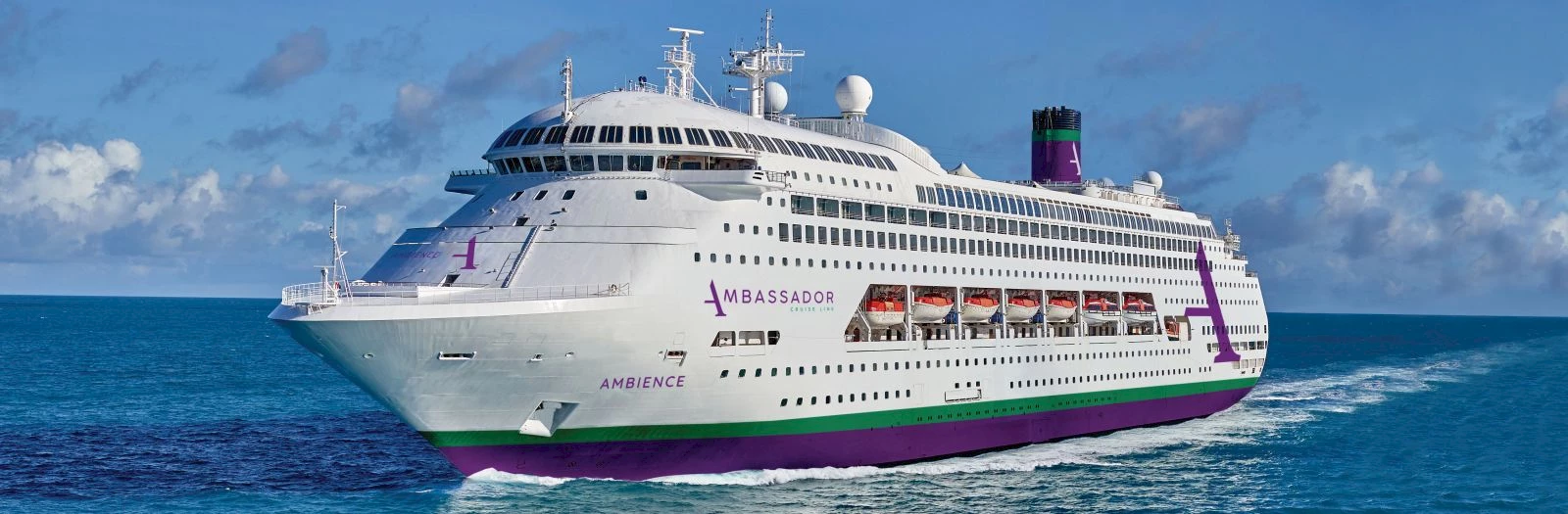
Ambassador was founded in 2021 by Christian Verhounig, the former CEO of Cruise & Maritime Voyages, which went into administration during the pandemic in July 2020. The line was created to fill the gap left by CMV, targeting the same loyal customer base of older British cruisers who valued affordable, traditional, no-fly cruising from regional UK ports. Ambassador describes itself as “Britain’s authentic no-fly cruise line” and operates three ships — Ambience (built 1991), Renaissance (built 1992), and Ambition (built 1999) — all acquired second-hand and refurbished. The fleet carries 1,100 to 1,400 guests per ship across itineraries departing from up to nine UK ports, including London Tilbury, Newcastle, Dundee, Edinburgh, Liverpool, Bristol, Belfast, Falmouth, and — new for the 2026/27 season — Portsmouth. The brand merged with French operator Compagnie Francaise de Croisieres in January 2025, forming the Ambassador Group and adding Renaissance as a third vessel for a new Caribbean fly-cruise programme. The ethos is warm, sociable, unpretentious, and resolutely British.
Viking Ocean Cruises was founded by Norwegian entrepreneur Torstein Hagen, building on the Viking river cruise brand established in 1997. The ocean division launched in 2015 with the delivery of Viking Star, and the fleet has since grown to 12 purpose-built ships — nine Star-class vessels at 47,800 gross tonnes carrying 930 guests each, and three Vela-class vessels at approximately 54,300 gross tonnes carrying 998 guests, with three more Vela-class ships on order through 2028. Every Viking ocean ship is built at Fincantieri’s Italian shipyards and follows an identical design philosophy: same deck layout, same restaurant names, same cabin categories, same public spaces. There is no casino, no children’s programme, no water slides, and no formal nights. The entertainment is the destination itself, supported by a Resident Historian programme, TED Talks screenings, Metropolitan Opera performances, and expert destination speakers. Viking listed on the New York Stock Exchange in 2024, raising over US$1.54 billion, and has been ranked the world’s number one ocean cruise line by Travel + Leisure and Conde Nast Traveller for five consecutive years.
The price difference tells the story. Ambassador fares start from less than GBP 60 per person per night. Viking’s veranda staterooms start from approximately USD 300 to 450 per person per night for a comparable European itinerary. That three-to-four-times price gap is not a quirk of marketing — it reflects a genuine product gap across ship age, build quality, inclusions, dining, enrichment, and onboard design. These lines serve entirely different markets, and understanding each on its own terms is more useful than forcing a direct horse race.
What is actually included
The inclusion gap between these two lines is one of the starkest in any cruise comparison, and it shapes the true cost of each product more than the headline fare suggests.
Ambassador includes in its base Saver Fare: full-board dining (breakfast, lunch, dinner, afternoon tea, and late-night snacks) in all main restaurants and the buffet; entertainment including theatre shows, live music, cabaret, and enrichment lectures; fitness classes, deck games, and pool access; use of the sauna, steam room, and relaxation room; port charges; and porterage of luggage between port and cabin. This is a straightforward full-board cruise fare in the traditional British sense.
Ambassador does not include: gratuities at GBP 6 to 7 per person per night (auto-charged); all drinks beyond water, tea, and coffee at mealtimes; speciality dining surcharges; shore excursions; spa treatments; Wi-Fi; travel insurance; and transport to the UK departure port. The Ambassador Fare tier bundles the premium Expedition Drinks Package (premium wines, spirits, speciality coffees) and all gratuities for an upgrade from approximately GBP 25 per person per day above the Saver rate. Shore excursions remain extra regardless of fare tier.
Viking includes in every fare: a private veranda (every cabin has one — no inside staterooms exist); all dining venues including Manfredi’s Italian, The Chef’s Table five-course tasting menu, Mamsen’s Norwegian deli, and the World Cafe; beer, wine, and soft drinks at lunch and dinner; speciality coffees, teas, and filtered water around the clock; one shore excursion per port of call; basic Wi-Fi on multiple devices; access to the LivNordic Spa thermal suite (sauna, steam room, snow grotto, hydrotherapy pool, cold plunge, and heated tile loungers); a heated main pool with retractable roof; self-service laundry with complimentary detergent; 24-hour room service; and the full enrichment programme including the Resident Historian.
Viking does not include: gratuities at approximately US$17 per person per day (auto-charged); cocktails and premium spirits (US$8 to 15 per drink, or the Silver Spirits Beverage Package at US$27 per person per night); The Kitchen Table cooking experience (US$180 to 260 per person); spa treatments; and flights or transfers.
The practical difference is enormous. Viking’s base fare covers items that Ambassador either charges separately for or does not offer at all — shore excursions, speciality dining, Wi-Fi, and thermal spa access. An Ambassador passenger who adds the Ambassador Fare drinks package, tips, one shore excursion per port, and a speciality dining evening is still receiving significantly less than what Viking includes at the base level. Viking settles the equation upfront. Ambassador keeps the headline low and adds incrementally.
Dining and culinary experience
The dining comparison reflects the broader product gap — both in the scope of what is available and in whether you pay extra for it.
Ambassador’s dining is traditional British cruise fare, competently executed for the price. The main dining room, Buckingham (on both Ambience and Ambition), offers multi-course dinners with open seating — traditional British and international cuisine including gala night menus on select evenings. Borough Market is the buffet venue with international stations for breakfast, lunch, and dinner. Complimentary afternoon tea with finger sandwiches, scones, and pastries is a charming inclusion. Ambition adds a second main dining room, Holyrood, with more contemporary menus. Reviewers consistently describe Ambassador’s main dining as “better than expected” for a budget line — a genuine compliment given the fare level.
Speciality dining carries surcharges. Saffron serves Indian cuisine at approximately GBP 17 per person. Lupino’s on Ambition offers Italian/Mediterranean at approximately GBP 15 per person. Sea & Grass on Ambience provides a multi-course tasting menu experience. The Chef’s Table on both ships is the most exclusive option — a multi-course experience hosted by the Executive Chef with a galley tour. These are pleasant additions but carry cumulative costs for a couple who dines at speciality venues more than once.
Viking’s dining is included, destination-inspired, and more ambitious. The Restaurant is the main dining room with open seating and a daily-changing menu that reflects the regions the ship is sailing through — Norwegian salmon in Scandinavia, regional Italian in the Mediterranean, local flavours in every port. Manfredi’s Italian Restaurant, named after Silversea founder Manfredi Lefebvre (a friend of Viking founder Torstein Hagen), serves authentic Italian with housemade pasta, osso buco, and regional wines in an intimate open-kitchen setting. It is included without surcharge. The Chef’s Table offers a five-course tasting menu with wine pairing that rotates every three days through Asian, French bistro, Norwegian, and thematic menus — also included. Mamsen’s, named after Hagen’s mother, serves Norwegian waffles, open-faced sandwiches, and Scandinavian pastries throughout the day. The World Cafe is an elevated market-style buffet with made-to-order stations, a sushi bar, and themed dinner nights. Wintergarden hosts traditional afternoon tea with three-tiered stands, finger sandwiches, and live music. The Pool Grill serves cooked-to-order burgers and salads. Complimentary 24-hour room service rounds out nine dining venues in total.
The only surcharge venue is The Kitchen Table — a two-part culinary experience where you shop for ingredients at a local market with Viking chefs in the morning and cook a multi-course meal together in the evening (US$180 to 260 per person, limited to 12 guests). Everything else, every night, is included.
The gap is not just about quality — though Viking’s Manfredi’s and Chef’s Table are genuine highlights that rival many restaurants ashore. It is about the model. A couple sailing Ambassador who visits Saffron once and the Chef’s Table once will spend approximately GBP 70 to 100 in speciality dining surcharges across a week. A couple on Viking visits Manfredi’s and the Chef’s Table as often as they wish without ever seeing a bill. For food-motivated travellers, the included speciality dining alone justifies a significant portion of Viking’s price premium.
Suites and accommodation
The accommodation philosophies reflect the age and origin of each fleet. Ambassador offers the full range of traditional cabin categories — inside, oceanview, balcony, and suite — reflecting 1990s cruise ship design. Viking offers a single product standard: every cabin has a private veranda, and the smallest is 270 square feet.
Ambassador’s cabins on Ambience (798 staterooms) range from inside cabins at 96 to 172 square feet through oceanview cabins at 162 to 190 square feet, balcony cabins at approximately 215 square feet, junior suites at 377 square feet plus a 46-square-foot balcony, and de luxe suites at 558 square feet plus a 67-square-foot balcony. Ambition follows a similar hierarchy across 680 staterooms. All cabins include tea and coffee making facilities, flat-screen TV, en-suite bathroom, fridge, hair dryer, personal safe, and UK 3-pin plug sockets with USB charging (USB-C being added to Ambience during the January 2026 refit). Suite guests receive priority boarding, complimentary room service breakfast, upgraded bathroom amenities, preferred restaurant reservations, welcome sparkling wine, and a fresh fruit basket. The ships also offer 89 dedicated sole-occupancy cabins on Ambience and 78 on Ambition — a genuine strength for solo travellers.
Viking’s cabins (465 staterooms on Star-class, 499 on Vela-class) start with the Veranda Stateroom at 270 square feet including veranda — larger than Ambassador’s balcony cabins and nearly double the size of Ambassador’s inside cabins. The Deluxe Veranda (270 square feet, identical layout, adds minibar and binoculars) is the most popular category at 272 per ship. The Penthouse Veranda (338 square feet) adds an upgraded minibar with alcoholic beverages, welcome champagne, an espresso machine, cashmere blanket, premium robes, and priority dining reservations. The Penthouse Junior Suite (405 square feet) adds a separate living area, complimentary laundry and dry cleaning, guaranteed dinner reservations at speciality restaurants, and early stateroom access. The Explorer Suite (757 square feet) is the only category with a bathtub. The Owner’s Suite — one per ship at 1,319 square feet — features a personal sauna, wet bar, kitchenette, and wine cooler stocked by Viking’s wine expert. Every Viking cabin features heated bathroom floors, premium linens, and a large shower.
The critical difference beyond size and age is consistency. Because Viking builds identical ships, a Deluxe Veranda on Viking Star is the same cabin on Viking Neptune or Viking Vela. Guests know exactly what they are booking regardless of ship. Ambassador’s ships, each acquired from different operators and built in different decades, vary meaningfully in cabin layout, condition, and style from vessel to vessel.
Viking does not offer inside or oceanview cabins. Every guest receives a private veranda. Ambassador’s lowest entry point — a small inside cabin — has no Viking equivalent, which is one reason Ambassador’s headline fare is so much lower. But the quality gap between Ambassador’s inside cabins (some under 100 square feet, reflecting 1991 cruise ship standards) and Viking’s entry-level veranda staterooms (270 square feet, purpose-built in 2015 or later) is a generation of shipbuilding apart.
Pricing and value
The price gap between Ambassador and Viking is the largest of any comparison I write for this site, and it reflects an equally large gap in product. This is not a case where two similar products are priced differently — it is a case where two fundamentally different categories of holiday carry the pricing you would expect.
Ambassador’s directional pricing (GBP, per person, based on two sharing): Short breaks of 3 to 5 nights start from approximately GBP 80 to 120 per person per night in an inside cabin. Norwegian fjord cruises of 5 to 10 nights run from approximately GBP 85 to 150 per person per night depending on cabin type. Medium voyages of 10 to 20 nights bring per-night rates down to approximately GBP 65 to 100. Long voyages of 20 to 45 nights can drop to GBP 50 to 80 per person per night at lead-in pricing. Ambassador frequently runs “first guest pays, second guest free” promotions that effectively halve the per-person rate for couples — a 40-night Caribbean voyage from GBP 4,949 becomes approximately GBP 62 per person per night for a couple. The Ambassador Fare (bundling premium drinks and gratuities) adds from approximately GBP 25 per person per day to the Saver rate. The 2026/27 season advertises full-board sailings from less than GBP 60 per person per night.
Viking’s directional pricing (USD, per person): A 7-night Mediterranean cruise in a Veranda Stateroom runs approximately US$350 to 600 per person per night depending on season. A 14-night Mediterranean ranges from approximately US$300 to 550 per person per night, with longer voyages bringing the per-diem down further. Gratuities at approximately US$17 per day are additional. Viking’s frequent promotions include Companion Fly Free offers, early booking discounts of up to US$4,000 per couple, free Silver Spirits packages on select sailings, and US$25 deposit promotions.
The effective price difference is approximately three to four times. A couple spending GBP 1,200 on a 7-night Ambassador fjords cruise in an oceanview cabin would spend roughly GBP 4,000 to 5,000 for a comparable 7-night Viking fjords cruise in a veranda stateroom. The Viking fare includes shore excursions, speciality dining, Wi-Fi, and thermal spa access that the Ambassador fare excludes — but even accounting for these inclusions, the gap remains substantial.
This is not a matter of one line being “better value” in the sense that bargain hunters use the term. Ambassador is genuinely cheap cruising — a full-board holiday from less than GBP 60 per night is remarkable by any standard. Viking is genuinely premium cruising with comprehensive inclusions on modern ships. The question is not which represents better value-for-money but which product category matches your expectations and budget. They are different holidays at different price points for different travellers.
Spa and wellness
Both lines offer spa facilities, but the scale, design, and inclusion model are not comparable.
Ambassador’s Green Sea Spa & Wellness Centre provides a serviceable spa on each ship with individual treatment rooms for massage, facials, hair salon services, and nail treatments, all at additional cost. The sauna, steam room, and relaxation area are complimentary. Fitness facilities include a fully equipped gymnasium with modern cardio and weight machines, and complimentary fitness classes including yoga, chair yoga, and dance sessions. Outdoor facilities include a swimming pool, splash pool, and exterior jogging track. The Green Sea Spa on Ambience received a refresh during the January 2026 drydock with new flooring, tiling, artwork, and greenery. It is a perfectly adequate spa for a budget cruise line, though the facilities reflect the age and original design of the ships.
Viking’s LivNordic Spa is a different proposition entirely — designed by Stockholm-based spa consultancy Raison d’Etre and rooted in the Scandinavian wellness tradition of alternating hot and cold treatments. The headline differentiator is that the entire thermal suite is complimentary for every guest, every day, without booking or payment. The facilities include a hydrotherapy pool with underwater benches and a faux fireplace, a Finnish sauna, a eucalyptus-scented steam room, heated tile loungers, a cold plunge pool, a relaxation room with ocean views, and Viking’s signature snow grotto — a sub-zero room with gently falling snowflakes that delivers the cold phase of the Nordic bathing cycle. Viking was the first cruise line to feature a snow grotto at sea when it debuted on Viking Star in 2015. Most cruise lines charge US$40 to 60 per day for equivalent thermal suite access. Viking includes it for all 930 guests. The main pool features a retractable glass roof for all-weather swimming, and a stern infinity pool overlooks the ship’s wake. Spa treatments are at additional cost — a 50-minute Swedish massage runs approximately US$139 to 209.
The distinction is clear. Ambassador offers a basic spa with complimentary sauna and steam access. Viking offers a world-class thermal suite designed as an integral part of the daily onboard experience, consistently ranked among the best spas at sea by Cruise Critic. For travellers who value daily wellness rituals — and in my experience, most guests over 50 do — Viking’s complimentary thermal suite represents genuine daily value that Ambassador simply cannot match.
Entertainment and enrichment
This is where the philosophical difference between the two lines is most visible, and where personal preference matters as much as any quality comparison.
Ambassador delivers traditional British cruise entertainment through a partnership with Peel Entertainment. The main theatre hosts nightly performances including West End-style musical revues, cabaret acts, comedy shows, classical music recitals, and original Theatre@Sea productions. The Observatory and Piano Bar provide live music in the evenings. Daytime programming includes quizzes, crafting sessions, dance classes, deck games, karaoke, enrichment lectures, port talks, and sail-away deck parties. Themed cruises add specific programming — an 80s themed cruise, Supercraft cruises with TV producer Julie Peasgood, marine wildlife conservation cruises with ORCA conservationists, and gardening and comedy cruises. Celebrity guest speakers and “In Conversation With” events appear on select sailings. The atmosphere is sociable, participatory, and designed for the traditional British cruise audience that enjoys variety shows, sing-alongs, and social gatherings.
Viking delivers intellectual enrichment designed around the destination. The Resident Historian programme is unique in the cruise industry — a university-style curriculum of lectures, roundtable discussions, and daily office hours for one-on-one conversations, all tailored to the specific itinerary being sailed. TED Talks screenings are curated for relevance to the voyage. Metropolitan Opera “Live in HD” performances — Peabody Award-winning productions with backstage interviews — screen in the ship’s theatre. Destination Performances bring local musicians and performers aboard — flamenco in Spain, opera in Italy, folk music in Scandinavia. Expert destination speakers include archaeologists, authors, and cultural specialists. Viking Orion and Viking Jupiter feature onboard planetariums. The Explorers’ Lounge — a two-level panoramic space at the bow with a library and live music — is the signature gathering point. Torshavn is the late-night venue, though evenings on Viking tend to wind down earlier than on entertainment-forward lines.
The divide is genuine and reflects the lines’ entirely different audiences. Ambassador passengers want variety shows, social quizzes, and a lively, communal atmosphere. Viking passengers want intellectual depth, cultural context, and a quieter evening pace. Neither approach is wrong. But the institutional quality of Viking’s enrichment partnerships — TED, the Metropolitan Opera, the Past Preservers Resident Historian network — represents a level of investment and ambition that Ambassador’s more modest programming does not attempt to match. Ambassador’s themed cruises, particularly the wildlife conservation and crafting sailings, show creative thinking within a budget framework. Viking’s enrichment is a cornerstone of the brand identity.
Fleet and destination coverage
The fleet comparison is as much about philosophy as it is about numbers.
Ambassador operates three ships — Ambience (70,285 GT, built 1991), Renaissance (55,575 GT, built 1992), and Ambition (48,123 GT, built 1999). All three were acquired second-hand, having sailed under multiple brands across decades of service. The fleet average age is approximately 32 years. Ambassador’s strategy has been to acquire and refurbish heritage tonnage at competitive prices rather than commission newbuilds, and no newbuild orders have been announced as of February 2026. Ambience and Ambition sail primarily from UK ports on no-fly itineraries. Renaissance operates the new Caribbean fly-cruise programme from Barbados, Martinique, and Curacao. All three ships underwent major drydock refurbishments in late 2025 and early 2026.
Ambassador’s destination coverage centres on Northern Europe and the Mediterranean, reached by sailing from UK ports: Norwegian fjords, British Isles, Iceland, Baltic and Scandinavia, Canary Islands, and extended Mediterranean voyages of 20 to 40 nights. Short break cruises of 3 to 5 nights to Belgium, Holland, France, and Germany provide accessible entry points. The Caribbean fly-cruise programme on Renaissance is the first departure from the UK-centric model. World cruises have included Australian port calls — Ambience visited Sydney, Melbourne, and Fremantle on a 120-day world cruise in 2024 — but these are occasional positioning voyages, not regular deployments. The 2026/27 season encompasses 84 itineraries across 146 ports in 48 countries.
Viking operates 12 ocean ships (growing to 15 by end of 2028), all purpose-built at Fincantieri’s Italian shipyards. Nine Star-class ships at 47,800 GT and three Vela-class ships at approximately 54,300 GT follow the identical-ship strategy — same deck layout, same restaurants, same cabin categories. The fleet average age is approximately six years, with the newest ships under one year old. The Vela-class vessels add hybrid engines, top-deck solar panels, and pollution-minimising exhaust systems while maintaining the same design language. Viking also operates two expedition ships (Viking Octantis and Viking Polaris) and approximately 80 river ships across separate brand divisions.
Viking’s destination coverage is global: Mediterranean (largest deployment by ship count), Scandinavia and Northern Europe (the brand’s spiritual home), British Isles, Australia and New Zealand, Asia, Alaska, Caribbean, Canada and New England, South America, and annual world cruises of 125 to 170 days. Viking’s smaller ship size allows access to ports that larger vessels cannot reach — Chioggia instead of Venice, Greenwich on the Thames instead of Southampton, and intimate Norwegian fjord harbours. Fourteen new ocean itineraries were announced for 2026/27, with 12 new recurring ports added including Bordeaux, Palma de Mallorca, Bilbao, and Fort William.
The fleet and destination gap is simply the difference between a three-ship regional operation and a 12-ship global fleet. Ambassador serves its UK home market capably with a focused programme of no-fly European itineraries. Viking covers the world with a modern, consistent fleet and is still growing — Viking Mira arrives in June 2026, Viking Libra in December 2026, Viking Astrea in June 2027, and Viking Lyra in November 2028.
Where each line excels
Ambassador excels in:
- Budget no-fly cruising from UK ports. Full-board sailings from less than GBP 60 per person per night, departing from up to nine UK regional ports without flights, is genuinely unmatched in the British cruise market at this price point.
- Solo traveller infrastructure. With 89 dedicated sole-occupancy cabins on Ambience and 78 on Ambition — no single supplement, welcome cocktail parties, dedicated solo dining tables, and regular meet-up events — Ambassador has one of the strongest solo programmes afloat.
- Traditional British cruise atmosphere. Afternoon tea, gala nights, variety shows, quizzes, and a warm, sociable passenger community create a distinctly British cruise experience that loyal passengers value deeply.
- Themed and special interest cruises. Wildlife conservation cruises with ORCA, Supercraft crafting cruises, gardening cruises, comedy cruises, and solar eclipse sailings show creative programming within a budget framework.
- Second-guest-free promotions. The recurring buy-one-get-one-free offers on longer voyages represent exceptional value for couples willing to commit to extended sailings.
- Regional UK port access. Departures from Newcastle, Dundee, Edinburgh, Liverpool, Bristol, Belfast, Falmouth, and Portsmouth mean many British travellers can drive to their embarkation port — no flights, no London connections.
Viking excels in:
- Cultural enrichment. The Resident Historian programme, TED Talks, Metropolitan Opera screenings, destination speakers, and destination performances create an intellectually stimulating environment unmatched by any other ocean cruise line.
- All-inclusive value. Shore excursions, speciality dining, Wi-Fi, beer and wine at meals, and thermal spa access are all included in every fare — eliminating the mental arithmetic of add-on costs.
- Modern fleet consistency. Twelve purpose-built identical ships under 11 years old deliver a consistent product that guests can rely on regardless of which vessel they board.
- Smaller ship intimacy. At 930 guests versus Ambassador’s 1,100 to 1,400, Viking ships feel calmer and more personal, with higher space ratios, shorter queues, and a closer relationship with crew.
- Scandinavian wellness. The complimentary LivNordic Spa thermal suite — including the snow grotto — is available to every guest daily without booking or payment.
- Global deployment. Viking sails the Mediterranean, Scandinavia, British Isles, Australia, New Zealand, Asia, Alaska, Caribbean, and world cruises from ports on every continent.
- Adults-only guarantee. The strict 18-plus policy on every sailing, no casino, and no themed parties create a serene environment that couples specifically seek.
Standout itineraries for Australian travellers
Ambassador
120-Day World Cruise (Ambience, departing London Tilbury). Ambassador’s world cruise in 2024 visited 34 destinations including Panama Canal, South Pacific, New Zealand, Sydney, Melbourne, Fremantle, South Asia, Africa, and South America. Future world cruises may include similar Australian port calls, offering Australians the chance to experience the line without flying to the UK — though these are annual events, not regular sailings, and availability and routing change from year to year.
40-Night Jewels of the Caribbean (Ambience, departing London Tilbury, January 2026, from GBP 4,949 per person with second guest free). At an effective rate of approximately GBP 62 per person per night for a couple, this extended voyage represents remarkable value for Australians planning an extended UK and Caribbean holiday. The length of sailing and UK departure point require significant time commitment and international flights.
31-Night Classical Mediterranean (Ambition, departing London Tilbury, February 2026, from GBP 3,389 per person). A comprehensive Mediterranean circuit from a UK port, ideal for an Australian combining a Mediterranean cruise with a longer UK visit. At approximately GBP 109 per person per night before the second-guest-free promotion, this is remarkably affordable for a month-long holiday.
Viking
Grand Australia Circumnavigation (32 days, roundtrip Sydney, Viking Orion). A full loop of the Australian coast with multiple ports — the standout Viking itinerary for Australian travellers who want to explore their own country at this ship size. Viking’s included excursion at every port provides guided experiences without additional cost. No international flights required.
Australia and New Zealand (15 days, Sydney to Auckland or reverse, Viking Orion). The core Australian season itinerary covering both countries. Viking’s smaller ship size suits New Zealand’s intimate harbours. Included excursion at every port. Accessible from Sydney without international travel.
Viking Homelands (15 days, Stockholm to Bergen). Viking’s signature Baltic itinerary through eight countries — the cruise that best showcases the Resident Historian programme and Nordic cultural authenticity. Accessible from Australia via the Companion Fly Free programme from Australian gateways.
Into the Midnight Sun (15 days, London to Bergen). Above the Arctic Circle in summer with Norwegian fjords, Lofoten Islands, Tromso, and the North Cape. Twenty-four-hour daylight and spectacular fjord scenery on a ship purpose-built for Nordic waters. A destination experience that plays to every Viking strength.
Viking World Voyage III (170 days, Fort Lauderdale to Stockholm, departing 22 December 2026 on Viking Sky). Six continents, 41 countries, 82 guided tours, 18 overnight cities. World cruise offers include free business-class airfare and shipboard credits worth over US$60,000 per couple — a genuinely extraordinary package for the world cruise market.
Ship-by-ship recommendations
Ambassador
Ambience — The flagship and primary UK-departure vessel, sailing from London Tilbury. Built in 1991 as Regal Princess for Princess Cruises, later Pacific Dawn for P&O Cruises Australia — many Australian cruisers will recognise this ship from its years in Australian waters. At 70,285 GT with approximately 1,400 passengers, it is the largest Ambassador vessel. The January 2026 drydock added propulsion upgrades, USB-C ports, window replacements, and a spa refresh. Choose Ambience for the widest itinerary selection and the largest sole-occupancy cabin allocation (89 dedicated solo cabins). Best for longer Mediterranean, Caribbean, and world cruise voyages from London.
Ambition — Sailing from Newcastle and, new for 2026/27, Portsmouth. Built in 1999, making it the newest and smallest of the fleet at 48,123 GT. Ambassador limits passenger numbers to 1,200 (versus a maximum capacity of 1,500), creating a higher space ratio comparable to many premium ships. The 2025 drydock included the installation of a kidney dialysis treatment centre — a thoughtful accessibility addition. Choose Ambition for a slightly more intimate Ambassador experience and convenient access from northern England or the south coast.
Renaissance — Dedicated to the Caribbean fly-cruise programme from Barbados, Martinique, and Curacao. Built in 1992 as Maasdam for Holland America Line, acquired via the CFC merger. At 55,575 GT with approximately 1,100 passengers, it offers an elegant layout inherited from its Holland America heritage. Choose Renaissance only if you specifically want Ambassador’s Caribbean fly-cruise product — this is not a UK no-fly departure.
Viking
Viking Orion — The primary ship for Australian and New Zealand seasons. If you want to sail Viking from Sydney without flying internationally, Orion is the ship. Also features the onboard planetarium — one of only two Viking ships with this distinctive space. Deployed to Australian waters December through March each year.
Viking Vela or Viking Vesta — The newest ocean ships (delivered 2024 and 2025), first of the Vela class. Slightly larger than Star-class siblings at approximately 54,300 GT with 998 guests, plus hybrid engines and solar panels, but maintaining the identical deck layout and amenities. Choose these for the newest hardware in the fleet, primarily deployed to the Mediterranean and Northern Europe.
Any Star-class ship — Because Viking deliberately builds identical ships, the experience on Viking Star (2015) is functionally the same as Viking Saturn (2023). The crew can transfer between ships without retraining, and every public space, restaurant, and cabin layout is consistent. This means you can book based on itinerary and dates without worrying about ship quality — a genuine strength that no other cruise line matches. The identical fleet eliminates the ship-lottery anxiety that many cruise lines create.
For Australian travellers specifically
This is the comparison category where the gap is widest, and where the recommendation is most clear-cut.
Viking has a substantial and growing Australian presence. Viking Orion deploys to Sydney and Auckland annually from December to March, with itineraries ranging from 15-night Australia and New Zealand cruises to the 32-day Grand Australia Circumnavigation. Sixty-seven sailings are available between February 2026 and March 2028 across Viking’s global programme, with 17 touching Australian or New Zealand waters per season. The dedicated Australian website (vikingcruises.com.au) prices in AUD and provides local customer service. Viking’s Companion Fly Free programme from Australian gateways — including Adelaide, Brisbane, Cairns, Canberra, Darwin, Gold Coast, Hobart, Launceston, Melbourne, Perth, and Sydney — provides economy flights worth up to AU$2,500 per person on select international sailings booked through Viking Air. This is a significant benefit, particularly for couples flying to Europe for a Mediterranean or Northern European cruise, where the saving can exceed AU$5,000 per couple. Viking also runs Australian Explorer Society events in Sydney and Melbourne. Brand awareness in Australia is strong, driven partly by television advertising and partly by the established reputation of Viking river cruises — many Australian ocean cruise guests come to Viking via prior river cruise experiences.
Ambassador has minimal Australian relevance. The line is built around UK no-fly cruising from British regional ports for British retirees. It does not base any ships in Australian waters, has no regular Australian departure ports, and its core “no-fly” value proposition is negated the moment an Australian boards an international flight to reach a UK port. Ambassador does have a dedicated Australia/New Zealand sales team headed by Dean Brazier and a dedicated page on their website for Australian and New Zealand travellers. Cruises are bookable through CruiseAway Australia, and Ambience did visit Sydney, Melbourne, and Fremantle during the 2024 world cruise. But this is niche access, not a meaningful Australian programme.
For Australians, the only realistic scenario for choosing Ambassador is as part of a broader UK holiday — fly to England for a family visit, a London break, or a wider European trip, and add an affordable Ambassador cruise departing from a regional UK port as one component of the holiday. In that specific context, Ambassador’s budget pricing makes it a sensible option. A 7-night Norwegian fjords cruise from London Tilbury at GBP 629 per person is an exceptionally affordable addition to a UK trip. But as a primary cruise holiday booked from Australia? Viking is the only serious option from this pairing, with local departures from Sydney, Australian pricing, and a comprehensive Fly Free programme.
The onboard atmosphere
The atmosphere on these two lines reflects their entirely different origins, audiences, and ambitions — and it is the factor that determines whether passengers return.
Ambassador’s atmosphere is a warm British social club afloat. The passenger base is predominantly British retirees, many of whom are former CMV cruisers who lost their preferred line in 2020 and found a spiritual successor in Ambassador. The social fabric is convivial, unpretentious, and genuinely warm. Solo travellers are particularly well served — the welcome cocktail parties, dedicated dining tables, and regular meet-up events create a sense of community that many solo passengers describe as the highlight of their voyage. Gala nights are optional but well-attended, with passengers dressing up more out of enthusiasm than obligation. Quizzes in the lounge attract enthusiastic participation. Dance classes fill up. The crew is described as friendly and diverse. The dress code is smart casual with no pressure. There is no casino, no nightclub energy, and no thrill-ride atmosphere. The Dome Observatory on Ambience, with panoramic views and live performances, is a lovely gathering space. The overall feeling is of a friendly community of like-minded travellers sharing a full-board holiday — comfortable, sociable, and distinctly British in character.
Viking’s atmosphere is a serene Scandinavian boutique hotel at sea. The design — blonde wood, neutral tones, clean lines, muted lighting, minimalist aesthetics — creates a residential calm that feels deliberately unlike a traditional cruise ship. The Explorers’ Lounge at the bow, with two storeys of panoramic glass, a library, and a telescope, sets the intellectual tone. The Living Room at the ship’s centre offers puzzles, board games, and reading nooks. Conversations at dinner tend to focus on the day’s port, tomorrow’s itinerary, or the morning’s Resident Historian lecture. The passenger base is older — predominantly 60s to 80s — and internationally diverse, though Americans, Britons, Australians, and Canadians predominate. The absence of casino noise, children’s activities, and high-energy production shows creates a quietude that some find restorative and others find too still. Evenings run earlier than on entertainment-forward lines. The ship rewards readers, thinkers, and travellers who are genuinely interested in where they are going. Staff are described as “incredibly kind, helpful, and attentive.” The consistent design across all 12 ships means the atmosphere is replicated fleet-wide — you know what you are getting before you board.
Both atmospheres are valid and well-executed for their respective audiences. Ambassador creates belonging — the warm familiarity of a community you join. Viking creates calm — the quiet sophistication of a space you inhabit. They are entirely different experiences, appealing to entirely different temperaments, and comparing them as though they are variations on the same theme misses the fundamental distinction. Ambassador is about people. Viking is about place.
The bottom line
Ambassador Cruise Line and Viking Ocean Cruises are not competitors, and choosing between them is not a matter of weighing comparable products. They serve different markets, different budgets, different expectations, and different travel philosophies. The comparison is useful for context — understanding where each line sits in the broader cruise landscape helps travellers calibrate what they are buying at each price point.
Choose Ambassador if you are a budget-conscious traveller planning a UK-based holiday and want to add an affordable cruise from a British port. Choose it for full-board sailings from less than GBP 60 per person per night, for dedicated sole-occupancy cabins with no single supplement, for traditional British entertainment and cuisine, and for the convenience of driving to a regional UK port without the hassle of airports. Accept that the ships are 27 to 35 years old, that inclusions beyond meals and entertainment are limited, that speciality dining carries surcharges, and that the line has no meaningful Australian presence. Ambassador does what it does — affordable, sociable, traditional British cruising — with warmth and competence.
Choose Viking if you want a premium, culturally enriching cruise on a modern ship with comprehensive inclusions. Choose it for purpose-built vessels under 11 years old carrying 930 guests. Choose it for included shore excursions, speciality dining, Wi-Fi, and thermal spa access. Choose it for the Resident Historian programme, TED Talks, and Metropolitan Opera screenings. Choose it for the LivNordic Spa snow grotto. Choose it for a strictly adults-only, casino-free, formal-night-free environment designed for curious travellers. Choose it for Australian departures from Sydney, Companion Fly Free from Australian gateways, and AUD pricing. Accept that the fare is three to four times higher, that entertainment options are limited to enrichment rather than production shows, that the passenger demographic skews older, and that the identical-ship philosophy means less variety across the fleet.
For Australian travellers, the practical recommendation is straightforward. Viking is the line you can actually sail from home — from Sydney, with Australian pricing, with included flights on international itineraries, and with a premium product that justifies the investment. Ambassador is a pleasant budget option you might encounter during a UK holiday, and its remarkably low fares make it an attractive add-on for Australians already planning time in Britain. But these are not the same decision. One is choosing your next cruise. The other is discovering an unexpected opportunity while abroad.