Aurora Expeditions
Expedition Cruising
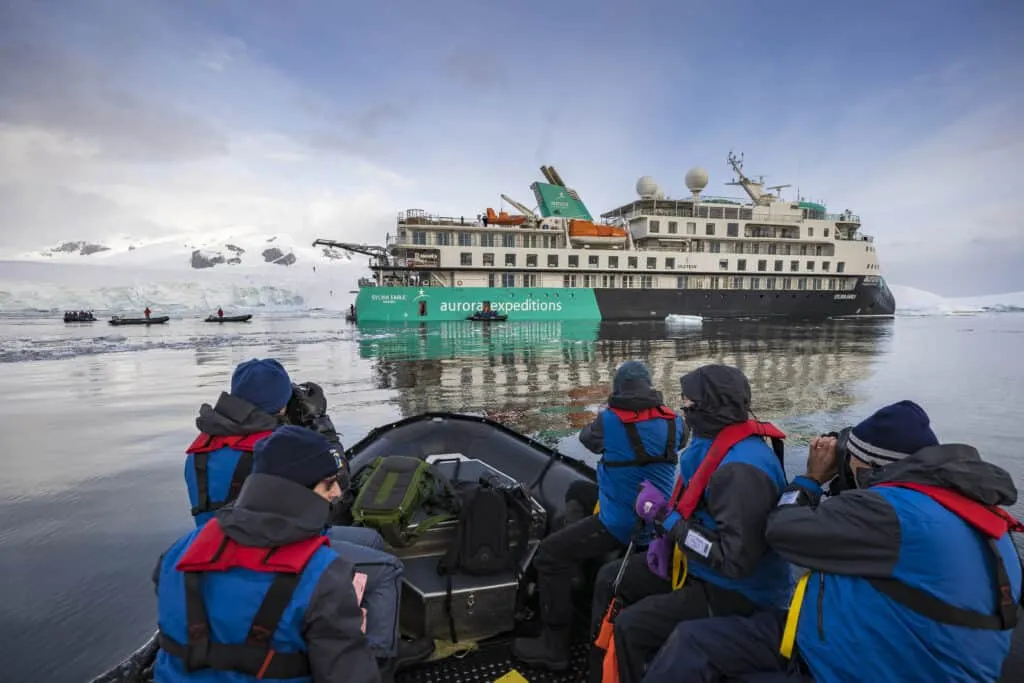
Aurora is the expedition line I recommend first for Australian clients heading to Antarctica. It's Australian-owned, the expedition team-to-guest ratio is exceptional at 1:8, and the three ships — Greg Mortimer, Sylvia Earle, and the new Douglas Mawson — all feature the Ulstein X-BOW hull design that genuinely makes the Drake Passage crossing more comfortable. They cap polar voyages at 130 passengers, which means more Zodiac landings and more time on the ice. The vibe is adventurous but not rugged — you're still coming back to a heated pool and a very good dinner.
Aurora Expeditions was founded in Sydney in 1991 by mountaineer Greg Mortimer OAM — the first Australian to summit Everest, and he did it without supplementary oxygen — alongside his wife Margaret Werner. The company began by chartering vessels to take small groups of adventurers to Antarctica, and that founding ethos of intimate, expert-led exploration has never wavered. Three decades on, Aurora operates its own fleet of three purpose-built expedition ships: Greg Mortimer, Sylvia Earle, and the newest addition, Douglas Mawson, which was christened in Sydney Harbour in late 2025. The company name itself pays homage to Sir Douglas Mawson's legendary Antarctic vessel, connecting it to Australia's deep history of polar exploration.
All three ships feature the Ulstein X-BOW hull, a patented inverted bow design that splits wave energy rather than slamming through it. Aurora was the first expedition company to put this technology on a passenger vessel, and the practical effect on the Drake Passage crossing — the most notorious stretch of open water on any expedition itinerary — is meaningful. Reduced impact, less vibration, and higher transit speeds through swells translate to a noticeably more comfortable ride and, for many passengers, the difference between managing seasickness and not. Combined with Rolls-Royce zero-speed stabilisers and Ice Class 1A ratings, these are serious expedition vessels designed for serious polar conditions.
What sets Aurora apart in the expedition space is the combination of Australian heritage, adventure credibility, and a genuine sense of purpose. The company is a Certified B Corporation, was the first Australian member of both IAATO and AECO, and runs seven active citizen science projects that turn passengers into contributors rather than spectators. It is not trying to be a luxury line with Zodiac landings bolted on; it is an expedition company that happens to provide comfortable ships, good food, and heated pools to come back to after a day on the ice.
Aurora caps polar voyages at 130 passengers, which places its ships firmly in IAATO's Category C1 — the classification that permits landings with a maximum of 100 people ashore at any time. With only 130 guests, Aurora can typically land everyone in a single rotation, which means more time on the ice and less time waiting on the ship. Larger expedition vessels carrying 200 or more passengers must cycle groups through multiple rotations, and the difference in time ashore is substantial. Aurora aims for two landings or Zodiac excursions per day, with two to three hours ashore per landing, and in favourable conditions that can stretch to three activities in a single day.
The expedition team numbers 15 to 20 specialists per voyage, producing a guide-to-guest ratio of approximately 1:8 — among the best in the industry. The team includes marine biologists, glaciologists, ornithologists, historians, photographers, and activity leaders, many of whom have been with Aurora for well over a decade. These are not scripted presenters reading from a brief; they are career field scientists and expedition professionals who lead every landing, drive every Zodiac, and deliver evening lectures drawn from genuine expertise. The photography programme, led by a dedicated photographer on every voyage, is included in the fare and offers both group workshops and informal one-on-one guidance during landings.
Beyond the core landing programme, Aurora pioneered several of the adventure activities that are now standard across the expedition industry: ice camping, sea kayaking, commercial climbing, and scuba diving were all introduced by Aurora in Antarctica before any other operator followed. Today, the optional activity menu includes kayaking, stand-up paddleboarding, scuba diving, snorkelling, ski and snowboard touring, alpine trekking, and the legendary Shackleton's Crossing on South Georgia. Camping and snowshoeing are included at no extra charge on selected voyages. Passengers do not need to be athletes to enjoy the core programme, but they should be comfortable walking on uneven ground and getting in and out of a Zodiac. For those who prefer a gentler pace, ship-based wildlife viewing, Zodiac cruises, and the enrichment lecture programme are rewarding in their own right.
Aurora's inclusion package covers the essentials well without claiming to be fully all-inclusive. All meals, snacks, tea, coffee, soft drinks, and juices are included throughout the day. House wine and beer are included with dinner, and the Captain's Farewell reception adds house cocktails. Premium spirits, cocktails, and wines beyond the house selection are charged separately. Complimentary Starlink Wi-Fi is available fleet-wide in all cabins and public spaces. Port surcharges, permits, and landing fees are bundled into the fare, as is the full enrichment lecture programme.
On polar voyages, Aurora provides a three-in-one expedition jacket — a waterproof outer shell with a removable insulated liner — which passengers keep after the voyage. Insulated waterproof Muck boots are loaned for the duration of the trip. Antarctic sailings include one night's pre-voyage hotel accommodation and an airport transfer in Ushuaia. Guests in Junior Suites receive a stocked minibar, a bottle of champagne, and complimentary binoculars. Captain's Suite guests receive a replenished minibar and the same extras. Both suite categories include gratuities, which for standard staterooms are charged at US$15 per person per day and added to the onboard account.
The activities that carry additional fees are sea kayaking, scuba diving, ski and snowboard touring, alpine trekking, and snorkelling on selected itineraries. Specific pricing for these supplements is not published on the website and varies by voyage — Aurora directs passengers to enquire directly. Camping, snowshoeing, the photography programme, and all Zodiac excursions and guided landings are included. International flights to and from the embarkation port are not included on any voyage except where specified for Fly the Drake itineraries.
Aurora's food sits firmly in the hearty expedition fare category — well-sourced, well-prepared, and designed to fuel active days rather than impress food critics. Each ship carries two dining venues: the main restaurant, Gentoo, which serves buffet-style breakfast and lunch and a la carte multi-course dinners, and a secondary restaurant offering a more intimate steakhouse-style evening service. On the Greg Mortimer this is the Tuscan Grill; on the Sylvia Earle it is Rockhopper. The Douglas Mawson adds a second bar and a pool bar to the mix. Open seating at all meals encourages socialising, and there are no assigned tables.
The culinary programme has a genuine sustainability dimension that goes beyond marketing. Aurora runs a Sustainable Food Programme sourcing organic produce and dairy, free-range chicken and eggs, and Argentinian grass-fed beef where possible. From the 2025-26 season, the company banned all salmon from onboard menus due to the environmental impacts of salmon farming — a bold stance in an industry where smoked salmon is practically a default breakfast offering. Tea, coffee, and snacks are available around the clock, which matters when you have been standing on a penguin beach in sub-zero wind for two hours.
Dietary requirements including vegetarian, vegan, and gluten-free are accommodated, though Aurora uses "reasonable endeavours" language rather than guaranteeing every request. The secondary restaurant has limited capacity and reservations fill quickly, so book early if an intimate dinner setting matters to you. The food is not on the level of what Ponant or Silversea deliver — there are no Michelin-star partnerships or sommelier-curated wine programmes — but it is consistently satisfying and compares well to what you will find on Quark or HX. For most expedition passengers, the priority is what happened on the landing that day, not what is on the plate, and Aurora's dining meets that standard comfortably.
Aurora draws a passenger demographic that skews Australian, well-travelled, educated, and physically active. The majority are over 50, though the adventure activity programme and photography workshops are increasingly attracting younger guests. Roughly 30 percent of passengers travel solo — a notably high proportion that reflects both the dedicated solo cabins and the communal atmosphere on board. The nationality mix is predominantly Australian and New Zealand, with a growing contingent of North American and European travellers. The typical Aurora passenger is more likely to own hiking boots than a dinner jacket.
The dress code is expedition casual throughout, and there are no formal nights. Most passengers wear the same clothes from the day's Zodiac landings to dinner. Some guests change for the Captain's Welcome and Farewell drinks, but there is no expectation or pressure. Evenings revolve around enrichment lectures from the expedition team — genuinely excellent presentations on wildlife, glaciology, history, and photography — followed by drinks at the bar and conversation. There is no organised entertainment in the traditional cruise sense: no shows, no casino, no theatre. The bar stays open, and conversation flows naturally. If your idea of a good evening is discussing humpback whale feeding behaviour with a marine biologist over a glass of wine, you will be entirely at home.
This is not the right product for travellers who want ultra-luxury service, formal dining, or structured evening entertainment. There is no butler service, no premium all-inclusive bar, and no room service to speak of. The cabins are well designed for expedition travel — modern interiors, heated bathroom floors, and roughly 85 percent with private balconies — but they are not the spacious suites you would find on Silversea or Ponant. What Aurora offers instead is an egalitarian, unpretentious atmosphere where the Captain chats with passengers at the bar, the expedition leaders eat alongside guests, and the entire experience is oriented around what is happening outside the window. For the audience it serves, that trade-off is not just acceptable — it is the point.
Aurora is the only Australian-owned expedition cruise company operating purpose-built ships, and that matters beyond national pride. The Sydney headquarters means you are dealing with an Australian office, Australian consumer protections, and a team that understands the Australian market. The company was founded by an Australian explorer, named after an Australian expedition vessel, and carries a distinctly Australian character — unpretentious, adventure-first, egalitarian — that permeates the onboard experience. Australian crew members and expedition team members feature prominently across the fleet.
For Antarctic Peninsula voyages departing from Ushuaia, Australian travellers typically fly via Santiago on Qantas or LATAM, roughly 12 to 13 hours direct from Sydney, then connect to Ushuaia in another three and a half hours. Aurora includes one night's pre-voyage hotel and an airport transfer in Ushuaia, but international flights are your responsibility. Allow buffer days for connections — missing the ship's departure is not recoverable. For those who want to bypass the Drake Passage, Fly the Drake itineraries route through Punta Arenas with charter flights to King George Island. More uniquely for Australians, Aurora offers East Antarctica and sub-Antarctic voyages departing from Hobart, visiting Commonwealth Bay, Macquarie Island, and the Ross Ice Shelf — rare itineraries that eliminate the South American transit entirely.
Solo travellers are exceptionally well served. Aurora offers ten dedicated solo cabins on every sailing from the 2026-27 season with no single supplement — a genuinely meaningful commitment in a segment where single supplements are often punitive. The Douglas Mawson has three solo cabin types, including one on Deck 7 with a French balcony. A cabin-share programme pairs willing solo travellers of the same gender, and if no match is found, the solo supplement is waived. These are not afterthought concessions; solo travellers represent roughly a third of Aurora's passengers, and the programme is designed accordingly.
Aurora sits in the mid-range of the expedition market — meaningfully more accessible than ultra-luxury operators like Silversea, Ponant, and Seabourn, and roughly competitive with Quark Expeditions and HX on a per-diem basis for Antarctic Peninsula voyages. The entry-level per diem for a standard Antarctic voyage works out to approximately A$1,200 to A$1,600 per person per day depending on cabin category and departure date, which positions Aurora as a strong value proposition given the newer fleet, the X-BOW hull advantage, and the expedition team ratio. Against Ponant, which typically runs A$1,800 to A$2,500 per diem with a more luxury-oriented product, Aurora is the clear choice for travellers who prioritise adventure over fine dining and champagne.
Where Aurora differentiates on value is the combination of fleet modernity and activity breadth. All three ships were built between 2019 and 2025 — there are no ageing legacy vessels in the fleet — and the adventure programme offers more optional activities than any direct competitor at this price point. The inclusion of camping, snowshoeing, the photography programme, and Starlink Wi-Fi in the fare is competitive, and the complimentary expedition parka is a genuine inclusion rather than a gimmick. Against Quark, Aurora's hardware advantage is clear; against HX, which carries 500-plus passengers on its larger vessels, Aurora's intimacy and time-ashore advantage is decisive.
A non-refundable deposit of US$2,500 per person is required within seven days of booking, with final payment due 90 days before departure. Aurora may permit a one-time deposit transfer to a future voyage within 24 months for a US$500 administration fee. Travel insurance with medical evacuation cover of at least US$250,000 is mandatory. The solo supplement structure is among the most generous in the expedition sector, and Aurora periodically runs promotions waiving the solo supplement across entire seasons. Loyalty programme members earn escalating discounts and onboard credits from their second voyage onward, and the programme never expires — a small but welcome detail for passengers who tend to return.
Share your dates and preferences and we will come back with Aurora Expeditions cabin options, pricing, and insider tips.