Variety Cruises
Yacht-Style Cruising
Variety is my go-to recommendation for clients who want to island-hop Greece the way the locals do — pulling into tiny harbours that big ships can't reach, swimming off the back of the boat, and eating dinner ashore in a village taverna. The ships are not new and won't win any design awards, but the crew is exceptional and the itineraries are brilliant. Think of it as chartering a friend's yacht, not booking a luxury cruise.
Variety Cruises is a third-generation, family-owned Greek cruise line headquartered in Athens, and one of the last genuinely independent operators in the yacht-cruising space. The Venetopoulos family has been welcoming international guests to Greece since 1949, when historian Diogenis Venetopoulos founded an educational travel company with the aim of sharing his homeland's archaeological heritage with the world. That founding philosophy — travel should be immersive, respectful of local culture, and conducted at a human scale — still runs through the company today under CEO Filippos Venetopoulos, the third generation at the helm.
The fleet of eight vessels carries between 34 and 72 guests each, making Variety the smallest-ship operator in the yacht cruising category. These are not purpose-built luxury yachts in the Ritz-Carlton mould; they are compact, character-rich motor yachts and motor sailers, most acquired and refurbished over the decades, with an average build year of around 1988. The company completed a fleet-wide renovation programme in 2025, and the vessels are well maintained, but prospective guests should understand that Variety trades newness for heritage and authenticity for opulence. The Greek crew is warm, attentive, and unfailingly personal — this is the line's greatest asset, and the quality that loyal passengers return for.
What truly distinguishes Variety is where the ships go. With shallow drafts and lengths under 70 metres, every vessel in the fleet can slip into tiny harbours, quiet coves, and lesser-known islands that are entirely inaccessible to larger competitors. Beyond the Greek Islands — the company's spiritual home — Variety sails the Seychelles, French Polynesia, the Italian coast, the Adriatic, and West Africa, the last of these a genuinely unique itinerary that no other yacht line offers. The company was recognised with Lloyd's List Greek Shipping Passenger Line of the Year in 2024, a significant industry endorsement of its position in the market.
The scale of a Variety voyage is what defines it. With 34 to 72 guests on board, you are not on a cruise ship — you are on a large private yacht where the captain is visible and accessible, the crew learn your name within hours, and your fellow passengers become genuine company rather than anonymous faces in a crowd. By the second evening, the social dynamic is closer to a house party than a holiday. Conversation is the primary entertainment, the sun deck is the social hub, and the rhythm of each day is shaped by the sea, the ports, and the swim stops rather than by a printed programme of activities.
Two of the vessels — the Galileo and the Panorama — are three-masted motor sailers that carry sails and can raise them in favourable conditions. They cruise primarily under motor power, so this is not a true sailing experience in the Star Clippers sense, but the sails add visual romance and atmosphere that the motor yachts lack. Most vessels feature a swim platform at the stern for direct sea access, with complimentary snorkelling gear, kayaks on select ships, and fishing equipment available. The emphasis is on simple, unstructured water access — jumping off the back of the boat for a morning swim in the Aegean is a highlight that passengers cite again and again. Alfresco dining on the upper deck under the stars, offered on warmer evenings, is another moment that captures the spirit of the experience.
The small-port advantage is Variety's single greatest competitive strength. Routinely calling at tiny Greek island harbours like Folegandros, Kythnos, and the inner harbour at Patmos, as well as remote West African river ports, isolated Seychelles islands, and French Polynesian lagoon anchorages, the fleet reaches places that even Windstar, SeaDream, and Star Clippers cannot access. Extended evening stays in port — often overnight — allow guests to wander village streets, find a harbourside taverna, and experience island life after the day-trippers have departed. This access to quieter, more authentic destinations is the reason most guests choose Variety, and the reason most of them return.
Variety operates a half-board model, which is less inclusive than most yacht-category competitors but deliberately structured. The fare covers accommodation, breakfast, and one additional meal — either lunch or dinner depending on the itinerary and port schedule. Some itineraries offer full board with all three meals, so it is worth confirming the meal structure at booking. Captain's Welcome and Farewell dinners are included on every voyage, as is the use of the sun deck, swim platform, and snorkelling gear. Port taxes and fees are covered on most bookings, and Zodiac or tender transfers where required are part of the fare.
What is not included is a longer list than you will find on SeaDream, Windstar, or Ritz-Carlton. Alcoholic beverages, soft drinks, and juices are purchased separately from the onboard bar. Shore excursions are available at supplemental cost. Gratuities are not included — the recommended amount is around EUR 15 to 18 per person per day, distributed to all crew. Flights and transfers to the embarkation port, travel insurance, laundry, and Wi-Fi on most vessels are also extra. The true daily cost of a Variety cruise is meaningfully higher than the advertised fare once you factor in drinks, tips, meals ashore, and optional excursions.
The half-board model is a genuine philosophical choice rather than a deficiency. Variety wants guests to eat ashore, to discover local cuisine independently, and to engage with the destinations they visit at a deeper level than the dining room allows. Many passengers consider this freedom the best part of the voyage. That said, travellers who prefer the certainty and simplicity of an all-inclusive fare should understand that Variety requires more budgeting and planning than its yacht-category peers.
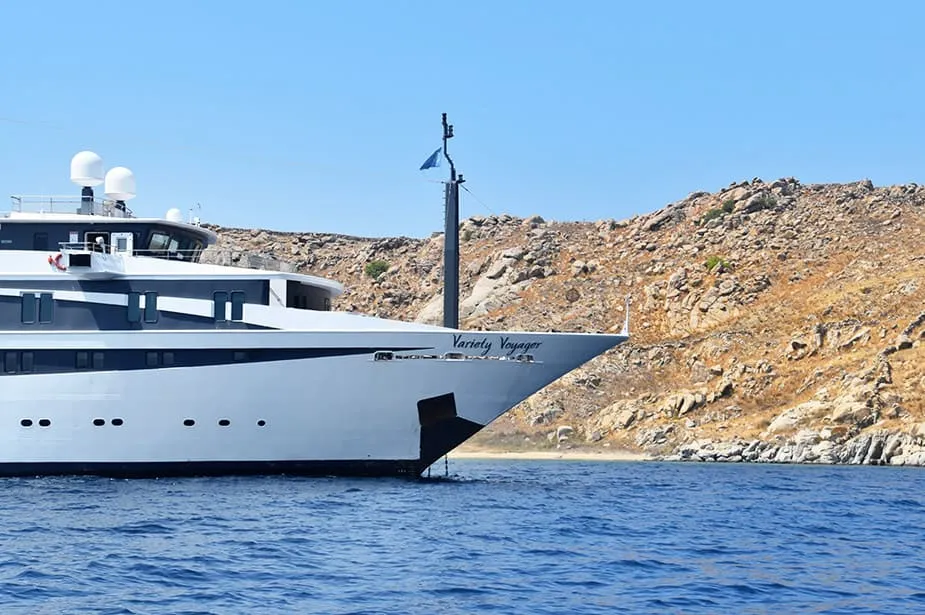
Every Variety vessel has a single main dining room with open seating — one restaurant, one menu, one sitting. On a yacht carrying 40 to 72 guests, this functions as a communal dining experience rather than a limitation. The Variety Voyager offers a slightly more expansive arrangement with separate indoor and outdoor dining areas and a wider menu selection. On warmer evenings across the fleet, dinner may be served alfresco on the upper deck, and occasional barbecue evenings are offered on select itineraries — intimate dinners under the stars for 30 to 50 guests that capture the private-yacht spirit better than almost anything else on the programme.
The cuisine is Mediterranean-influenced with strong Greek and regional accents. Menus draw on local ingredients sourced at port, and on Greek island itineraries you can expect fresh seafood, grilled meats, salads dressed in good olive oil, feta, and seasonal vegetables. On West Africa and Seychelles sailings, the menus incorporate local flavours and ingredients from the destinations visited. The crew is accommodating with dietary requests — vegetarian options are generally available, and common requirements can be managed with advance notice — though the small galley and single-menu format inherently limit flexibility compared to larger ships with multiple dining venues.
Food quality is a subject on which reviews are genuinely divided. Many guests praise the freshness, the authentic Greek flavours, and the generous portions. Others describe the cuisine as fine but unremarkable, and note that breakfast can become repetitive on longer voyages. The Variety Voyager tends to receive stronger dining reviews than the older, smaller ships. What is beyond dispute is that the half-board model means you will eat ashore on roughly half of your evenings, and for many guests — particularly on Greek island itineraries — those harbourside taverna meals turn out to be the culinary highlights of the trip.
The typical Variety guest is between 50 and 75, well-travelled, culturally curious, and part of a couple. The passenger mix is genuinely international — roughly a third North American, a third European, and the balance from across the globe, including a small but growing Australian contingent on the French Polynesia and Seychelles itineraries. Solo travellers are a small but welcome presence, and families with children are rare — there are no children's facilities, no kids' clubs, and the compact cabins are not designed for family occupancy.
The atmosphere is among the most casual in yacht cruising. Shorts, T-shirts, and swimwear are the daytime uniform. Evenings call for smart-casual at most — a collared shirt and sundress — and there are no formal nights, no dress code enforcement, and no jacket requirement. Barefoot on the sun deck is perfectly normal. The service style is warm, familial, and unpretentious — more taverna host than five-star concierge — and this Greek warmth is the brand's greatest strength and its most polarising quality. Guests who want genuine human connection and easy informality will love it. Those expecting polished ultra-luxury service may find it rustic.
Variety is emphatically not the right choice for travellers who want structured entertainment, production shows, nightlife, a spa, a gym, or a pool. There is no theatre, no casino, no cruise director, and on most vessels, no fitness equipment. The entertainment is the destination, the company of fellow passengers, sunset cocktails on the sun deck, and the stars overhead. Rainy days or rough-sea days can feel quiet. This is a line for people who are comfortable with stillness, conversation, and their own company — and who understand that the real programme happens ashore, not on board.
Variety Cruises does not maintain an Australian office, local phone number, or dedicated trade representation, and no vessel in the fleet has ever sailed from an Australian port. Fares are quoted in euros or US dollars, and Australian travellers typically book through a specialist cruise agent who can provide guidance on cabin selection, itinerary choice, and the logistics of reaching the embarkation port. This is where working with an agency that knows the product well makes a genuine difference — the variance between vessels and itineraries is significant enough that the right advice at the booking stage matters more than it does on larger, more standardised cruise lines.
The most accessible Variety destination from Australia is French Polynesia. Papeete is approximately eight to nine hours from Sydney via direct Air Tahiti Nui services, making the Tahiti itinerary the easiest to reach without a marathon journey through the Gulf or Europe. Greek Islands sailings depart from Athens, which is 20 to 24 hours from Sydney or Melbourne via Dubai, Singapore, or Doha. Seychelles departures from Mahe are 15 to 18 hours via Abu Dhabi or Dubai. West Africa itineraries — departing from Banjul in The Gambia — require the longest routing at 24 to 30 hours via London or Casablanca, and are best suited to travellers combining the cruise with a broader European or African itinerary.
For Australians drawn to the Greek Islands, a Variety cruise pairs naturally with a pre- or post-cruise land stay in Athens, the Peloponnese, or Crete. The intimate scale and short embarkation process — you walk on to the yacht in Piraeus harbour, not through a cruise terminal — means the transition from land travel to sea is seamless and unhurried. We regularly build itineraries that combine a Variety Greek Islands sailing with independent travel through mainland Greece, and the half-board dining model makes this kind of flexible, self-directed trip particularly rewarding.
Variety Cruises sits at the affordable end of the yacht cruising spectrum, with per-diem rates roughly half those of SeaDream and a third of Ritz-Carlton. A seven-night Greek Islands sailing starts from approximately AUD 440 to 780 per person per night for an entry-level cabin, while Seychelles and French Polynesia itineraries command higher rates reflecting the destinations and longer positioning. The Variety Voyager, the flagship, carries a modest premium over the smaller vessels.
However, the advertised fare tells only part of the story. Because Variety is half-board with drinks, gratuities, and excursions extra, the realistic all-in cost is meaningfully higher than the headline number. Budget for drinks, tips, meals ashore, and at least a couple of shore excursions, and the per-diem gap between Variety and its more inclusive competitors narrows considerably. Variety remains the most accessible entry point to yacht-scale cruising, but it is not as inexpensive as the brochure fare initially suggests. We are transparent about this with every client because managing expectations on total spend is essential to a satisfying experience.
Solo supplements apply but are not publicly standardised — they vary by voyage, cabin category, and occupancy, and there is no cabin-share programme. Deposits are 25 per cent of the cruise fare per person, due within seven days of booking, with final payment 60 days before departure. Early booking discounts of around 10 per cent are periodically available during wave season, and last-minute deals appear for shoulder-season departures. Peak Greek summer sailings in July and August fill quickly and should be booked six to twelve months ahead. The Variety Club loyalty programme rewards repeat guests generously, culminating in a 50 per cent fare discount at the tenth cruise — one of the most aggressive loyalty benefits in the industry.
Share your dates and preferences and we will come back with Variety Cruises cabin options, pricing, and insider tips.