Regent Seven Seas
Ultra-Luxury Cruising
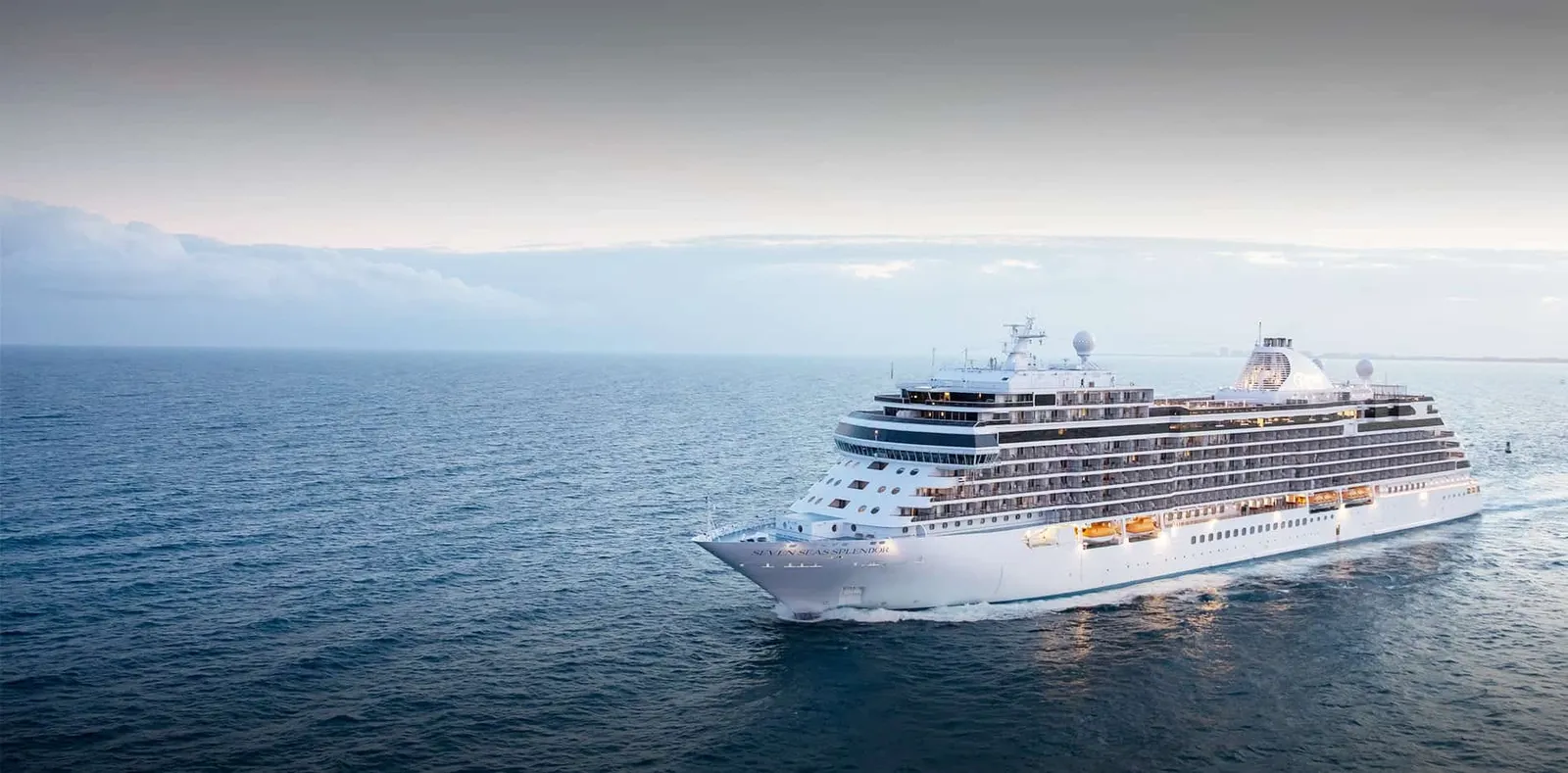
Regent is the line I recommend when clients tell me they never want to reach for their wallet on holiday. The all-inclusive proposition is the most comprehensive in the industry — unlimited shore excursions, speciality dining, premium drinks, Wi-Fi, gratuities, and even business-class air on certain categories are all folded into the fare. The suites are the largest in luxury cruising at every category level, and the service ratio of nearly one crew member per guest means nothing goes unnoticed. Seven Seas Splendor and Grandeur are the standouts in the current fleet, and Seven Seas Prestige arriving in late 2026 will raise the bar further.
Regent Seven Seas Cruises was born in 1992 from the merger of Radisson Cruises and Seven Seas Cruises, and spent its first decade establishing a proposition that remains its defining feature today: the most inclusive fare in luxury cruising. Originally branded as Radisson Seven Seas, the line rebranded in 2006 and was acquired in 2014 by Norwegian Cruise Line Holdings, which also operates Oceania Cruises and Norwegian Cruise Line. That corporate backing has funded an ambitious fleet expansion — the Explorer-class trio of Seven Seas Explorer, Splendor, and Grandeur launched between 2016 and 2023, and the new Prestige-class flagship arrives in late 2026.
What sets Regent apart from every competitor is the breadth of what the fare covers. Other luxury lines include drinks and gratuities; Regent includes those plus unlimited shore excursions in every port, all speciality dining without surcharges, valet laundry, a stocked minibar, and — on higher suite categories — pre-cruise hotel nights, business-class flights, and private transfers. The result is an experience where guests genuinely stop thinking about cost. That frictionless quality, paired with the largest suites at every category level in the ultra-luxury segment and a crew-to-guest ratio approaching one-to-one, is why Regent's loyal repeat clientele is among the most devoted in the industry.
The fleet covers virtually every major cruise region — Mediterranean, Northern Europe, Alaska, Caribbean, Asia, South Pacific, Australia and New Zealand, Africa, and South America — with particular strength in longer voyages and annual world cruises that appeal to well-travelled guests who have already seen the obvious ports and want deeper, more extended itineraries.
Regent's all-inclusive proposition is genuinely the broadest in ultra-luxury cruising, but the specifics matter because not every inclusion applies to every suite category. At the base level — the All-Inclusive Cruise Fare — every guest receives unlimited shore excursions in every port, all dining across every restaurant with no surcharges, premium wines and spirits throughout the day, unlimited Starlink-powered Wi-Fi, pre-paid gratuities, and a minibar stocked and replenished daily to personal preferences. From the Deluxe Veranda category upward, valet laundry (wash, press, and fold) is included. Concierge suites and above add a one-night pre-cruise luxury hotel stay and priority booking for dining and excursions. Butler service begins at the Penthouse level, bringing unpacking and packing, canapés on demand, chilled Champagne whenever you want it, and personalised concierge management of reservations and special occasions.
The Ultimate All-Inclusive Fare layers on roundtrip flights — with a choice of economy, premium economy, business, or first class — coach transfers between airport and ship, and a Blacklane chauffeur credit of up to US$500 per suite for private car service. For Australian travellers booking European or Americas itineraries, the included flights alone can represent significant value. The Regent Suite, available on each ship, takes things further still with a private car and driver in every port and unlimited dry cleaning.
It is worth being honest about what is not included. Spa treatments at the Serene Spa are charged separately, though the thermal suite, sauna, and steam room are complimentary for all guests. A curated wine list is included with meals, but rare and vintage bottles from the premium wine programme carry a supplement. Regent Choice excursions — premium small-group and private experiences — cost extra above the unlimited complimentary programme. And travel insurance is the guest's responsibility. These exclusions are relatively minor in the context of the overall fare, but they are real, and I mention them because transparency matters when the price point is this high.
Dining is one of Regent's genuine strengths, and the fact that every restaurant is included without surcharges is a meaningful advantage over competitors who charge supplements at their top venues. Compass Rose, the main dining room, operates on an open-seating basis and features an unusually flexible menu: one side offers full customisation, where guests choose a protein, preparation method, sauce, and accompaniments individually, while the other presents the executive chef's nightly specials and a multi-course degustation. It is a distinctive approach that rewards experimentation. Prime 7 is the fleet's steakhouse and consistently earns praise for its aged cuts and classic American steakhouse atmosphere. Chartreuse delivers refined French cuisine. Pacific Rim, available on the Explorer-class ships, serves pan-Asian dishes spanning Thai, Japanese, Korean, and Indonesian traditions, and is frequently singled out by guests as the standout venue aboard. La Veranda operates as a relaxed buffet for breakfast and lunch before transforming into Sette Mari at dinner for Italian cuisine — a dual-purpose space that works well.
Regent does not currently promote a headline celebrity chef partnership in the way that Seabourn has Thomas Keller or Oceania has Jacques Pepin. The culinary programme is led by the line's own executive chef team, with guest chef appearances on select Spotlight Voyages. The Culinary Arts Kitchen on Explorer-class ships and the newly introduced Epicurean Enrichment Studio on the refurbished Mariner and Voyager offer hands-on cooking classes that connect guests to regional cuisines. The wine programme includes a curated selection of fine wines with every meal, complemented by a premium list for purchase, and the Head Sommelier is available for guidance. The included list is well-regarded, though dedicated oenophiles may find it narrower than what Silversea or Crystal offer at the complimentary tier.
I should note the one persistent criticism that appears across reviews: food temperature. Multiple guests across different ships and sailing years report that hot dishes arrive warm rather than genuinely hot. It does not appear to be a dealbreaker for most, but it is consistent enough to mention. Room service is available around the clock and included in the fare, which is a welcome option on evenings when a formal sit-down dinner does not appeal.
The typical Regent guest is 55 to 75 years old, affluent, well-travelled, and experienced with cruise holidays. On longer voyages and world cruises, the average skews older. Shorter sailings and Alaska itineraries attract a slightly younger cohort, but Regent remains firmly oriented toward the mature luxury traveller. The nationality mix is predominantly North American on Caribbean, Alaska, and transatlantic sailings, with a more international blend — British, German, Australian — on European and Asia-Pacific deployments. Repeat guests from the Seven Seas Society form a significant proportion of passengers on any given sailing, particularly on longer voyages, and this creates a convivial, club-like atmosphere where people return because they enjoy the company as much as the ship.
The dress code was updated in August 2025 to permit refined denim and dress sneakers in the evening — a shift that generated considerable discussion among loyal guests. In practice, evenings are elegant casual: slacks, collared shirts, dresses, and smart shoes are the norm. Formal Optional evenings occur once or twice per voyage, where dinner jackets and gowns appear but are not required. The overall tone is polished and sociable without being rigid. Evenings revolve around cocktails with live music in the Observation Lounge or Stars Lounge, production shows in the Constellation Theatre on Explorer-class ships, and leisurely dinners across the speciality restaurants. This is not a party ship — there are no waterslides, no DJ sets, no late-night discos.
Regent is not the right fit for families with young children, budget-conscious travellers, anyone seeking expedition or adventure cruising, or guests who want a high-energy social scene. It is, however, an excellent fit for couples and small groups who want to explore the world at a measured pace, in beautiful surroundings, without ever thinking about the bill.
The Seven Seas Society is Regent's loyalty programme, and its structure is straightforward. Membership begins automatically after your first sailing. You earn one point per night, counting all full-fare nights since 1993, and crucially, points never expire and status never requires requalification. Once you reach a tier, it is permanent. The programme runs across seven levels: Bronze from seven nights, Silver from 21, Gold from 75, Platinum from 200, Titanium from 400, Diamond from 1,000, and Commodore from 2,000 nights. Benefits escalate through the tiers and include shipboard credits, priority dining and disembarkation, exclusive savings on select voyages, Blacklane private car transfers at the Titanium level, and unlimited dry cleaning from Diamond upward.
Through the NCLH Status Honoring Program, members of Norwegian Cruise Line's Latitudes Rewards or Oceania's loyalty programme receive courtesy recognition and a subset of benefits when sailing Regent, and vice versa. This is not a full status match, but it is a useful courtesy for guests exploring across the NCLH portfolio. Status matching from non-NCLH lines such as Silversea or Seabourn is not available. Overall, the programme is competitive and the permanent status structure is a genuine advantage, though Silversea's Venetian Society offers more aggressive onboard benefits at lower tiers.
Regent is well-represented in Australia through Norwegian Cruise Line Holdings' Sydney office in Barangaroo, which supports all three NCLH brands with a team of nearly 200 staff. Australian travel agents have strong booking relationships with Regent, and dedicated Business Development Managers serve the local trade. For Australian guests, this means local support, AUD-quoted fares through specialist agents, and access to Australia-specific promotions including fly-free offers and reduced deposit campaigns.
Regent typically deploys a ship to Australian and New Zealand waters during the southern hemisphere summer — roughly November through March — with Sydney as the primary departure port and Auckland also featuring prominently. Itineraries include Australia circumnavigations, trans-Tasman crossings, and repositioning voyages through Southeast Asia that connect ports like Singapore, Bali, Komodo, Darwin, and Cairns en route to Sydney. These repositioning sailings are particularly appealing for Australian travellers who want an extended voyage without the long-haul flight at both ends.
For Australian guests booking European or Americas itineraries, the Ultimate All-Inclusive fare includes roundtrip flights from Australian gateways including Sydney, Melbourne, Brisbane, and Perth. However, fares from Australian cities tend to sit higher than from North American gateways, and routing may require connections. Many Australian guests prefer the cruise-only All-Inclusive fare and arrange their own flights using frequent flyer points or preferred carriers, which often delivers a better outcome for both cost and routing flexibility.
Regent is unambiguously expensive. Entry-level Veranda Suites start from roughly AUD $435 to $700 per person per night on a directional basis, climbing through Concierge, Penthouse, and higher categories into significantly higher territory. But the headline number is only meaningful in context. When I compare Regent's fare against a premium line where drinks, shore excursions, speciality dining, Wi-Fi, and gratuities are all added individually, the effective per-diem gap narrows considerably — and on port-intensive itineraries where unlimited included excursions might save thousands of dollars, it can narrow dramatically. This is the essential calculation with Regent: the sticker price looks high, but the total cost of a comparable experience on a less-inclusive line is often closer than you expect.
Solo travellers face a standard single supplement of 75 per cent of the per-person fare, which is among the steepest in the segment. Reduced supplements of 25 to 50 per cent appear regularly on select sailings, and occasional zero-supplement offers do surface, particularly on repositioning voyages and shoulder-season departures. Deposits are typically 15 per cent for voyages of 25 nights or fewer and 20 per cent for longer sailings, with reduced deposits of 7.5 per cent occasionally available during wave season promotions in January through March. The cancellation policy is standard for ultra-luxury: modest administrative fees more than 150 days out, escalating through 25, 50, and 75 per cent penalties until reaching 100 per cent forfeiture at 60 days or fewer.
Prices are identical whether booked directly through Regent or through a travel agent — Regent enforces rate parity. However, agents affiliated with luxury consortia can offer meaningful added value in the form of onboard credits, suite upgrades, and bonus amenities. For Australian travellers, booking through a specialist cruise agent who can quote in AUD, manage air from Australian gateways, and leverage consortia benefits is generally the smartest approach.
Share your dates and preferences and we will come back with Regent Seven Seas cabin options, pricing, and insider tips.