Quark Expeditions
Expedition Cruising
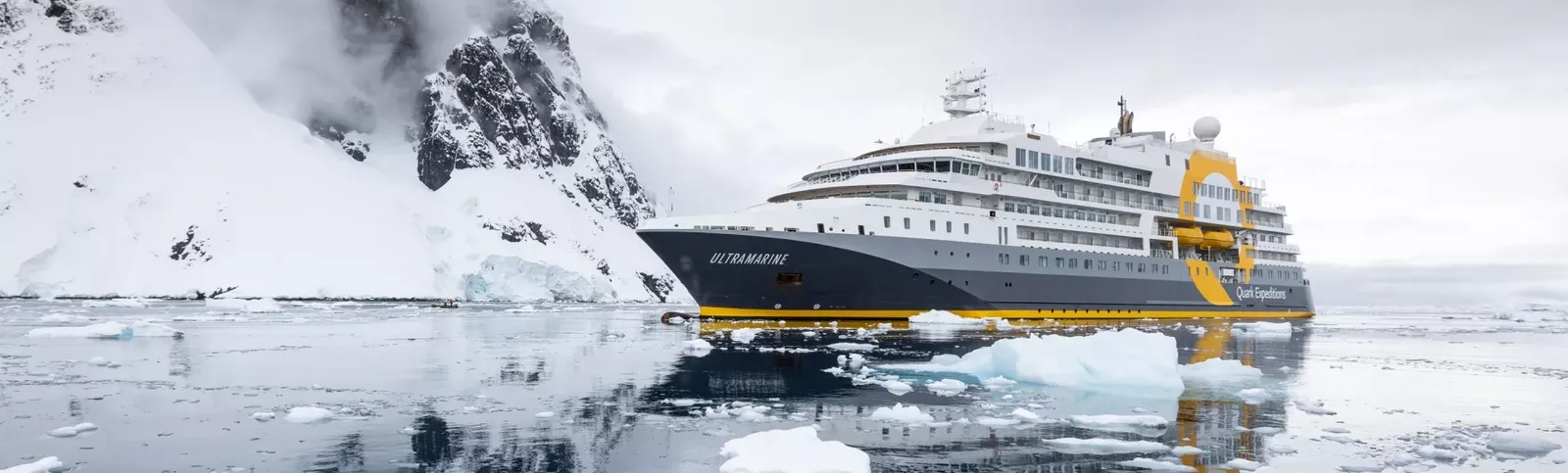
Quark is the name in polar expedition cruising for good reason — they took the first consumer travellers to the North Pole in 1991 and have been pushing boundaries ever since. The Ultramarine is the best purpose-built polar expedition ship I have seen: twin helicopters for heli-landing excursions, 20 Zodiacs launched from an internal hangar, and cabins with heated bathroom floors that you will genuinely appreciate after a morning on Antarctic ice. If your clients want the most active, adventure-forward polar experience available, Quark is the answer.
Quark Expeditions holds a singular place in polar travel. In 1991, the company chartered a Russian nuclear icebreaker and took the first commercial passengers to the geographic North Pole, a voyage that effectively created the polar expedition cruise industry as we know it. In the decades since, Quark has remained purely polar — Antarctica and Arctic, nothing else — accumulating more operational experience in ice than any other expedition operator. They were one of seven founding members of IAATO, sit on more than thirty of its committees, and have racked up a list of polar firsts that includes the first Antarctic circumnavigation and the first Arctic Ocean circumnavigation. When people in the industry talk about polar expedition cruising, Quark is the reference point.
What separates Quark from the growing field of operators who have entered polar waters in recent years is focus. There are no Mediterranean repositioning seasons, no Kimberley diversions, no tropical itineraries to fill the calendar. Every voyage operates in ice, every crew member is trained for polar conditions, and every dollar of investment goes into making the polar experience better. The flagship Ultramarine, launched in 2021, is the clearest expression of that philosophy — a purpose-built PC6 ice-class vessel carrying twin Airbus H145 helicopters, twenty Zodiacs deployed from an internal water-level hangar, and cabins with heated bathroom floors. It is, by any honest assessment, the most capable adventure expedition ship operating in polar waters today.
Quark's expedition team is the engine of the entire experience, and this is where the company genuinely leads. The published guide-to-guest ratio is 1:6, the lowest in the polar expedition industry, and it shows. On a typical Ultramarine voyage, upwards of thirty expedition staff are aboard — marine biologists, glaciologists, ornithologists, polar historians, photographers, and outdoor educators, many with PhDs and over a decade of polar guiding experience. Every guide has passed through Quark Academy, the company's proprietary training programme and the only one of its kind in expedition cruising, which covers IAATO and AECO protocols, wildlife interaction guidelines, and polar safety procedures. The result is a consistency of quality across vessels and seasons that is difficult for competitors to match.
On the ice, the programme is built around two landings per day, weather and ice permitting, with Zodiac cruising excursions offered alongside or instead of shore landings. IAATO rules limit landings to one hundred people ashore at any time, and because all Quark ships carry fewer than two hundred passengers, the rotation is efficient — you spend more time on the ice and less time waiting on the ship. The Ultramarine's internal Zodiac hangar, with four embarkation points launching twenty inflatables simultaneously, cuts embarkation times roughly in half compared to conventional davit-launched systems. That translates directly into extra minutes at every landing site, which over the course of a voyage adds up meaningfully.
Beyond the standard landing programme, Quark offers a range of adventure options that tilt the experience toward the active end of the spectrum. Kayaking, stand-up paddleboarding, Antarctic camping, snowshoeing, and the polar plunge are all available, and on Ultramarine, the twin helicopters open up flightseeing, heli-landings, and on select Arctic voyages, heli-hiking and heli-skiing. Dedicated solo cabins — six on Ultramarine, seven on Ocean Explorer — reflect Quark's awareness that a significant portion of polar travellers come alone. Guests must be able to board and disembark Zodiacs independently and walk on uneven, rocky, and sometimes icy terrain. This is not a cruise where you watch Antarctica from a heated lounge. If that is what you want, other operators will serve you better.
Quark moved significantly toward an all-inclusive model in late 2024, adding complimentary alcoholic beverages and satellite Wi-Fi to all voyages. The fare now covers accommodation, all meals, beer, wine, spirits, and cocktails, Wi-Fi, shore landings and Zodiac excursions, expert-led lectures and presentations, a complimentary 3-in-1 parka that you keep, loaned insulated waterproof boots, and a reusable water bottle. On Ultramarine, flightseeing helicopter excursions and one heli-landing experience are included in the base fare, which is a substantial value addition that no other sub-200-passenger polar operator matches.
What is not included: international flights to the embarkation port, travel insurance (mandatory, and you should not even consider travelling without it), gratuities, spa treatments, laundry, and premium wines and spirits beyond the complimentary selection. The paid adventure options — sea kayaking, stand-up paddleboarding, and Antarctic camping — carry additional charges. The kayaking programme in particular is worth noting: it runs for the full voyage with multiple outings and is a genuine commitment, not a casual add-on. If kayaking is important to you, book it early because places are limited and they sell out.
Quark's dining operates at what I would call expedition comfort rather than fine dining. It is not competing with the multi-restaurant programmes of Ponant or Silversea, and it does not pretend to. On Ultramarine, the main restaurant seats all guests in a single open-seating arrangement with floor-to-ceiling windows at the bow, and a secondary venue offers lighter fare, early-riser breakfast, afternoon tea, and late-night snacks. Dinner is a multi-course sit-down affair with rotating international menus — appetiser, main, dessert — and the quality consistently surprises given how far from civilisation these ships operate. Reviewers regularly single out the food as a highlight, with generous portions and genuine variety.
Dietary requirements including vegetarian, vegan, gluten-free, and allergy-specific needs are accommodated when noted on the medical form before departure. On select Arctic voyages to Greenland and Nunavut, the Tundra to Table experience offers something genuinely unique — a four-course modern fusion dinner created in partnership with Igapall, a Greenlandic culinary collective, and hosted by Inuit or Icelandic chefs. It is the only exclusively Inuit-led culinary experience in the expedition cruise industry, and it adds a cultural dimension that elevates the dining programme well beyond the standard shipboard repertoire. All alcoholic beverages are now complimentary throughout the day, which removed one of the most common complaints from the pre-2024 era.
Quark attracts an educated, well-travelled crowd with a genuinely international mix — North American, European, Australian, and increasingly Asian travellers, typically aged between 35 and 65, though guests in their twenties and eighties are not uncommon. The common thread is a desire to be active and engaged rather than pampered. Conversations at dinner and in the Panorama Lounge tend toward travel stories, wildlife sightings, and plans for the next day's landing rather than anything you would hear on a conventional cruise ship. The expedition team dines with passengers, which creates a more personal, collegial atmosphere and means the expertise does not stop when the lecture ends.
The dress code is entirely informal. There are no formal nights. Guests routinely wear fleece, hiking trousers, and Gore-Tex to dinner, and while a collared shirt or casual dress is suggested for the Captain's Welcome toast and the farewell dinner, it is genuinely optional. Evening entertainment centres on expedition lectures, recap presentations in the theatre, wildlife documentaries, and informal socialising in the lounges. There is no casino, no production show, no nightclub. Board games, the polar-themed library, and conversation are the entertainment, and most guests are in bed by ten because the next morning's landing call comes early.
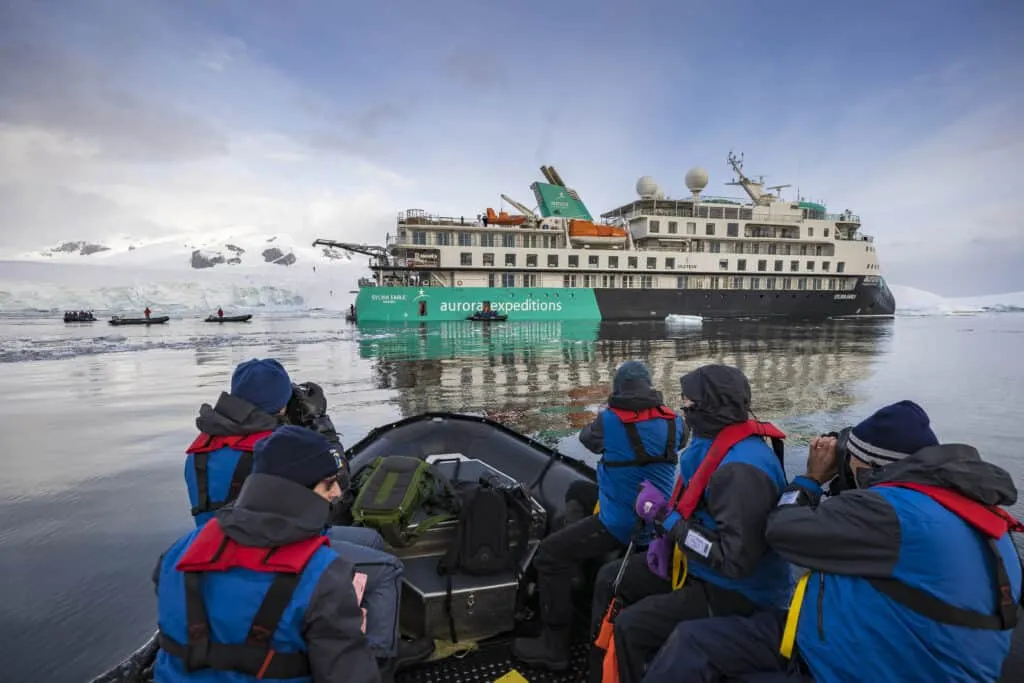
This is the right ship for travellers who consider the destination the point of the voyage and the ship a comfortable base camp. It is not the right ship for anyone who values butler service, multiple fine-dining venues, formal evenings, or the social infrastructure of a luxury cruise. Quark sits firmly at the adventure end of the expedition spectrum, closer to Aurora Expeditions than to Silversea or Ponant, and makes no apology for it. If you find yourself more excited by a glacier calving than by a degustation menu, you will be in good company.
Getting to Quark's embarkation ports from Australia requires some planning. For Antarctic voyages departing Ushuaia, the most common routing is Sydney or Melbourne to Santiago via LATAM or Qantas, then a domestic connection through Buenos Aires to Ushuaia — roughly twenty to twenty-four hours of travel each way with connections. For Fly-the-Drake departures from Punta Arenas, the routing runs through Santiago. Arctic voyages departing Longyearbyen or Reykjavik require a European hub connection, adding further complexity. Pre- and post-voyage hotel nights are not optional extras; they are essential buffers against jet lag and connection risk.
Quark has no Australian office, no local phone number, and prices exclusively in USD. Australian travellers typically book through the global team or through Australian-based expedition cruise specialists who carry Quark product and understand the logistics of getting from Australia to the bottom of the world. Working through a specialist is worth the effort, particularly for coordinating flights, managing currency exposure, and packaging pre- and post-voyage arrangements. Solo travellers from Australia should note the dedicated solo cabins on both Ultramarine and Ocean Explorer, as well as the cabin-share programme that waives the single supplement if no match is found — a meaningful benefit when the supplement on premium cabins can exceed ten thousand dollars.
Quark sits in the mid to upper-mid range of polar expedition pricing. For a standard eleven-day Antarctic Peninsula voyage on Ultramarine, entry-level cabins start from roughly A$1,000 to A$1,400 per person per day when factoring in early-booking discounts, which Quark offers aggressively at up to 30 percent off select sailings. That positions Quark broadly in line with Aurora Expeditions and noticeably below the ultra-luxury polar operators — Ponant, Silversea, and Seabourn — where per-diem rates climb considerably higher. HX Expeditions offers a lower entry point, but on significantly larger ships with a less intimate expedition feel.
The value calculation shifted meaningfully in late 2024 when Quark added complimentary beverages and Wi-Fi to all voyages. Combined with the included parka, boots, and helicopter flights on Ultramarine, the inclusion package is now competitive with operators that charge several hundred dollars more per day. Deposits are typically 20 to 25 percent of the fare, and the cancellation policy follows a tiered penalty structure — the fifteen-day free cancellation window is helpful, but beyond that, penalties escalate to 100 percent within 60 days of departure. The Quark Protection Promise allows cancellation fees to be applied as credit toward a future voyage, which is a reasonable safety net but not a substitute for comprehensive travel insurance. Early booking is the single most effective way to manage cost on a Quark expedition — the best cabins on the most popular departures sell out well in advance, and the early-booking discounts are genuine.
Share your dates and preferences and we will come back with Quark Expeditions cabin options, pricing, and insider tips.