Poseidon Expeditions
Expedition Cruising
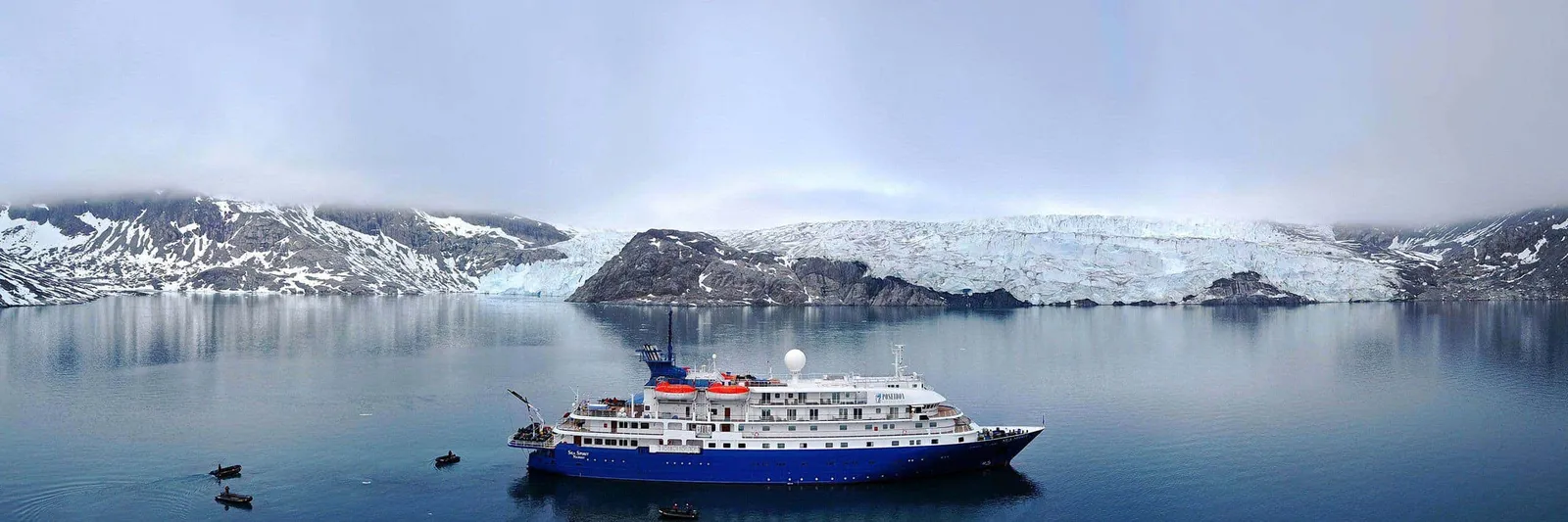
Poseidon is my sleeper pick in polar expedition cruising. They operate just one ship — the 114-guest Sea Spirit — and they do it exceptionally well. The all-suite accommodation punches above its weight, the expedition team has won Best Polar Expedition Operator multiple years running, and because they are less well-known than Quark or Lindblad, availability is often better and pricing more competitive. For a first Antarctic or Svalbard voyage, Poseidon delivers a polished experience without the premium price tag of the big expedition brands.
Founded in 1999, Poseidon Expeditions has quietly built one of the strongest reputations in polar expedition cruising without the marketing budgets or brand recognition of its larger competitors. The company operates a single vessel — the 114-guest, all-suite Sea Spirit — and focuses exclusively on the Arctic and Antarctic, following the polar seasons between hemispheres. Svalbard, Greenland, and Iceland in the northern summer; the Antarctic Peninsula, the Falkland Islands, and South Georgia in the southern summer. More recently, the company has added British Isles voyages during the repositioning window between seasons. This focused approach means every aspect of the operation is optimised for polar travel, from the ice-strengthened hull and fleet of ten Zodiacs to the specialist expedition team that has won Best Polar Expedition Operator at the International Travel Awards four consecutive years.
The company has deep roots in polar operations. For over two decades, Poseidon chartered Russian nuclear icebreakers for North Pole voyages and Franz Josef Land expeditions — itineraries that were among the most distinctive in the industry. Those programmes were suspended following the 2022 Ukraine conflict, and the company has since pivoted entirely to Svalbard, Greenland, Iceland, and British Isles operations in the Arctic season. It was a significant strategic loss, but Poseidon adapted well. The Antarctic programme, which has always been the core product, was unaffected, and the extended South Georgia season through April from the 2026-27 season onwards demonstrates a company still investing in its itinerary depth.
What distinguishes Poseidon from the crowded field of polar operators is the combination of intimacy, expedition quality, and competitive pricing. With only 114 guests aboard, you know your fellow travellers by name within days. The all-suite configuration means no inside cabins and no cramped berths. And the pricing sits noticeably below the luxury expedition tier of Silversea, Seabourn, and Ponant while delivering an expedition experience that reviewers consistently rate as equal to or better than operators charging considerably more. It is not the newest ship afloat, and it lacks the headline hardware of some competitors, but for travellers who prioritise substance over sparkle, Poseidon is a genuinely compelling option.
The expedition team is the single most praised element across every review platform, and it is the reason Poseidon has collected four consecutive International Travel Awards. The onboard team includes marine biologists, ornithologists, geologists, glaciologists, climate specialists, and polar historians, supported by photography guides and an expedition leader. The staff-to-passenger ratio sits at approximately one to nine — competitive though behind the industry leaders — but the small guest count means you have genuine access to experts rather than queuing for attention. Guides dine with passengers, creating organic connections that enrich the experience beyond the structured lecture programme.
On a typical expedition day, the ship offers two excursions — a morning landing and an afternoon outing, weather and ice permitting. These alternate between full shore landings and Zodiac-only cruising through iceberg channels, glacier fronts, and wildlife colonies. With only 114 passengers, the Sea Spirit sits comfortably under IAATO's Category 1 threshold of two hundred passengers, allowing efficient rotations without the extended waiting that plagues larger ships. Landing time typically runs between ninety minutes and two and a half hours per outing, and the terrain varies from rocky penguin colonies to snow-covered slopes. An open bridge policy means guests can visit the bridge whenever navigational conditions allow, and the wraparound Deck 4 provides excellent photography and wildlife spotting from the ship itself.
Optional paid activities include the Poseidon Sea Kayak Club, a voyage-length programme that lets members kayak on every excursion day, and Antarctic camping for one night using bivvy sacks provided by the expedition team. Both must be pre-booked and have limited availability. There are no helicopters, no submarines, and no fly-the-Drake option — if those features are important to you, Quark or Scenic are better choices. What Poseidon offers instead is a concentrated, expert-led programme that maximises time in the environment rather than on the ship. Moderate fitness is required for all off-ship activities: you need to board and disembark Zodiacs independently and walk on uneven, sometimes icy terrain without assistance.
From May 2026, Poseidon has moved to a substantially more inclusive fare structure. All voyages now include all-day house beer, wine, spirits, and soft drinks — a significant upgrade from the previous model where drinks were largely pay-as-you-go outside of welcome and farewell events. This brings Poseidon broadly into line with Quark, which introduced complimentary beverages in late 2024, and narrows the gap with the fully inclusive luxury operators.
The fare covers all-suite accommodation with daily housekeeping, all meals — buffet breakfast and lunch, a la carte three-course dinner, and afternoon tea — complimentary satellite Wi-Fi, all Zodiac excursions and shore landings, the expert lecture programme, and a complimentary expedition parka that is yours to keep. Waterproof boots are provided on loan for the duration of the voyage. On Arctic voyages departing Longyearbyen, a pre-voyage hotel night and airport transfer are included, which is a genuinely useful inclusion given the logistics of reaching Svalbard.
The main exclusions are international flights, travel insurance with mandatory evacuation coverage, gratuities at a recommended twenty-four US dollars per person per day, sea kayaking and Antarctic camping add-ons, laundry, premium spirits beyond the house selection, and personal expenses. Gratuities and flights will be the largest additional costs for most Australian travellers. Travel insurance is non-negotiable — Poseidon requires a minimum of two hundred thousand US dollars in emergency evacuation coverage, and given the remoteness of the operating environment, comprehensive cover is genuinely essential rather than a suggestion.
The Sea Spirit attracts an international passenger mix — guests from fifteen to twenty nationalities is typical on any given voyage, and the atmosphere is distinctly cosmopolitan rather than dominated by any single market. The average age skews older, with most passengers in their fifties through seventies, though the triple-share suites bring a younger cohort of adventurous travellers seeking a more affordable entry point. English is the primary language on board, and the expedition team operates bilingually where needed.
The social dynamics of a 114-guest ship are fundamentally different from larger expedition vessels. You will dine with the same people, share Zodiac excursions with familiar faces, and develop genuine connections with the expedition team over the course of the voyage. The Club Lounge on Deck 4 serves as the social hub — espresso machine, afternoon tea, live music, and an impressive beer list — and the outdoor bistro by the jacuzzi on Deck 5 provides a casual alternative when weather permits. Public spaces are inviting without being extravagant. The library is well stocked, the lecture theatre comfortable, and the fitness centre functional if modest.
This is not a ship for travellers seeking resort-style luxury, formal dinners, or extensive spa and entertainment facilities. The gym is small, there is no full spa, and the ship's 1991 vintage is evident in cabin layouts and bathroom sizes despite the 2017 refurbishment. What you get instead is an expedition-focused atmosphere where the destination and the wildlife take priority over the hardware. If you want a floating five-star hotel that visits Antarctica, Silversea or Seabourn will suit you better. If you want an intimate, expert-led expedition where the ship is a comfortable base camp rather than the main attraction, Poseidon delivers exactly that.
Poseidon Expeditions has no Australian office, no local phone number, and no fares denominated in Australian dollars. All pricing is in US dollars, and bookings are placed through Poseidon's global team or through Australian-based expedition cruise agents who stock Poseidon product and provide local support. This is not unusual for a smaller polar operator, but it does mean Australian travellers need to be comfortable with the currency exposure and the time-zone gap for any pre-departure communication.
Getting to the ship requires some planning. For Antarctic voyages departing Ushuaia, the most common routing from Sydney or Melbourne runs through Santiago or Buenos Aires with a domestic connection onward — roughly twenty to twenty-four hours of travel each way, plus a recommended buffer night before embarkation. For Arctic voyages departing Longyearbyen in Svalbard, you fly to a European hub and connect from there, with the pre-voyage hotel night in Longyearbyen included in the fare. British Isles voyages depart from Portsmouth or Edinburgh, which are straightforward to reach via London. None of these routings is dramatically different from what Australian travellers face when booking with any other polar operator — the Drake Passage crossing adds two days each way for Antarctic voyages, and there is no fly-the-Drake alternative with Poseidon.
Poseidon occupies a compelling position in the polar expedition market — priced noticeably below the luxury expedition tier of Silversea, Seabourn, and Ponant, comparable to Oceanwide Expeditions and Polar Latitudes for entry-level suites, and offering a level of onboard comfort and expedition quality that punches well above that price bracket. On an indicative per-diem basis for an entry-level suite in twin share, expect to budget roughly fifteen hundred to two thousand Australian dollars per person per day for an Antarctic Peninsula voyage, twelve hundred to sixteen hundred for a longer South Georgia itinerary where the daily rate drops with voyage length, and fourteen hundred to eighteen hundred for an Arctic Svalbard voyage. British Isles repositioning cruises come in significantly lower at six hundred to nine hundred per day.
The triple-share suites deserve specific mention because they fundamentally change the accessibility equation. By offering a third berth in entry-level cabins, Poseidon brings Antarctic expeditions within reach of travellers — particularly younger ones and solo adventurers — who might otherwise struggle to justify the outlay. Early booking discounts of ten to fifteen per cent are standard for the coming season, and super early bird promotions of up to twenty-five per cent appear periodically. A twenty per cent deposit secures your booking, with the balance due ninety to one hundred and twenty days before departure. The cancellation terms are strict beyond that window — one hundred per cent forfeiture at ninety days or fewer — so comprehensive travel insurance is essential. For the quality of the expedition programme, the all-suite accommodation, and the now-inclusive beverage package, Poseidon represents strong value in a segment where pricing has risen sharply in recent years.
Share your dates and preferences and we will come back with Poseidon Expeditions cabin options, pricing, and insider tips.