Norwegian Cruise Line
Mainstream Cruising
NCL is the line I suggest when clients want a big-ship experience without the formality. Freestyle Cruising means no fixed dinner time, no assigned table, and genuinely no dress code pressure — just turn up wherever you fancy eating. The Haven suites are the real insider tip: a private luxury enclave with its own pool, restaurant, and concierge hidden inside a mainstream ship. Norwegian Aqua has raised the bar significantly.
Norwegian Cruise Line was founded in 1966 when Norwegian shipping magnate Knut Kloster and Israeli entrepreneur Ted Arison launched the car ferry Sunward on weekly Caribbean cruises from Miami, effectively inventing the modern cruise industry. That partnership later dissolved — Arison went on to found Carnival — but the company he left behind continued to evolve. Today, NCL operates as a wholly owned subsidiary of Norwegian Cruise Line Holdings, a publicly traded company that also owns Oceania Cruises and Regent Seven Seas Cruises, making the group the third-largest cruise operator globally.
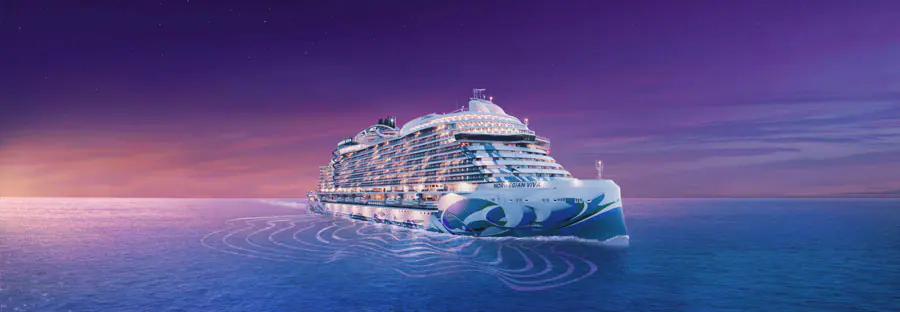
NCL's defining contribution to the industry arrived in May 2000 with the introduction of Freestyle Cruising — a concept that eliminated fixed dining times, assigned seating, and enforced dress codes in one stroke. It was the biggest single innovation in the modern cruise experience, and every major line has since adopted elements of it. But NCL remains the most fully committed to the philosophy. There is no formal night, no assigned table, and no expectation that you show up anywhere at a particular time. The freedom is genuine, and for guests who find traditional cruising's rituals off-putting, it is transformative. The fleet of 19 ships ranges from compact older vessels to the newest Prima Plus class, led by Norwegian Aqua, which launched in early 2025 with features like the Aqua Slidecoaster hybrid ride and the first official Prince tribute show at sea.
What distinguishes NCL within the mainstream category is the combination of Freestyle flexibility, an unusually diverse entertainment offering, and The Haven — a keycard-gated luxury enclave with its own pool, restaurant, and butler service tucked inside a mainstream ship. NCL competes primarily with Royal Caribbean and, to a lesser extent, Carnival and MSC. Within that group, it sits roughly level with Royal Caribbean on pricing, above Carnival, and below Celebrity on the premium spectrum. The brand's energy is American, informal, and activity-driven — this is a line built around choice, not ritual.
The base cruise fare on NCL covers your cabin, main dining room meals for breakfast, lunch, and dinner, the buffet, basic room service, pools, the fitness centre, production shows, and kids' clubs. That is where the inclusions end. Alcoholic drinks, Wi-Fi, specialty dining, shore excursions, spa treatments, go-kart sessions, and daily service charges of US$20 per person — US$25 for suites and The Haven — are all additional. NCL is fundamentally an a la carte line, and the true cost of a comfortable sailing sits meaningfully above the advertised fare.
The Free at Sea promotional package, included on most bookings, is NCL's answer to the inclusion question. The standard tier bundles an unlimited open bar covering drinks up to US$15 each, two specialty restaurant meals per sailing, 150 minutes of standard Wi-Fi, and a US$50 shore excursion credit per port per stateroom. For moderate drinkers, the open bar alone justifies the package — four to five drinks a day comfortably exceeds the break-even point. Non-drinkers extract significantly less value. The Free at Sea Plus upgrade, at approximately US$50 per person per day, adds super-premium spirits, unlimited streaming Wi-Fi via Starlink, and — critically — includes the daily service charges, which simplifies the budgeting considerably.
The Haven takes the inclusion conversation to another level entirely. Haven guests receive a private pool and sun deck, an exclusive restaurant serving breakfast, lunch, and dinner, a dedicated lounge with concierge, 24-hour butler service, priority embarkation and tender access, and priority entertainment and dining reservations. Depending on the booking, complimentary specialty dining and premium beverages may also be included. The three-bedroom Garden Villa — a sprawling suite with private terrace — has won multiple awards for best cruise ship suite. It is a genuinely clever proposition: all the entertainment and dining variety of a four-thousand-passenger mainstream ship, with a private luxury retreat whenever the energy becomes too much.
Freestyle dining is the heart of the NCL experience. There are no fixed times, no assigned tables, and no expectation of when or where you eat. Most ships offer 15 to 20 dining venues, from main dining rooms operating on open seating to casual all-day options and a roster of specialty restaurants that is genuinely the broadest in mainstream cruising. The main dining rooms — typically two or three per ship, with names like Taste, Savor, and the Manhattan Room — serve multi-course rotating menus that are competent without being exceptional. The Garden Cafe buffet handles the volume adequately, though quality reviews on older ships range from acceptable to disappointing. The Prima-class Indulge Food Hall, an 11-station venue covering everything from tapas to Indian street food, is a standout innovation that markedly improves the complimentary dining offering.
The specialty dining roster is where NCL flexes its advantage. Cagney's Steakhouse, Le Bistro French, Teppanyaki, La Cucina Italian, Ocean Blue Seafood, Food Republic Asian fusion, and a dedicated sushi bar are typical across the newer fleet, with cover charges tiered from around US$40 to US$60 per person. The quality in these venues is consistently good and occasionally excellent — Cagney's and Le Bistro are the perennial favourites. Free at Sea includes two specialty meals per sailing, and the Haven often includes additional specialty dining access, which means guests in upper categories can sample the full range without additional outlay.
The honest assessment of NCL's dining is that quantity is the strength and consistency is the weakness. No other mainstream line gives you as many places to eat, and the variety means you can eat a different cuisine every night of a week-long cruise without repeating. But the complimentary venues — the main dining rooms and particularly the buffet — do not reach the standard of Royal Caribbean's equivalents, and dietary accommodation, while available, is adequate rather than inspired. If food is your primary criterion, Celebrity or Oceania will serve you better. If choice, flexibility, and the freedom to eat wherever you feel like at any hour appeals, NCL has no equal in the mainstream segment.
NCL ships are energetic, social, and buzzy. The typical passenger base is broad — ages ranging from the 30s to the 70s with a median around 50 — and significantly younger than Holland America, Cunard, or Princess. On Caribbean and Alaska sailings, 70 to 80 per cent of passengers are North American. Families with children are well represented during school holidays, couples account for the largest segment, and groups of friends travelling together are common. Solo travellers have a genuine home here thanks to the Studio cabins and their exclusive lounge. The atmosphere is distinctly American in character: English is the dominant language, entertainment leans heavily on US pop culture and Broadway, and the menus are American-mainstream in style.
The dress code — or deliberate lack thereof — is central to the NCL identity. There are no formal nights. Daytime is genuinely casual, and evening dining calls for resort casual at most — collared shirts and trousers rather than suits or jackets. NCL introduced Norwegian's Night Out as an optional dress-up evening, but it is a gentle suggestion, not an enforced policy. For guests who dislike the formality of traditional cruising, this remains NCL's most powerful draw. Entertainment is a genuine strength: Broadway-calibre production shows have historically included full-length musicals like Kinky Boots, SIX, and Beetlejuice, though NCL is shifting toward original in-house productions alongside the licensed shows. Live music venues like Syd Norman's Pour House and the Cavern Club Beatles bar keep the later evenings lively on newer ships.
Being straightforward about who NCL is not for matters as much as who it suits. Guests seeking quiet, intimate ships with intellectual enrichment — destination lectures, cultural programming, museum-quality art — should look at Viking or Holland America. Anyone who expects a truly all-inclusive price where the fare is the fare will find NCL's add-on culture frustrating; Virgin Voyages or an ultra-luxury line addresses that better. And passengers who are sensitive to commercial upselling should be warned: NCL's onboard revenue approach is the most aggressive of the three major US cruise lines, with persistent promotions for drink packages, spa treatments, photo packages, and art auctions that some guests find intrusive.
Latitudes Rewards is NCL's complimentary loyalty programme, automatically enrolling guests after their first cruise. Members earn one point per cruise night, with bonus points for suite and Haven bookings. The programme spans seven tiers — Bronze, Silver, Gold, Platinum, Sapphire, Diamond, and Ambassador — with benefits escalating at each level. The early tiers offer discounts on the open bar package and members-only promotional offers. The programme becomes meaningfully valuable at Platinum, which requires 75 points and unlocks a 50 per cent open bar discount, two complimentary specialty dinners, a pre-cruise concierge service, and priority restaurant and entertainment reservations.
The upper tiers deliver genuinely strong benefits for committed NCL guests. Sapphire at 150 points adds shore excursion discounts and access to exclusive member cruises. Diamond at 350 points includes a one-time complimentary cabin upgrade and enhanced Wi-Fi discounts. Ambassador at 700 points — realistically achievable only by the most dedicated repeat cruisers — rewards with a complimentary seven-night cruise. Since October 2025, NCLH has offered cross-brand loyalty status recognition across Norwegian, Oceania, and Regent Seven Seas, meaning your Latitudes tier is honoured when sailing sister brands. This is a meaningful differentiator versus Carnival Corporation's less integrated approach, and it creates a genuine incentive for NCLH loyalists to explore premium and luxury cruising within the family.
NCL maintains a dedicated Australian office at Level 7, 99 Elizabeth Street, Sydney, with a local reservations line at 1300 255 200 and an Australian website at ncl.com/au/en that quotes fares in AUD. The line is well represented in the Australian travel trade through CLIA Australasia and maintains relationships with the major agency groups. Booking through an Australian specialist agent frequently secures additional onboard credit, cabin upgrades, or consortium benefits not available through the website.
NCL deploys ships to Australian waters seasonally, typically from December through March, with Sydney as the primary embarkation port. The current programme covers Australia and New Zealand itineraries of 11 to 14 nights. The 2026/27 season expands with an enhanced programme featuring overnight calls in both Melbourne and Adelaide, plus itineraries covering Tasmania, Kangaroo Island, and South Australia. NCL has also announced over 30 new Asia-Pacific itineraries for the broader region, increasing the options accessible to Australian travellers without long-haul flights.
For Australians wanting to experience NCL's flagship Caribbean, Alaska, or Mediterranean product, the routing requires planning. Auckland is a direct three-hour flight. Singapore connects directly in around eight hours, opening access to repositioning and Asia itineraries. The marquee Caribbean departures from Miami route through Los Angeles at 20 to 24 hours total travel. Alaska sailings from Seattle connect via the US West Coast at 16 to 20 hours. European embarkation points — Barcelona, Rome, Southampton — connect through Middle Eastern hub carriers. The fly-cruise logistics are manageable but meaningful in both cost and travel time, which is worth factoring into the overall budget when comparing a local Australian deployment against an international sailing.
NCL's per-diem pricing sits in the mainstream segment — roughly comparable to Royal Caribbean, above Carnival and MSC, and below Celebrity and Holland America in the premium tier. A seven-night Caribbean cruise in a balcony stateroom starts from approximately US$180 to US$350 per person per night at double occupancy before any add-ons. The Prima-class ships command a premium over older fleet members, and peak-season sailings during school holidays and the northern summer push prices higher. These are directional figures that shift substantially with ship, season, and booking timing.
The critical number for budgeting is the all-in daily cost, because the advertised fare only tells part of the story. Adding the daily service charges at US$20 per person, plus the real-world cost of drinks, Wi-Fi, and a couple of specialty dining experiences, brings the effective daily spend meaningfully above the sticker price. Free at Sea offsets some of this — the included open bar and dining credits are genuine value — but passengers who upgrade to Free at Sea Plus at US$50 per day need to factor that into their comparison. When you stack NCL's total cost against Royal Caribbean with a comparable drink package, the gap between the two narrows to a point where the decision comes down to priorities rather than price. The Haven represents a different value equation entirely: it delivers a luxury experience comparable in many respects to a suite on Celebrity or a premium-tier cabin on Viking, at a per-diem that undercuts both, while retaining access to the full mainstream ship beneath.
Solo travellers benefit from NCL's Studio cabins — purpose-built singles with no supplement on seven ships — which remain the strongest solo proposition in mainstream cruising. Wave season from January through March consistently delivers the best promotional pricing and bonus inclusions, and booking six to nine months before sailing typically secures the optimal balance of price and cabin selection. Deposits range from US$100 to US$1,000 per person depending on cabin category and cruise length, with final payment due 120 days before departure. Cancellation terms are standard for the mainstream segment, with penalties escalating from 25 per cent at 60 to 89 days out to the full fare within 14 days. For Australian travellers budgeting a fly-cruise, the international airfare, pre-cruise hotel, and foreign exchange on onboard spending in US dollars should all be layered onto the cruise cost to reach a realistic total.
Share your dates and preferences and we will come back with Norwegian Cruise Line cabin options, pricing, and insider tips.