Iceland Pro Cruises
Expedition Cruising
This is the specialist pick for Iceland — a small company run by Icelanders who genuinely know every fjord, hot spring, and fishing village on the circumnavigation route. The ship is modest but the guiding is exceptional, and you visit tiny ports that the bigger expedition lines skip entirely. It is the closest thing to a local's tour of Iceland by sea.
Iceland ProCruises — now operating as Arctic ProCruises following a 2025 rebrand — is a specialist operator built on a single premise: nobody knows Iceland's coastline better than the Icelanders themselves. The company grew out of the Iceland ProTravel Group, a network of roughly 15 travel companies across seven countries, all focused on Iceland and Scandinavia. Founded in 2003 by native Icelander Gudmundur Kjartansson, the group launched its cruise division in 2014 as a natural extension of decades of land-based Icelandic expertise. The signature product is the circumnavigation of Iceland, a nine-to-ten-day voyage from Reykjavik that traces the entire coastline through fjords, volcanic landscapes, whale-rich waters, and fishing villages that larger ships cannot reach.
What distinguishes this company from bigger expedition brands is the depth of local knowledge embedded in every aspect of the operation. The expedition team, the chef, the itinerary design, and the cultural programme are all Icelandic. This is not a global operator that has added Iceland to a broad portfolio — it is a company whose entire identity is rooted in one destination, and that focus produces a calibre of guiding and local access that generalist lines simply cannot replicate. The recent expansion into Greenland and Svalbard under the Arctic ProCruises name has broadened the programme, but Iceland remains the heartland.
It is worth understanding the business model. Iceland ProCruises does not own any ships. It charters vessels from partner companies — currently Oceanwide Expeditions and Plantours — and provides the expedition team, itinerary, and guest experience. This asset-light approach means the fleet can change between seasons, which has happened several times. The former flagship MS Seaventure was sold in 2025, and the current programme uses the MV Hondius, MV Plancius, MV Ortelius, and MS Hamburg. It is an unusual model, and prospective guests should understand that the shipboard hardware may differ from one season to the next.
The expedition team is the heart of the product, and this is where Iceland ProCruises earns its specialist reputation. Many team members are native Icelanders or long-term Iceland residents, bringing genuine first-hand expertise in the country's geology, volcanology, wildlife, saga history, and contemporary culture. Lectures on topics from tectonic plate dynamics to Norse mythology are delivered by people who grew up with these subjects, not by hired presenters working from a brief. All communications are in English, with many voyages also staffed by German-speaking team members — a legacy of the company's strong European roots. The enrichment programme is consistently cited by passengers as a genuine educational experience rather than filler between ports.
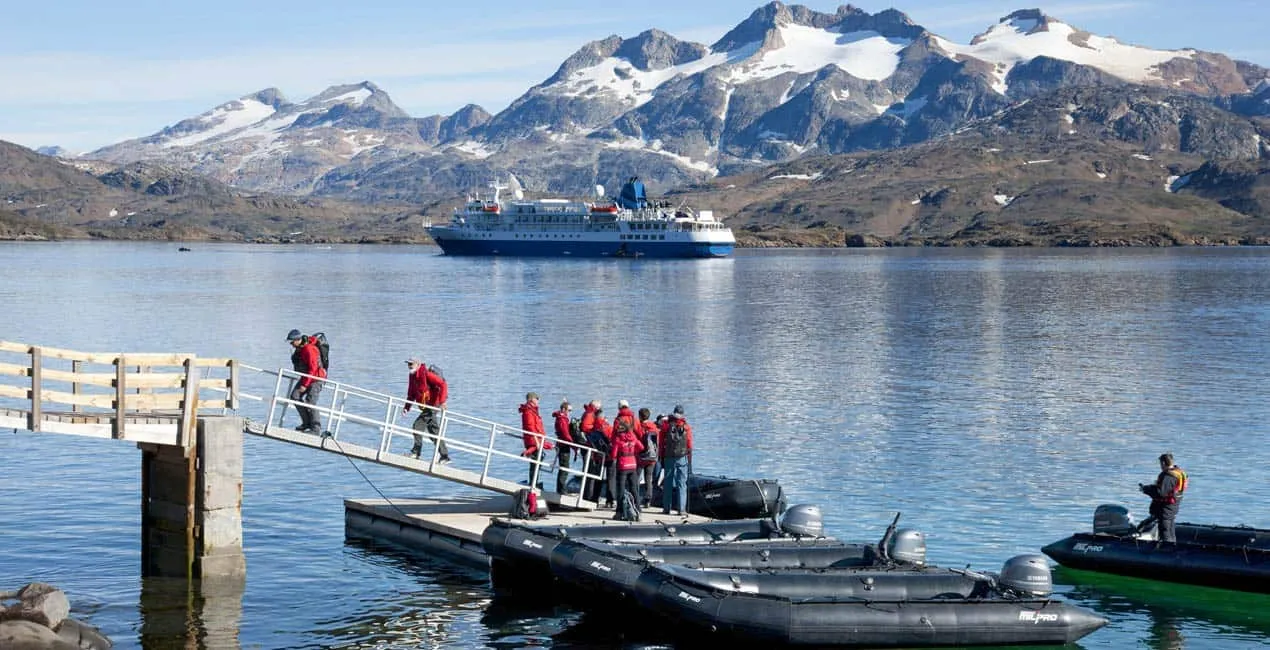
Landing operations follow the standard expedition model. All vessels carry fleets of Zodiacs for shore access and wildlife cruising, and landings are weather-dependent with the captain retaining final authority on feasibility. The circumnavigation typically includes one to two port calls per day, accessing sites ranging from puffin colonies and geothermal pools to remote fishing hamlets. The guide-to-guest ratio sits at roughly 1:11 to 1:16 depending on the vessel — adequate for the soft-expedition model, though below the ratios offered by the most guide-intensive polar operators. Where the numbers fall slightly short, the local expertise compensates. Having an Icelandic geologist explain volcanism while you are standing on a lava field hits differently than a lecture theatre presentation.
The overall fitness requirement is modest. You need to be comfortable boarding a Zodiac from a gangway, walking on uneven ground, and managing ship stairs without assistance. Beyond that, the activity level is relaxed. This is a soft expedition rather than an extreme wilderness programme, and the shore excursion model allows passengers to choose their level of engagement each day. Optional excursions range from gentle village walks to more demanding glacier hikes, but nobody is required to participate in anything beyond their comfort level.
The inclusion structure is a hybrid model that differs from many expedition competitors, and it is important to understand the distinction clearly. The base fare covers accommodation, full board (buffet breakfast and lunch, a la carte dinner), water, tea, and coffee throughout the day, afternoon tea and late-night snacks, all Zodiac excursions, the expedition team and enrichment lecture programme, port fees and landing charges, rubber boots on loan for landings, and a complimentary expedition jacket that passengers keep.
What is not included matters just as much. Organised shore excursions at ports of call — whale watching, glacier tours, cultural visits, geothermal bathing — are paid extras, and this is a significant departure from operators like Aurora Expeditions, Quark, or Ponant, where shore activities are typically bundled into the fare. Iceland is an expensive country, and excursion costs reflect that reality rather than excessive operator markup. Passengers who want to participate in three or four activities daily should budget meaningfully above the base fare. Alcoholic beverages and soft drinks beyond water, tea, and coffee are also purchased separately, which adds to the total cost for passengers who enjoy wine with dinner.
International flights, travel insurance, airport transfers, gratuities, and laundry are all additional. Some itineraries include a pre-cruise hotel night in Reykjavik and domestic flights, but this varies by departure. The net effect is that the advertised base fare, while competitive, does not represent the full cost of the holiday. This is not unusual in the expedition segment, but the combination of excluded excursions and excluded drinks means the gap between headline price and total spend is wider here than with more inclusive competitors.
Life on board is intimate, communal, and destination-focused rather than ship-focused. With vessels carrying between 108 and 170 expedition passengers (the 420-passenger MS Hamburg is a separate group-cruise product with a different character), you get to know your fellow travellers quickly. The single main restaurant operates open seating with no assigned tables, and the social dynamic tends toward shared conversation over meals rather than private dining. The expedition team eats alongside guests, and evenings revolve around enrichment lectures, the bar, and whatever the day's landings have given everyone to talk about.
The passenger demographic splits between English-speaking and German-speaking guests, reflecting the company's dual-market heritage. On bilingual voyages, announcements and some materials are delivered in both languages, and the social atmosphere has a distinctly international flavour. Australian travellers will find themselves in a minority, but the communal nature of small-ship expedition cruising makes integration effortless. The demographic skews older and well-travelled — this is a culturally curious audience, not a party crowd.
This is not the right product for travellers seeking luxury amenities, formal evenings, or polished entertainment. There is no casino, no production shows, no spa worth mentioning, and no room service. The cabins are functional rather than lavish — compact outside staterooms with private bathrooms, adequate for expedition travel but modest by contemporary cruise standards. What the company offers instead is authenticity: an Icelandic chef cooking Icelandic food with Icelandic ingredients, an Icelandic expedition team sharing their own culture, and an itinerary designed by people who know every anchorage on the route. For the right traveller, that trade-off is not a compromise — it is the entire point.
Getting to Iceland from Australia requires commitment. There are no direct flights, and the most efficient routing is typically via Helsinki on Finnair, then connecting to Reykjavik on Icelandair — total travel time of roughly 24 to 28 hours each way. London, Copenhagen, and Middle Eastern hubs all provide alternative connections. Qantas frequent flyer members can redeem points on oneworld partners including Finnair and British Airways for the European legs. Budget for return airfares in the range of two to four thousand dollars depending on season, route, and class of travel. Allow at least one full buffer day in Reykjavik before embarkation — arrival fatigue is real after that journey, and missing a ship departure in Iceland is not recoverable.
The timing question comes down to what you want to experience. June and July deliver the midnight sun, with near-24-hour daylight, peak puffin and whale activity, and the warmest weather Iceland offers (which is to say, cool by Australian standards — layers are essential). August and September departures offer the chance of Northern Lights and dramatic autumn colours, though reduced daylight and rougher seas are part of the bargain. For most Australian travellers, the Iceland circumnavigation makes sense as part of a broader European itinerary, and the company's nine-to-ten-day voyage length allows it to be combined with time in Scandinavia, the British Isles, or continental Europe.
Iceland ProCruises does not have an Australian office, Australian phone line, or Australian trade representation. Fares are quoted in US dollars, British pounds, or euros — not Australian dollars — and you will be subject to exchange rate fluctuations. Booking through an Australian specialist travel agency provides a layer of local support and consumer protection that booking direct from Hamburg does not. European power outlets (220V Europlug) are standard on board, so pack a travel adaptor.
Iceland ProCruises has consistently been described as the most affordable option for a full circumnavigation of Iceland by expedition ship, and that positioning is genuine. Entry-level per diems on the Iceland programme work out to roughly A$500 to A$800 per person per day in triple or quadruple share cabins, rising to A$1,000 to A$1,300 in superior doubles and suites. Against the handful of other operators offering Iceland circumnavigations — most of which are larger luxury expedition brands charging considerably more — the value proposition is clear, provided you understand what is and is not included.
The catch is that the base fare alone does not represent what you will actually spend. Shore excursions at every port, alcoholic beverages, international flights, and gratuities are all additional, and in a country as expensive as Iceland, excursion costs can add several hundred dollars per person to the total. A realistic all-in budget for an Australian traveller — including flights, the cruise, excursions, drinks, insurance, and pre- and post-cruise accommodation — will be meaningfully higher than the headline fare suggests. This does not make the product poor value, but it does mean careful budgeting is essential.
A 20 per cent deposit is due at booking, with final payment due between six and nine weeks before departure depending on the vessel operator. Cancellation penalties escalate sharply as the departure date approaches, and travel insurance with cancellation and medical evacuation cover is mandatory. Solo travellers do not have dedicated single cabins, but the triple and quadruple berth cabins on the Hondius and Plancius provide a cost-effective option for passengers willing to share. The company has periodically run solo traveller promotions, so it is worth asking about availability. There is no loyalty programme and no repeat-guest recognition — a reflection of the company's small-operator scale rather than an oversight.
Share your dates and preferences and we will come back with Iceland Pro Cruises cabin options, pricing, and insider tips.