HX Expeditions
Expedition Cruising
HX is the biggest name in polar expedition cruising for good reason — they have more Antarctic departures than anyone and their hybrid ships are genuinely pioneering. The expedition teams are outstanding, the science programme is real, and they were the first line to ban single-use plastics and heavy fuel oil. If Antarctica or Svalbard is the goal, HX should be the starting point.
HX Expeditions — rebranded from Hurtigruten Expeditions in late 2023 — is the world's largest expedition cruise operator by number of polar departures and the most established name in expedition travel, with roots stretching back to 1896 when the first Arctic charter voyage sailed from Hammerfest to Svalbard. The rebrand to HX was designed to draw a clear line between the global expedition company and Hurtigruten, which retains the Norwegian Coastal Express route between Bergen and Kirkenes. Since early 2025, the two are legally separate businesses under different ownership, with independent fleets, booking systems, and management teams. If you are planning an Antarctic or Arctic expedition, you want HX. If you want the classic Norwegian coastal mail-boat voyage, that is Hurtigruten.
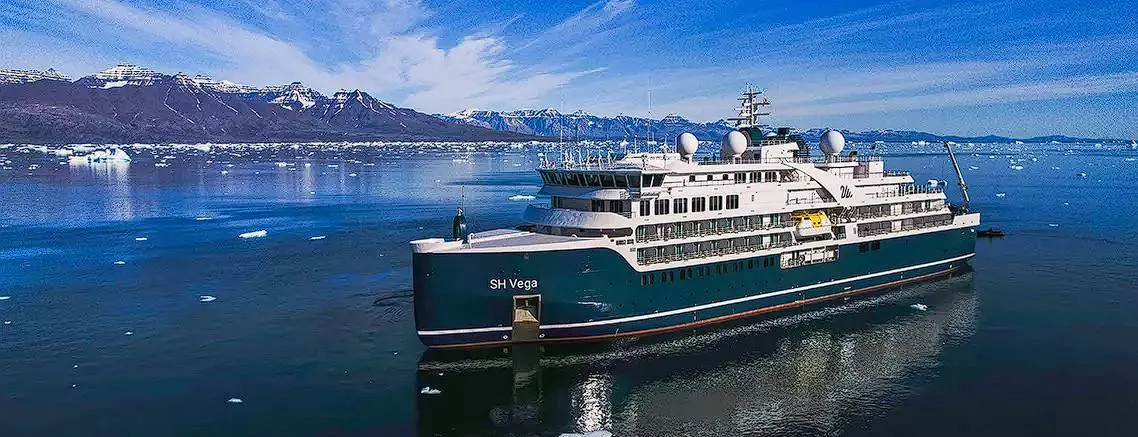
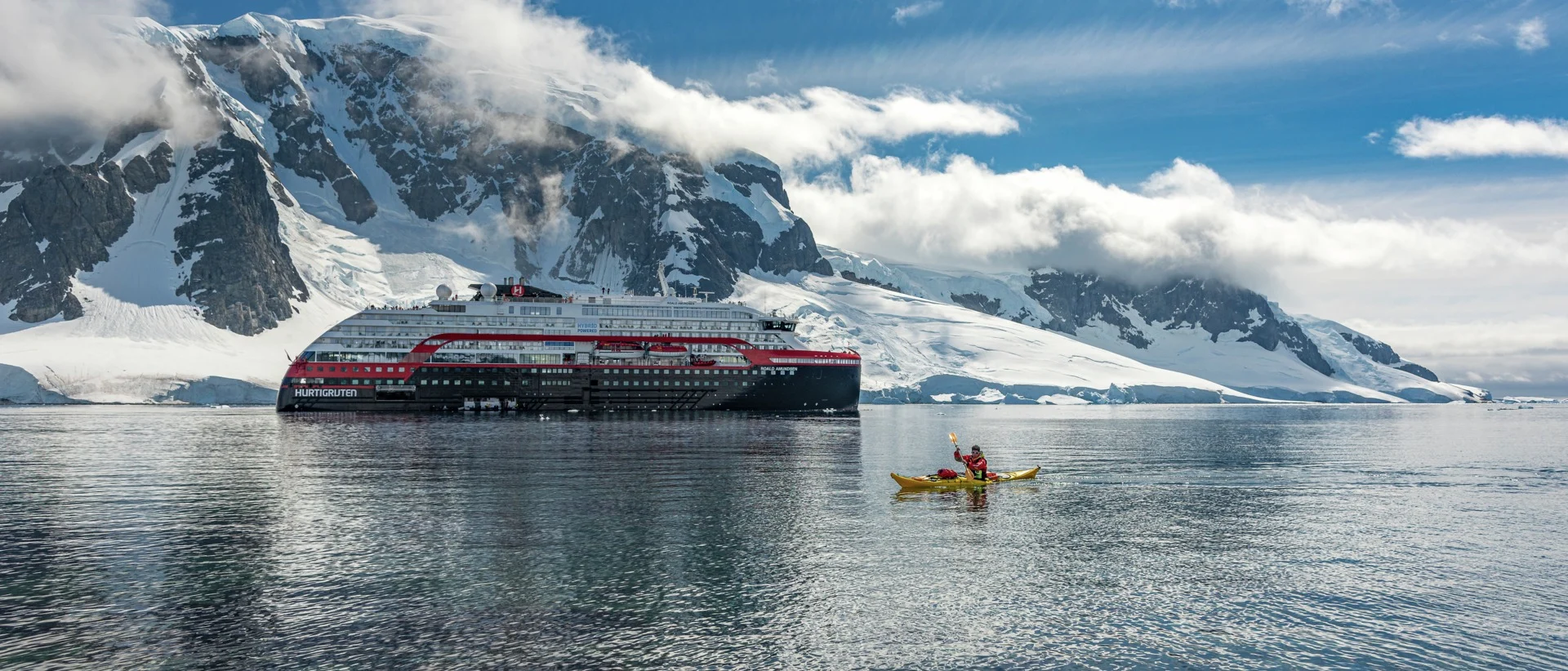
The fleet centres on two hybrid-powered sister ships — MS Fridtjof Nansen and MS Roald Amundsen — which were the world's first battery-hybrid expedition cruise ships when they launched in 2019 and 2020. These vessels can operate on battery power alone in the most sensitive environments, reducing emissions by approximately twenty percent compared to conventional diesel. The veteran MS Fram and the smaller MS Spitsbergen round out the polar fleet, both freshly refurbished in 2025 with new Science Centres and updated cabins. A fifth vessel, MV Santa Cruz II, operates year-round in the Galapagos.
What defines HX is scale combined with a genuine science-driven ethos. The company holds founding membership in AECO (the Arctic expedition cruise operators' body) and full operator membership in IAATO for Antarctica. It was the first cruise line to ban single-use plastics and heavy fuel oil, and it operates an in-house polar guide training academy that won the Princess Royal Training Award. HX is not positioned as luxury — this is not the Ponant or Silversea experience. It is purposeful, adventure-first expedition cruising at a more accessible price point, with the deepest bench of polar itineraries in the industry.
Every HX voyage carries a multi-disciplinary expedition team of marine biologists, ornithologists, glaciologists, historians, photographers, and cultural interpreters. The exact team size varies by ship, with the hybrid vessels carrying approximately fifteen to twenty specialists and the smaller Fram and Spitsbergen carrying ten to fifteen. The guide-to-guest ratio on the larger ships sits at roughly one to twenty-five — honest about it, that is notably lower than Aurora Expeditions at one to eight or Quark at one to ten. It is the trade-off for sailing at a lower price point on a larger vessel, and it is the single most important distinction to understand when comparing HX to its smaller-ship competitors.
The Science Centre is the intellectual heart of every ship, equipped with microscopes, digital screens, Blueye underwater drones for live subsea footage, and hands-on workshop space. HX runs genuine citizen science programmes on every voyage in partnership with organisations including Happywhale, eBird, iNaturalist, and the University of Tasmania's Institute for Marine and Antarctic Studies. Guests contribute real data — whale photographs for migration tracking, phytoplankton samples, water-clarity measurements — and the 2025-2026 Antarctic season alone targets over sixteen thousand data submissions across more than twenty research projects. This is not performative science tourism; it is structured participation that contributes to peer-reviewed research.
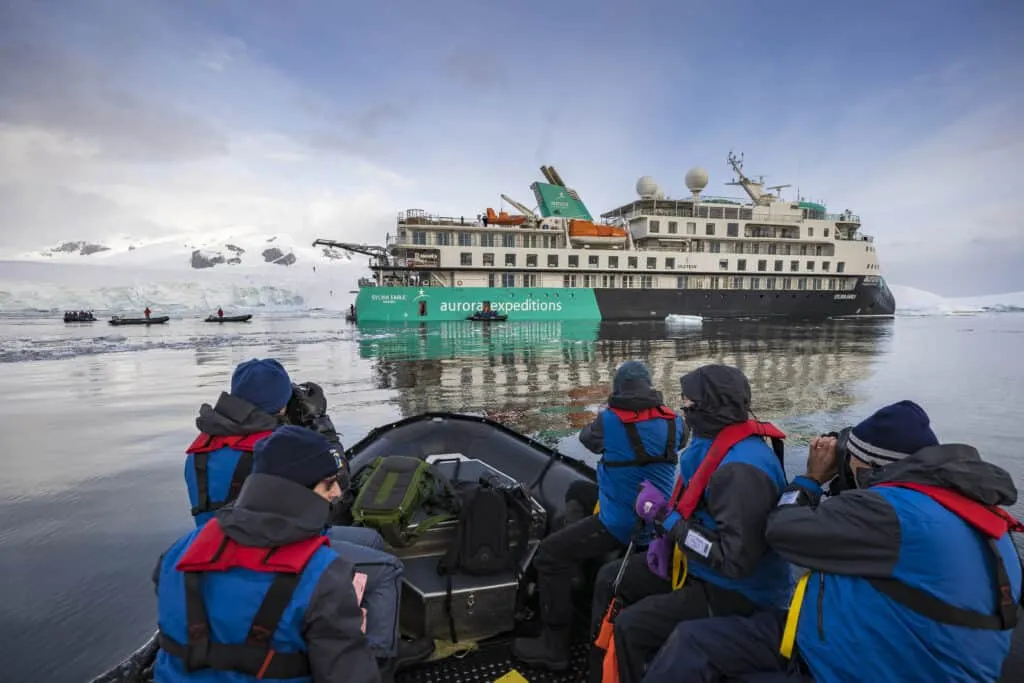
Landings typically run twice daily when conditions allow, split between Zodiac cruises and shore excursions. On the hybrid ships with five hundred guests in polar waters, IAATO regulations permit only one hundred ashore at any time, meaning passengers rotate in five groups — a process that takes longer than on ships carrying two hundred or fewer. On MS Fram, with her polar cap of two hundred guests, rotations are faster and the experience more intimate. Included activities cover all nature landings, Zodiac cruising, wildlife observation, the polar plunge, extended hikes, and every lecture and Science Centre session. Optional paid extras include sea kayaking, overnight camping by bivvy bag or tent, and snowshoeing. You do not need to be an athlete, but you must be able to safely board and exit a Zodiac, and landing terrain can be challenging — slippery rocks, deep snow, and steep shorelines are standard.
HX transitioned to an all-inclusive fare model in late 2024, which significantly improved its value proposition and brought it in line with what Ponant and Silversea have offered for years. The base fare now covers full-board dining at all standard restaurants, house wine, beer, spirits, and cocktails throughout the day and evening, complimentary Starlink Wi-Fi, gratuities, and all daily expedition activities including landings, Zodiac cruising, and hikes. Every guest receives a wind- and water-resistant expedition jacket to keep, a reusable water bottle, loaned rubber boots and trekking poles, and a professional digital photo album from the onboard photographer. All lectures, Science Centre access, and citizen science participation are included.
Antarctic voyages add further value. Most itineraries include charter flights between Buenos Aires and Ushuaia and a pre-cruise night at a five-star Buenos Aires hotel — meaningful inclusions that some competitors charge separately for. Suite guests receive additional benefits including complimentary fine dining at Restaurant Lindstrom for every meal and priority embarkation.
What is not included: international flights to the embarkation port, travel insurance, optional paid activities such as kayaking, camping, and snowshoeing, premium drinks, spa treatments, Restaurant Lindstrom for non-suite guests, and laundry. The shift to all-inclusive eliminated a significant source of previous guest complaints about drinks charges and hidden costs, and it makes the total cost easier to compare against competitors on a like-for-like basis.
HX's culinary programme is rooted in the Norway's Coastal Kitchen concept — Scandinavian-influenced cooking that emphasises fresh, sustainably sourced ingredients, regional flavours that reflect the voyage destination, and a style that sits somewhere between hearty expedition fare and refined Nordic cuisine. Menus change daily, with dishes ranging from fresh seafood and reimagined Nordic classics to international options designed for a multinational guest mix that skews heavily European.
The main restaurant, Aune, serves all guests for breakfast, lunch, and dinner. Breakfast and lunch are buffet format; dinner is plated service. Restaurant Lindstrom is the fine-dining venue — an intimate, refined space named after Adolf Lindstrom, chef to Norwegian polar explorers, offering Scandinavian-inspired tasting menus and premium wine pairings. It is included for suite guests at all meals and available to other guests for a surcharge. Fredheim provides casual dining and quick bites throughout the day, and the recently refurbished MS Spitsbergen added Brygge Bistro for daytime snacks.
There are no celebrity chef partnerships — unlike Ponant with Alain Ducasse or Silversea with S.A.L.T. — and the buffet format at breakfast and lunch is the most common critique from guests who have experienced fully plated service on luxury expedition lines. That said, reviewers consistently rate the food as very good for the expedition segment, and the quality at Lindstrom in particular receives genuine praise. The dress code is relaxed at all times, including in Lindstrom — there are no formal nights on any HX ship. Vegetarian, vegan, and special dietary needs are accommodated with advance notice; halal, kosher, and severe allergy requirements should be communicated well before sailing.
HX attracts a broad, internationally diverse guest mix — predominantly European, with strong representation from the United Kingdom, Germany, Scandinavia, North America, and increasingly Australia. The typical passenger is aged forty to seventy, curious rather than pampered, and drawn to the destination rather than the ship. Many are couples, but HX reports that nearly twenty percent of guests travel solo, making it one of the more solo-friendly expedition lines. This is not a luxury experience in the traditional sense — there are no butlers, no silver-service dining, no evening entertainment beyond expedition team presentations and conversation in the lounges. If you want the polish of Ponant or the intimacy of Silversea, HX is not the right fit.
The sustainability ethos is genuine rather than cosmetic. The hybrid propulsion system, the ban on single-use plastics and heavy fuel oil, the citizen science partnerships, and the AECO and IAATO memberships all reflect a company that takes its environmental obligations seriously. Scandinavian design runs through the interiors — clean lines, natural materials including oak and birch, warm lighting, and an overall aesthetic that feels purposeful rather than decorative. The dress code is expedition casual at all times: layers for activities, comfortable clothes for the ship, no jackets or formal wear required anywhere.
The honest assessment: HX is best suited to travellers who want to reach extraordinary places aboard well-run ships with knowledgeable expedition teams, and who care more about what is happening outside the window than what is on the dinner menu. It is not for anyone seeking ultra-luxury, intimate ship atmospheres, or the kind of service where staff outnumber guests. The larger hybrid ships in particular can feel like expedition cruising at scale — efficient and well-organised, but not intimate. If the small-ship, high-touch expedition experience matters most, the smaller Fram or a competitor like Aurora will deliver that more directly.
HX made a meaningful commitment to the Australian market in 2025 by establishing a dedicated sales and marketing team for Australia and New Zealand, with a guest services team based in Melbourne. This gives Australian clients a local point of contact during business hours — a practical advantage over dealing with European headquarters in different time zones. The Australian website displays pricing in AUD, and around seventy percent of HX's Asia-Pacific bookings come through travel advisors, so working with a specialist agent is the standard path.
There are no HX departures from Australian ports — unlike Aurora Expeditions, which sails from Sydney. For Antarctica, the most common routing from Australia is Sydney or Melbourne to Buenos Aires via Santiago on Qantas or LATAM, both oneworld alliance carriers, with Qantas Frequent Flyer points earnable. HX includes charter flights from Buenos Aires to Ushuaia and a pre-cruise hotel night, so the only international airfare to arrange is the Australia-to-Buenos-Aires leg. Budget two to four thousand dollars for that return flight and allow for the thirteen-hour time difference when planning arrival timing. For Arctic voyages to Svalbard or Greenland, routing is typically through Singapore, Dubai, or London, adding transit time but opening access to some of the most remarkable expedition destinations on the planet.
The destinations most relevant to Australian travellers are Antarctica — where HX offers the largest programme of any operator — and the Arctic, particularly Svalbard, Greenland, and the Northwest Passage. HX also runs expedition-style Alaska voyages and year-round Galapagos departures, both of which are reachable from Australia with one or two connections. The 163 percent revenue growth HX has reported across the Asia-Pacific region since 2019 signals that Australian demand for expedition cruising continues to accelerate, and HX's local investment reflects a serious commitment to capturing that market.
HX occupies the budget-to-mid tier of the expedition market — meaningfully more affordable than luxury-expedition operators like Ponant, Silversea, and Seabourn, broadly comparable to Quark Expeditions, and competitive with Aurora Expeditions when the all-inclusive fare is factored in. Entry-level Polar Outside cabins on a standard Antarctic Peninsula voyage sit at roughly eleven hundred to fifteen hundred Australian dollars per person per day, which represents strong value given that drinks, Wi-Fi, gratuities, and all expedition activities are now covered. The move to all-inclusive pricing in late 2024 was a significant shift that closed much of the perceived gap between HX and operators that had been offering inclusive fares for years.
Against its closest competitors: Aurora Expeditions runs at a similar or slightly higher per-diem on a smaller, more intimate ship with better guide ratios — the premium is justified if expedition intimacy matters most. Quark sits in a comparable price band but charges separately for some items HX now includes. Ponant and Silversea operate in a different segment entirely, typically running fifty to one hundred percent higher on a per-diem basis, with luxury amenities and smaller guest counts to match. The honest positioning is that HX offers the most Antarctic departures, the broadest itinerary range, and one of the lowest barriers to entry for genuine expedition cruising — but the trade-off is larger ships, longer landing rotations, and a less polished onboard product than the luxury-expedition field.
Solo travellers find HX more accommodating than most. Limited no-supplement cabins are released periodically on a first-come-first-served basis, and when those are gone, supplements start from just twenty-five percent — exceptional in an industry where fifty to one hundred percent is standard. Deposits are twenty-five percent of the fare, with the balance due ninety days before departure. Shoulder season departures in November and March offer the best value, while peak December and January sailings command higher fares and sell out earliest. HX runs regular promotional campaigns including wave sales and early-booking incentives. Comprehensive travel insurance with medical evacuation cover is mandatory and, at this level of expenditure, non-negotiable.
Share your dates and preferences and we will come back with HX Expeditions cabin options, pricing, and insider tips.