Sea Cloud Cruises and Windstar Cruises both carry sailing heritage — but one hand-sets 29 sails on a 1931 tall ship carrying 64 guests, the other unfurls computer-controlled sails on modern yachts reaching 342 guests. Both access small harbours. Both eschew formal nights. Jake Hower compares two very different eras of sailing at sea for Australian travellers.
| Sea Cloud Cruises | Windstar Cruises | |
|---|---|---|
| Category | Yacht-Style | Yacht-Style / Luxury |
| Rating | ★★★★☆ | ★★★★☆ |
| Fleet size | 3 ships | 7 ships |
| Ship size | Yacht (under 140) | Yacht (under 300) |
| Destinations | Mediterranean, Caribbean, Northern Europe | Mediterranean, Caribbean, Alaska, French Polynesia |
| Dress code | Elegantly casual | Resort casual |
| Best for | Tall-ship sailing romantics | Romantic small-ship and sailing enthusiasts |
Sea Cloud is for the traveller who wants authentic, hand-set sailing aboard a vessel of irreplaceable heritage — a 1931 tall ship with original mahogany cabins, silver service dining, and the profound spectacle of 29 sails raised by hand. Windstar is for the traveller who wants sailing romance combined with modern fleet breadth — computer-controlled sails on three masted yachts, the James Beard Foundation culinary partnership, and a seven-ship fleet reaching Tahiti year-round, Alaska, Japan, and seasonally Australian waters. For Australians drawn to maritime history and intimate luxury at the smallest scale, choose Sea Cloud. For Australians wanting sailing heritage with broader destination coverage, modern suite accommodation, and the ability to board from Australian ports, choose Windstar.
The core difference
Both Sea Cloud Cruises and Windstar Cruises are sailing lines — but the word “sailing” means something entirely different on each. The gap between hand-set sails on a 1931 tall ship and computer-controlled sails on a modern yacht spans nearly a century of maritime engineering, and the guest experience aboard reflects that distance in every detail.
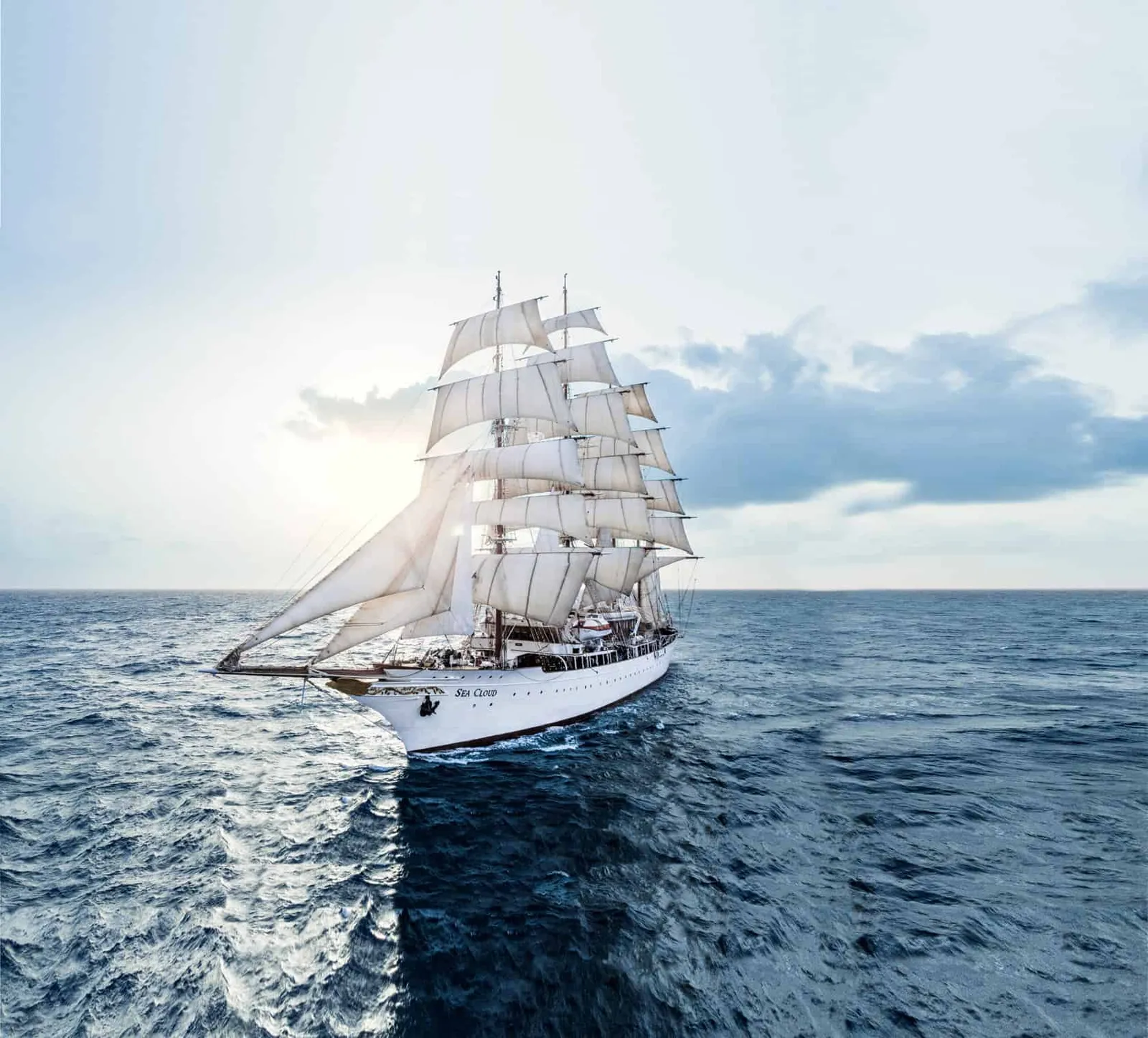
Sea Cloud preserves sailing as craft. The original 1931 vessel — built as the world’s largest private yacht for Marjorie Merriweather Post — carries just 64 guests while a professional crew hand-sets 29 sails across 3,000 square metres of canvas using techniques unchanged since the age of sail. The crew climb the rigging, haul the lines, and trim the canvas by hand. The ship moves under wind power whenever conditions allow. Sea Cloud II (2001, 94 guests) and Sea Cloud Spirit (2021, 136 guests) extended the fleet with purpose-built three-masted barques that maintain the same artisanal sailing philosophy. There are no computers controlling the sails. There is no button to press. The Hamburg-based company, founded in 1979, offers what no other cruise line can — a living connection to the golden age of sail wrapped in five-star hospitality.
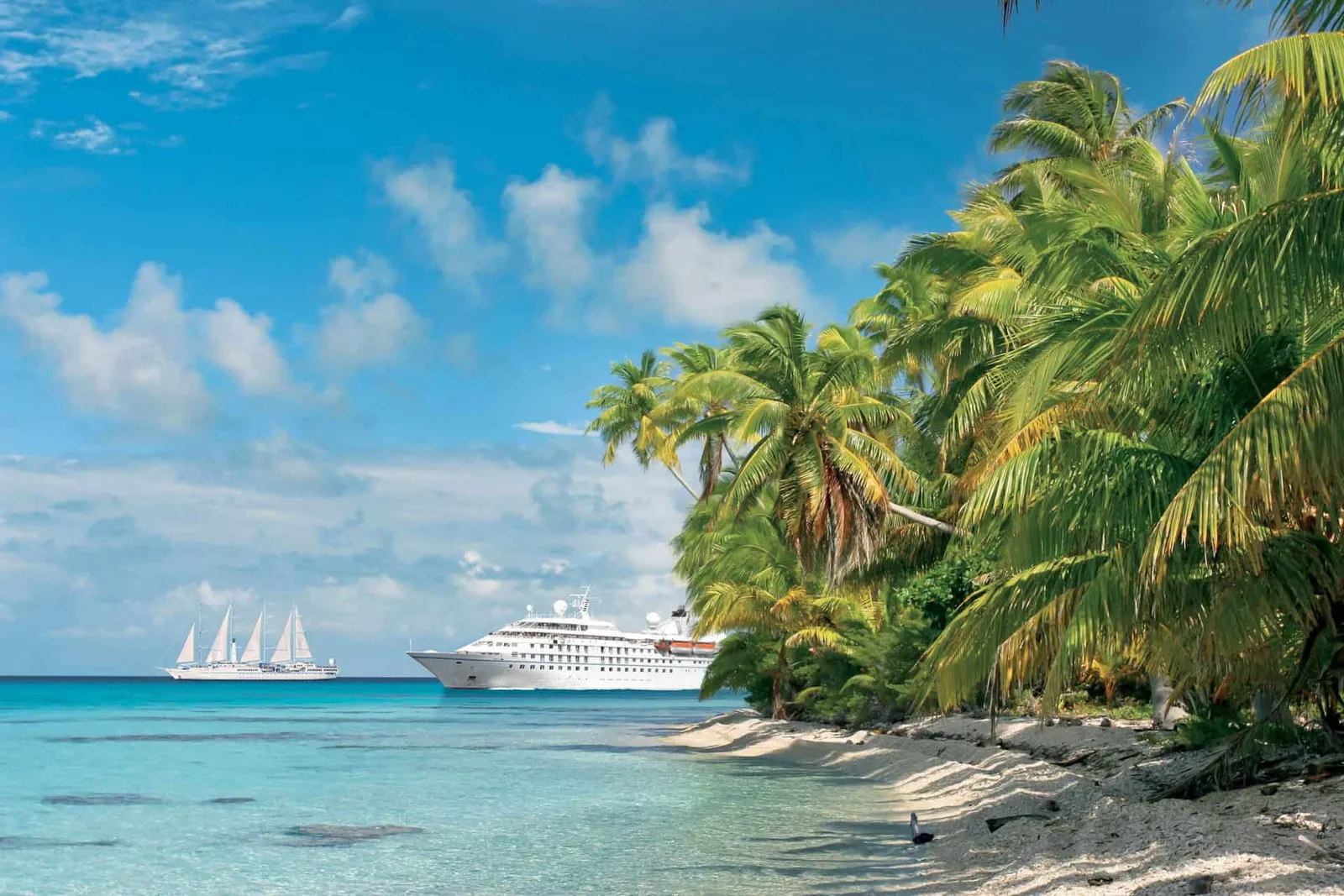
Windstar preserves sailing as romance. Three of its seven ships — Wind Surf (342 guests), Wind Star (148 guests), and Wind Spirit (148 guests) — are motorised sailing yachts with four or five masts of computer-controlled sails that unfurl at every departure to the swelling Vangelis “1492” score. The sails deploy under wind power when conditions permit, capable of generating speeds up to twelve knots without engines. The technology is sophisticated — sensors monitor wind speed and direction, adjusting sail trim automatically — and the result is genuinely beautiful: masted silhouettes against sunset horizons that define the Windstar brand. The four motor yachts in the fleet (Star Breeze, Star Legend, Star Pride, and the new-build Star Seeker) carry no sails at all, broadening the fleet’s reach to Alaska, Japan, and Australian waters.
For Australian travellers, the distinction matters practically as well as philosophically. Sea Cloud offers the most authentic sailing experience in the cruise industry — hand-set sails on a vessel built before the Great Depression — but restricts you to the Caribbean, Mediterranean, and Northern Europe aboard three ships. Windstar offers sailing romance across a seven-ship fleet reaching a dozen regions, including year-round Tahiti and seasonal Australian departures. The question is not whether you prefer sailing — both deliver it — but whether you want the artisanal or the engineered version, and how much destination flexibility matters.
What is actually included
The inclusion models differ in ways that matter at the till — and both sit below the truly all-inclusive lines in comprehensiveness.
Sea Cloud’s fare covers all dining — breakfast, lunch, afternoon tea, and multi-course dinners with complimentary table wines at dinner. A daily cocktail hour with open bar is included. Soft drinks are available throughout the day. Sea Cloud Spirit adds a swimming platform and spa, with treatments at extra cost. Gratuities are at guests’ discretion and not included in the fare. Premium wines and spirits outside the cocktail hour are charged separately. Shore excursions are priced individually.
Windstar’s base fare covers all dining across every restaurant without surcharges, 24-hour room service, non-alcoholic beverages, complimentary watersport marina access, group fitness classes, and onboard enrichment. Alcoholic beverages, Wi-Fi, and crew gratuities (USD $16 per person per day) are excluded. The All-In package bundles unlimited drinks, Wi-Fi, and prepaid gratuities for USD $99 per person per day before sailing. An 18 per cent service charge applies to individual drink purchases outside the package.
For Australian travellers, the comparison favours different drinking habits. Sea Cloud’s complimentary table wines at dinner and cocktail hour are a genuine inclusion for moderate drinkers — two or three glasses of wine with dinner and a pre-dinner cocktail cost nothing extra. Windstar’s All-In package at USD $99 per day is more comprehensive for heavier drinkers — unlimited spirits, cocktails, and wines throughout the day — but it is a paid add-on rather than an inclusion. For non-drinkers, Windstar’s lower base fare without the All-In package can represent better value. Neither line approaches the comprehensive all-inclusive model of a SeaDream or Silversea.
Dining and culinary experience
Both lines deliver excellent cuisine — but the culinary philosophies and the scale of the dining programmes are markedly different.
Sea Cloud’s dining is European, elegant, and intimate. A single restaurant serves regionally inspired multi-course meals with complimentary table wines. The galley prepares fresh, seasonal menus drawing on Mediterranean and European traditions, sourcing ingredients at ports of call. On the original Sea Cloud, dining for 64 guests in a room with 1930s fixtures and silver service is a private dinner party. Sea Cloud Spirit accommodates 136 guests with modern presentation while maintaining the fleet’s culinary standards. Afternoon tea is a daily ritual. The wine selection at dinner is thoughtfully curated and included — a detail that adds genuine value and removes the friction of ordering.
Windstar’s culinary programme is anchored by the James Beard Foundation partnership — now spanning more than a decade. On select sailings, James Beard Award-recognised chefs board for cooking demonstrations, hosted dinners with wine pairings, and local market tours. On every Windstar voyage, the dinner menu features a rotating Signature Recipe from a James Beard-affiliated chef. The crown jewel is Candles — the open-air restaurant on the Star Deck where guests dine on steak and seafood under the stars, widely cited as one of the most romantic dining settings at sea. Dining venues number from two on the sailing yachts to five on Star Seeker, including Amphora (the main restaurant), Stella Bistro, the Veranda, and Basil + Bamboo. All dining is included without surcharges across every venue.
Sea Cloud wins on intimacy — a single kitchen preparing multi-course meals for 64 to 136 guests with included wines in a heritage setting. Windstar wins on variety and culinary storytelling — more venues, the James Beard partnership, and the unforgettable Candles experience under open sky. For food-motivated Australian travellers, both deliver above expectation — but Windstar’s broader programme offers more options across a longer voyage.
Suites and accommodation
The accommodation comparison spans the widest range of any pairing in this series — from 1930s mahogany cabins to 2025 new-build suites with wrap-around verandahs.
Sea Cloud’s cabins are defined by the fleet’s extraordinary range. On the 1931 original, owner’s cabins retain their mahogany panelling, marble fireplaces, and gold-plated fixtures — interiors of irreplaceable historical significance. Standard cabins on the original vessel are compact with portholes. Sea Cloud II offers contemporary accommodation with improved bathrooms across 47 cabins. Sea Cloud Spirit introduced balcony cabins, a wellness area, and modern suite accommodation across 69 cabins — the most comfortable vessel in the fleet and a genuine competitor to modern small-ship standards.
Windstar’s accommodation varies dramatically across its fleet. The sailing yachts Wind Star and Wind Spirit carry staterooms of approximately 188 square feet with portholes. Wind Surf offers deluxe suites at 376 square feet. The Star Plus class motor yachts are all-suite vessels rebuilt during the USD $250 million Star Plus Initiative — entry-level suites from 277 square feet, Classic Suites at 400 square feet, and Owner’s Suites at 820 square feet with separate living and dining areas. Star Seeker introduces twelve suite categories up to the Horizon Owner’s Suite at 796 square feet with wrap-around verandah. Most Star Seeker suites feature private verandas or floor-to-ceiling infinity windows.
The accommodation verdict depends on which ships you compare. Sea Cloud’s 1931 owner’s cabins are irreplaceable but compact by modern standards. Windstar’s sailing yachts are similarly compact. But Windstar’s Star Plus class and Star Seeker offer modern suite accommodation with private outdoor space that Sea Cloud Spirit approaches but does not quite match in scale. If modern suites with verandas are essential, Windstar’s newer motor yachts deliver. If historical character is what you seek, Sea Cloud’s original vessel stands alone.
Pricing and value
The pricing comparison is nuanced — both lines span a range, and the value calculation depends on which ships and what inclusions you factor in.
Sea Cloud’s pricing varies by vessel. The original Sea Cloud’s owner’s cabins command AUD $1,200 to $1,500 or more per person per night — a premium for irreplaceable heritage. Standard cabins across the fleet range from approximately AUD $600 to $900 per person per night. Sea Cloud Spirit offers a broader range. Fares include dining with table wines at dinner and the daily cocktail hour, but premium beverages, gratuities, and excursions are additional.
Windstar’s pricing spans a wider range across its diverse fleet. Entry-level pricing on the sailing yachts starts from approximately AUD $350 to $500 per person per night for seven-night Mediterranean or Caribbean sailings. Star Plus class ships command a slight premium. Adding the All-In package at USD $99 per day brings the per-diem to approximately AUD $500 to $750 with drinks, Wi-Fi, and gratuities included. Star Seeker pricing reflects its new-build status. The range across seven ships and a dozen regions means Windstar offers more price points than Sea Cloud’s three-ship fleet.
For Australian travellers, Windstar holds a significant accessibility advantage. Star Breeze sails seasonally from Sydney, Melbourne, and Cairns — eliminating long-haul flights entirely. Wind Spirit operates year-round from Papeete, reachable via a direct eight-hour Air Tahiti Nui flight from Sydney. Sea Cloud’s every embarkation port requires international flights of 20 to 30 hours from Australian gateways. When flights are factored in, a Windstar Tahiti sailing from Papeete or an Australian coastal voyage from Sydney represents dramatically lower total cost than any Sea Cloud voyage for an Australian traveller.
Spa and wellness
Both lines offer wellness proportionate to their scale, with one investing significantly in modern facilities.
Sea Cloud’s wellness has evolved with its fleet. The original Sea Cloud and Sea Cloud II offer minimal spa facilities — the deck and the sea are the wellness programme. Sea Cloud Spirit added a dedicated wellness and spa area, a swimming platform, and an ocean-view fitness centre in 2021. Across all three ships, the most profound wellness is the sailing itself — the meditative rhythm of a vessel under canvas, the sea air, and the disconnection from daily life.
Windstar’s spa varies across the fleet. Star Plus class ships feature the World Spa with treatment rooms, a sauna, steam room, therapy showers, and heated loungers. The sailing yachts have more compact spa facilities. Star Seeker elevates the spa with a full-service facility and modern fitness centre. The watersport marina — kayaks, paddleboards, snorkelling gear, sailing dinghies, and PADI-certified diving in select regions — complements the spa with active ocean engagement. Both Star Plus and Star Seeker offer modern fitness equipment.
Windstar’s newer vessels offer more comprehensive spa and wellness facilities than any ship in the Sea Cloud fleet, including Sea Cloud Spirit. Sea Cloud Spirit’s swimming platform and spa are noteworthy additions to a sailing fleet, but Windstar’s Star Plus and Star Seeker facilities are more modern and more extensive. Both lines share the watersport marina as a genuine wellness differentiator — active ocean engagement that no gym can replicate.
Entertainment and enrichment
Neither line is a floating theatre — both attract travellers who view that as a feature. But the enrichment approaches differ meaningfully.
Sea Cloud’s enrichment is destination-focused and intellectually rich. Guest lecturers cover maritime history, regional culture, and the ships’ extraordinary histories. The original Sea Cloud’s story — from Marjorie Merriweather Post’s private yacht to World War II service — provides compelling narrative material. Classical music performances suit the heritage atmosphere. The daily spectacle of watching the crew hand-set 29 sails is entertainment in its purest form — guests consistently describe it as the most memorable moment of any cruise. Evening gatherings in the ship’s elegant public rooms have the warmth of a cultured country house party.
Windstar’s enrichment is destination- and culinary-focused. The James Beard Foundation culinary sailings bring guest chefs aboard for cooking demonstrations, market tours, and hosted dinners. On every voyage, the Signature Recipe adds culinary storytelling to dinner. Local musicians and cultural performers board at port. The signature sail-away ceremony — watching computer-controlled sails unfurl as the ship departs, sometimes to the Vangelis score — is a moment of genuine theatre unique to Windstar. The deck barbecue on warm-weather itineraries adds casual social energy. Acoustic artists fill the lounges in the evening. There are no production shows, no casino, and no formal nights.
The distinction is tone. Sea Cloud’s enrichment is contemplative — history, music, and the wonder of hand-set sails. Windstar’s enrichment is celebratory — chef storytelling, the sail-away ceremony, and the social energy of the deck barbecue. Both are excellent. Sea Cloud suits the traveller who wants intellectual depth. Windstar suits the traveller who wants experiential variety.
Fleet and destination coverage
The fleet comparison reveals the most significant practical difference between these lines — and for Australian travellers, it may be the deciding factor.
Sea Cloud operates three ships across a focused seasonal geography. Sea Cloud (64 guests), Sea Cloud II (94 guests), and Sea Cloud Spirit (136 guests) rotate between the Caribbean (winter) and the Mediterranean, Canary Islands, and Northern Europe (summer). All three are tall sailing ships with hand-set sails. Itineraries range from four to nineteen nights. The ships’ shallow draft accesses small harbours. The fleet does not visit the Pacific, Alaska, Asia, or Australian waters.
Windstar operates seven ships across three distinct classes, growing to eight with Star Explorer in December 2026. The Wind Class sailing yachts — Wind Surf (342 guests), Wind Star (148 guests), and Wind Spirit (148 guests) — define the brand with masted silhouettes and computer-controlled sails. The Star Plus class motor yachts — Star Breeze, Star Legend, and Star Pride (312 guests each) — deliver all-suite modern cruising. Star Seeker (224 guests, December 2025) adds an ice-strengthened hull for Alaska. The fleet covers the Mediterranean, Caribbean, Tahiti year-round, Alaska, Japan, Southeast Asia, Costa Rica and Panama, Canada and New England, and seasonally Australia and New Zealand — visiting over 330 ports worldwide.
For Australian travellers, the destination breadth gap is decisive. Sea Cloud requires international flights of 20 to 30 hours to every embarkation port. Windstar offers Star Breeze from Sydney and Cairns, Wind Spirit from Papeete via a direct eight-hour flight, and Star Seeker in Japan — accessible from Australian cities in ten hours. The ability to experience sailing heritage without leaving the southern hemisphere, or to combine a domestic Windstar cruise with a Mediterranean sailing later, gives Windstar a practical advantage that Sea Cloud’s three ships cannot match.
Where each line excels
Sea Cloud excels in:
- Authentic hand-set sailing. Twenty-nine sails raised by trained square-rigger sailors using techniques unchanged since the 1930s. No computer controls, no buttons — pure artisanal sailing that exists nowhere else in cruising.
- Heritage and provenance. The 1931 original with its mahogany-panelled owner’s cabins, marble fireplaces, and gold-plated fixtures is a maritime treasure you sleep in. No other vessel in passenger service carries comparable history.
- Ultra-intimate capacity. Sixty-four guests on the original Sea Cloud, 94 on Sea Cloud II, and 136 on Sea Cloud Spirit — smaller than every Windstar vessel except the 148-guest sailing yachts.
- European cultural enrichment. Guest lectures, maritime history, and classical music create intellectual depth aboard vessels whose stories deserve scholarly attention.
- Included table wines. Complimentary wines at dinner and a daily cocktail hour are included in the fare — a genuine saving for moderate drinkers without the need for an add-on package.
Windstar excels in:
- Fleet breadth and destination coverage. Seven ships across the Mediterranean, Caribbean, Tahiti, Alaska, Japan, Southeast Asia, and Australia — more than double Sea Cloud’s regional reach. Year-round Tahiti is uniquely accessible from Australia.
- Australian accessibility. Star Breeze from Sydney, Melbourne, and Cairns. Wind Spirit from Papeete via direct flight. No Sea Cloud vessel sails within 20 hours of Australia.
- Modern suite accommodation. Star Plus Owner’s Suites at 820 square feet and Star Seeker suites with private verandas offer modern accommodation that Sea Cloud’s heritage fleet cannot match in scale.
- The James Beard Foundation partnership. Award-winning chefs aboard select sailings, Signature Recipes on every departure, and Candles open-air dining under the stars — a culinary programme with institutional prestige.
- The sail-away ceremony. Computer-controlled sails unfurling at departure, sometimes to the Vangelis score, create a moment of maritime theatre that is Windstar’s emotional signature.
Standout itineraries for Australian travellers
Sea Cloud
Sea Cloud: Caribbean under Canvas (7-10 nights, winter season) — The original 1931 vessel under full sail through the Windward and Leeward Islands with just 64 guests. The owner’s cabins with their 1930s appointments transform this into a bucket-list experience. Fly via the United States from Australian east coast cities, connecting through Dallas, Los Angeles, or Miami.
Sea Cloud Spirit: Mediterranean and Adriatic (7-14 nights, summer season) — The newest vessel with balcony cabins and spa exploring the Italian and French Rivieras, Greek Islands, and Dalmatian coast. At 136 guests, Sea Cloud Spirit offers the most accessible entry to the fleet with modern comfort. Fly to Mediterranean embarkation ports from Australian gateways via Emirates, Singapore Airlines, or Qatar Airways.
Windstar
Wind Spirit: Tahiti and French Polynesia (7 nights, year-round, roundtrip Papeete) — The standout itinerary for Australians in this entire comparison. The 148-guest sailing yacht explores Moorea, Raiatea, Taha’a, Bora Bora, and Huahine under sail. Air Tahiti Nui operates direct Sydney to Papeete flights in approximately eight hours. Sea Cloud has no Pacific presence whatsoever.
Star Breeze: Australia and New Zealand (various lengths, seasonal) — The all-suite Star Plus class motor yacht from Sydney, Melbourne, and Cairns. Suites from 277 square feet. For Australians wanting an intimate yacht experience without leaving the region, this is the only option from either line.
Star Seeker: Alaska (7-12 nights, May-August 2026) — The new-build 224-guest vessel with ice-strengthened hull in Alaska. Signature Expeditions include hiking, kayaking, and skiff outings. A destination Sea Cloud has never visited. Australians connect via Air Canada or United to Vancouver.
Wind Surf: Mediterranean (7 nights, roundtrip Rome or Athens) — The flagship sailing yacht with five masts and 342 guests. Candles dining under the stars. A more affordable Mediterranean sailing option than Sea Cloud Spirit, with the romance of computer-controlled sails rather than hand-set canvas.
Ship-by-ship recommendations
Sea Cloud
Sea Cloud (64 guests, 1931) — The irreplaceable original. Book for the owner’s cabins and the most authentic sailing experience in cruising. This is a once-in-a-lifetime voyage for maritime history enthusiasts.
Sea Cloud II (94 guests, 2001) — The purpose-built barque with contemporary comforts and traditional sailing. A strong middle ground between the heritage intensity of the original and Sea Cloud Spirit’s modernity.
Sea Cloud Spirit (136 guests, 2021) — The modern flagship with balcony cabins, spa, and swimming platform. The best entry point for first-time Sea Cloud guests or those wanting contemporary amenities alongside sailing heritage. Directly comparable to Windstar’s sailing yachts in capacity while offering a fundamentally different sailing philosophy.
Windstar
Wind Spirit (148 guests, 1988) — The year-round Tahiti yacht. Four masts, 101 crew, and the watersport marina in lagoon waters. The Windstar vessel most comparable to Sea Cloud in intimacy and sailing heritage. Choose for French Polynesia and the most accessible sailing experience from Australia.
Wind Surf (342 guests, 1990) — The flagship and world’s largest motor-sailing yacht. Five masts, seven sails reaching 221 feet, and the full Candles experience. Choose for Mediterranean and Caribbean when the grandeur of sail under modern control appeals.
Star Breeze, Star Legend, or Star Pride (312 guests each) — All-suite motor yachts rebuilt during the Star Plus Initiative. No sails, but the most spacious suites in the fleet — Owner’s Suites at 820 square feet. Star Breeze deploys seasonally in Australian waters.
Star Seeker (224 guests, December 2025) — The first purpose-built Windstar vessel. Ice-strengthened hull, Rolls-Royce diesel-electric hybrid propulsion, twelve suite categories, five dining venues. Debuts in the Caribbean before Alaska and Japan. For Australian travellers, the Japan deployment is particularly compelling.
For Australian travellers specifically
The accessibility gap between these lines is the widest in this comparison series — and for a market 20 to 30 hours from most European ports, it is decisive for many travellers.
Sea Cloud’s Australian presence is limited. The Hamburg-based company draws its clientele predominantly from German-speaking Europe and the United Kingdom. Australian representation is niche. Every embarkation port — Barcelona, Athens, Venice, Bridgetown — requires international flights of 20 to 30 hours from Australian gateways. Booking through specialist Australian agents like Pan Australian Travel provides flight routing expertise and navigates European booking systems. The onboard atmosphere carries a Continental sensibility that Australian travellers who enjoy European culture will appreciate.
Windstar’s Australian representation is well-established. Travel the World Group has served as the line’s General Sales Agent in Australia for more than thirty-eight years. Windstar operates an Australian website with AUD pricing and locally relevant promotions. Star Breeze deploys seasonally from Sydney, Melbourne, and Cairns. The year-round Tahiti programme via Wind Spirit from Papeete is accessible via direct Air Tahiti Nui flights from Sydney in eight hours. Windstar’s international passenger mix includes a notable Australian contingent, particularly on Pacific and Australian deployments.
The flight factor is the primary practical differentiator. Windstar offers two pathways Sea Cloud cannot match: Australian-waters departures (Star Breeze) and short-haul Tahiti access (Wind Spirit). For Mediterranean sailings — where both lines operate strong programmes — flight costs and transit times from Australian gateways are comparable. But the ability to experience yacht-style cruising without a long-haul flight, or with only an eight-hour Tahiti flight, gives Windstar an accessibility advantage that Sea Cloud’s heritage and artisanal sailing cannot overcome for time-poor or flight-averse Australian travellers.
The onboard atmosphere
These two lines feel markedly different aboard — and the distinction begins the moment you board.
Sea Cloud’s atmosphere is reverential, European, and steeped in history. Guests board the 1931 original knowing they are walking decks that Marjorie Merriweather Post walked, and the collective mood reflects that awareness. The predominantly German, Swiss, and British passenger base brings a cultured, well-travelled sensibility. Dinners are silver service. Conversation revolves around the ship’s history, the ports, and the sailing. When the crew hand-sets the sails, the deck falls silent in shared wonder. The dress code is elegantly casual — no formal nights, but a natural European sophistication. The evenings have the warmth of a country house gathering. Across all three ships, the atmosphere is contemplative, romantic, and quietly luxurious.
Windstar’s atmosphere is romantic, international, and gently adventurous. With never more than 342 guests — and often just 148 on the sailing yachts — the intimacy is pronounced. Staff know your name by the second day. The Captain is visible and approachable. The passenger mix is diverse — American, British, European, and Australian — with a slightly younger average age than Sea Cloud. The dress code is yacht casual: sundresses, sandals, no pretension. The sail-away ceremony creates a shared moment of theatre that bonds guests immediately. Candles dining under the stars adds romance. The deck barbecue adds conviviality. The cultural vibe is barefoot, adventurous, and quietly romantic.
The distinction is cultural. Sea Cloud is the sailing equivalent of a European heritage hotel — reverence for history, quiet luxury, and intellectual stimulation. Windstar is the sailing equivalent of a boutique resort — accessible elegance, social warmth, and the romance of sails against sunset. Both attract travellers who have chosen sailing over spectacle — but they express that choice in different registers.
The bottom line
Sea Cloud Cruises and Windstar Cruises share a heritage that no other cruise lines can claim — both put sails in the sky and both move under wind power. In an industry where most ships are floating resorts with no connection to maritime tradition, both preserve something precious. Choosing between them is choosing between two eras of sailing, two philosophies of hospitality, and two very different approaches to the relationship between a ship and the sea.
Choose Sea Cloud for the most authentic sailing experience in cruising — hand-set sails on a 1931 tall ship, owner’s cabins with original mahogany and marble, silver service dining with included wines, and the profound spectacle of 29 sails raised by professional square-rigger sailors. Choose it for 64 guests on the original vessel, for guest lectures on maritime history, and for a European atmosphere of quiet refinement. Choose Sea Cloud Spirit for balcony cabins and modern spa facilities without losing the sailing heritage. Accept that the fleet is small, the geography is limited, every embarkation requires a long-haul flight from Australia, and the accommodation on older vessels is compact.
Choose Windstar for sailing romance combined with modern fleet breadth — computer-controlled sails on three masted yachts, the James Beard Foundation culinary partnership, Candles dining under the stars, and a seven-ship fleet covering a dozen regions worldwide. Choose it for year-round Tahiti access via an eight-hour flight from Sydney, for seasonal Australian departures from Sydney and Cairns, for modern suites with private verandas on Star Plus and Star Seeker, and for the strongest per-diem value among sailing-heritage lines. Accept that the computer-controlled sails, while beautiful, lack the artisanal authenticity of Sea Cloud’s hand-set canvas, that the motor yachts in the fleet carry no sails at all, and that the largest vessels carry 342 guests — intimate by any standard, but not 64.
For the Australian traveller who loves sailing, these lines serve different purposes that complement rather than compete. A Windstar Tahiti for the accessible sailing romance, followed by a Sea Cloud Mediterranean for the heritage and the art — that combination delivers both eras of sailing at sea. The traveller who experiences both will understand that hand-set canvas and computer-controlled sails are not different versions of the same thing but different expressions of the same love.