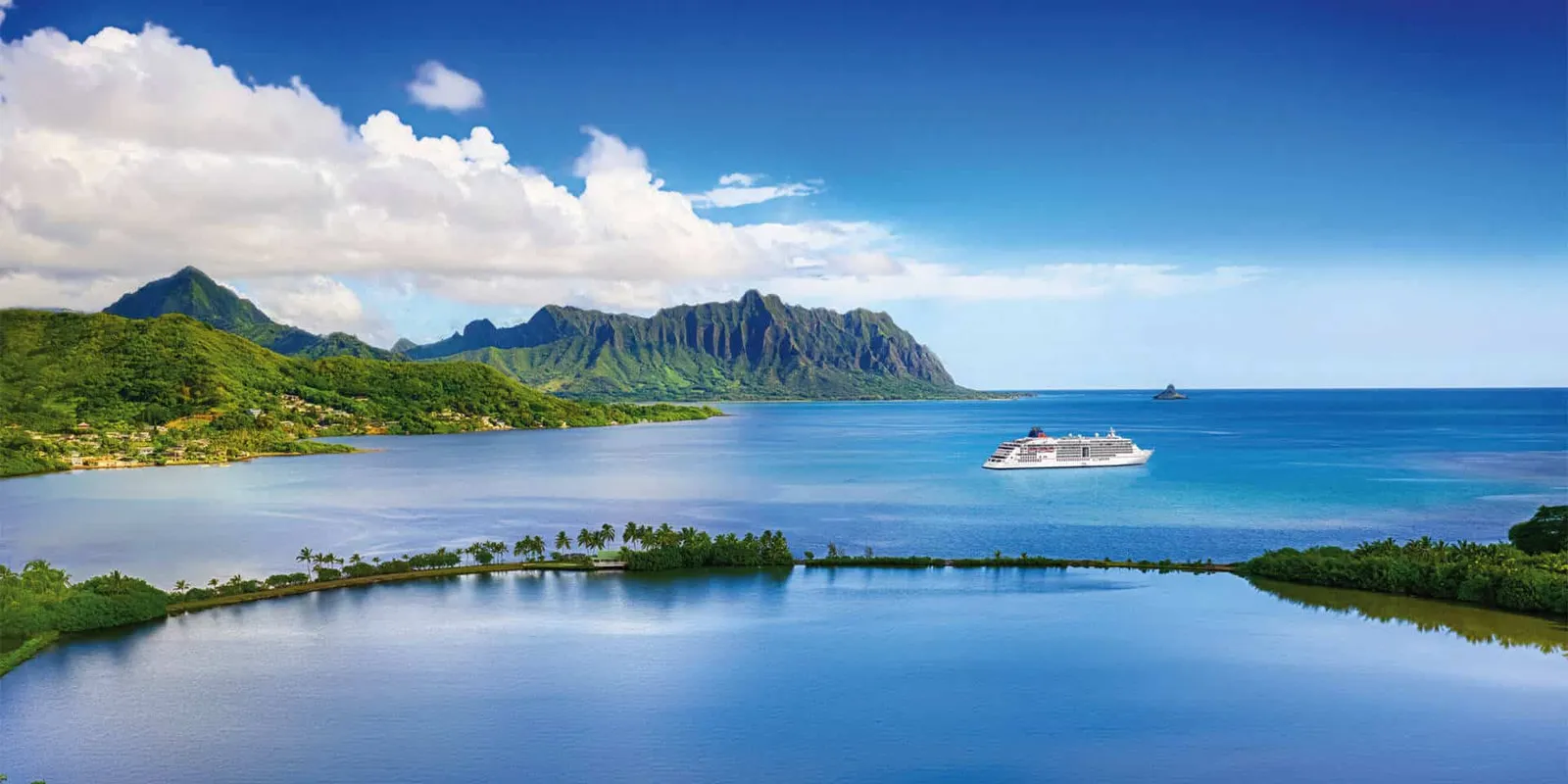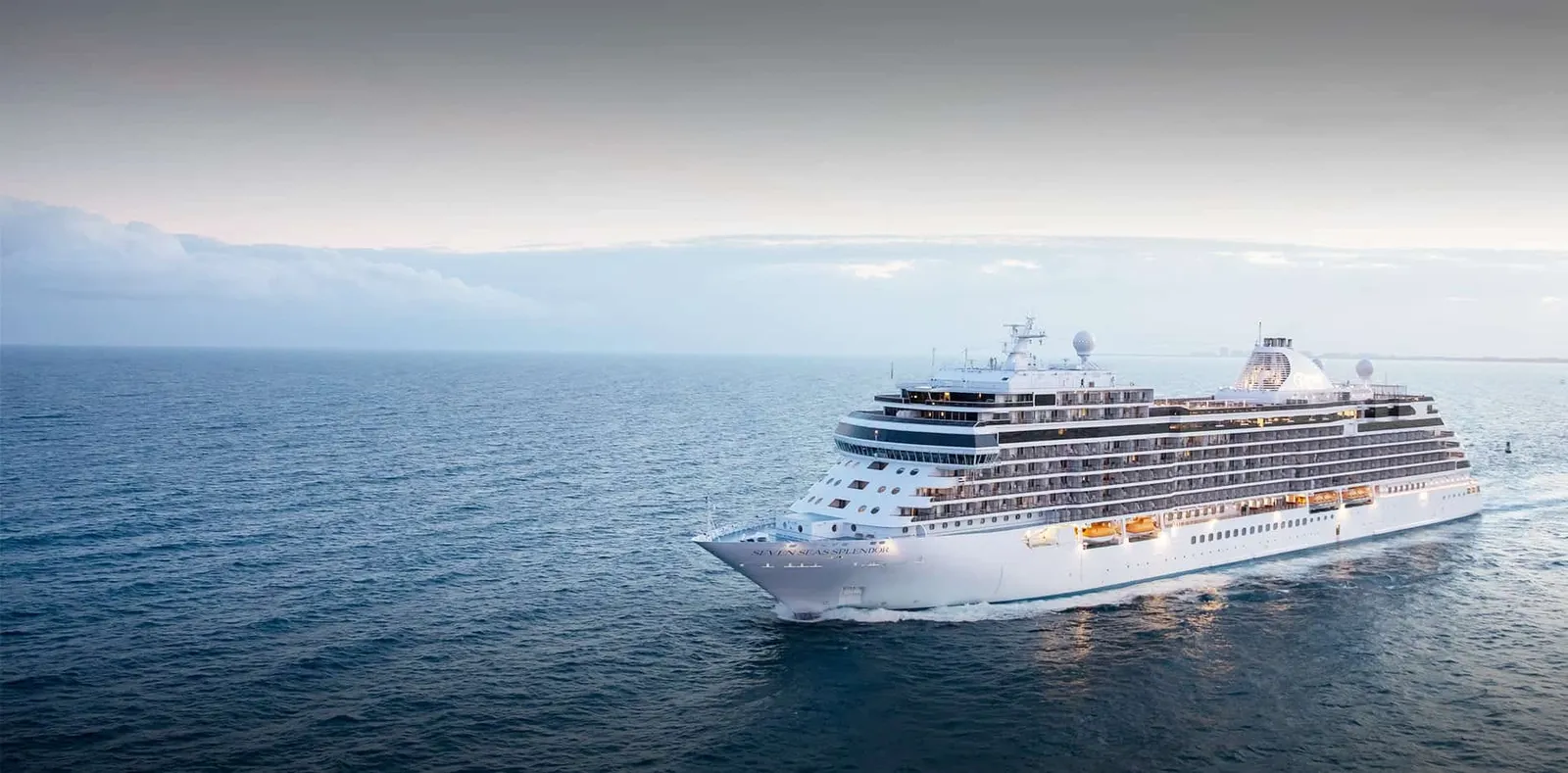
| Regent Seven Seas | SeaDream Yacht Club | |
|---|---|---|
| Category | Ultra-Luxury | Yacht-Style / Ultra-Luxury |
| Rating | ★★★★★ | ★★★★☆ |
| Fleet size | 6 ships | 2 ships |
| Ship size | Small (under 1,000) | Yacht (under 120) |
| Destinations | Mediterranean, Caribbean, Alaska, Northern Europe | Caribbean, Mediterranean, Northern Europe |
| Dress code | Formal evenings | Casual elegance |
| Best for | All-inclusive luxury seekers | Ultra-intimate yacht lifestyle travellers |
This is ultra-luxury cruising's most dramatic scale contrast — the segment's most comprehensively all-inclusive fleet against a twin-yacht operation carrying just 112 guests on vessels where the crew know every passenger by name before the first sunset. Regent delivers business-class air from Australian gateways, unlimited shore excursions, the largest suites at every category, and seven ships covering every major cruise region. SeaDream delivers genuine mega-yacht intimacy with an open bar, a retractable watersports marina, Balinese Dream Beds under the stars, and access to tiny harbours no cruise ship can reach. For Australians, the practical gap is wide: Regent has approximately 24 sailings in AU/NZ waters with included flights for international voyages; SeaDream has no Australian departures and requires long-haul flights to Caribbean or Mediterranean embarkation ports. Choose Regent if completeness, accessibility, and suite space matter most. Choose SeaDream if genuine yacht-scale intimacy, watersports, and the romance of small harbours speak to you — and you are willing to travel to reach them.
The core difference
This comparison reveals ultra-luxury cruising’s widest philosophical divide — a line that includes everything imaginable in a single fare against a line that rejects the very concept of being a cruise line at all.
Regent Seven Seas Cruises has spent three decades perfecting completeness. The all-inclusive fare covers business-class flights from Australian gateways on Emirates, Qantas, or Singapore Airlines; unlimited shore excursions at every port with over 4,500 options; every restaurant without surcharges; premium drinks; Starlink Wi-Fi; all gratuities; valet laundry; airport transfers; and a pre-cruise hotel night. Six all-suite ships carry 490–750 guests across every major cruise region, with Seven Seas Prestige arriving late 2026 at 77,000 gross tonnes and 822 guests. The suites are the largest in the segment at every category. The experience is polished, proven, and designed to remove every friction point.
SeaDream Yacht Club is something else entirely. “It’s yachting, not cruising” is not a marketing slogan — it is an operational philosophy that shapes every aspect of the experience. Two twin yachts, SeaDream I and SeaDream II, each carry just 112 guests. Built in 1984 for Sea Goddess Cruises, later operated by Cunard and then Seabourn, the vessels were acquired in 2001 by Atle Brynestad — the same Norwegian shipping magnate who founded Seabourn in 1986. Brynestad’s vision was radical simplicity: strip away cruise conventions, shrink the guest count to private-yacht proportions, install a retractable watersports marina, and create an atmosphere of “Casual Perfection” where no black tie is required, no rigid schedule exists, and the crew — nearly as numerous as the guests — know your name, your drink, and your preferences by the first evening.
For Australian travellers, the practical dimension is stark. Regent has approximately 24 sailings in Australian and New Zealand waters between 2026 and 2028, with roundtrip Sydney departures and included business-class flights for international voyages. SeaDream has no Australian departures, no Asia-Pacific deployment, and no announced plans for southern hemisphere itineraries. Every SeaDream voyage requires a long-haul flight that you arrange and pay for yourself. This is not a minor inconvenience — it is a fundamental constraint on accessibility.
What is actually included
Both lines are genuinely all-inclusive, but the scope of what each covers differs markedly.
Regent includes in every fare: unlimited shore excursions at every port (Go Local immersive experiences, Regent Choice curated excursions, and independent options); all dining at every restaurant without surcharges, caps, or reservation fees; premium spirits, wines, and cocktails; Starlink Wi-Fi; all gratuities; valet laundry; and 24-hour in-suite dining. From Concierge suites upward: roundtrip business-class air from international gateways including Australian cities; airport-to-ship transfers; a pre-cruise luxury hotel night; and a private chauffeur credit via Blacklane. Butler service from Penthouse Suites upward.
SeaDream includes: an open bar with premium wines, champagne, spirits, and cocktails at all hours; all dining (one main dining room plus top-deck casual dining) without surcharges; all gratuities; complimentary watersports equipment from the retractable marina platform (jet skis, sailboats, kayaks, paddleboards, snorkelling gear, water skiing); and the Champagne and Caviar Splash beach event on Caribbean itineraries.
SeaDream does not include: flights (no air programme from any gateway); shore excursions (all at additional cost); airport-to-yacht transfers; Wi-Fi (available for purchase — connectivity is limited on vessels of this size); or laundry service (available for purchase).
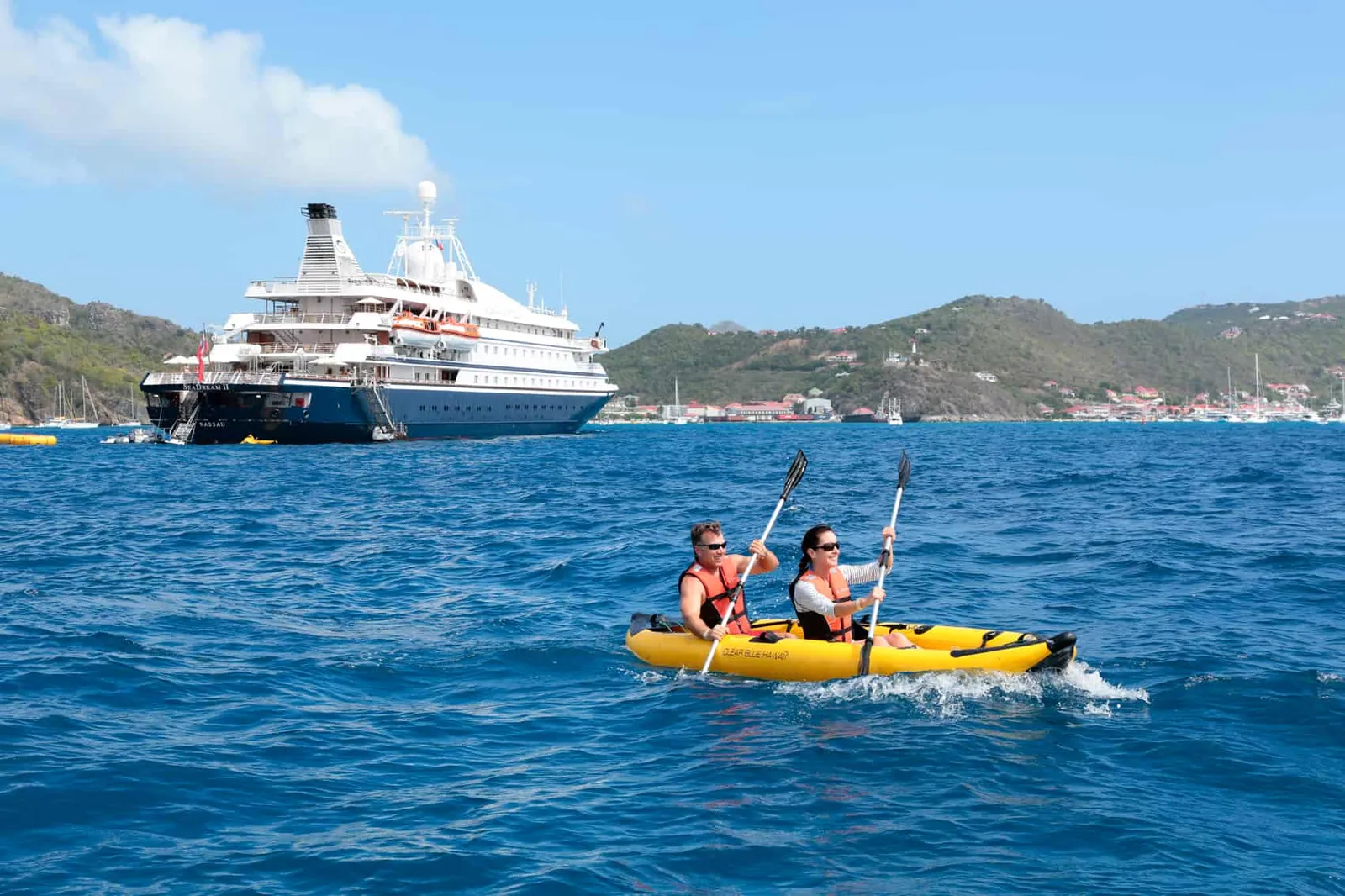
The distinctive SeaDream inclusion: the retractable watersports marina. A hydraulic platform at the stern lowers to the waterline, deploying jet skis, Laser sailboats, kayaks, paddleboards, water skis, and snorkelling equipment for complimentary use by all guests. This active-water dimension — unique among ultra-luxury lines at this scale — transforms afternoons at anchor. SeaDream was offering marina watersports years before Ritz-Carlton brought the concept to a larger scale.
The Australian impact. For an Australian couple, Regent’s included business-class air to a Mediterranean embarkation port is worth AUD $12,000–$24,000. Add unlimited excursions over a 10-night voyage (AUD $2,000–$5,000 if purchased separately) and valet laundry, and Regent absorbs AUD $15,000–$30,000 in costs that SeaDream guests must budget separately. Against SeaDream’s shorter voyages (typically 7–15 nights) and smaller scale, the inclusion gap is even more pronounced — SeaDream’s fare covers what happens once you are aboard, while Regent’s fare covers the entire journey from your front door.
Dining and culinary experience
Both lines deliver outstanding cuisine — but the dining experience could not be more different in character.
SeaDream’s dining is singular and intimate. One main dining room seats all 112 guests (though never at once — open seating and flexible timing are hallmarks). The Forbes Travel Guide has rated it the highest-rated restaurant at sea. The chef and team prepare everything a la minute from regional ingredients sourced at market stops along the route. Menus change daily based on what is fresh and available. The signature degustation menu features courses paired with wines selected by the sommelier. Top Deck dining offers al fresco lunch and dinner under the stars. There is no speciality restaurant, no alternative venue, and no reservation system — because with 112 guests, none is needed. The kitchen knows what you ate last night and adjusts accordingly. If you mention a craving at breakfast, it may appear at dinner.
Regent offers seven to eleven dining venues depending on the ship, all included without restriction. On Explorer-class ships: Compass Rose serves refined French-Continental cuisine with open seating. Prime 7 is a premium steakhouse with dry-aged cuts. Pacific Rim delivers pan-Asian cuisine. Chartreuse provides intimate French fine dining for 30 guests. Sette Mari at La Veranda offers Italian trattoria. Coffee Connection serves all-day casual fare. The Pool Grill provides al fresco dining. You can dine at any restaurant every evening of your voyage without restriction. Seven Seas Prestige expands to 11 dining experiences, adding Azure (Mediterranean shared plates) and new al fresco concepts.
The culinary verdict: SeaDream wins on intimacy, precision, and the deeply personal nature of a single kitchen cooking for 112 people — the chef literally adjusts your meal based on your preferences and what the galley has sourced that morning. Regent wins overwhelmingly on variety and choice — seven to eleven restaurants spanning French, Italian, Asian, steakhouse, and al fresco cuisines. If you prize the feeling of dining in a private yacht’s galley where the chef knows your name, SeaDream is extraordinary. If you value choosing between seven restaurants each evening with no restrictions, Regent delivers a breadth SeaDream’s two-ship operation cannot attempt.
Suites and accommodation
The accommodation philosophies are as different as the ships themselves.
Regent’s entry-level Deluxe Veranda Suite on Explorer-class ships is 361 square feet with an 88-square-foot private balcony — the largest entry-level accommodation in ultra-luxury cruising. Every Regent suite has a private balcony. Penthouse Suites span 545–892 square feet. The Regent Suite on Explorer-class ships is 4,443 square feet with a private spa, Steinway Grand piano, and a 1,417-square-foot balcony. The incoming Skyview Regent Suite on Seven Seas Prestige will reach 8,794 square feet — the largest all-inclusive suite in cruise history, with a private elevator, gym, sauna, and 3,703-square-foot balcony.
SeaDream’s Yacht Club Staterooms average 195 square feet — roughly half the size of Regent’s entry level. There are no private balconies on either yacht; Deck 3 and 4 staterooms have picture windows, while Deck 2 staterooms have ocean-view portholes. The Commodore Club Staterooms on Deck 4 offer approximately 390 square feet. The Owner’s Suite — one per yacht — reaches 447 square feet with a sitting area and large window wall. The Admiral’s Suite is approximately 375 square feet.
The comparison is dramatic. Regent’s entry-level suite is 85 per cent larger than SeaDream’s standard stateroom. The Regent Suite is nearly ten times the size of SeaDream’s Owner’s Suite. Every Regent guest has a private balcony; no SeaDream guest does.
But SeaDream’s philosophy renders the comparison somewhat misleading. The yachts are designed so that life happens on deck — the Balinese Dream Beds, the top-deck lounging areas, the watersports marina, the open-air bar. The stateroom is where you sleep and dress; the yacht is where you live. On Regent, the suite is a destination in itself — a place to spread out, entertain, and spend hours in private comfort. Both approaches work; they simply define “luxury” differently.
Pricing and value
The per-diem comparison is closer than you might expect, but the total-cost picture diverges sharply for Australians.
Regent’s per-diem runs approximately USD $650–$1,140 per person per night depending on ship, itinerary, and suite category. A 10-night Mediterranean sailing in a Deluxe Veranda Suite on Explorer-class starts from roughly USD $860–$1,140 per night. Seven Seas Prestige introductory pricing starts from approximately USD $650 per night.
SeaDream’s per-diem runs approximately USD $500–$850 per person per night. A 7-night Caribbean voyage in a Yacht Club Stateroom typically costs roughly USD $550–$750 per night. Mediterranean voyages are slightly higher. The 15-night Norwegian and British Isles voyages in summer can reach USD $700–$850 per night. The per-diem appears competitive until you account for what each fare includes.
Total cost for an Australian couple on a Mediterranean voyage:
Regent (10-night, Deluxe Veranda Suite, all-inclusive): approximately AUD $22,000–$32,000 per couple. This covers the cruise, business-class flights from Australia, unlimited shore excursions, all dining, drinks, transfers, and a pre-cruise hotel night.
SeaDream (7-night, Yacht Club Stateroom): approximately AUD $8,000–$14,000 for the cruise fare. Add business-class flights from Sydney to Europe (AUD $10,000–$18,000). Add shore excursions (AUD $700–$2,000). Add transfers and incidentals (AUD $500–$1,000). Total: approximately AUD $19,200–$35,000 — for three fewer nights, in a stateroom half the size, without a private balcony.
The arithmetic is clear. Regent delivers more nights, larger suites with balconies, unlimited included excursions, and business-class flights for a comparable total cost. SeaDream’s value proposition is not financial — it is experiential. You pay for 112-guest intimacy, a retractable watersports marina, Balinese Dream Beds under the stars, and access to harbours no larger ship can reach.
Spa and wellness
The wellness offerings reflect the scale difference between the two lines.
Regent’s Serene Spa & Wellness on Explorer-class ships occupies two decks with a complimentary Hydrothermal Suite featuring an aromatherapy steam room, infrared sauna, chill room, and experiential showers — open to all guests without booking. Treatment rooms have ocean views. Products are by ELEMIS and Kerastase. Seven Seas Prestige will feature the most expansive spa at sea, with an infinity pool, quartz crystal healing beds, and zero-gravity massage tables. The fitness centre uses Technogym equipment.
SeaDream’s spa is intimate and personal — a small treatment area with two to three treatment rooms, a relaxation space, and Thai-trained therapists offering massage, facials, and body treatments. The yacht also features a small gym. The spa is proportionate to the 112-guest count — you will not queue for a treatment, and the therapist will know your preferences by the second visit. Products vary by sailing.
The real wellness comparison: SeaDream’s wellness advantage is not the spa — it is the lifestyle. The retractable marina turns every afternoon at anchor into an active wellness session. Kayaking, paddleboarding, jet skiing, water skiing, and swimming directly from the yacht are physical activities that no Regent spa programme can replicate. The Balinese Dream Beds offer sleep under the stars. The casual, unscheduled pace of a SeaDream voyage — no announcements, no itinerary pressure — is itself a form of wellness. Regent has the superior dedicated spa facility; SeaDream has the more holistic lifestyle.
Entertainment and enrichment
Neither line is built for Broadway-style entertainment, but they approach the alternative differently.
Regent’s Constellation Theater on Explorer-class ships seats approximately 694 guests for narrative-driven production shows with a 12-person cast and seven-piece orchestra. Current productions include Broadway in Concert and Diamond Run. The Culinary Arts Kitchen offers hands-on cooking classes (USD $89). Guest lecturers include former ambassadors and scientists. The Observation Lounge provides panoramic views with live music for pre-dinner cocktails.
SeaDream has no theatre, no production shows, and no formal entertainment programme. This is deliberate. With 112 guests, the yacht creates its own social atmosphere. A pianist plays in the lounge. Conversations happen naturally at the bar — with a guest count this small, you meet everyone aboard within two days. The entertainment is the destination, the watersports marina, the top-deck sunset with champagne, and the Champagne and Caviar Splash on the beach. SeaDream’s approach assumes that guests who choose a 112-passenger yacht are not looking for a showroom.
The philosophical difference is absolute. Regent believes a luxury cruise should offer structured programming — theatre, cooking classes, lectures, and an Observation Lounge. SeaDream believes a luxury yacht should let the guests, the sea, and the destinations do the work. If you want your evenings programmed, Regent provides. If you want your evenings to unfold organically over cocktails with new acquaintances while the yacht moves quietly through the night, SeaDream delivers precisely that.
Fleet and destination coverage
The fleet comparison is the most lopsided in any ultra-luxury pairing.
Regent operates six ships (becoming seven with Prestige in late 2026): Explorer (2016, 750 guests), Splendor (2020, 750 guests), Grandeur (2023, 746 guests), Mariner (2001, refurbished 2025, 700 guests), Voyager (2003, refurbishing 2026, 700 guests), and Navigator (1999, 490 guests). Seven Seas Prestige arrives late 2026 at 77,000 gross tonnes and 822 guests. Destinations span the Mediterranean, Northern Europe, Alaska, Caribbean, Asia, South Pacific, Australia, New Zealand, Africa, South America, and annual world cruises of 130–154 nights. In any given month, Regent has ships in half a dozen regions simultaneously.
SeaDream operates two ships — SeaDream I and SeaDream II, each carrying 112 guests. Built in 1984 for Sea Goddess Cruises, the yachts passed through Cunard and Seabourn ownership before Atle Brynestad acquired them in 2001. The yachts sail 7–15-night voyages in the Caribbean (winter), the Mediterranean (spring, summer, autumn), and Norwegian fjords and British Isles (summer). There is no world cruise. There is no Australian deployment. The operational scope is deliberately narrow — two yachts, two hemispheres, seasonal rotations, and harbours too small for anyone else.
What this means in practice: Regent offers 50-plus unique itineraries per year across every continent. SeaDream offers perhaps 15–20 unique itineraries focused on the Caribbean and Mediterranean, with seasonal Norwegian extensions. If itinerary variety and global coverage matter, Regent is in a different category. If you know you want the Caribbean or Mediterranean and you want it on a 112-guest yacht that docks in tiny harbours — Portofino rather than Civitavecchia, Jost Van Dyke rather than St Thomas — SeaDream goes where Regent cannot.
Where each line excels
Regent excels in:
- All-inclusive completeness. Business-class air, unlimited shore excursions, all dining, drinks, transfers, pre-cruise hotel, and laundry in one fare. No other line matches this scope.
- Suite size. The largest suites at every category in ultra-luxury cruising. Every suite has a private balcony. The incoming Skyview Regent Suite on Prestige reaches 8,794 square feet.
- Global coverage. Seven ships covering every major cruise region. Approximately 24 Australian sailings between 2026 and 2028.
- Dining variety. Seven to eleven included restaurants spanning multiple cuisines.
- Australian accessibility. Roundtrip Sydney departures, included business-class air from Australian gateways, dedicated local reservations.
SeaDream excels in:
- Intimate scale. 112 guests — a genuine mega-yacht experience. The crew know your name, your drink, and your preferences before sunset on day one.
- Watersports marina. A retractable platform deploying jet skis, sailboats, kayaks, paddleboards, and snorkelling gear. SeaDream pioneered this concept in ultra-luxury cruising.
- Small harbour access. The yachts’ size allows them to dock in tiny ports — Motun, Hvar’s old harbour, Isles des Saintes, Bequia — that Regent’s ships cannot reach.
- Casual atmosphere. “Casual Perfection” — no black tie, no rigid schedules, no announcements. Shorts and polo shirts at dinner are perfectly acceptable.
- Balinese Dream Beds. Sleeping on deck under the stars while the yacht sails — an experience unique to SeaDream and genuinely unforgettable.
- Champagne and Caviar Splash. The signature beach party — champagne and caviar at the water’s edge on a secluded Caribbean beach.
Standout itineraries for Australian travellers
Regent
Sydney roundtrip (10 nights, December 2026 on Seven Seas Explorer) — No flight required for NSW residents. Cruise to New Zealand and back. From approximately AUD $11,169 per person. The most convenient ultra-luxury option.
Bali to Sydney (16 nights on Seven Seas Explorer) — Via Komodo, Darwin, Cairns, and the Queensland coast. Fly to Bali (approximately 6.5 hours), cruise home. Business-class flights included.
Grand Continental Sojourn (82 nights, Barcelona to Sydney) — An extended voyage home from Europe through the Mediterranean, Middle East, Asia, and into Australian waters. Business-class air to Barcelona included.
Mediterranean (7–14 nights on Explorer-class ships, multiple departures) — Business-class flights from Australia included. Unlimited shore excursions at every port.
SeaDream
Mediterranean yacht voyage (7 nights, SeaDream I or II, May–October) — The most accessible SeaDream experience for Australians. Fly Sydney to Nice, Rome, or Athens (approximately 22–24 hours via Singapore or Dubai). Embark in ports like Dubrovnik, Nice, or Athens. Visit harbours Regent’s ships cannot enter — Hvar’s old harbour, Ponza, Hydra, Bonifacio.
Caribbean yacht voyage (7 nights, SeaDream I or II, November–April) — Fly to San Juan, Barbados, or St Martin. The Champagne and Caviar Splash on a secluded beach. Marina deployed daily in turquoise Caribbean anchorages. Balinese Dream Beds under Caribbean stars.
Norwegian fjords (10–15 nights, summer on SeaDream I or II) — SeaDream’s founder is Norwegian, and these voyages reflect a deep personal connection to the coastline. Tiny harbour towns, fjord anchorages, and midnight sun from the Balinese Dream Beds.
Ship-by-ship recommendations
Regent
Seven Seas Grandeur (746 guests, 2023) — The newest Explorer-class ship, featuring original Picasso and Miro artwork and a commissioned Faberge egg. Excellent for a first Regent experience.
Seven Seas Explorer (750 guests, 2016) — The primary ship deployed to Australia and New Zealand. Choose for Australian-departing sailings.
Seven Seas Prestige (822 guests, arriving late 2026) — Eleven dining venues. The Skyview Regent Suite at 8,794 square feet. The most ambitious new build in the segment.
Seven Seas Mariner (700 guests, 2001, refurbished 2025) — Good value within the Regent fleet. Same comprehensive inclusion package as the newer ships.
SeaDream
SeaDream I (112 guests, built 1984, extensively refurbished) — The original yacht. Virtually identical to SeaDream II in specifications and amenities. Choose based on itinerary rather than ship.
SeaDream II (112 guests, built 1984, extensively refurbished) — The sister yacht. Same 112-guest capacity, same crew ratio, same marina platform, same Balinese Dream Beds. Both yachts have been comprehensively maintained and updated since Brynestad’s 2001 acquisition — the 1984 build date reflects the hull, not the guest experience.
The honest assessment: at 112 guests per ship, the specific yacht matters less than the itinerary. Both deliver the identical SeaDream experience. Choose whichever is sailing the route you want on the dates that suit.
For Australian travellers specifically
The Australian-specific considerations in this comparison strongly favour Regent — and honestly so.
Regent’s Australian proposition is comprehensive. Approximately 24 sailings in Australian and New Zealand waters between 2026 and 2028. Roundtrip Sydney departures. A new Seven Seas Navigator winter season from 2027 covering Fremantle, Darwin, the Queensland coast, and circumnavigation options. Included business-class air from Sydney, Melbourne, Brisbane, Perth, and Adelaide on Emirates, Qantas, or Singapore Airlines. A dedicated Australian reservations line. Strong distribution through Australian luxury travel agencies.
SeaDream’s Australian proposition is essentially nonexistent. The yachts do not visit Australian waters, do not deploy to Asia-Pacific, and show no indication of doing so. Australian travellers must fly to the Caribbean (San Juan, Barbados — 24-plus hours) or the Mediterranean (Nice, Athens, Rome — 22-plus hours) to embark. Flights are at your own expense. There is no Australian reservations office. Booking is typically through specialist yacht-charter agents or directly via SeaDream’s American headquarters.
Loyalty pathways for Australians: Regent’s Seven Seas Society offers cross-brand status honouring with Norwegian Cruise Line and Oceania Cruises under the NCLH parent company — practical for Australians who cruise domestically on Norwegian or internationally on Oceania. SeaDream’s Club is a standalone programme offering USD $500 savings on select voyages, 10–15 per cent onboard booking discounts, and a captain-hosted cocktail reception for returning guests. Neither line has a direct Qantas Frequent Flyer partnership.
The honest recommendation for Australians: If you are choosing between Regent and SeaDream and you live in Australia, Regent is the overwhelmingly practical choice. It comes to your waters, includes your flights, handles your excursions, and delivers suites twice the size at a comparable total cost. SeaDream requires genuine effort to reach — but the effort is rewarded with something Regent cannot deliver. A week on a 112-guest yacht, sleeping on deck under the stars, swimming from the marina in a hidden Caribbean cove while the captain serves champagne on the beach, is not a cruise. It is an experience in a category of its own.
The onboard atmosphere
These lines create profoundly different social environments — and the difference is almost entirely a function of scale.
Regent’s atmosphere is polished, relaxed, and sociable. The passenger base averages 58–65, predominantly American and British with strong Australian representation on southern hemisphere sailings. Many guests are experienced luxury cruisers. The all-inclusive model removes calculation and friction. The dress code allows refined denim and dress trainers after 6 PM under “Elegant Casual.” The Observation Lounge is the social heart. With 750 guests, there is enough variety to find your people — bridge players, wine enthusiasts, solo travellers — without the obligation to socialise with everyone. You can be anonymous on Regent if you wish.
SeaDream’s atmosphere is intimate, casual, and familial. With 112 guests, anonymity is impossible — and that is the point. By day two, you know every face aboard. By day four, you know names, stories, and where people are from. The dress code is “Casual Perfection” — no black tie, no formal nights, no jacket requirements. Shorts and a clean polo shirt are appropriate at dinner. The captain joins guests for drinks. The crew call you by name without consulting a seating chart. The atmosphere is closer to a private house party on the water than any other cruise experience.
The key question: Do you want the social flexibility of 750 guests — the ability to socialise or retreat at will, with formal programming available every evening? Choose Regent. Do you want the intimacy of 112 people sharing a yacht — where the crew are practically family, the captain joins your table, and you sleep on deck under the stars? Choose SeaDream. These are not degrees of the same experience; they are fundamentally different kinds of holidays.
The bottom line
Regent Seven Seas and SeaDream Yacht Club are both outstanding — but they are built for different desires, and comparing them on conventional metrics misses the point.
Choose Regent if your priority is the most complete, most convenient ultra-luxury cruise available. Business-class flights from Australia included. Unlimited shore excursions at every port. The largest suites in the segment, all with private balconies. Seven to eleven dining venues without surcharges. Approximately 24 Australian sailings. Seven Seas Prestige, arriving late 2026, will be the most ambitious ultra-luxury new build in years. For Australians who want everything handled — from the flight out of Sydney to the last excursion at the final port — Regent has no peer.
Choose SeaDream if what matters most is the feeling of being aboard a private yacht. One hundred and twelve guests. A crew that knows your name before sunset. A retractable marina deploying jet skis, sailboats, and kayaks in hidden coves. Balinese Dream Beds under the stars. The Champagne and Caviar Splash on a Caribbean beach. Access to tiny harbours — Portofino’s inner harbour, Jost Van Dyke, Bonifacio — that no larger ship can enter. Accept that the staterooms are smaller, there are no balconies, the flight from Australia is long, and the ships are 40 years old. What SeaDream offers in return is not a better cruise — it is a different category of experience altogether. Some travellers sail SeaDream once and never go back to anything else. I understand why.
For Australians who can do both: Regent for your regular ultra-luxury cruising — the convenience, the inclusions, the Australian departures. SeaDream for a once-a-year Caribbean or Mediterranean escape — the week you leave the cruise world behind and remember what it feels like to simply be on the water.