Oceania Cruises and Windstar Cruises both operate in the upper-premium space with no formal nights and included dining — but they deliver fundamentally different experiences. One is the finest mid-size culinary cruise line afloat, the other a boutique sailing yacht operator whose computer-controlled sails define the romance of small-ship cruising. Jake Hower compares their inclusions, dining, fleet, and value for Australian travellers.
| Oceania Cruises | Windstar Cruises | |
|---|---|---|
| Category | Luxury | Yacht-Style / Luxury |
| Rating | ★★★★☆ | ★★★★☆ |
| Fleet size | 8 ships | 7 ships |
| Ship size | Mid-size (1,000-2,500) | Yacht (under 300) |
| Destinations | Mediterranean, Asia, South Pacific, Caribbean | Mediterranean, Caribbean, Alaska, French Polynesia |
| Dress code | Country club casual | Resort casual |
| Best for | Food-focused culturally curious cruisers | Romantic small-ship and sailing enthusiasts |
Oceania is the best value upper-premium line at sea — Jacques Pépin's culinary programme across up to ten dining venues, included speciality restaurants, and a relaxed Country Club Casual atmosphere on mid-size ships carrying 684 to 1,250 guests. Windstar counters with genuine sailing heritage across three masted yachts, the James Beard Foundation culinary partnership, barefoot watersport marina platforms, and access to smaller ports that mid-size ships cannot reach — all on vessels carrying just 148 to 342 guests. For Australians wanting culinary breadth, larger staterooms, and classic itineraries at a competitive per-diem, choose Oceania. For Australians drawn to the romance of wind-assisted cruising, intimate yacht-style atmosphere, and destinations like Tahiti year-round, choose Windstar.
The core difference
Oceania Cruises and Windstar Cruises sit in the same broad market segment — upper-premium, no formal nights, food-forward — but the experience aboard could hardly be more different. The choice between them is not about quality. Both deliver excellent service and genuine culinary commitment. The choice is about what kind of ship you want under your feet.
Oceania’s identity is culinary. The line’s trademarked claim to “The Finest Cuisine at Sea” is backed by Jacques Pépin — former personal chef to three French heads of state including Charles de Gaulle, author of thirty cookbooks, host of thirteen PBS television series, and Oceania’s Executive Culinary Director since 2003. On the O-class ships (Marina, Riviera, and the incoming Allura and Vista), guests choose from up to ten dining venues — Jacques (French bistro), Polo Grill (American steakhouse), Red Ginger (pan-Asian), Toscana (Italian), Aquamar Kitchen (wellness), and more — all included without surcharges. The mid-size format (684 to 1,250 guests) creates a relaxed, Country Club Casual atmosphere where jackets and ties are never required. Under Norwegian Cruise Line Holdings alongside Regent and Norwegian, Oceania operates across the Mediterranean, Caribbean, Alaska, Asia, and increasingly Australian waters with a fleet that prioritises culinary breadth and onboard space.
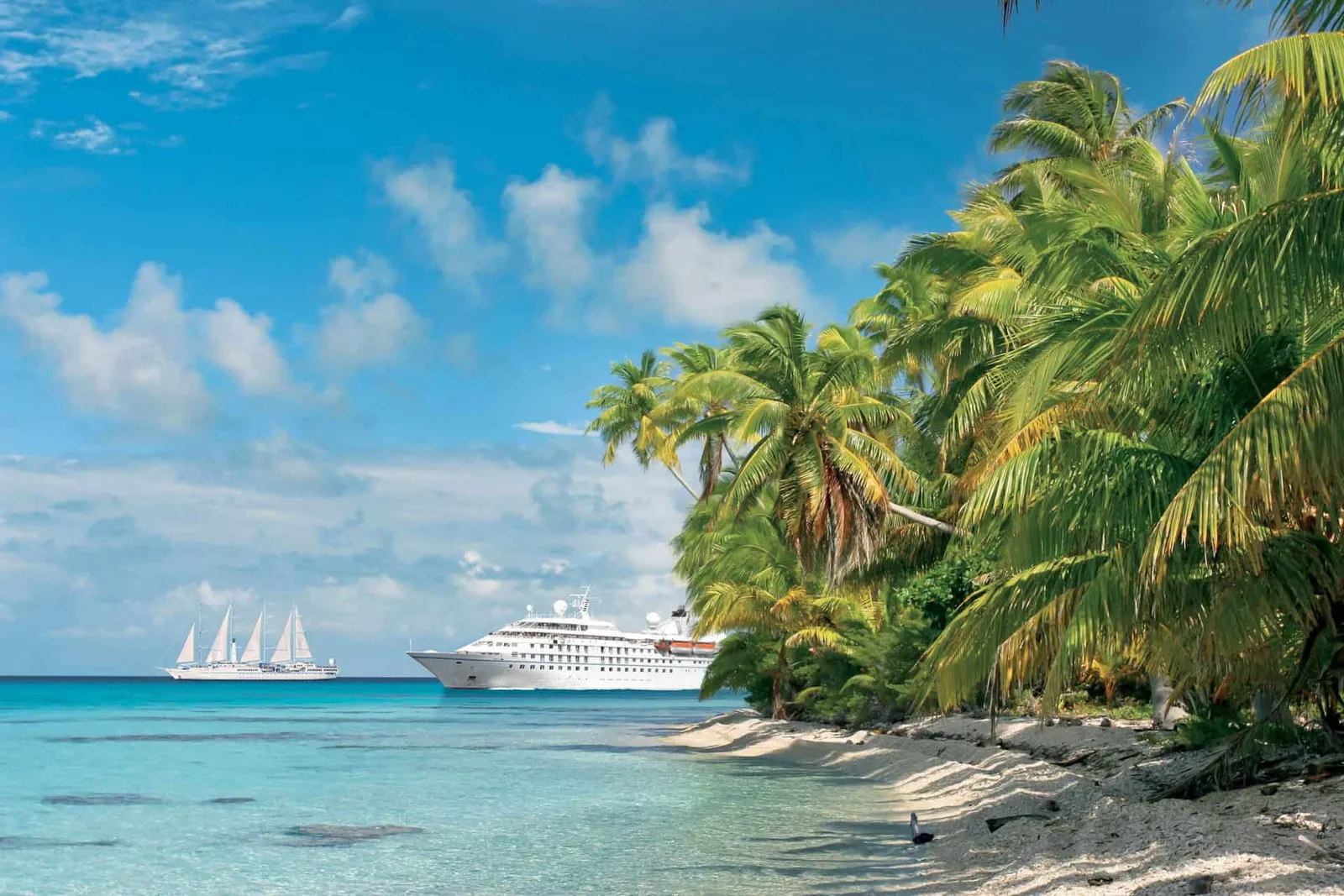
Windstar’s identity is sailing. Three of its seven ships — Wind Surf (342 guests), Wind Star (148 guests), and Wind Spirit (148 guests) — are motorised sailing yachts carrying four or five masts of computer-controlled sails that unfurl during every departure and deploy whenever wind conditions permit. The line’s tagline, “180 degrees from ordinary,” captures a philosophy of barefoot elegance, watersport marina platforms that lower directly into the ocean, and access to harbours that mid-size ships cannot enter. The Star Plus class motor yachts (Star Breeze, Star Legend, Star Pride, each carrying 312 guests after the USD $250 million Star Plus Initiative renovation) and the new-build Star Seeker (224 guests, arriving December 2025) round out a fleet that never exceeds 342 guests on any vessel. The James Beard Foundation culinary partnership, now in its eleventh year, anchors a dining programme that emphasises chef-driven creativity over venue count. Owned by Xanterra Parks and Resorts (a subsidiary of The Anschutz Corporation), Windstar is the antithesis of the mega-ship — intimate, casual, and defined by the romance of wind-assisted cruising.
For Australian travellers, the practical question often comes down to purpose. If you want the widest restaurant choice at sea, larger staterooms, and a competitive per-diem on classic itineraries, Oceania is the obvious pick. If you want to feel the sails catch the wind, swim from the back of the ship, and dock in ports where even Oceania’s R-class ships cannot fit, Windstar delivers an experience that no other line in this comparison can replicate.
What is actually included
Both lines market inclusivity, but the specifics differ meaningfully — and the details matter when calculating total cost from an Australian wallet.
Oceania’s “Your World Included” programme (launched October 2024) covers all speciality restaurant dining without surcharges, shipboard gratuities, unlimited Wi-Fi, speciality coffees and non-alcoholic beverages, still and sparkling water, gourmet ice cream, laundry services, in-stateroom dining, and group fitness classes. From September 2025 bookings, guests choose one amenity: either complimentary wine and beer by the glass during lunch and dinner hours, or a shore excursion credit scaled by voyage length (USD $400 for nine days up to USD $1,200 for twenty-six or more days). If neither is selected, a non-use credit applies. Premium spirits, cocktails, wines by the bottle, spa treatments, and shore excursions beyond any credit remain additional costs. La Reserve by Wine Spectator and the Privée Dom Pérignon experience carry surcharges.
Windstar’s base fare covers all dining across every restaurant without surcharges, 24-hour room service, non-alcoholic beverages including speciality coffees, complimentary watersport marina access (kayaks, paddleboards, snorkelling gear, water skiing), group fitness classes, and onboard enrichment events. What Windstar does not include in the base fare: alcoholic beverages, Wi-Fi, crew gratuities (USD $16 per person per day), and laundry. The All-In package bundles unlimited beer, wine, cocktails, and spirits, unlimited Wi-Fi for two devices, and prepaid gratuities for USD $99 per person per day when purchased before sailing (USD $109 if added onboard). An 18 per cent beverage service charge applies to individual drink purchases outside the package.
The net effect for Australian travellers: Oceania’s base fare is more inclusive — gratuities, Wi-Fi, and laundry are covered without any add-on. For moderate or non-drinkers, Oceania delivers clearly better value at the base fare level. For regular drinkers, Windstar’s All-In package at USD $99 per day covers unlimited spirits and cocktails — a broader beverage inclusion than Oceania’s wine-and-beer amenity. For a couple on a ten-night cruise, the All-In package adds roughly AUD $3,200 to the total cost. Whether that represents better or worse value than Oceania depends entirely on consumption habits and how much weight you place on included laundry and gratuities.
Dining and culinary experience
Both lines boast genuine culinary pedigree — Jacques Pépin for Oceania, the James Beard Foundation for Windstar. The experience, however, is fundamentally different in scale and style.
Oceania is a restaurant ship. On O-class vessels, guests choose nightly from Jacques (French bistro, named for Pépin), Polo Grill (premium American steakhouse), Red Ginger (pan-Asian, praised for its lobster tempura), Toscana (Italian heritage), Aquamar Kitchen (wellness-inspired with calorie-conscious and plant-forward menus), The Grand Dining Room (main restaurant with over 270 rotating recipes), Terrace Café (buffet that converts to Tuscan, Asian, or Middle Eastern themed evenings), and Waves Grill (casual poolside, transforming to a pizzeria at night). On R-class ships (Regatta, Insignia, Nautica, Sirena), the count drops to six venues but the quality holds. The Culinary Center on O-class ships offers hands-on cooking classes at eighteen individual workstations — a genuine professional teaching kitchen with no equivalent on Windstar. Every restaurant except La Reserve and Privée is included. The breadth is unmatched in the upper-premium and luxury segments.
Windstar is a chef’s table. The James Beard Foundation partnership, now spanning over a decade, places James Beard Award-recognised chefs aboard select sailings for cooking demonstrations, hosted dinners with wine pairings, and local market tours. On every Windstar sailing — not just culinary-themed departures — the dinner menu at Amphora (the main restaurant) features a rotating “Signature Recipe” from the cruise’s resident James Beard Foundation-affiliated chef, built around local market ingredients wherever possible. Additional dining venues include Candles, the signature open-air restaurant on the Star Deck where guests dine on steak and seafood under the stars — widely cited as one of the most romantic dining experiences at sea. On Star Plus class ships, Cuadro 44 by Anthony Sasso (a Michelin-recognised chef) served Spanish-influenced cuisine, though this venue is transitioning to Basil + Bamboo, offering Asian and Mediterranean fare on Star Seeker and during upcoming refurbishments. Stella Bistro and the Veranda round out the options. Star Seeker introduces five dining venues in total, all included.
The dining count tells the story. Oceania offers eight to ten complimentary venues on O-class ships. Windstar offers three to five, depending on the vessel. But Windstar’s Candles — dining under the open sky with the sails silhouetted above — is an experience Oceania cannot replicate. And the James Beard chef rotations bring a different culinary personality to each sailing, creating variety through people rather than venues.
The verdict is clear: Oceania delivers the widest variety of complimentary dining in the upper-premium segment. Windstar delivers a more intimate, chef-driven experience where the setting and the storytelling behind the food matter as much as the menu itself. For food-motivated travellers who want options every night, Oceania. For those who value a curated, personal culinary experience with the best alfresco dining at sea, Windstar.
Suites and accommodation
The accommodation comparison reflects the fundamental difference in ship philosophy — Oceania’s mid-size vessels offer substantially more space per cabin than Windstar’s deliberately intimate yachts.
Oceania’s O-class ships (Marina, Riviera, Allura, Vista) offer Veranda staterooms from 282 to 291 square feet including a private veranda — generous for the segment. Penthouse Suites reach 440 square feet. The Owner’s Suites span approximately 2,000 square feet. On the smaller R-class ships (684 guests), staterooms are tighter at 165 to 216 square feet in standard categories, though still functional. All staterooms feature Prestige Tranquility Beds, Bulgari bath amenities, and twice-daily housekeeping. Butler service is available from Penthouse level upward.
Windstar’s Star Plus class ships (Star Breeze, Star Legend, Star Pride) are all-suite vessels with entry-level suites starting at 277 square feet. Classic Suites offer 400 square feet with separate bedroom and living areas. The mid-ship Owner’s Suites span 820 square feet with large living and dining areas, separate bedroom, and full bath with separate shower and tub plus a half bath. Forward Owner’s Suites are 575 square feet. The Grand Owner’s Suite, created by combining adjoining suites, reaches 1,374 square feet. All suites were completely refurbished during the USD $250 million Star Plus Initiative, receiving new Egyptian cotton bedding, firmer mattresses, remodelled bathrooms, and re-upholstered furnishings designed by The Johnson Studio at Cooper Carry in New York.
Windstar’s sailing yachts are more compact. Wind Surf offers deluxe ocean-view suites at 376 square feet with two bathrooms — comfortable for a sailing vessel — and standard staterooms at 188 square feet. Wind Star and Wind Spirit carry staterooms with portholes rather than windows or balconies, ranging from approximately 188 square feet. These are well-appointed but genuinely intimate spaces, reflecting the sailing heritage where guests spend their days on deck, on excursions, or in the water rather than in their cabins.
Star Seeker (arriving December 2025) introduces a new standard. The 224-guest vessel offers twelve suite categories, from Oceanview Suites with queen beds to the Horizon Owner’s Suites at 796 square feet with wrap-around verandahs and separate living and dining areas. Deluxe Suites run 380 square feet plus a 110-square-foot balcony. Most suites feature private verandas or floor-to-ceiling infinity windows, walk-in mosaic glass showers, and fully stocked minibars. The four highest categories add Illy espresso machines, canapé service, and fresh flowers.
The tradeoff is intentional. Oceania’s larger staterooms suit its classical cruising model where sea days, in-suite dining, and evening relaxation are central to the experience. Windstar’s more compact cabins on the sailing yachts reflect a philosophy that the destination — and the ocean itself — is the attraction. The Star Plus class and Star Seeker narrow the gap considerably, offering suite-level accommodation that competes directly with Oceania’s mid-tier categories.
Pricing and value
The pricing comparison between these lines is nuanced — headline fares tell only part of the story, and the total cost depends heavily on drinking habits and add-on preferences.
Oceania’s per-diem on classic itineraries runs approximately AUD $600 to $800 per person per night for entry-level Veranda staterooms on O-class ships. A 14-night Mediterranean voyage costs roughly AUD $12,000 to $16,000 per person including gratuities, all dining, Wi-Fi, and laundry. Add the beverage amenity (included wine and beer at meals) or shore excursion credit, and the value proposition strengthens further. Oceania is consistently described as offering “luxury dining at premium prices” — a positioning that resonates strongly with value-conscious Australian travellers.
Windstar’s per-diem varies by ship class and destination. Entry-level pricing on Wind Class sailing yachts starts from approximately USD $250 to $400 per person per night for seven-night Mediterranean or Caribbean itineraries — often lower than Oceania before add-ons. A seven-night Mediterranean cruise on Wind Surf from Rome starts from approximately USD $4,450 per person for an Oceanview Suite. Star Plus class ships command a slight premium. Star Seeker pricing reflects its new-build status with modern suite accommodation. Adding the All-In package (USD $99 per person per day) for drinks, Wi-Fi, and gratuities adds roughly AUD $1,600 per person for a ten-night cruise. The total per-diem with All-In typically falls in the AUD $500 to $750 range — competitive with Oceania when comparing like-for-like inclusions.
For a direct Mediterranean comparison: a ten-night Oceania voyage in a Veranda stateroom costs roughly AUD $8,000 to $10,000 per person with gratuities, dining, Wi-Fi, and laundry included. A comparable Windstar Star Plus class sailing with the All-In package costs roughly AUD $7,000 to $9,500 per person. The pricing gap is narrow, but Oceania’s inclusion of laundry, the Culinary Center, and ten dining venues versus Windstar’s three to four tips the value equation toward Oceania for guests prioritising onboard variety. Windstar’s value proposition strengthens for guests who prioritise the intimate sailing experience, the watersport marina, and the ability to dock in smaller ports.
For French Polynesia — where both lines compete directly — Windstar holds a distinct advantage through year-round deployment and deeper regional expertise, often at a lower per-diem than Oceania’s occasional South Pacific offerings.
Spa and wellness
Both lines offer spa facilities, but at scales reflecting their different ship sizes and philosophies.
Oceania’s Canyon Ranch SpaClub operates across the fleet in partnership with the renowned Tucson-based wellness brand. On O-class ships, the spa spans approximately 5,000 square feet with treatment rooms, a thalassotherapy pool, an aromatic steam room, a Finnish sauna, and a relaxation lounge. The fitness centre features Technogym equipment with panoramic ocean views. Signature treatments include the Canyon Ranch Intensive Massage (80 minutes) and Elemis facial therapies. The partnership brings onshore Canyon Ranch expertise to sea — health consultations, nutrition counselling, and fitness assessments are available alongside standard spa services. A dedicated Aquamar Kitchen restaurant serves spa-inspired cuisine, extending the wellness philosophy into dining. The integration of spa and culinary wellness is seamless and distinctive.
Windstar’s spa offering reflects the fleet’s intimate scale. On Star Plus class ships, the World Spa features treatment rooms, a sauna, a steam room, a therapy shower, heated loungers, and male and female changing rooms. High-tech workout equipment and fitness classes are available. On the sailing yachts, spas are more compact — treatment rooms, a sauna, and basic fitness equipment. Services across the fleet include massages, facials, body treatments, Chinese medicine, teeth whitening, hair styling, manicures, and pedicures. Star Seeker elevates the spa experience with a full-service spa accessed via a grand entrance from the deck above, alongside a modern fitness facility.
Where Windstar distinguishes itself is the watersport marina platform — a retractable platform at the stern that lowers directly into the ocean, creating a private water sports centre. Complimentary kayaks, paddleboards, snorkelling gear, sailboats, windsurfers, water trampolines, and even water skiing are available. PADI-certified diving is offered in the Caribbean, Central America, and French Polynesia. The marina operates on all anchored days, weather permitting, and is consistently cited as an unexpected highlight by guests. No Oceania ship offers anything comparable — the opportunity to swim, kayak, or paddleboard directly from the back of your ship is unique to Windstar’s fleet.
The difference is architectural. Oceania offers the more comprehensive traditional spa in partnership with an established wellness brand, integrated with culinary wellness through Aquamar Kitchen. Windstar offers active, ocean-based wellness — swim in the sea from the marina platform, kayak a tropical lagoon, then return for a massage. Neither is superior; they serve different definitions of wellness.
Entertainment and enrichment
Neither line is a floating theatre, but they approach evenings and enrichment differently — and understanding this prevents booking the wrong ship.
Oceania’s enrichment programme centres on culinary education. The Culinary Center on O-class ships offers hands-on cooking classes at eighteen individual workstations — a professional teaching kitchen where guests learn regional cuisines relevant to the itinerary. Guest lecturers cover history, science, and culture. The Martini Bar hosts live piano and cocktail gatherings. The evening atmosphere is quiet, social, and unhurried — a jazz trio, a cocktail, conversation. There are no production shows, no theatre, no cabaret cast. The dress code is Country Club Casual at all times — no formal nights, ever. Some travellers find the evenings understated; others appreciate the absence of forced entertainment. Oceania does have a casino — unusual for this segment.
Windstar’s enrichment programme is destination-focused and experiential. The James Beard Foundation culinary-themed sailings bring guest chefs aboard for cooking demonstrations, local market tours, and exclusive hosted dinners with paired wines — but these occur on select departures, not every sailing. On every voyage, the daily “Signature Recipe” from a James Beard-affiliated chef adds culinary storytelling to dinner. Entertainment is deliberately low-key: local musicians perform in ports, acoustic artists and cultural dancers bring regional flavour aboard, and resident musicians fill the lounges in the evening. The signature sail-away ceremony — watching the computer-controlled sails unfurl as the ship departs port — is a moment of genuine theatre that no other cruise line offers. The deck barbecue on warm-weather itineraries adds casual social energy. There are no production shows, no casino, no formal nights. The dress code is “Yacht Casual” — sundresses, collared shirts, relaxed elegance without pretension.
The distinction is philosophical. Oceania makes the kitchen the stage with its professional Culinary Center. Windstar makes the ocean and the sails the spectacle. Neither produces Broadway-calibre shows — if evening entertainment matters, neither line is the right choice. But if you value the experience of watching enormous sails unfurl against a Mediterranean sunset while sipping a cocktail on the open deck, Windstar delivers a nightly moment that Oceania simply cannot.
Fleet and destination coverage
The fleet comparison reveals two different strategies — Oceania’s focus on a compact, culinarily excellent mid-size fleet versus Windstar’s diverse armada of sailing yachts, motor yachts, and new-build expedition-capable vessels.
Oceania operates four ships (growing to six with Allura arriving in 2025 and Vista following): Marina (2011, 1,250 guests), Riviera (2012, 1,250 guests), Regatta (1998, 684 guests), Insignia (1998, 684 guests), plus Nautica and Sirena in the R-class. The O-class ships are the flagships with the full ten-venue dining programme. The R-class ships are more intimate with fewer restaurants but charm and character from decades of refined service. All ships focus on classic ocean itineraries — no expedition capability, no Zodiacs, no ice-class ratings. Oceania had over 230 Mediterranean cruises in its 2026 programme alone, making it one of the most prolific upper-premium lines in Europe. The fleet also covers the Caribbean, Alaska, Asia, South Pacific, and now Australian waters.
Windstar operates seven ships across three distinct classes (growing to eight with Star Explorer in December 2026). The Wind Class sailing yachts — Wind Surf (342 guests, 1990), Wind Star (148 guests, 1986), and Wind Spirit (148 guests, 1988) — define the brand with their masted silhouettes and computer-controlled sails. The Star Plus class motor yachts — Star Breeze, Star Legend, and Star Pride (312 guests each, originally built for Seabourn, stretched and renovated 2020–2021) — deliver all-suite modern yacht cruising. Star Seeker (224 guests, December 2025) is the first purpose-built new vessel with ice-strengthened hull, Rolls-Royce diesel-electric hybrid propulsion, and twelve suite categories. Star Explorer (224 guests, December 2026) will be based year-round in Europe. The fleet deploys across the Mediterranean, Caribbean, Tahiti and French Polynesia, Alaska, Japan, Southeast Asia, Costa Rica and Panama Canal, Canada and New England, and seasonally to Australia and New Zealand — visiting over 330 ports worldwide.
For Australian travellers, the key difference is access. Oceania’s larger ships visit major and secondary ports across the world’s most popular cruise regions. Windstar’s smaller ships access ports that Oceania cannot — secluded Greek harbours, intimate Caribbean anchorages, and shallow Polynesian lagoons. In Tahiti specifically, Wind Spirit operates year-round from Papeete, giving Windstar a depth of regional expertise that Oceania, with occasional South Pacific deployments, cannot match.
Where each line excels
Oceania excels in:
- Culinary breadth. Ten complimentary dining venues spanning more cuisines than any other upper-premium line. The Culinary Center’s professional teaching kitchen has no equivalent on Windstar. Jacques Pépin’s involvement since 2003 provides twenty-plus years of culinary direction and consistency.
- Mediterranean depth. Over 230 cruises per season across the region, with itineraries from seven to fifty-six nights and frequent overnight port stays in Barcelona, Istanbul, and Monte Carlo. The mid-size O-class ships access most major and secondary ports with efficient dock-side berthing.
- Stateroom space. Larger cabins at every comparable price point. Entry-level veranda staterooms on O-class ships are 282 to 291 square feet — significantly more than Windstar’s sailing yacht cabins and competitive with Star Plus class suites.
- Value positioning. The lowest per-diem of any upper-premium line with this calibre of dining and inclusion — consistently cited as the best value in the segment for Australian long-haul travellers.
Windstar excels in:
- Sailing heritage. The only cruise line operating motorised sailing yachts with computer-controlled sails. The sail-away ceremony, the sound of canvas catching wind, and the sight of masted sails against open ocean create an emotional connection that no motor-driven vessel can replicate.
- Intimate scale. Never more than 342 guests, often just 148. Staff know your name by the second day. The crew-to-guest ratio approaches 1:1 on the sailing yachts (101 crew for 148 guests). The atmosphere is genuinely yacht-like, not “small cruise ship.”
- Tahiti and French Polynesia. Wind Spirit operates year-round from Papeete — one of only a handful of ships permanently deployed in the region. Windstar’s local expertise, Zodiac-free shallow-water access, and intimate size suit French Polynesia perfectly.
- Watersport marina. The retractable platform offering complimentary kayaking, paddleboarding, snorkelling, sailing, water skiing, and PADI-certified diving is a genuine differentiator. No Oceania ship offers direct ocean access from a marina platform.
- Port access. The smallest Windstar ships anchor in harbours and coves that even Oceania’s R-class cannot reach — hidden Greek islands, intimate Caribbean bays, and shallow Polynesian lagoons.
Standout itineraries for Australian travellers
Oceania
Riviera: Outback to Verdant Bali (14 nights, February 2026, Sydney to Bali) — Oceania’s flagship Australian sailing. Departs Sydney via Brisbane, Whitsunday Island, Cairns, Cooktown, Darwin, Komodo, and Bali. No international flights needed for departure. Ten dining venues, Country Club Casual atmosphere, and the Jacques Pépin culinary programme throughout. The itinerary combines the Great Barrier Reef, Top End Australia, and Indonesian exploration on a single voyage.
Riviera: Maori Heritage Route (14 nights, January 2026, Auckland to Sydney) — Crosses the Tasman via Rotorua, Napier, Wellington, Christchurch, Dunedin, Hobart, and Melbourne. Air New Zealand connects Australian capitals to Auckland. A strong first Oceania experience for Australians wanting a domestic-region sailing without the commitment of a long-haul positioning voyage.
Riviera: Mediterranean Grand Voyage (28–42 nights, multiple segments combinable) — The best Oceania experience for food-motivated Australians. Sea days between Mediterranean ports allow proper exploration of all ten restaurants. Included Wi-Fi, gratuities, and laundry make extended voyages financially practical. Fly from Australian gateways via Singapore Airlines, Emirates, or Qantas to Mediterranean embarkation ports.
Windstar
Wind Spirit: Tahiti and French Polynesia (7 nights, year-round, roundtrip Papeete) — The signature Windstar experience. The 148-guest sailing yacht explores Moorea, Raiatea, Taha’a, Bora Bora, and Huahine under sail. The watersport marina deploys in crystal-clear lagoons. Candles under-the-stars dining with Polynesian skies overhead. Air Tahiti Nui operates direct Sydney to Papeete flights (approximately eight hours). For Australians wanting French Polynesia without the long-haul complexity of European positioning, this is arguably the most accessible luxury South Pacific cruise available.
Star Seeker: Alaska (7–12 nights, May–August 2026, Vancouver to Juneau or Seward) — Windstar’s new-build 224-guest vessel brings ice-strengthened hull capability and expedition leaders to Alaska. Signature Expeditions include hiking, kayaking, and skiff outings in small groups. The intimate ship size accesses ports that Oceania’s 1,250-guest Riviera cannot. Australians connect via Air Canada, United, or Qantas to Vancouver.
Star Seeker: Grand Japan (10 nights, September–November 2026, Tokyo to Osaka or reverse) — Windstar’s popular Japan itinerary on the newest ship in the fleet. The 224-guest format suits Japan’s smaller ports and intimate harbours. Following Alaska season, Star Seeker repositions across the Pacific for an extended Japan deployment — combining two bucket-list destinations in a single season for Australians planning a longer trip.
Wind Surf: Mediterranean (7 nights, multiple departures, roundtrip Rome or Athens) — The flagship sailing yacht exploring the Italian and French Rivieras, Greek islands, and Dalmatian coast under sail. Seven-night voyages from approximately USD $4,450 per person suit Australians wanting a shorter European sailing experience with the romance of masted sails.
Ship-by-ship recommendations
Oceania
Riviera or Marina (1,250 guests, 2012/2011) — The flagship experience with all ten dining venues, the Culinary Center, Canyon Ranch SpaClub, and the La Reserve wine experience. Start here for the definitive Oceania voyage. Riviera is deployed to Australian waters for 2025–2026 — the easiest entry point for Australians wanting to try the line without international flights.
Regatta or Insignia (684 guests, 1998) — The most intimate Oceania ships. Fewer dining venues than O-class but a devoted following. Best suited to travellers who want a smaller ship with Oceania’s culinary standards. The R-class format suits French Polynesia and smaller port itineraries well.
Allura (approximately 1,200 guests, arriving 2025) — The newest ship, bringing the O-class experience with design updates. Worth watching for introductory pricing and the novelty factor of sailing on a brand-new vessel.
Windstar
Wind Spirit (148 guests, 1988, refurbished 2020) — The year-round Tahiti yacht. Four masts of computer-controlled sails, 101 crew for 148 guests, and the watersport marina in lagoon waters. This is the purest Windstar experience — genuinely intimate, genuinely under sail, in one of the world’s most beautiful cruise regions. Choose for French Polynesia.
Wind Surf (342 guests, 1990) — The flagship sailing yacht and the world’s largest motor-sailing vessel. Five masts, seven sails reaching 221 feet high, and a passenger space ratio of 47.5 — nearly double many large cruise ships. The Candles restaurant, expanded deck space, and deluxe ocean-view suites at 376 square feet make Wind Surf the most spacious sailing yacht option. Choose for Mediterranean and Caribbean.
Star Breeze, Star Legend, or Star Pride (312 guests each) — The all-suite motor yachts, completely rebuilt during the Star Plus Initiative. Entry-level suites from 277 square feet, mid-ship Owner’s Suites at 820 square feet. No sails, but the most modern accommodation in the fleet until Star Seeker. Star Breeze has been deployed for Australian and New Zealand itineraries — choose for the closest-to-home Windstar experience.
Star Seeker (224 guests, December 2025) — The first purpose-built Windstar vessel with ice-strengthened hull, twelve suite categories, five dining venues, and the reimagined watersport marina platform. Debuts in the Caribbean before Alaska and Japan in 2026. For Australians planning ahead, the Japan deployment represents the most compelling way to experience the newest ship in the fleet.
For Australian travellers specifically
Both lines court the Australian market, but with different levels of local presence and accessibility.
Oceania’s Australian presence operates through the Norwegian Cruise Line Holdings office in Sydney (1300 355 200). Riviera’s Australian debut for 2025–2026 signals serious commitment to the market, with Sydney as the primary embarkation port and itineraries to New Zealand, Bali, the South Pacific, and Papua New Guinea. For Australian travellers on long-haul European or Mediterranean itineraries, Oceania’s programme of over 230 Mediterranean cruises per season provides extensive choice, accessible via Qantas, Emirates, or Singapore Airlines from Australian gateways. The adults-only policy commencing in 2026 further sharpens the line’s appeal for the core Australian demographic of well-travelled couples aged 55 and above.
Windstar’s Australian representation is handled through Travel the World Group, the line’s General Sales Agent in Australia for more than thirty-eight years. Windstar operates an Australian website (windstar.com.au) with AUD pricing and locally relevant promotions. Star Breeze has been deployed for Australia and New Zealand seasons with itineraries departing from Sydney, Melbourne, and Cairns — including Cairns to Sydney coastal voyages and Auckland roundtrip itineraries visiting both New Zealand islands. The Australian deployment is seasonal and less established than Oceania’s growing direct presence, but Windstar’s accessibility for Tahiti cruises — direct Air Tahiti Nui flights from Sydney to Papeete in approximately eight hours — makes the year-round French Polynesia programme highly relevant for Australian travellers seeking a short-haul luxury escape.
The flight factor matters differently for each line. Oceania’s primary strength for Australians is its Australian-waters deployment — Riviera from Sydney eliminates the long-haul flight entirely. For Mediterranean sailings, both lines require positioning flights from Australia (approximately 20–24 hours). For Tahiti, Windstar holds a clear advantage: year-round departures from Papeete with a direct eight-hour flight from Sydney versus Oceania’s occasional South Pacific deployments. For Alaska, both lines offer Vancouver or Seward embarkation, accessible from Australian gateways via Air Canada, United, or Qantas with one stop.
The loyalty pathway matters differently. Oceania’s Club integrates with Norwegian Cruise Line Holdings — status earned on Norwegian or Regent carries to Oceania and vice versa. For Australians building toward ultra-luxury, the pathway leads naturally to Regent Seven Seas (same parent company). Windstar’s Yacht Club is a standalone four-tier programme earning points per cruise day, with benefits escalating from a five per cent fare discount at entry to complimentary Wi-Fi, laundry, and USD $100 onboard credit per sailing at the top Four Star tier. For Australians planning repeat Windstar sailings, the cumulative savings are meaningful — but the programme does not extend to any partner line.
The onboard atmosphere
These two lines feel as different as their ship sizes suggest — and choosing correctly on atmosphere matters as much as choosing correctly on destination.
Oceania’s atmosphere is the Country Club. The passenger base averages 55 to 70 years old, predominantly American and Canadian with growing Australian representation on southern hemisphere sailings. The dress code is permanently Country Club Casual — slacks, polo shirts, sundresses. No formal nights, no jackets required, no gala evenings. The evening energy is conversational and quiet: a jazz trio in the Martini Bar, aperitifs in the library, a lingering dinner in Jacques. Service is warm and efficient rather than ceremonial. The mid-size format (684 to 1,250 guests) means you see familiar faces without feeling crowded, but the ship never feels empty either. There is a casino — unusual for an upper-premium line. The cultural vibe is comfortable, American, and food-obsessed. For Australians, the English-speaking environment and relaxed social atmosphere feel immediately accessible.
Windstar’s atmosphere is the private yacht. With never more than 342 guests — and often just 148 on the sailing ships — the intimacy is pronounced. Staff know your name by the second day, your wine preference by the third. The captain is visible daily, often dining with guests. The passenger mix skews slightly younger than Oceania — couples in their late 40s to early 60s — with a more international blend of North American, British, European, and Australian guests. Honeymooners are attracted to the sailing yachts. The dress code is “Yacht Casual” — sundresses, collared shirts, sandals. No formal nights, no jackets, no pretension. Evenings are intimate rather than programmed: a cocktail on the open deck watching the sails catch the last light, dinner at Candles under the stars, acoustic music in the lounge. There is no casino. The cultural vibe is barefoot, adventurous, and quietly romantic. For Australians who find large-ship cruising overwhelming, Windstar’s scale and atmosphere can be genuinely revelatory — multiple guests report that Windstar changed their entire perception of cruising.
The size difference creates a fundamentally different social dynamic. On Oceania, you can choose anonymity — the mid-size format allows you to spend an entire voyage without seeing every passenger. On Windstar’s sailing yachts, with just 148 guests, you will know most of your fellow travellers by mid-cruise. For some, that intimacy is the entire point. For others, it feels confining. Know which you are before booking.
The bottom line
Oceania and Windstar compete in the same premium space, share a commitment to inclusive dining without surcharges, and both reject formal nights — but the experience aboard is so different that choosing the wrong one will leave you disappointed regardless of the objective quality.
Choose Oceania for the finest culinary cruise experience at a competitive per-diem. Choose it for ten dining venues, a professional cooking school, classic Mediterranean and world itineraries, and a relaxed English-speaking atmosphere where the food is the event. Choose it for larger staterooms, the Canyon Ranch spa partnership, and the straightforward value of included dining, gratuities, Wi-Fi, and laundry. Choose Riviera’s Australian-waters deployment for the easiest possible entry into the line. Accept that the fleet has no sailing heritage, that the ships are mid-size rather than intimate, and that the evening entertainment is deliberately understated.
Choose Windstar for the romance of sailing — computer-controlled sails unfurling at every departure, the sound of canvas catching wind, and the sight of masted yachts silhouetted against open ocean. Choose it for the most intimate passenger counts at sea (just 148 guests on the sailing yachts), the James Beard Foundation culinary partnership, Candles under-the-stars dining, and the watersport marina platform that turns the ocean into your swimming pool. Choose it for year-round Tahiti departures with a direct eight-hour flight from Sydney. Choose it for smaller ports that mid-size ships cannot reach. Accept that the sailing yachts are three to four decades old (though regularly refurbished), that the dining venue count is lower, that staterooms on the wind-class ships are compact, and that alcoholic drinks, Wi-Fi, and gratuities cost extra unless you purchase the All-In package.
For most Australian travellers, these lines do not directly compete — they serve different moods and different moments. An Oceania Mediterranean grand voyage for the food, followed by a Windstar Tahiti sailing for the romance, is not an unusual combination. And for the traveller who cannot decide, consider this: Oceania will remind you of the finest country club you have ever visited. Windstar will remind you of the best sailing holiday you never knew you wanted. Both are worth experiencing at least once.