HX Expeditions and Quark Expeditions both sail to the Antarctic Peninsula — but one carries 500 passengers on hybrid-powered ships that cannot land everyone ashore, while the other carries 199 with twin helicopters and an industry-best guide ratio. Jake Hower examines what that difference means for Australian travellers choosing between volume polar cruising and specialist expedition.
| HX Expeditions | Quark Expeditions | |
|---|---|---|
| Category | Expedition | Expedition |
| Rating | ★★★★☆ | ★★★★☆ |
| Fleet size | 10 ships | 4 ships |
| Ship size | Small (under 1,000) | Small (under 500) |
| Destinations | Norwegian Coast, Arctic, Antarctica, Greenland | Antarctica, Arctic, Greenland, Svalbard |
| Dress code | Relaxed | Relaxed |
| Best for | Coastal and expedition nature lovers | Polar expedition adventure travellers |
Quark Expeditions is the polar specialist's choice — purpose-built Ultramarine carrying 199 passengers with twin Airbus H145 helicopters, a 1:6 guide ratio, IAATO Category C1 landing rights guaranteeing everyone goes ashore, included drinks fleet-wide, the Friedlaender Lab whale research partnership, and the only commercial North Pole voyages aboard a nuclear icebreaker. HX Expeditions counters with the largest Antarctic programme afloat — fifty departures per season, hybrid battery-powered ships that were a world first, an all-inclusive fare, and entry-level pricing from approximately AUD 13,355 that undercuts most expedition competitors. Choose Quark when landing quality, helicopter access, guide ratio, and dedicated polar expertise matter most. Choose HX when departure flexibility, lower entry price, and the widest seasonal calendar are the priority — but understand that the 500-passenger hybrid ships deliver a fundamentally different expedition experience.
The core difference
HX Expeditions and Quark Expeditions both sail to Antarctica. Both carry ice-class ships, Zodiac fleets, and multi-disciplinary expedition teams. Both hold IAATO membership. Both transitioned to included drinks in November 2024. On paper, they look like direct competitors in the same market segment. They are not.
The difference between these two lines is arguably the most dramatic in this entire comparison series — not a matter of degree, but of kind. HX operates large expedition ships carrying up to 500 passengers on hybrid-electric power, offering the most departures of any Antarctic operator and an all-inclusive fare that undercuts much of the market. Quark operates specialist polar ships carrying fewer than 200 passengers with twin helicopters, the best guide ratio in the industry, and three decades of polar-only expertise. One is volume expedition cruising at an accessible price. The other is dedicated polar adventure with hardware and staffing that no high-volume operator can match.
The single most important distinction comes down to an IAATO regulation that many first-time Antarctic travellers have never heard of. Ships carrying more than 200 passengers fall under IAATO Category C2 — they can make landings, but only 100 passengers are permitted ashore at any one time. HX’s MS Roald Amundsen and MS Fridtjof Nansen carry 500 passengers on polar voyages. That means five rotation groups of 100, each waiting their turn while the others explore. Quark’s Ultramarine carries 199 passengers — IAATO Category C1 — requiring only two rotations. The practical result is that Quark passengers spend dramatically more cumulative time standing on Antarctic ice, observing wildlife at close range, and being guided by expedition experts on the ground.
HX Expeditions was born from Hurtigruten’s global expedition arm, rebranded in late 2023, and formally separated from Hurtigruten’s Norwegian coastal brand in early 2025 under new ownership led by Arini Capital Management and Cyrus Capital Partners. The company operates five vessels: the hybrid-powered MS Roald Amundsen and MS Fridtjof Nansen (530 passengers in non-polar waters, capped at 500 in Antarctica), the smaller MS Fram (200 passengers polar), MS Spitsbergen (150 passengers), and MV Santa Cruz II (90 passengers, Galapagos only). HX’s claim to distinction is scale and propulsion — fifty Antarctic departures per season (the largest programme afloat), the world’s first hybrid battery-powered expedition cruise ships, an all-inclusive fare covering drinks, Wi-Fi, gratuities, and expedition gear, and entry-level pricing that sits below most competitors. The Norwegian heritage runs deep: the company traces its roots to the coastal mail routes of 1893, and the expedition team includes Inuit cultural interpreters and Arctic nature guides who bring lived polar knowledge. HX is a legitimate expedition line with a genuine commitment to science and sustainability. But the 500-passenger ships create structural compromises that cannot be engineered away.
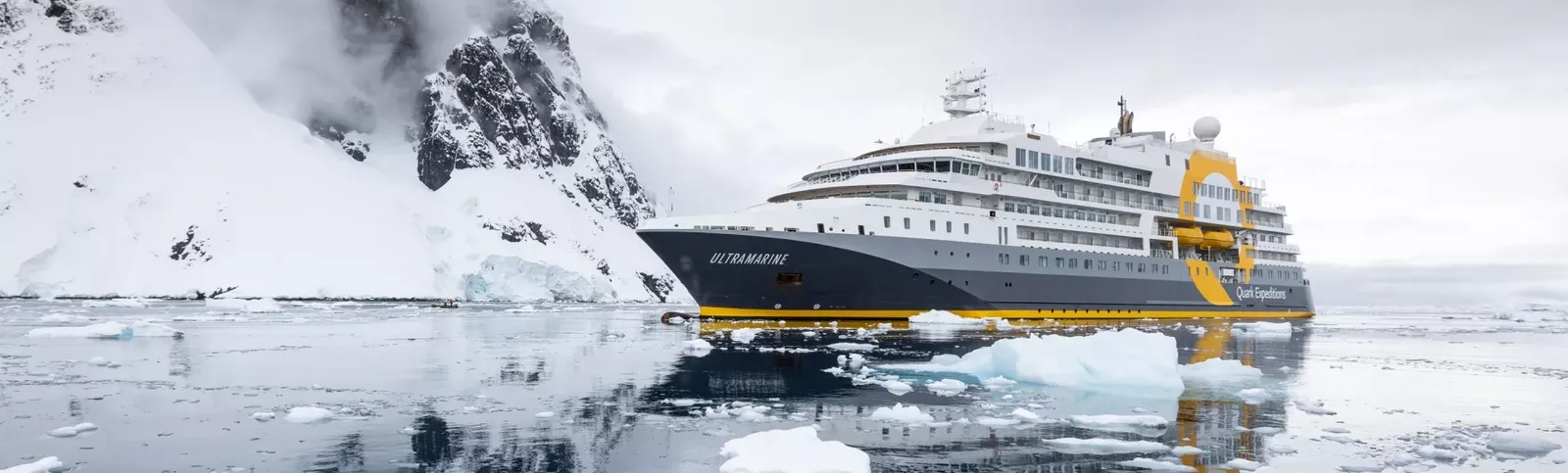
Quark Expeditions is the polar purist. Founded in 1991 by Mike McDowell and Lars Wikander — who led the first commercial voyage to the Geographic North Pole aboard a nuclear icebreaker — Quark has operated exclusively in polar waters for over three decades. No Mediterranean. No Galapagos. No Kimberley. Arctic and Antarctic, full stop. Headquartered in Seattle and owned by Travelopia (a KKR portfolio company), Quark was one of the seven founding members of IAATO. The company’s defining asset is Ultramarine — a 199-passenger purpose-built expedition ship carrying twin Airbus H145 helicopters that enable Snow Hill Emperor penguin colony access, included flightseeing, and heli-landings that no other sub-200-passenger polar ship can offer. The fleet also includes Ocean Explorer (138 passengers, X-BOW hull design), World Voyager (168 passengers, hybrid-electric engines), and the nuclear icebreaker 50 Years of Victory for North Pole voyages. Quark’s Quark Academy is the only proprietary polar training programme in the expedition cruise industry. Since November 2024, all voyages include complimentary drinks and Wi-Fi. The company won World’s Leading Polar Expedition Operator at the World Travel Awards in both 2024 and 2025.
For the Australian traveller comparing these two lines, the question is not which is better — it is what kind of Antarctic experience you are actually buying.
Expedition team and guides
The guide ratio comparison between HX and Quark is the starkest of any pairing in this series, and it directly affects almost every aspect of the expedition experience.
Quark’s expedition team operates at a claimed ratio of approximately 1:6 — on a reported Greenland voyage aboard Ultramarine, 37 expedition guides sailed with approximately 199 passengers. This is the best ratio in the polar expedition industry by a significant margin. The team includes marine biologists, glaciologists, geologists, ornithologists, cetologists, polar historians, photographers, and outdoor educators, many holding PhD-level qualifications. Specialist whale researchers from the Friedlaender Lab at the University of California, San Diego, and HappyWhale sail on select itineraries, bringing active academic research directly into the passenger experience. The Quark Academy — the only proprietary polar training programme in expedition cruising — ensures all staff pass IAATO and AECO examinations before deployment. Expedition team members routinely dine with passengers, creating the kind of informal expert-guest relationships that define the best polar voyages. On a shore landing, a group of seven or eight passengers might have a dedicated guide — intimate enough for real-time species identification, individual photography coaching, and adaptive route-finding based on the group’s interests.
HX’s expedition team carries approximately 15 to 20 multi-disciplinary specialists per voyage — marine biologists, wildlife biologists, ornithologists, glaciologists, historians, photographers, and cultural interpreters. The team quality is genuinely strong: Tudor Morgan brings nearly thirty years of polar exploration experience, and HX’s in-house polar guide training academy won the Princess Royal Training Award in 2024. The problem is mathematics. On the hybrid ships carrying 500 passengers, those 15 to 20 guides produce an estimated ratio of approximately 1:25 to 1:30. On a shore landing — where only 100 passengers are ashore at once — the ratio improves to perhaps 1:5 to 1:7 for the active landing group, but the team is simultaneously managing Zodiac operations, preparing the next rotation, and running onboard programming for the 400 passengers still on the ship. The workload is fundamentally different from Quark’s, where the entire expedition team can focus on 199 passengers total. On MS Fram (200 passengers polar), HX’s ratio improves to approximately 1:10 to 1:13 — competitive with most expedition operators, though still below Quark’s Ultramarine.
The difference is not about individual guide quality — both lines employ excellent polar professionals. The difference is about access. On Quark, you will interact with expedition experts multiple times daily — during landings, at meals, in the lounge after dinner. On HX’s hybrid ships, those same calibre experts are stretched across five times as many passengers. The lecture in Quark’s Ambassador Theatre accommodates 199 people; the same lecture on MS Roald Amundsen accommodates 500. Questions get asked. Not all get answered. This is the structural reality of high-volume expedition cruising, and it cannot be resolved by hiring better guides.
Where HX offers a distinctive advantage is cultural interpretation. On Greenland voyages, HX deploys Inuit cultural interpreters — including Niels Sanimuinaq Rasmussen, a Master of Ice Camp specialising in Greenlandic Inuit culture. These are not expedition guides in the traditional sense but cultural ambassadors whose presence gives HX’s Arctic programme a depth of local knowledge that few operators can match. Quark counters with the Tundra to Table culinary programme developed with Greenlandic collective Igapall, but HX’s cultural integration is more sustained across the voyage.
Ships and expedition hardware
The hardware comparison between HX and Quark reveals two completely different philosophies of expedition ship design — one optimised for scale and efficiency, the other for polar specialisation and access.
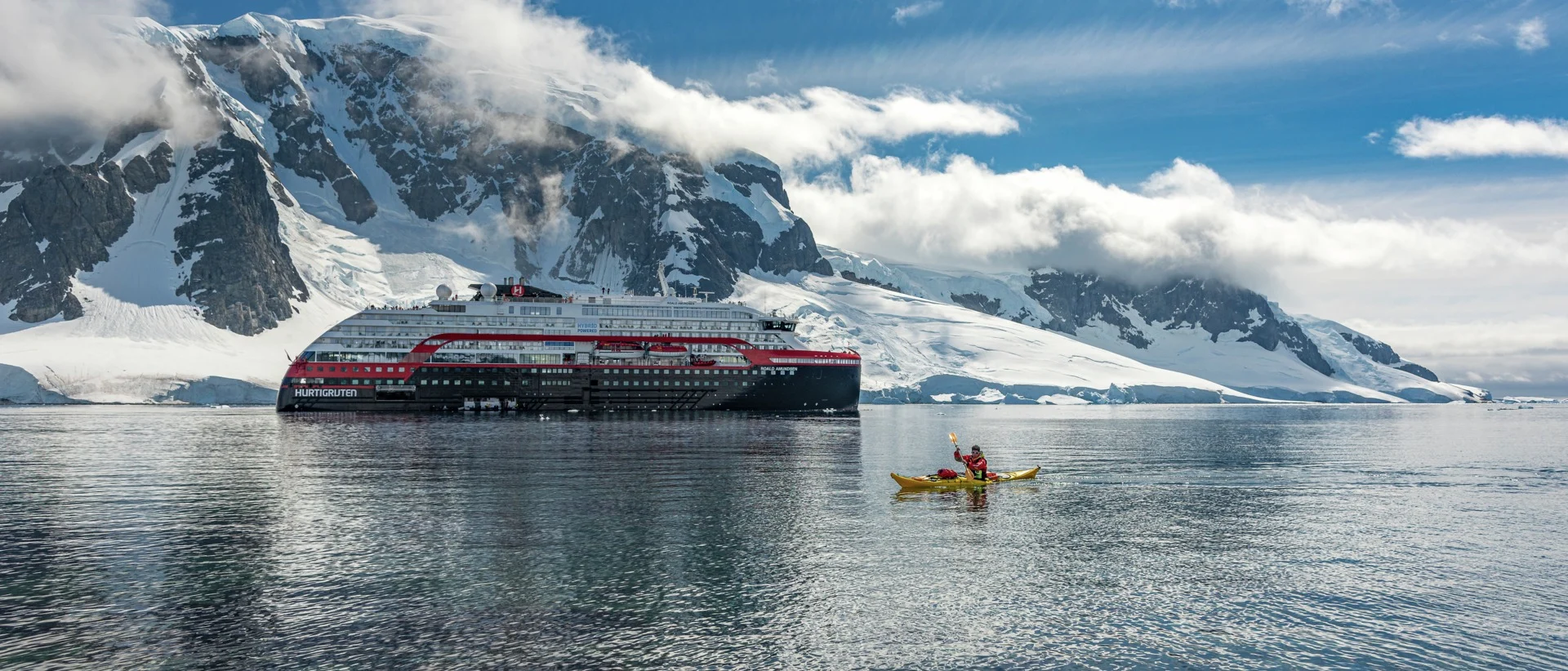
HX’s fleet centres on the MS Roald Amundsen and MS Fridtjof Nansen — purpose-built hybrid battery-powered expedition ships launched in 2019 and 2020 respectively. At 20,889 gross tonnes and 140 metres in length, these are genuinely large expedition vessels. They were the world’s first hybrid-powered cruise ships, featuring Rolls-Royce SAVe Cube technology with four diesel engines producing 14,400 kW total and two Corvus Energy lithium-ion battery packs providing approximately 1.25 MWh of battery capacity. They can operate on battery power alone for 30 to 60 minutes, reducing CO2 emissions by approximately 20 per cent compared to conventional diesel. Both hold PC6 ice class — standard for Antarctic Peninsula operations. Each carries 17 inflatable Explorer Boats stored in a tender pit on Deck 3, enabling fast Zodiac deployment without cranes. The smaller MS Fram (11,647 GT, 200 passengers polar, ice class 1B) was fully refurbished in April 2025 and represents HX’s most expedition-capable ship, though it operates on fewer itineraries. MS Spitsbergen (150 passengers, ice-strengthened hull) handles technical Arctic itineraries including Svalbard.
Quark’s fleet leads with Ultramarine — a 13,500 GT, 128-metre purpose-built expedition ship carrying 199 passengers. Ultramarine holds Ice Class 1A+ (slightly higher than HX’s hybrid ships) and was built by Brodosplit in Croatia specifically for polar operations. The ship’s twin Airbus H145 helicopters are stored in a dedicated hangar with two helidecks — the fastest, most fuel-efficient helicopters in their category, each carrying 8 passengers plus pilot. Twenty Zodiacs are stored in a water-level internal hangar with four embarkation points enabling simultaneous loading from multiple sides of the ship. This deployment system is an engineering achievement — faster on-and-off means more time at landing sites. Ocean Explorer (8,228 GT, 138 passengers) features the Ulstein X-BOW inverted hull design — the same technology used by Aurora Expeditions — which delivers noticeably smoother sailing through rough seas. World Voyager (9,300 GT, 168 passengers) adds hybrid-electric Rolls-Royce engines. The nuclear icebreaker 50 Years of Victory, chartered for North Pole voyages, is in a category entirely its own — 23,439 GT, 75,000 horsepower, capable of smashing through 2.5 metres of multi-year ice.
The helicopter advantage is Quark’s most consequential differentiator. Ultramarine’s twin H145s unlock destinations that no Zodiac-only ship — including every HX vessel — can reach. The Emperor penguin colony at Snow Hill Island is accessible only by helicopter transfer across sea ice. Heli-landings place passengers on mountain ridges and ice shelves that would otherwise remain scenic backdrops glimpsed from a Zodiac. Every Ultramarine passenger receives at least two complimentary 15-minute flightseeing excursions and one heli-landing per voyage. HX does not carry helicopters on any ship. This is not a marginal difference — it is an entire dimension of Antarctic access that HX simply cannot offer.
HX’s propulsion advantage is genuine but less experientially transformative. The hybrid battery system is a meaningful environmental achievement and a legitimate selling point for sustainability-minded travellers. Silent battery-mode operation in sensitive wildlife areas reduces disturbance. But for the passenger, the hybrid system does not change what you can see or where you can go — it changes how you feel about the environmental footprint of getting there. That matters, but not in the same way that helicopter access matters when you are standing 50 metres from an Emperor penguin colony.
Neither line carries a submarine (unlike Scenic Eclipse or Seabourn). HX deploys Blueye underwater drones for live video feeds to the Science Center, while Quark does not market any underwater viewing technology. Both carry kayak fleets and camping equipment for optional adventure activities.
Landing experience and shore programme
This is where the IAATO Category C1 versus C2 distinction becomes the defining difference between these two lines — not an abstract regulation, but a lived experience that shapes every expedition day.
On Quark’s Ultramarine (199 passengers, Category C1): IAATO permits a maximum of 100 passengers ashore at any one time. With 199 passengers, Ultramarine requires only two rotation groups. Zodiac operations launch from a water-level hangar with four embarkation points, enabling simultaneous loading that gets passengers to the landing site fast. A typical shore excursion delivers 1.5 to 2.5 hours on the ground. Two landings per day — morning and afternoon — are standard when conditions permit. With a 1:6 guide ratio, each landing group has abundant expert supervision. The helicopter programme adds a third dimension: while one group is ashore and another is Zodiac cruising, helicopter flightseeing can run concurrently. The total daily expedition programming on Ultramarine is genuinely dense.
On HX’s hybrid ships (500 passengers, Category C2): The same IAATO 100-person limit applies, but 500 passengers means five rotation groups. Each group of 100 cycles through in sequence — while your group is ashore, four groups are on the ship waiting. Zodiac groups of 12 to 16 shuttle between ship and shore. The briefing area on Deck 3 accommodates 36 passengers at a time. Typically two excursions per day are offered: one land-based (hiking, wildlife observation) and one water-based (Zodiac cruising). The rotation logistics on HX’s hybrid ships are described by the company as “well-organised, ran like a military operation” — and that description is apt. The system works. But it is a system designed to manage volume, not to maximise individual exploration time. Your total time ashore per day on an HX hybrid ship will be substantially less than on Quark’s Ultramarine.
On HX’s MS Fram (200 passengers, Category C1): The landing experience improves dramatically. At 200 passengers, Fram sits just inside the Category C1 threshold, requiring only two rotation groups — comparable to Quark’s Ultramarine. The ship was fully refurbished in 2025 and is preferred by experienced polar travellers who recognise the structural advantage of the smaller vessel. If you are booking HX for Antarctica and landing quality matters to you, Fram is the ship to choose. The challenge is that Fram operates fewer Antarctic departures than the hybrid ships, limiting availability.
Included activities on HX: Nature landings and shore excursions, Zodiac cruising, wildlife observation, polar plunge, all lectures and Science Center activities, citizen science participation, and extended hikes where available. Paid add-ons include sea kayaking (EUR 129 to 199 per person), camping by bivvy bag (EUR 350) or tent (EUR 429), and snowshoeing.
Included activities on Quark: Zodiac cruises, guided hikes, snowshoeing, polar plunge, helicopter flightseeing and heli-landing on Ultramarine, and all expert lectures. Paid add-ons include the voyage-length sea kayaking programme (approximately USD 1,995), stand-up paddleboarding (approximately USD 295), and Antarctic camping (approximately USD 295 for one night, limited to 50 participants, early season only).
The cost comparison on activities is revealing. Quark’s kayaking programme at USD 1,995 is significantly more expensive than HX’s EUR 129 to 199 options — but Quark’s is a multi-outing voyage-length programme with small groups and prior experience recommended, while HX offers individual outings. HX’s camping is more expensive (EUR 350 to 429) than Quark’s (USD 295) but offers both bivvy bag and tent options. The included helicopter flights on Quark’s Ultramarine — worth hundreds of dollars if priced as add-ons — tip the total value balance.
What is actually included
Both lines transitioned to more inclusive fare models in 2024, but the details differ in ways that compound over the course of a voyage.
HX’s all-inclusive fare covers: all daily expeditions and activities (landings, Zodiac cruising, hikes), full-board dining at Aune Restaurant and Fredheim, house wine, beer, spirits, and cocktails throughout the day and evening (excluding premium drinks), complimentary Starlink Wi-Fi, gratuities, sauna, hot tubs, fitness room, expedition jacket (wind and water-resistant, yours to keep), reusable water bottle, rubber boot loan, trekking pole loan, and a complimentary digital photo album from the onboard photographer. On Antarctic voyages, charter flights between Buenos Aires and Ushuaia and a pre-cruise night at a five-star hotel in Buenos Aires are included. Suite guests receive complimentary fine dining at Restaurant Lindstrom.
Quark’s included fare covers: shipboard accommodation with daily housekeeping, all meals, complimentary beer, wine, spirits, and cocktails at all bars and during dinner, complimentary Wi-Fi, shore landings and Zodiac excursions, expert lectures and workshops, the complimentary 3-in-1 parka (yours to keep), insulated waterproof boots on loan, collapsible water bottle, and — on Ultramarine — helicopter flightseeing and heli-landing. Gratuities are not included: Quark recommends USD 10 to 15 per person per day, collected anonymously at voyage end.
The net comparison: HX’s inclusion of gratuities is a genuine advantage — on an 11-day voyage, that saves approximately USD 110 to 165 per person. HX’s included Buenos Aires hotel night and charter flight to Ushuaia also add real value. Quark counters with the included helicopter programme on Ultramarine — two flightseeing excursions and a heli-landing that would cost hundreds of dollars with any operator that charges for comparable experiences. Both include drinks, Wi-Fi, parka, and boots.
What is not included on either line: International flights from Australia, travel insurance, paid adventure activities (kayaking, camping, paddleboarding), spa treatments, premium drinks, and laundry. HX charges a surcharge for non-suite guests dining at Lindstrom. Quark has no surcharge dining venues.
The difference between these two fare structures is relatively modest in dollar terms. The difference in what you receive for that fare — a 500-passenger hybrid ship versus a 199-passenger ship with helicopters — is enormous.
Destination coverage and itinerary depth
Both lines operate primarily in the Antarctic and the Arctic, but their geographic scope and seasonal calendars differ — and one offers a destination that exists in a category of its own.
HX’s destination portfolio is the broader of the two. Antarctica: fifty departures per season across Highlights of Antarctica (12 days), Antarctic Circle (17 days), Iconic Antarctica (15 days), and Antarctica combined with South Georgia and Falklands (22 to 24 days). Ships deployed include MS Roald Amundsen, MS Fridtjof Nansen, and MS Fram — three of five fleet vessels committed to the Antarctic programme. Arctic: multiple Svalbard itineraries including a new spring departure, the largest-ever Greenland season with four vessels including three Grand Greenland voyages, four new Arctic Canada sailings, and two Northwest Passage crossings including a new west-to-east route from Alaska to Greenland. Beyond the poles: Alaska (fifth season on MS Roald Amundsen), Galapagos year-round on MV Santa Cruz II, West Africa and Cape Verde (HX is the sole cruise line offering these), South America, Iceland, and British Isles. HX has been sailing to Antarctica since 2013 and offers more departure dates than any other expedition operator.
Quark’s destination portfolio is exclusively polar — the Arctic and Antarctic, nothing else. Antarctica: Peninsula voyages from Ushuaia across multiple itineraries (10 to 14 days), South Georgia and Falklands combinations (18 to 23 days), Antarctic Circle crossings, Snow Hill Emperor penguin colony visits accessible only via Ultramarine’s helicopters, the Antarctic Express Fly-the-Drake programme (8 days from Punta Arenas), and science-focused itineraries including Antarctic Marine Mammals co-developed with the Friedlaender Lab. The 2025-2026 season offers 41 departure dates across five destination regions. Arctic: Svalbard circumnavigation, Greenland coast itineraries, Northwest Passage, Iceland transits, and multi-destination Arctic voyages. The crown jewel: North Pole voyages aboard the nuclear icebreaker 50 Years of Victory — 14 days to the Geographic North Pole, one of only two commercial operators offering this journey.
Where the coverage comparison becomes interesting: HX wins on sheer volume and breadth. Fifty Antarctic departures versus Quark’s 41 means more date flexibility for time-constrained travellers. Galapagos, Alaska, and West Africa give HX a year-round expedition calendar that Quark’s polar-only model cannot match. But Quark’s exclusivity is its advantage — when every voyage, every route, every crew member is dedicated to polar operations, the institutional depth runs deeper. Quark’s Snow Hill Emperor penguin itinerary and North Pole voyages represent genuinely unique destinations that HX cannot access.
Fly-the-Drake comparison: Quark offers the Antarctic Express Fly-the-Drake programme — an 8-day itinerary from Punta Arenas with charter flights to King George Island, from approximately USD 14,370 per person. This uses Ocean Explorer or World Voyager (not Ultramarine, so no helicopter programme). HX does not offer any fly-the-Drake option. All HX Antarctic voyages include the full Drake Passage crossing by sea. Charter flights between Buenos Aires and Ushuaia are included, but the Drake crossing remains unavoidable. For Australian travellers with limited leave time or genuine concern about the Drake, Quark’s fly-cruise option is a significant advantage.
Cabins and accommodation
Both lines provide functional expedition accommodation designed for polar voyaging — not luxury suites designed for extended lounging. The cabin is where you sleep, dry gear, and charge camera batteries. The Antarctic is outside.
HX’s cabin range on the hybrid ships (MS Roald Amundsen and MS Fridtjof Nansen) spans 265 cabins across three main tiers. All cabins are outside-facing — no inside cabins on the hybrid ships. Fifty per cent have private balconies. Polar Outside cabins (183 to 248 square feet) provide windows and a sitting area at the entry level. Arctic Superior cabins (161 to 291 square feet) offer balconies on upper decks. Expedition Suites range from 200 square feet for entry-level suites to 517 square feet for the Extra-Large Suite Forward, with hot tub bathrooms in aft suites and sweeping forward views in the top category. Scandinavian interior design uses natural materials — granite, oak, birch, and wool. On MS Fram, inside cabins are available as the most economical option. MS Spitsbergen offers inside cabins as small as 9 square metres — the most affordable accommodation in the HX fleet.
Quark’s cabin range on Ultramarine spans 102 suites across 9 categories — fewer cabins but greater variety per passenger. The entry-level Explorer Suite at 285 square feet is one of the largest entry-level cabins in polar expedition cruising — significantly more spacious than HX’s Polar Outside at 183 to 248 square feet. The Balcony Suite (226 square feet interior plus 52-square-foot balcony) is the most popular category. The Ultra Suite at 563 square feet features two walk-in closets and three distinct living zones. Six Solo Panorama Suites at 132 square feet serve solo travellers with floor-to-ceiling windows. On Ocean Explorer, 72 cabins across 8 categories include 7 solo cabin options and Scandinavian design aesthetics. World Voyager offers 84 all-balcony cabins across 5 categories.
The space comparison at entry level strongly favours Quark. Ultramarine’s Explorer Suite at 285 square feet provides 37 to 102 square feet more living space than HX’s Polar Outside cabin. At the balcony tier, Quark’s 278 total square feet (interior plus balcony) exceeds HX’s Arctic Superior options in most sub-categories. At the top end, Quark’s Ultra Suite at 563 square feet comfortably surpasses HX’s Extra-Large Suite Forward at 517 square feet. However, HX’s hybrid ships carry 265 cabins versus Ultramarine’s 102, meaning more inventory and more booking availability.
Solo traveller options: Quark offers 6 Solo Panorama Suites on Ultramarine and 7 solo cabins on Ocean Explorer (including one balcony solo cabin). Quark’s cabin-share programme waives the single supplement if no match is found — a meaningful benefit. HX has no dedicated solo cabin category but releases limited cabins with no single supplement on select sailings, with standard solo supplements starting from 25 per cent (competitive versus the industry norm of 50 to 100 per cent). HX periodically releases these in monthly batches on a first-come-first-served basis. For dedicated solo travellers, Quark’s purpose-built solo cabins are the stronger proposition.
Practical notes: All HX cabins include European two-pin plug sockets, tea and coffee facilities, and Scandinavian-designed bathrooms. Quark’s Ultramarine suites include individual climate control, and the Explorer Suite’s 285 square feet provides ample space for camera gear, expedition clothing, and field guides — a practical consideration that matters more on an expedition ship than a resort cruise.
Pricing and value
The headline price comparison favours HX — but the headline price buys a fundamentally different product.
HX’s directional pricing for a 12-day Highlights of Antarctica voyage on MS Roald Amundsen: Polar Outside from approximately AUD 13,355, Arctic Superior from approximately AUD 15,856, Expedition Suite from approximately AUD 18,901. A 17-day Antarctic Circle crossing starts from approximately AUD 17,000. Flight-inclusive packages with Buenos Aires charter flights from approximately AUD 13,977 for 15 days. HX’s per diem for entry-level polar voyages sits at approximately AUD 1,100 to 1,500 per person per day — among the most accessible in expedition cruising.
Quark’s directional pricing for an 11-day Classic Antarctic Explorer on Ultramarine: Explorer Triple or Explorer Suite from approximately USD 10,000 to 13,000 per person (with early booking discounts of up to 30 per cent), Balcony Suite from approximately USD 14,000 to 18,000, Ultra Suite from approximately USD 30,000 to 40,000-plus. At current exchange rates, entry-level Ultramarine fares translate to approximately AUD 16,000 to 20,000 per person. Ocean Explorer entry fares start from approximately USD 10,000 to 12,000. The 8-day Fly-the-Drake starts from approximately USD 14,370.
The value equation is more complex than headline pricing suggests. HX is cheaper by approximately AUD 3,000 to 6,000 per person at entry level — a meaningful difference. But consider what each fare delivers: HX’s entry fare buys passage on a 500-passenger ship with a 1:25 to 1:30 guide ratio, five-group landing rotations, no helicopters, and no fly-the-Drake option. Quark’s entry fare buys passage on a 199-passenger ship with a 1:6 guide ratio, two-group landing rotations, twin helicopter flightseeing and heli-landing included, and the option to book fly-the-Drake itineraries. The question is not whether HX is cheaper — it clearly is. The question is whether the price difference reflects a proportional difference in expedition quality. Many experienced polar travellers would argue that Quark’s entry fare delivers two to three times the expedition substance of HX’s entry fare on the hybrid ships.
The MS Fram exception: HX’s Fram at 200 passengers delivers a landing experience comparable to Quark’s ships (Category C1, two rotations) at HX pricing. Fram itineraries represent the best value-for-expedition-quality in the HX fleet. If you are price-sensitive but unwilling to compromise on landing logistics, Fram is the HX ship to target.
Solo traveller pricing: Quark periodically waives solo supplements on select sailings (all Ultramarine Arctic 2026 departures on Balcony Suites, saving up to USD 10,000). HX’s no-supplement releases and 25 per cent base supplement are competitive. Both represent strong value for solo polar travellers.
Booking timing: Both lines offer the best discounts during wave season (December to March) and for early booking. Quark’s aggressive early-booking discounts of up to 30 per cent can substantially narrow the price gap with HX. Shoulder season departures — November and March — are 20 to 40 per cent cheaper than peak December and January on both lines.
Onboard enrichment and science
Both lines maintain active science programmes, but Quark’s is more deeply integrated into the voyage identity while HX’s is supported by broader institutional infrastructure.
HX’s enrichment programme centres on the Science Center — a dedicated facility on every expedition ship, new or upgraded on both Fram and Spitsbergen during the 2025 refurbishments. The Science Center features microscopes, touch screens, Blueye underwater drones for live underwater footage, and serves as the hub for the onboard expedition programme. Citizen science partnerships include eBird, iNaturalist, HappyWhale, FjordPhyto, and the Secchi Disk Programme. A partnership with the University of Tasmania’s Institute for Marine and Antarctic Studies brings academic credibility. The 2025-2026 season sees over 1,100 cabins donated to science, support for 20-plus research projects, and 16,000-plus data submissions planned. The lecture programme covers wildlife, culture, history, geology, and glaciology with multilingual interpretation available — German language support is standard on many voyages, reflecting HX’s significant German-speaking market. Photography workshops run in the Science Center, with a professional photographer on the expedition team and a complimentary digital photo album included in every fare.
Quark’s enrichment programme is anchored by the exclusive Friedlaender Lab partnership with the University of California, San Diego — Professor Ari Friedlaender’s Biotelemetry and Behavioral Ecology Lab places active whale researchers aboard select voyages. Portable hydrophones allow passengers to listen to underwater whale sounds — an experience described by passengers as genuinely transformative. HappyWhale research associates guide fluke photography for global whale tracking. Seabird surveys run during Drake Passage crossings in collaboration with the Polar Collective. The dedicated Antarctic Marine Mammals: The World of Whales and Seals itinerary represents the most science-focused commercial polar voyage available — co-developed with active researchers, not retrofitted with guest-friendly science content. The Ambassador Theatre on Ultramarine features a high-resolution LED screen for lectures, documentaries, and daily expedition recaps. A media lab supports photograph processing and sharing.
The comparison: HX’s science infrastructure is broader — more partnerships, more programmes, a physical Science Center on every ship, and an impressive volume of data collection. Quark’s is deeper and more distinctive in its specific niche — the Friedlaender Lab partnership creates moments of genuine scientific discovery (hearing whale communication through hydrophones) that HX’s broader programme does not replicate. HX includes a professional photographer on every voyage with a complimentary photo album; Quark offers photography workshops but does not guarantee a dedicated photographer on every sailing. For the passenger who wants sustained daily engagement with citizen science, HX’s Science Center and seven-programme portfolio may edge ahead. For the passenger who wants a single transformative science experience, Quark’s whale research programme is unmatched.
Dining on expedition
Neither HX nor Quark positions itself as a culinary destination — the food needs to fuel expedition days, accommodate unpredictable schedules, and sustain morale in remote waters. Both succeed at this brief, with different strengths.
HX’s dining programme on the hybrid ships features three venues: Restaurant Aune (main dining, buffet breakfast and lunch, plated dinner service, international cuisine), Restaurant Lindstrom (fine dining, Scandinavian-inspired, included for suite guests, surcharge for others), and Fredheim (casual snacks and informal meals). MS Spitsbergen added Brygge Bistro during its 2025 refurbishment. The cuisine follows a “Norway’s Coastal Kitchen” philosophy emphasising local sourcing, seasonal ingredients, and reimagined Nordic classics. The dress code is relaxed even in Lindstrom — no formal nights. Buffet service at breakfast and lunch is a common critique from passengers accustomed to plated service, though the quality is rated as “very good” for an expedition line. Wine, beer, spirits, and cocktails are included throughout the day. No celebrity chef partnership — unlike Ponant (Ducasse), Silversea (S.A.L.T.), or Seabourn (Keller).
Quark’s dining programme on Ultramarine features two venues: Balena Restaurant (main dining, floor-to-ceiling windows at the bow, open seating, international cuisine for breakfast, lunch, and dinner) and Bistro 487 (lighter fare, healthy options, early riser breakfast, afternoon tea, late-night snacks). Ocean Explorer adds a private dining room seating 36 for more intimate meals. The signature culinary experience is Tundra to Table — an Inuit culinary programme developed with Greenlandic collective Igapall, featuring a four-course modern fusion dinner hosted by Inuit or Icelandic chefs. Available on select Arctic voyages at additional cost, this is the only exclusively Inuit culinary experience in expedition cruising. All alcoholic beverages are complimentary throughout the day. Food quality is consistently praised as a voyage highlight.
The comparison: HX offers more dining venues (three versus two on Ultramarine) and the option of the premium Lindstrom for passengers willing to pay the surcharge or booking a suite. Quark’s Tundra to Table is genuinely distinctive — a culturally immersive dining experience that no other expedition line offers. Both include drinks throughout the day. The meaningful daily difference is minimal: both deliver good expedition-standard food in casual settings with no pretension. Neither will disappoint, and neither will win awards for gastronomy. The point is the penguin colony, not the plate.
Standout itineraries for Australian travellers
HX Expeditions
Highlights of Antarctica (12 days, Buenos Aires return with charter flight to Ushuaia, MS Roald Amundsen or MS Fridtjof Nansen) — HX’s most accessible Antarctic itinerary. All-inclusive fare from approximately AUD 13,355 per person including drinks, Wi-Fi, gratuities, charter flights, and a pre-cruise night at the Hilton Buenos Aires. The entry point to Antarctic expedition cruising at a price that undercuts most competitors. Fly Sydney or Melbourne to Buenos Aires via Santiago (approximately 14 to 16 hours). Accept the trade-offs: 500 passengers, five-group landing rotations, no helicopters. If budget is the primary constraint, this is the most affordable way to reach the Antarctic Peninsula with a credible expedition operator.
Antarctica and South Georgia on MS Fram (22 to 24 days, various routings) — The itinerary that solves HX’s structural problem. MS Fram carries 200 passengers (Category C1), operates with better guide-to-guest ratios than the hybrid ships, and was fully refurbished in 2025. South Georgia’s king penguin colonies and Shackleton’s grave add expedition depth. From approximately AUD 25,000 per person. This is the HX product that experienced expedition travellers should target — the landing experience is categorically better than on the hybrid ships.
Svalbard in Spring on MS Spitsbergen (seasonal, Longyearbyen) — A distinctive Arctic itinerary exploring western Svalbard as it emerges from polar winter. MS Spitsbergen carries 150 passengers — HX’s most intimate expedition vessel — with a refurbished Science Center, new bistro, and strong ice capability. Polar bears, Arctic terns, walruses, and the returning polar sun. From Europe hub connections (approximately 22 to 24 hours from Australia).
Quark Expeditions
Classic Antarctic Explorer on Ultramarine (11 days, Ushuaia round trip) — Quark’s signature voyage with the full helicopter programme. Twin H145 flightseeing over glaciers and penguin colonies (minimum two flights included), heli-landing on an otherwise unreachable site, two landings per day with a 199-passenger ship and 1:6 guide ratio. Included drinks throughout. From approximately AUD 16,000 to 20,000 per person. Fly Sydney or Melbourne to Buenos Aires or Santiago, then connect to Ushuaia.
Snow Hill Emperor Penguins on Ultramarine (dedicated itinerary, limited departures) — The rarest wildlife encounter in expedition cruising. Helicopter transfer across sea ice to the Emperor penguin colony at Snow Hill Island — inaccessible by Zodiac, inaccessible to any ship without helicopter capability. This itinerary sells out far in advance. For the Australian traveller who has placed Emperor penguins at the top of the life list, this is the only option between these two lines — and one of the only options in the world.
Antarctic Express: Fly the Drake (8 days, Punta Arenas) — Skip the Drake Passage entirely with charter flights to King George Island. Maximise Peninsula time in just 8 days — ideal for the Australian professional with limited leave. Uses Ocean Explorer or World Voyager (no helicopter programme). From approximately USD 14,370 per person. Fly to Santiago, connect to Punta Arenas.
Ultimate Arctic Adventure: North Pole (14 days, aboard 50 Years of Victory nuclear icebreaker, June/July departures) — The Geographic North Pole. A 75,000-horsepower nuclear icebreaker smashing through multi-year Arctic ice. One of only two operators in the world offering this voyage. From Murmansk, Russia, requiring complex routing from Australia via Helsinki or Oslo. The ultimate bucket-list polar expedition.
For Australian travellers specifically
Getting to the ship: Both lines require international travel to reach Antarctic embarkation ports. For HX, the typical routing is Sydney or Melbourne to Buenos Aires (approximately 15 to 17 hours via Qantas, LATAM, or Aerolineas Argentinas) — HX includes charter flights from Buenos Aires to Ushuaia and a pre-cruise hotel night, simplifying logistics. For Quark’s standard Antarctic voyages, routing is identical: Australia to Buenos Aires or Santiago, then domestic connection to Ushuaia (approximately 3.5 hours). For Quark’s Fly-the-Drake, routing goes through Santiago to Punta Arenas. For Arctic voyages with either line, European hub connections (London, Copenhagen, Oslo) add 22 to 24-plus hours of travel from Australia. Qantas frequent flyer points are earnable on LATAM flights through the oneworld alliance.
Neither line departs from Australian ports. This contrasts with Aurora Expeditions (Hobart for East Antarctica) and Coral Expeditions (Australian coastal). For Australian travellers who want to minimise international transit, neither HX nor Quark offers an Australian departure solution.
Australian office presence: HX established a dedicated Australian and New Zealand sales and marketing team in 2025, with a Melbourne-based Guest Excellence team handling sales and service calls during Australian business hours (Monday to Friday, 8am to 6pm AEST). This is a meaningful commitment — 163 per cent revenue growth in the Asia-Pacific region since 2019 justified the investment. Quark has no Australian office. Sales are handled through the Seattle and Toronto teams and Australian-based expedition cruise specialists including Expedition Cruise Specialists and Chimu Adventures. For Australian travellers who value local booking support and Australian business hours, HX has the advantage.
Travel insurance: Standard travel insurance policies frequently exclude Antarctic and expedition cruise activities. Specialist expedition insurance with minimum AUD 500,000 medical coverage and AUD 250,000 evacuation coverage is strongly recommended. Both lines require mandatory travel insurance. Adequate medical facilities can be 72-plus hours away from any Antarctic position — evacuation insurance must cover helicopter extraction from polar regions.
Currency: HX prices in multiple currencies including AUD on its Australian website (travelhx.com/en-au/). Quark prices exclusively in USD globally. For Australian travellers, HX’s AUD pricing eliminates exchange rate uncertainty at booking time.
Loyalty programmes: HX Explorers offers a four-tier structure (Bronze to Platinum) with 5 per cent cruise discount at entry level and complimentary room upgrades at Platinum (500-plus points). Points are earned through cruise nights and onboard spending, valid for 7 years. Quark’s Shackleton Club is simpler but arguably more generous: USD 750 off any expedition immediately after first voyage, USD 1,500 off if rebooked within 14 days of disembarkation, USD 150 shipboard credit, and automatic cabin upgrades 60 days before departure. Quark’s 14-day rebooking bonus is a clever incentive — the onboard atmosphere after an Antarctic voyage creates powerful rebooking motivation, and USD 1,500 off captures that moment.
The onboard atmosphere
The onboard atmosphere on these two lines differs as much as the hardware — shaped by passenger count, demographic mix, and the fundamental expectations that each product creates.
HX’s atmosphere on the hybrid ships reflects the larger scale. With 500 passengers, these ships carry the social dynamics of a mid-sized expedition community rather than an intimate expedition family. The crowd is international with a significant German-speaking contingent (reflected in standard German-language interpretation for lectures). The age range spans from adventure-seeking retirees to families with teenagers. The hybrid ships feel comfortable, well-appointed, and efficiently managed — the Scandinavian design is clean and functional, the panoramic observation lounges are spacious, and there is room to find a quiet corner. But the intimacy that defines small-ship expedition travel is diluted. You will not know everyone by name on day two. The expedition team cannot dine with every table across a voyage. Lectures accommodate 500 people. The atmosphere is expedition-themed cruising rather than expedition immersion — pleasant, educational, and well-run, but lacking the intensity that comes with a smaller group sharing the same experiences simultaneously.
Evening programming on HX centres on lectures, recap presentations, and socialising in the lounges and bar areas. Cruise Critic reviewers note that onboard activities beyond lectures can be limited — “no real onboard activities,” “nothing to do in evenings except drink” appears in multiple reviews, particularly on sea-day-heavy itineraries. The all-inclusive bar softens this — with drinks included, the social lubrication is constant. The outdoor observation decks and open bridge policy provide wildlife-watching opportunities that do not require structured programming. The Science Center adds an informal drop-in space for engaged passengers. But the combination of 500 passengers and limited organised evening activities can leave some travellers wanting — particularly those accustomed to the densely programmed evenings of mainstream cruise ships (which HX is not) or the intimate expert-guest socialising of smaller expedition ships (which HX’s scale does not easily facilitate).
Quark’s atmosphere on Ultramarine is international, expedition-focused, and energised by the shared adventure of a sub-200-passenger community. The demographic spans 25 to 80-plus, with the strongest cohorts in the 35 to 44 and 55 to 64 age ranges — well-travelled, educated, and united by polar ambition. By the third day, most passengers know each other by face if not by name. Expedition team members dine with passengers, breaking down the expert-guest barrier that larger ships maintain by necessity. The Panorama Lounge — glass-enclosed with unobstructed views and a dance floor — is the social hub for post-dinner drinks, board games, and expedition stories. The Ambassador Theatre hosts daily recap presentations and documentary screenings. Interactive evenings include sea shanties and trivia nights. The dress code is entirely informal — sweatpants and Gore-Tex at dinner are the norm. Quark’s 4.9 out of 5 Trustpilot rating (319-plus reviews) reflects a consistently positive passenger experience.
The difference is not subtle. HX’s hybrid ships deliver a comfortable, well-organised expedition cruise with moments of genuine Antarctic wonder. Quark’s Ultramarine delivers an immersive polar expedition where the ship, the team, the passengers, and the ice form a single, intense community experience. Both have their appeal — HX for passengers who prefer some personal space and anonymity, Quark for those who want to be absorbed into the expedition.
The bottom line
HX Expeditions and Quark Expeditions occupy the same destination space but deliver fundamentally different products. The comparison is not close versus close — it is high-volume accessible expedition versus specialist premium polar adventure.
Choose HX Expeditions when departure flexibility matters — fifty Antarctic departures per season mean more date options than any other operator. Choose HX when the entry-level price point of approximately AUD 13,355 for a 12-day all-inclusive Antarctic voyage shapes the budget. Choose HX when hybrid battery-powered propulsion and the associated environmental credentials are a priority. Choose HX when you want the broadest destination calendar — Antarctica, Arctic, Alaska, Galapagos, and West Africa from a single operator. Choose HX when Australian booking support, AUD pricing, and Melbourne-based customer service hours matter. And critically, choose HX’s MS Fram over the hybrid ships if landing quality matters — the 200-passenger Fram delivers a Category C1 experience that the 500-passenger hybrids structurally cannot match. Accept that HX’s hybrid ships carry 500 passengers through Antarctic waters with a 1:25 to 1:30 guide ratio, require five-group landing rotations, and offer no helicopter access — trade-offs that are real and that experienced expedition travellers notice immediately.
Choose Quark Expeditions when the quality of the expedition experience matters more than the price of admission. Choose Quark when helicopter access is a priority — Ultramarine’s twin Airbus H145s unlock Snow Hill Emperor penguins, included flightseeing over glacial landscapes, and heli-landings that no Zodiac-only ship can reach. Choose Quark when the 1:6 guide ratio, sub-200-passenger ship size, and IAATO Category C1 landing rights — guaranteeing that everyone goes ashore with efficient two-group rotations — define your expectations for what an Antarctic expedition should be. Choose Quark when the North Pole aboard a nuclear icebreaker is on the life list. Choose Quark when included drinks, thirty-plus years of polar-only expertise, and the highest industry satisfaction ratings (4.9 on Trustpilot, World Travel Awards for 2024 and 2025) provide confidence. Accept that Quark has no Australian office, prices in USD only, does not include gratuities, and charges a premium over HX that reflects the genuinely different product being delivered.
For the Australian traveller weighing both lines, the most honest advice is this: if you have never been to Antarctica and the budget allows only one voyage, choose Quark. The landing experience, guide ratio, helicopter access, and sub-200-passenger intimacy of Ultramarine deliver the Antarctic expedition that most first-timers dream of — standing on the ice surrounded by penguins with an expert at your elbow, watching a glacier calve from a helicopter at 3,000 feet, and returning to a ship where the entire community shares the same day’s wonder. If budget is the binding constraint and any Antarctic experience surpasses no Antarctic experience — HX’s hybrid ships will get you there, and Antarctica is extraordinary regardless of the ship that carries you. The penguins do not check your IAATO category. The ice does not care how many passengers are waiting for the next Zodiac. But the structure of your expedition — how much time you spend ashore, how many guides walk beside you, whether a helicopter lifts you above the ice shelf — shapes the story you tell for the rest of your life.