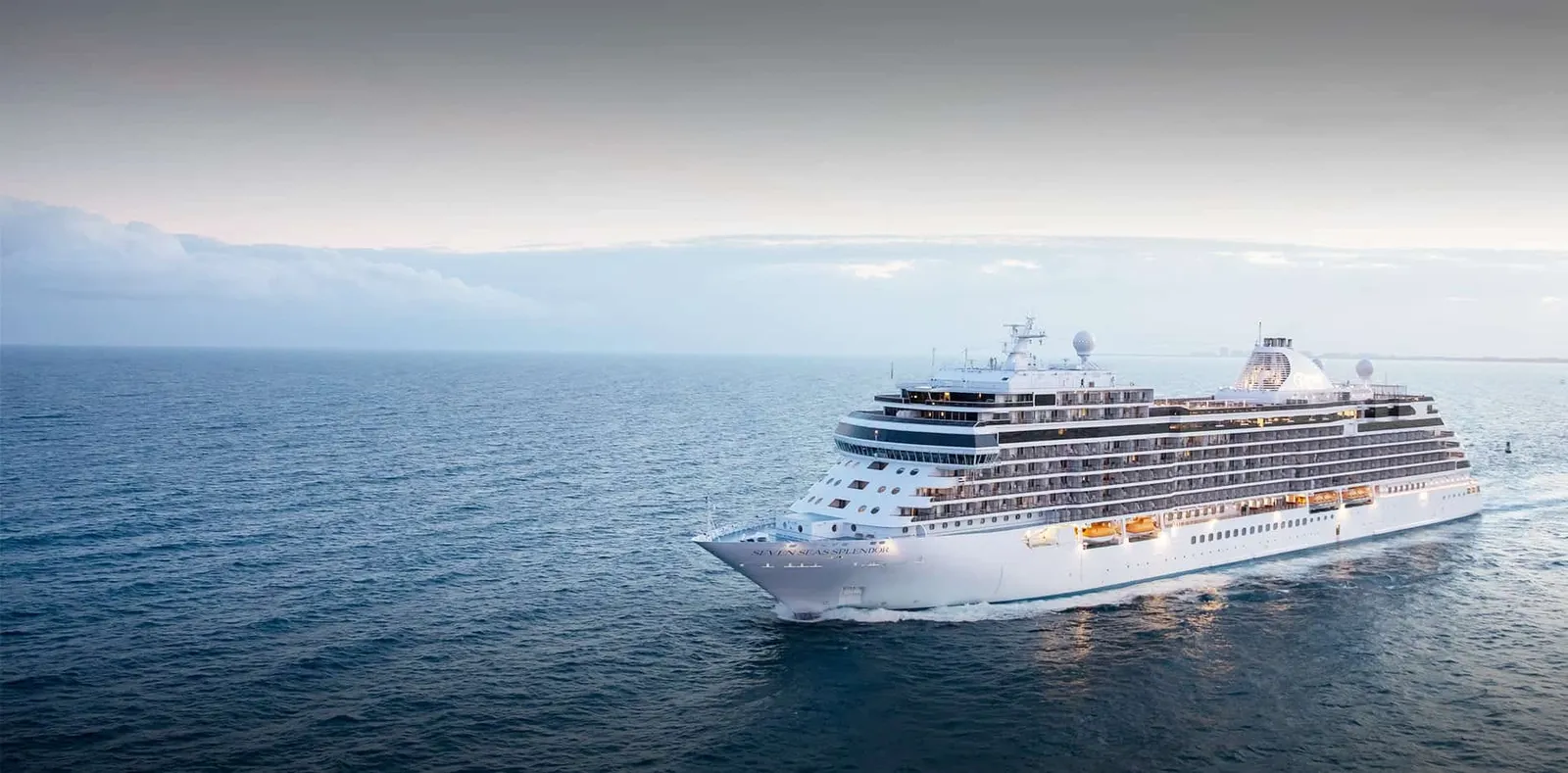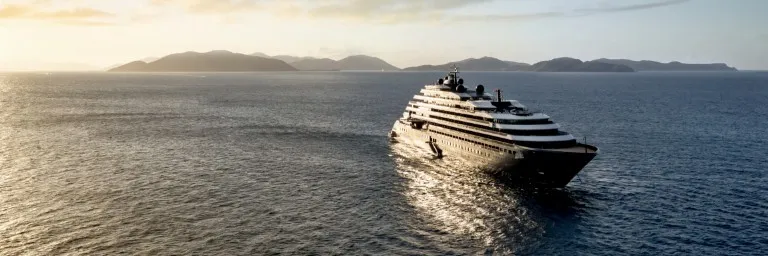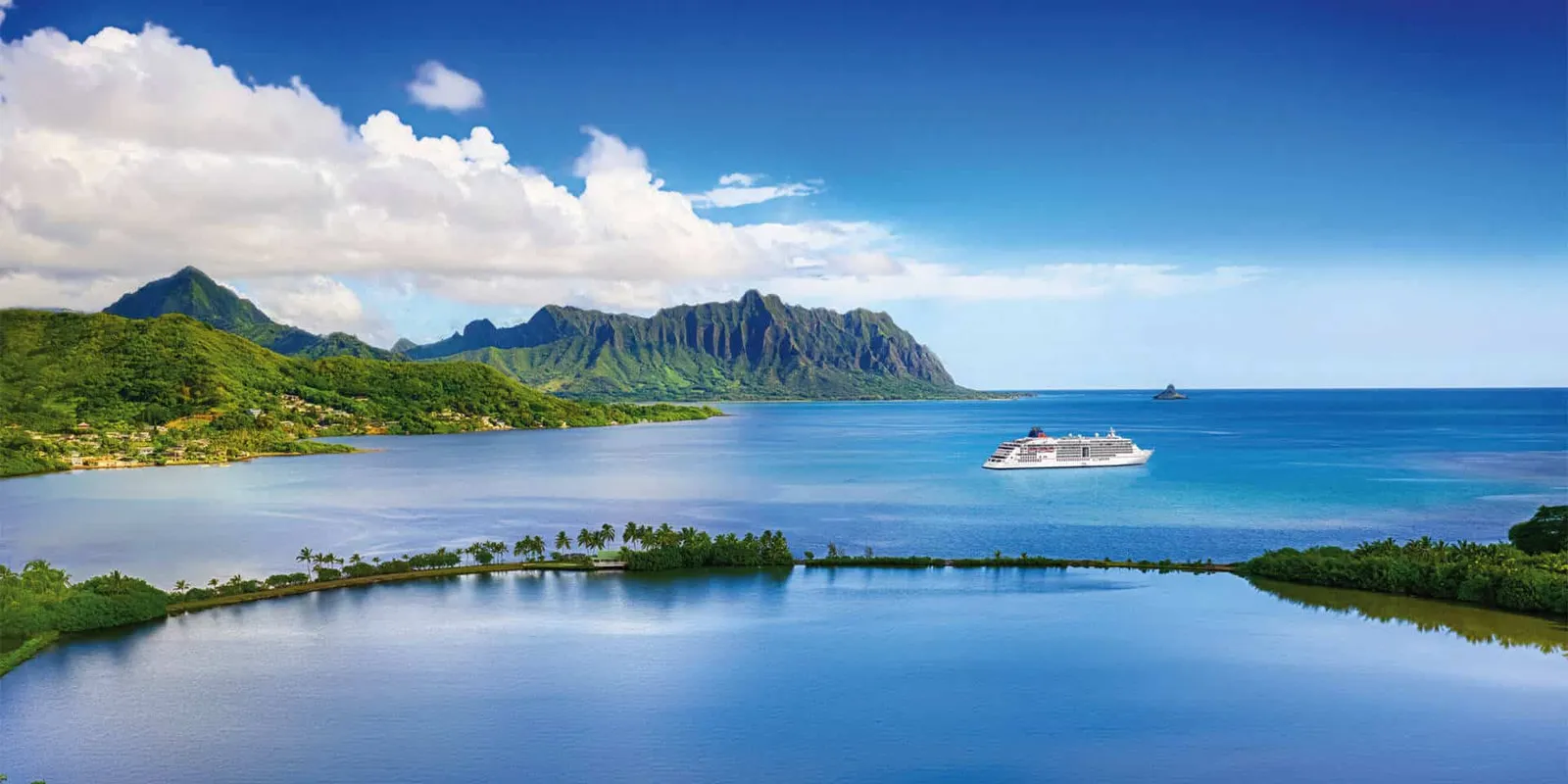
| Hapag-Lloyd Cruises | Seabourn | |
|---|---|---|
| Category | Expedition / Ultra-Luxury | Expedition / Ultra-Luxury |
| Rating | ★★★★★ | ★★★★★ |
| Fleet size | 5 ships | 5 ships |
| Ship size | Small (under 1,000) | Small (under 1,000) |
| Destinations | Worldwide, Arctic, Antarctica, Mediterranean | Mediterranean, Caribbean, Antarctica, Northern Europe |
| Dress code | Casual elegance | Casual elegance |
| Best for | German-heritage luxury and expedition travellers | Ultra-luxury intimate ship enthusiasts |
This is the ultra-luxury segment's most fascinating structural mirror — two lines that both operate dedicated expedition fleets alongside luxury ocean ships, both with PC6 ice class, both reaching Antarctica and the Arctic, and both deploying to Australia's Kimberley coast. Hapag-Lloyd brings 133 years of German maritime heritage, the only Berlitz five-stars-plus rating in history held for over two decades, Kevin Fehling's three-Michelin-star restaurant, and a scientific expedition ethos built around the Alfred Wegener Institute partnership. Seabourn brings Carnival Corporation's scale, Thomas Keller's only restaurant at sea, Dr. Andrew Weil's wellness programme, custom-built submarines that explore depths no diver can reach, and an all-inclusive fare that covers beverages Hapag-Lloyd charges extra for. For Australians, both lines offer Kimberley expeditions — but Seabourn's programme is established while Hapag-Lloyd's debut arrives in 2028. Seabourn's submarines are the decisive differentiator for expedition travellers. Hapag-Lloyd's EUROPA is widely considered the finest ocean ship afloat. Choose Hapag-Lloyd for the pinnacle of European ocean luxury and scientific expedition depth. Choose Seabourn for submarine capability, all-inclusive simplicity, and more immediate Australian access.
The core difference
Hapag-Lloyd Cruises and Seabourn are the only two ultra-luxury lines in the world that operate both dedicated ocean ships and purpose-built PC6 ice-class expedition vessels under a single brand. This structural parallel makes their comparison uniquely consequential — every other pairing in the ultra-luxury segment involves one line with expedition capability and one without, or two ocean-only competitors. Here, both lines can take you to Antarctica, the Arctic, the Kimberley, and the world’s most remote coastlines. The question is not whether you want expedition cruising — both deliver it. The question is which expedition philosophy, which ocean experience, and which ownership culture suits you.
Hapag-Lloyd’s identity is German maritime precision. The line traces its heritage to 1891, when the Augusta Victoria departed on what is widely regarded as the first pleasure cruise in history. Today Hapag-Lloyd operates under TUI Cruises — a joint venture between TUI Group and Royal Caribbean Group — with a deliberately constrained five-ship fleet. The ocean division comprises MS EUROPA (408 guests, widely considered the finest ship afloat) and MS EUROPA 2 (516 guests, the more relaxed and contemporary sister). Both have held the Berlitz five-stars-plus rating — the only ships in history to achieve it — for over two consecutive decades. The expedition division comprises three near-identical HANSEATIC-class vessels (Nature, Inspiration, and Spirit, 230 guests each), all PC6 ice class, each carrying 17 Zodiacs and a 16-person scientific expedition team. The partnership with the Alfred Wegener Institute for Polar and Marine Research enables genuine citizen science aboard. EUROPA features The Globe by Kevin Fehling — the only three-Michelin-star chef’s restaurant at sea.
Seabourn’s identity is American-heritage ultra-luxury with expedition ambition. Founded in 1986 by Norwegian entrepreneur Atle Brynestad and acquired by Carnival Corporation in 1999, Seabourn operates five ships: three ocean vessels (Seabourn Ovation, Encore, and Sojourn, 458 to 604 guests each) and two expedition ships (Seabourn Venture and Seabourn Pursuit, 264 guests each, launched 2022 and 2023). The ocean ships feature Thomas Keller’s only restaurant at sea and the Spa & Wellness with Dr. Andrew Weil. The expedition ships carry the same ultra-luxury standards plus a game-changing capability: two custom-built submarines per ship, capable of diving to approximately 300 metres, alongside full Zodiac fleets and kayaks. These submarines — unique in the cruise industry — allow guests to observe environments beneath Antarctic ice, Kimberley reef walls, and tropical coral formations that no diver can access.
For Australian travellers, the comparison hinges on three questions. First, submarines: if underwater exploration matters, Seabourn is the only choice — Hapag-Lloyd’s expedition ships do not carry submarines. Second, language: Hapag-Lloyd’s onboard culture is primarily German, with bilingual English available on all ships from 2026 — comfortable but not seamless for English-speaking Australians. On Seabourn, English is the primary language. Third, timing: Seabourn operates established Kimberley expeditions now; Hapag-Lloyd’s Kimberley debut is 2028.
What is actually included
The inclusion gap between these two lines is the widest in the ultra-luxury segment — and it favours Seabourn substantially.
Hapag-Lloyd includes: all dining without surcharges at every restaurant across all five ships — including The Globe by Kevin Fehling on EUROPA and all six restaurants on EUROPA 2. Gratuities are included. The Ocean Spa on EUROPA and EUROPA 2 provides sauna, steam, and fitness facilities. On expedition ships, all Zodiac excursions, expert-guided landings, and expedition activities are included in the fare. What Hapag-Lloyd does not include: alcoholic beverages — the only ultra-luxury line to exclude them. Beer, wine, spirits, and cocktails are charged individually or available through a beverage package at EUR 44 per person per day. Wi-Fi is limited to 60 free minutes daily, with extended packages available from EUR 19 per day. Butler service is reserved for Penthouse Suites and above on EUROPA 2 — not available in every category.
Seabourn includes: premium spirits, wines, and cocktails throughout the ship without limits; all dining at every restaurant without surcharges or reservation caps, including The Grill by Thomas Keller; all gratuities; complimentary Wi-Fi; 24-hour in-suite dining; butler service in every suite category on ocean ships; and all enrichment programming. On expedition ships, the fare additionally covers all Zodiac excursions, submarine dives (subject to conditions and scheduling), kayak excursions, and expert-guided landings.
The practical impact for a 14-night voyage: A couple sailing Hapag-Lloyd who enjoy wine with dinner, cocktails before dinner, and occasional spirits in the evening could spend EUR 1,200 to EUR 1,800 on beverages that Seabourn includes in the base fare. Add extended Wi-Fi at EUR 19 per day for two devices across 14 nights (EUR 532), and the out-of-pocket spending above Hapag-Lloyd’s fare easily exceeds EUR 1,700 to EUR 2,300 — before spa treatments or shore excursions. This does not diminish Hapag-Lloyd’s product quality, but it means the headline fare comparison between the two lines understates the true cost gap. Seabourn’s all-inclusive model eliminates these decisions entirely.
Dining and culinary experience
Both lines anchor their dining programmes around chef partnerships at the very peak of the culinary world — and both include all speciality dining without surcharges.
Hapag-Lloyd’s dining programme is headlined by The Globe on EUROPA — the only restaurant at sea overseen by a chef who holds three Michelin stars. Kevin Fehling, whose Hamburger restaurant The Table by Kevin Fehling maintained three Michelin stars for nine consecutive years, personally cooks on eight EUROPA voyages per year. The Globe serves a 12-course tasting menu with wine pairings on those sailings, delivering a culinary experience that multiple food critics have rated among the finest dining available anywhere, land or sea. Beyond The Globe, EUROPA features three additional restaurants, all included: a continental fine dining room, an Asian-fusion restaurant, and an Italian venue. EUROPA 2 expands to six restaurants — including a sushi bar and a pan-Asian concept — all included without surcharges. On HANSEATIC expedition ships, the single restaurant serves regionally inspired menus reflecting expedition destinations, with expedition barbecues on polar shores when conditions permit.
Seabourn’s dining programme centres on The Grill by Thomas Keller — the only Thomas Keller restaurant at sea. Keller, the chef behind The French Laundry (three Michelin stars since 2006) and Per Se (three Michelin stars since 2004), designed a menu built around tableside preparation: Dover sole deboned before you, Caesar salad tossed tableside, Baked Alaska flambeed with ceremony, and steaks cooked to exacting standards. The Grill’s poolside setting evokes the great mid-century American steakhouse tradition. The Restaurant, Seabourn’s main dining room, operates with open seating and multi-course rotating menus. The Colonnade offers indoor-outdoor dining with regional themes. On expedition ships, Earth & Ocean adapts the dining programme with destination-inspired menus reflecting the voyage’s expedition focus.
The comparison: Hapag-Lloyd holds the higher Michelin-star pedigree — Fehling’s three stars versus Keller’s six stars across two restaurants (though Keller does not cook aboard personally as Fehling does on select sailings). Fehling’s personal presence on EUROPA eight times per year is a unique asset — there is no equivalent experience on any other cruise line, including Seabourn. Seabourn’s strength is the tableside theatre of Keller’s concept, the broader beverage inclusion (wines with dinner are included at no additional cost, whereas Hapag-Lloyd charges for wine service), and the consistency of the programme across five ships. Hapag-Lloyd offers more dining venues on EUROPA 2 (six versus Seabourn’s five to six). For the food-driven traveller who specifically wants Fehling cooking in person, EUROPA is unmatched. For the traveller who values Thomas Keller’s culinary philosophy and inclusive wine pairings across every voyage, Seabourn delivers.
Suites and accommodation
Both lines offer all-suite accommodation at the upper end, but the design philosophies — and the definition of what constitutes a “suite” — differ.
Hapag-Lloyd’s EUROPA carries 204 suites from 370 square feet (Ocean Suite) to the Owner’s Suite at 914 square feet, with a Grand Penthouse spanning 635 square feet plus a 215-square-foot veranda. Every suite has a private veranda. The design is understated European elegance — marble bathrooms, walk-in wardrobes, muted colour palettes, and fine fabrics. EUROPA’s public spaces feature 890 original artworks curated by a dedicated art director. EUROPA 2 offers 251 suites from 376 square feet with a more contemporary, relaxed aesthetic — lighter woods, floor-to-ceiling windows, and a design language that reviewers describe as “modern European boutique hotel.” On HANSEATIC expedition ships, cabins range from approximately 210 to 484 square feet with glass-fronted balconies — functional and well-designed for expedition use, with quick-dry materials and storage for expedition gear.
Seabourn’s ocean ships carry all-suite accommodation from the Veranda Suite (approximately 300 square feet plus private veranda) to the Wintergarden Suite (914 square feet with a glass-enclosed solarium). Penthouse Suites span approximately 436 square feet plus veranda. The design is refined and neutral — quality soft furnishings, marble bathrooms, and a residential quality that Seabourn describes as “elegant but not ornate.” All suites receive dedicated butler service. On expedition ships, suites range from approximately 355 square feet to the Wintergarden Suite, with purpose-built mud rooms, expedition staging areas, and storage for polar gear that ocean ships lack. All expedition suites include butler service.
The comparison: At the entry level, Hapag-Lloyd’s EUROPA Ocean Suite (370 square feet) is larger than Seabourn’s Veranda Suite (approximately 300 square feet), and EUROPA’s design and finish quality are widely regarded as the highest in the ultra-luxury segment — a claim supported by the consecutive Berlitz five-stars-plus ratings. EUROPA 2’s suites are similarly spacious and more contemporary. On expedition ships, Hapag-Lloyd’s HANSEATIC cabins are slightly smaller at the entry level but functionally well-designed. Seabourn’s butler service in every expedition category is a genuine differentiator — Hapag-Lloyd reserves butler service for upper categories on EUROPA 2 and does not offer it on HANSEATIC ships.
Pricing and value
Hapag-Lloyd is widely regarded as the most expensive line in the ultra-luxury segment. Seabourn is premium but more accessible — and the inclusion gap magnifies the difference.
Hapag-Lloyd’s per-diem is the highest in the segment. EUROPA fares start from approximately EUR 700 to EUR 1,200 per person per night for an Ocean Suite, with Antarctic HANSEATIC expedition voyages from approximately EUR 818 per person per night (22-day Ushuaia itineraries from EUR 18,190). EUROPA 2 fares run slightly lower but remain premium. Add the beverage package (EUR 44 per person per day) and extended Wi-Fi (EUR 19 per day), and the effective per-diem rises by EUR 63 to EUR 107 per person daily. A 14-night EUROPA sailing in an Ocean Suite with beverages and Wi-Fi costs approximately EUR 12,500 to EUR 18,500 per person — before flights.
Seabourn’s per-diem runs approximately USD $600 to $900 per person per night for ocean sailings in a Veranda Suite. Expedition sailings — Kimberley, Antarctica, Arctic — command a premium of approximately USD $800 to $1,500 per night, reflecting the inclusion of Zodiac excursions, submarine dives, and expert guides. A 14-night Seabourn ocean sailing costs approximately USD $8,400 to $12,600 per person all-inclusive. A 12-night Kimberley expedition runs approximately AUD $14,000 to $21,000 per person with all expedition activities included.
The total-cost comparison: When Hapag-Lloyd’s add-on costs for beverages and Wi-Fi are factored in, the gap between the two lines on comparable ocean itineraries can reach 30 to 40 per cent — Hapag-Lloyd consistently more expensive. On expedition itineraries, the gap narrows because both lines include expedition activities, but Seabourn’s submarine capability adds value that Hapag-Lloyd cannot match at any price. For Australian travellers, flight costs are comparable to European embarkation ports for both lines. For Kimberley expeditions, Seabourn’s departures from Broome and Darwin eliminate international flights entirely — domestic flights from east coast capitals cost AUD $500 to $1,200 return.
Spa and wellness
Both lines invest in quality spa facilities, with Seabourn’s Dr. Andrew Weil partnership creating a more integrated holistic programme.
Hapag-Lloyd’s Ocean Spa on EUROPA and EUROPA 2 features treatment rooms, a sauna and steam room, a relaxation area, and a fitness centre. EUROPA includes a 38-course golf simulator — a distinctive amenity in the ultra-luxury segment. EUROPA 2 adds an expanded spa with a broader treatment menu and a more contemporary design. On HANSEATIC expedition ships, spa facilities are compact but functional, with treatment rooms, a sauna, and a small fitness area. The emphasis on expedition ships is active wellness — Zodiac landings, polar hikes, and kayaking rather than spa treatments.
Seabourn’s Spa & Wellness with Dr. Andrew Weil is the line’s signature wellness partnership. Dr. Weil has developed a programme blending Eastern and Western traditions: mindful meditation, yoga, nutritional guidance, and spa treatments designed around his integrative health philosophy. The spa features treatment rooms, a thermal suite with sauna and steam, a fitness centre, and an outdoor retreat area. The programme extends beyond the spa to dining (wellness-focused menu options) and daily routines (guided meditation and mindfulness sessions). On expedition ships, the spa operates alongside the expedition programme, with post-Zodiac and post-submarine recovery treatments designed for polar conditions.
The comparison: Hapag-Lloyd’s spa facilities on EUROPA and EUROPA 2 are excellently appointed but conventionally structured — quality treatments in a quality space. Seabourn’s Dr. Weil partnership creates a more philosophically integrated programme that shapes the broader onboard experience. Hapag-Lloyd’s golf simulator is a unique amenity. Seabourn’s Dr. Weil wellness menus and daily meditation sessions extend wellness beyond the spa deck. For guests who value a holistic wellness philosophy integrated into the daily rhythm of the voyage, Seabourn offers more. For guests who want an excellent spa alongside a world-class golf simulator, Hapag-Lloyd’s EUROPA delivers.
Entertainment and enrichment
Both lines prioritise destination-focused enrichment over production-show entertainment — but the approaches reflect their distinct cultural identities.
Hapag-Lloyd’s enrichment is deeply intellectual and destination-driven. EUROPA features expert lectures on history, culture, science, and geopolitics, delivered by academics, journalists, and diplomats. The onboard library is curated to reflect the voyage’s destinations. Classical music recitals in the Belvedere Lounge and jazz performances create evening atmosphere. EUROPA 2 adds the Jazz Club, a more contemporary entertainment venue. On HANSEATIC expedition ships, enrichment deepens further: the partnership with the Alfred Wegener Institute provides genuine scientific programming, with marine biologists, glaciologists, ornithologists, and historians delivering daily briefings and leading every Zodiac excursion. The Ocean Academy science centre features microscopes and specimens for hands-on learning. Citizen science programmes allow guests to contribute to data collection alongside professional researchers. No other expedition line — including Seabourn — matches this level of formalised scientific integration.
Seabourn’s enrichment centres on the Seabourn Conversations programme, featuring guest speakers from diverse backgrounds — authors, scientists, diplomats, and adventurers. Destination-focused talks prepare guests for upcoming ports. The Spa & Wellness with Dr. Andrew Weil extends enrichment into health and mindfulness. Evening entertainment includes production-style shows in the Grand Salon, live music in the Observation Lounge, and the signature Caviar in the Surf beach event. On expedition ships, the 26-person expedition team — larger than Hapag-Lloyd’s 16 — delivers daily briefings, Zodiac excursions, kayak expeditions, and guided submarine dives with narrated commentary from expedition naturalists. The submarine dives themselves become enrichment events — observing underwater ecosystems in real time with expert narration.
The distinction: Hapag-Lloyd’s scientific expedition enrichment is more formalised and academically rigorous, anchored by the Alfred Wegener Institute partnership. Seabourn’s expedition enrichment is broader in scope and includes submarine-based discovery that Hapag-Lloyd cannot offer. On ocean ships, both lines deliver quality lectures and destination-focused programming without production-show spectacle. Neither line has a casino. Hapag-Lloyd’s classical music and cultural programming reflect its European intellectual tradition. Seabourn’s Caviar in the Surf adds an experiential dimension.
Fleet and destination coverage
Both lines operate five ships with similar fleet structures — but deployment strategies and destination breadth differ.
Hapag-Lloyd operates five ships: MS EUROPA (408 guests, ocean, five-stars-plus), MS EUROPA 2 (516 guests, ocean, five-stars-plus), HANSEATIC nature (230 guests, expedition, PC6 ice class, 2019), HANSEATIC inspiration (230 guests, expedition, PC6 ice class, 2019), and HANSEATIC spirit (230 guests, expedition, PC6 ice class, 2021). The fleet covers 124 routes across the 2025-2026 season spanning the Mediterranean, Northern Europe, both polar regions, Africa, the Americas, the Pacific, and from 2027 Australia, with the Kimberley debut in 2028.
Seabourn operates five ships: Seabourn Ovation (604 guests, ocean, 2018), Seabourn Encore (604 guests, ocean, 2016), Seabourn Sojourn (458 guests, ocean, 2010), Seabourn Venture (264 guests, expedition, PC6 ice class, 2022), and Seabourn Pursuit (264 guests, expedition, PC6 ice class, 2023). Deployment covers the Mediterranean, Northern Europe, the Caribbean, Alaska, Australia and New Zealand, Asia, Antarctica, the Arctic, the Kimberley, the Amazon, and the South Pacific.
The coverage comparison: Both lines offer comparable global reach, with Seabourn holding an advantage in established Australian deployment. Hapag-Lloyd’s three expedition ships versus Seabourn’s two provide more expedition departure options, but Seabourn’s two ships carry submarines that fundamentally differentiate the expedition experience. Hapag-Lloyd’s HANSEATIC inspiration is the only bilingual expedition ship in the fleet — Nature and Spirit were German-only until the January 2026 bilingual transition. Seabourn’s ocean ships carry more guests (458 to 604 versus 408 to 516) but the capacity difference is modest and both lines deliver intimate, small-ship experiences.
Where each line excels
Hapag-Lloyd excels in:
- Ocean ship quality. EUROPA is widely considered the finest ship afloat — the only vessel to hold a Berlitz five-stars-plus rating for over 20 consecutive years. The 890-artwork collection on EUROPA 2 is unmatched. For the traveller who values the physical ship as an end in itself, EUROPA has no equal.
- Scientific expedition depth. The Alfred Wegener Institute partnership, 16-person scientific teams, the Ocean Academy science centre, and genuine citizen science programmes create the most academically rigorous expedition experience available. Seabourn’s expedition team is larger (26 versus 16) but does not match this formalised scientific structure.
- Michelin-star dining pedigree. Kevin Fehling’s three-Michelin-star restaurant The Globe — with Fehling cooking personally on eight EUROPA voyages per year — is the highest Michelin-credentialed dining experience at sea. No surcharges, no caps, no restrictions.
- European cultural identity. Classical music, curated art collections, intellectual programming, and a refined German-heritage service culture create an atmosphere unlike any American-heritage competitor.
- Expedition fleet uniformity. Three near-identical HANSEATIC-class ships provide consistent expedition quality across more deployments than Seabourn’s two expedition vessels.
Seabourn excels in:
- Submarine capability. Custom-built submarines diving to 300 metres — unique in the cruise industry. Observe environments beneath Antarctic ice, Kimberley reef systems, and tropical coral walls that are invisible from the surface and inaccessible to divers. This is Seabourn’s most compelling competitive advantage over every competitor, including Hapag-Lloyd.
- All-inclusive value. Premium beverages, all dining without surcharges, Wi-Fi, and gratuities included in every fare. The inclusion gap with Hapag-Lloyd — which charges for beverages and extended Wi-Fi — is the widest in ultra-luxury.
- Established Australian access. Kimberley expeditions from Broome and Darwin now, ocean ship deployments to Australian and New Zealand waters seasonally. Hapag-Lloyd does not arrive in Australian waters until 2027, with the Kimberley debut in 2028.
- Thomas Keller’s tableside theatre. The Grill offers a dining experience built around preparation performed before you — a concept as memorable as Fehling’s tasting menu, though different in character.
- Dr. Andrew Weil wellness programme. The most philosophically integrated wellness programme in ultra-luxury, extending from the spa to daily routines and dining menus.
- English-language primacy. English is the default onboard language. Australian travellers will never feel like linguistic outsiders — a practical advantage over Hapag-Lloyd’s German-primary culture.
Standout itineraries for Australian travellers
Both lines reach the Kimberley — but Seabourn is there now, while Hapag-Lloyd arrives in 2028. Both require international flights for polar expeditions.
Hapag-Lloyd
EUROPA 2: Singapore to Perth (approximately 18 nights, January-February 2027) — Hapag-Lloyd’s first Australian deployment. Sail from Singapore through Indonesia to Fremantle/Perth, with calls at Bali, Komodo, and Western Australian ports. Bilingual German-English service. Six restaurants, all included. The most refined ship to ever call at Fremantle. Fly to Singapore from Australian east coast capitals in approximately eight hours.
EUROPA 2: Perth to Auckland (approximately 16 nights, February-March 2027) — Continue from Fremantle across the Great Australian Bight, through Bass Strait, and across the Tasman to New Zealand. Domestic embarkation from Perth for Western Australian travellers. Melbourne, Hobart, and Milford Sound en route.
HANSEATIC spirit: Kimberley Expedition (18 days, February 2028) — Hapag-Lloyd’s maiden Kimberley voyage. King George River, Montgomery Reef, the Horizontal Waterfalls, and the Houtman Abrolhos archipelago. A 16-person scientific expedition team brings the Alfred Wegener Institute’s rigour to the Kimberley — marine biologists, geologists, and ornithologists leading every Zodiac excursion. PC6 ice class — vastly over-engineered for the Kimberley, but a testament to the ship’s polar pedigree. Bilingual German-English operation.
HANSEATIC nature or spirit: Antarctica (20-22 days from Ushuaia, multiple departures) — The most comprehensive Antarctic programme in ultra-luxury. Including the rarely visited Weddell Sea itinerary — among the most ambitious Antarctic voyages available. PC6 ice class navigates through first-year ice. 16-person scientific team. Charter flights to Ushuaia included in the fare. From approximately EUR 18,190 per person.
Seabourn
Seabourn Venture or Pursuit: Kimberley Expedition (10-12 nights, Broome to Darwin or reverse, May-August) — The established Kimberley programme with submarine dives beneath ancient Kimberley reef systems. Zodiac landings at King George River, Montgomery Reef, and the Horizontal Waterfalls. Expert naturalist team and guided submarine narration. All expedition activities included. Domestic flights from east coast capitals to Broome from AUD $500 to $1,200 return. The submarines are the decisive differentiator — observe underwater Kimberley ecosystems that Hapag-Lloyd’s HANSEATIC ships, despite their scientific teams, cannot access.
Seabourn Ovation or Encore: Australia and New Zealand (various lengths, seasonal deployment) — Ocean ships in Australian and New Zealand waters for the southern summer season. Embarkation from Sydney, Melbourne, and Auckland. The Grill by Thomas Keller and the Dr. Andrew Weil wellness programme operate in Australian waters. All-inclusive fare with premium beverages.
Seabourn Venture: Antarctica (16-21 nights from Ushuaia) — PC6 ice class with submarine dives beneath Antarctic ice — the only expedition ship offering underwater Antarctic exploration. South Georgia, the Falkland Islands, and the Antarctic Peninsula. 26-person expedition team. Zodiac landings, kayaking, and submarine narrated dives. Fly from Australian capitals to Buenos Aires, connecting to Ushuaia.
Seabourn Pursuit: South Pacific and Amazon (various lengths, seasonal deployment) — Expedition exploration of Papua New Guinea, Melanesia, and the Amazon with submarine capability. A distinctly different expedition profile from the polar programme.
Ship-by-ship recommendations
Hapag-Lloyd
MS EUROPA (408 guests, ocean) — The finest ship afloat by Berlitz’s standard. The Globe by Kevin Fehling, four restaurants, the Ocean Spa, the 38-course golf simulator, and 890 original artworks. German is the primary language. For the traveller who values the ship itself as the centrepiece of the voyage and who is comfortable in a German-speaking environment (or speaks German), EUROPA delivers an experience no competitor — including Seabourn — can match for physical quality and culinary peak.
MS EUROPA 2 (516 guests, ocean) — The more relaxed, contemporary, and bilingual sister. Six restaurants, a more international passenger mix, and a dedicated International Hostess for English-speaking guests. The better choice for Australians who want Hapag-Lloyd’s ocean quality without full immersion in the German-language culture. Choose for the 2027 Australian deployment.
HANSEATIC inspiration (230 guests, expedition, PC6 ice class) — The bilingual expedition ship and the most accessible HANSEATIC vessel for English-speaking Australians. 17 Zodiacs, a 16-person scientific team, and the Ocean Academy science centre. Choose for Antarctic, Arctic, and — from 2028 — Kimberley expeditions.
HANSEATIC nature and HANSEATIC spirit (230 guests each, expedition, PC6 ice class) — Transitioning to bilingual from January 2026. Near-identical to Inspiration. Spirit is confirmed for the Kimberley 2028 debut. Choose by itinerary.
Seabourn
Seabourn Ovation (604 guests, 2018) — The newest ocean ship and the best introduction to Seabourn. The Grill by Thomas Keller, Dr. Weil wellness, and the most contemporary ocean-ship design in the fleet. Choose for Mediterranean, Northern European, and Australian seasonal deployments.
Seabourn Encore (604 guests, 2016) — Near-identical to Ovation. Choose based on itinerary.
Seabourn Sojourn (458 guests, 2010) — The smallest and most intimate ocean ship. Choose for the most personal Seabourn ocean experience and for repositioning itineraries that offer exceptional per-night value.
Seabourn Venture (264 guests, 2022, PC6 ice class) — The flagship expedition ship with two custom submarines. Choose for Kimberley and Antarctic expeditions. The submarines are the feature that no Hapag-Lloyd ship can match.
Seabourn Pursuit (264 guests, 2023, PC6 ice class) — Near-identical to Venture. The newest ship in the Seabourn fleet. Choose based on itinerary — South Pacific, Amazon, and complementary polar seasons.
For Australian travellers specifically
The Australian equation in this comparison is shaped by timing, language, and submarines.
Seabourn’s Australian proposition is established and immediate. Expedition ships operate Kimberley seasons from Broome and Darwin with submarine dives — unique in Australian waters. Ocean ships deploy seasonally to Australia and New Zealand with embarkation from Sydney, Melbourne, and Auckland. Seabourn operates through Carnival Corporation’s Australian infrastructure. The all-inclusive fare means no unexpected charges for beverages or Wi-Fi. English is the primary language aboard every ship. For the Australian traveller who wants to board a Kimberley expedition this year or next, Seabourn is the only choice from this pairing.
Hapag-Lloyd’s Australian proposition is arriving but not yet here. EUROPA 2 makes the line’s first Australian call in January 2027 — Singapore to Perth, then Perth to Auckland. HANSEATIC spirit’s maiden Kimberley expedition is confirmed for February 2028. These are significant deployments: EUROPA 2 will be the most refined ocean ship to ever call at Australian ports (excluding private charters), and the HANSEATIC Kimberley expedition will bring Hapag-Lloyd’s formalised scientific programme to the Kimberley for the first time. But for the Australian traveller planning 2026, Hapag-Lloyd requires patience and international flights.
The language factor: This is the practical consideration most Australian travellers underestimate. Hapag-Lloyd’s German-language primacy does not mean English-speaking guests are unwelcome — from January 2026, all five ships operate bilingually, and EUROPA 2 has a dedicated International Hostess. But German-speaking passengers constitute the overwhelming majority on most sailings, and the onboard culture — from the evening social dynamics to the library holdings to the conversational rhythm at dinner — is fundamentally German. An Australian who speaks no German will be comfortable but not culturally immersed. On Seabourn, English is the default language, the social dynamics are international, and an Australian will never feel linguistically peripheral.
The submarine factor: For expedition-minded Australians, Seabourn’s submarines are the single most distinctive asset in this comparison. The ability to dive beneath the Kimberley’s ancient waters and observe marine environments invisible from the surface — in Australia’s own backyard — is available on no other cruise line. Hapag-Lloyd’s scientific expedition teams are arguably more academically rigorous, with genuine citizen science programmes and the Alfred Wegener Institute partnership. But Hapag-Lloyd’s Zodiacs operate on the surface; Seabourn’s submarines go beneath it. This distinction is not a minor amenity difference — it is a fundamentally different way of experiencing the underwater world.
The onboard atmosphere
These two lines create distinctly different social environments rooted in their cultural identities — and the distinction matters more here than in almost any other ultra-luxury pairing.
Hapag-Lloyd’s atmosphere is European intellectual sophistication. EUROPA’s passenger base is predominantly German — well-travelled, cultured, and oriented around food, art, and meaningful conversation. Evenings in the Belvedere Lounge feature classical music recitals. The library is curated for the voyage’s destinations. The dress code on EUROPA is more formal than most ultra-luxury competitors — gentlemen are expected to wear a jacket at dinner. EUROPA 2 is deliberately more relaxed, with a younger demographic and more casual evenings. On HANSEATIC expedition ships, the shared intensity of Zodiac landings and scientific briefings creates a camaraderie rooted in intellectual curiosity. The atmosphere across all ships is refined, understated, and distinctly continental.
Seabourn’s atmosphere is relaxed American-heritage luxury. The dress code is “casual elegance” — no formal nights, no jacket requirements. The service is attentive, warm, and anticipatory. The passenger base is international — American, British, European, and Australian — with a shared interest in destination and quality. The Observation Lounge is the social hub for pre-dinner cocktails. On expedition ships, the shared experience of submarine dives and Zodiac landings creates bonds between guests. The Caviar in the Surf event — champagne and caviar on a beach — captures the line’s blend of luxury and adventure. The atmosphere is confident, welcoming, and less intellectually formal than Hapag-Lloyd’s.
The distinction for Australians: An Australian aboard EUROPA will be among a small minority of English speakers on most sailings — welcomed and comfortable, but culturally observing rather than culturally immersed. An Australian aboard Seabourn will be among a diverse international mix where English is the common language and the social dynamic is naturally inclusive. On expedition ships, the shared adventure of landings and submarine dives transcends language on both lines — but Seabourn’s English-language primacy and larger Australian market presence make the social integration more seamless.
The bottom line
Hapag-Lloyd and Seabourn are the ultra-luxury segment’s most structurally similar competitors — both with ocean and expedition fleets, both with PC6 ice class, both reaching the world’s most extraordinary destinations. The right choice depends on what you value most.
Choose Hapag-Lloyd for the pinnacle of European ocean luxury and scientific expedition depth. EUROPA is widely considered the finest ship afloat — the Berlitz five-stars-plus rating held for over two decades is not marketing but an independently verified standard no other ship has achieved. Kevin Fehling’s The Globe is the highest Michelin-credentialed restaurant at sea. The Alfred Wegener Institute partnership creates the most academically rigorous expedition programme in the industry. Accept that beverages are not included (a meaningful daily cost), that the onboard culture is primarily German (bilingual but not seamlessly English), that the pricing is the highest in the segment, and that Australian deployment does not begin until 2027 with the Kimberley in 2028. For the traveller who values the physical ship as the finest expression of maritime luxury, who appreciates genuine scientific enrichment, and who is comfortable in a European cultural environment, Hapag-Lloyd offers something no competitor can replicate.
Choose Seabourn for submarine-equipped expedition luxury, all-inclusive simplicity, and established Australian access. The custom submarines — unique in the cruise industry — transform expedition cruising from surface observation to underwater discovery. The all-inclusive fare covers premium beverages, all dining without surcharges, and Wi-Fi — eliminating the add-on costs that raise Hapag-Lloyd’s effective daily rate by EUR 63 to EUR 107 per person. Thomas Keller’s tableside theatre and Dr. Andrew Weil’s integrated wellness programme are world-class. English is the primary language. Kimberley expeditions are established now, with submarine dives beneath Australia’s own ancient waters. For the Australian traveller who wants to explore the Kimberley with submarines this year, who values all-inclusive transparency, and who prefers English as the default onboard language, Seabourn delivers immediate access and a unique underwater dimension that Hapag-Lloyd — despite its formidable scientific credentials — cannot match.