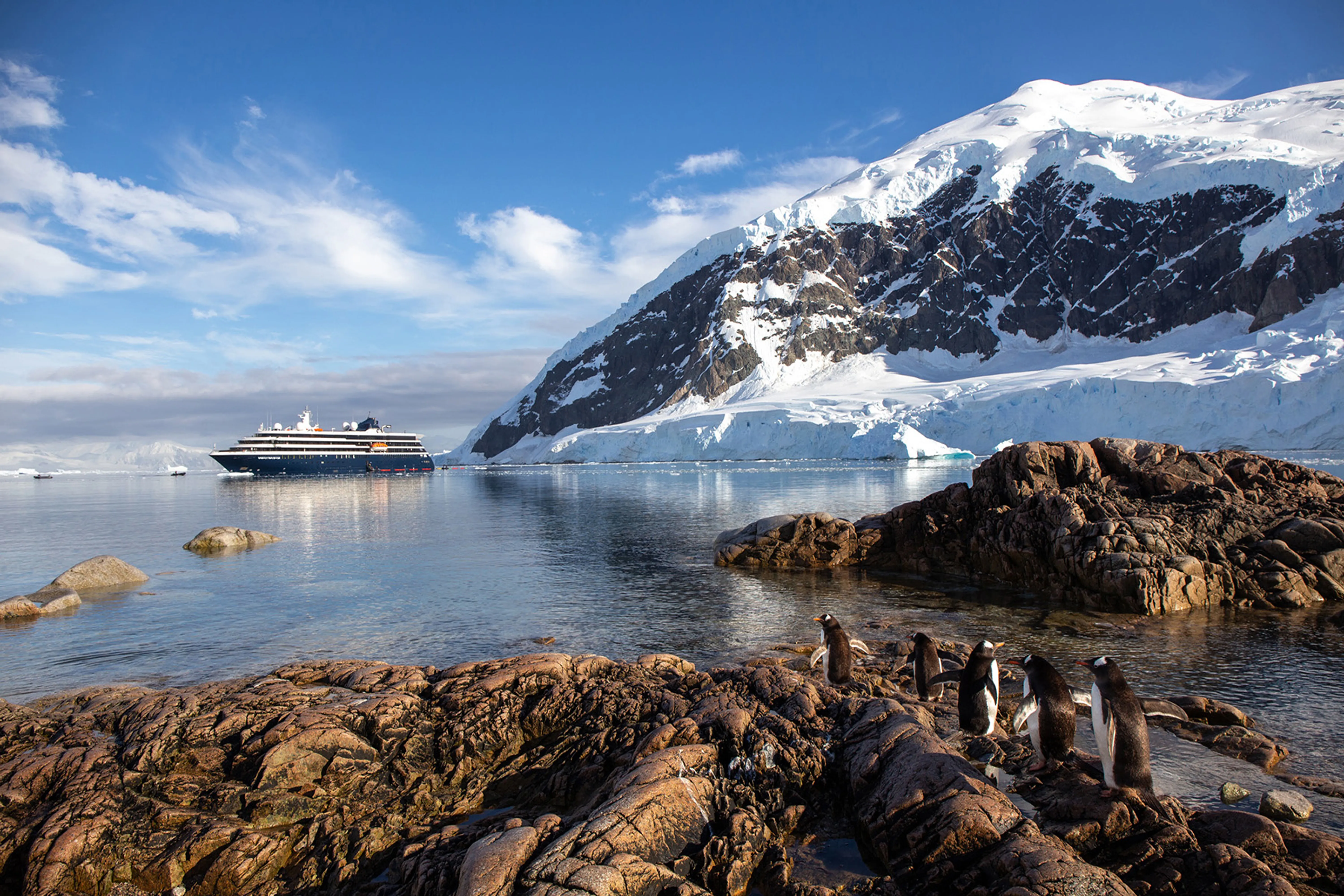
Atlas Ocean Voyages and Ponant are both small-ship luxury expedition lines, making this one of the most direct comparisons in the series. Atlas operates 3 ships with 196 guests each; Ponant operates 13 ships with 184 to 264 guests. Both offer Zodiac landings and polar capability — but Ponant has the world's only luxury icebreaker, Alain Ducasse dining, and a deep Australian presence. Jake Hower compares the two.
| Atlas Ocean Voyages | Ponant | |
|---|---|---|
| Category | Expedition / Luxury | Luxury / Expedition |
| Rating | ★★★★☆ | ★★★★★ |
| Fleet size | 3 ships | 13 ships |
| Ship size | Small (under 500) | Small (under 500) |
| Destinations | Antarctica, Arctic, Mediterranean, Caribbean | Antarctica, Mediterranean, Arctic, South Pacific |
| Dress code | Resort casual | Smart casual |
| Best for | All-inclusive luxury expedition travellers | French-inspired luxury expedition travellers |
This is a genuine head-to-head expedition comparison. Atlas offers a compelling all-inclusive package with included flights from North American gateways, premium drinks, and modern hardware across three intimate ships. Ponant counters with a thirteen-ship fleet including Le Commandant Charcot (the only luxury icebreaker afloat), Ducasse-trained cuisine, an established Australian operation with Kimberley departures, and cross-brand loyalty spanning Paul Gauguin and Aqua Expeditions. For Australians, Ponant's deeper fleet, Kimberley programme, and local presence make it the more accessible and versatile choice. Atlas appeals to travellers seeking a boutique alternative with comprehensive inclusion.
The core difference
Atlas Ocean Voyages and Ponant are the most directly comparable lines in this series — both operate small luxury expedition ships with Zodiac fleets, polar capability, and casual dress codes. The competition is genuine, and the differences are in scale, heritage, cuisine, and Australian presence.
Atlas operates three Portuguese-flagged polar-class vessels — World Navigator, World Traveller, and World Voyager — each carrying approximately 196 guests. The fleet launched from 2021 with modern hardware and a comprehensive all-inclusive model: roundtrip flights from North American gateways, premium drinks, Wi-Fi, gratuities, and butler service in suites. Atlas is a subsidiary of Mystic Invest, and the brand positions as boutique luxury expedition.
Ponant, rebranded as Ponant Explorations Group in March 2025, operates thirteen ships spanning five classes — from the 32-guest sailing yacht Le Ponant to the 245-guest Le Commandant Charcot, the only luxury icebreaker afloat with PC2 ice class. Six Explorer-class ships carry the Blue Eye underwater lounge and Zodiac fleets. The Ducasse Conseil culinary partnership brings Michelin-star heritage to two restaurants per ship. Owned by Groupe Artemis (the Pinault family), Ponant is unambiguously French in language, cuisine, and passenger mix. The fleet deploys simultaneously across the Kimberley, Antarctica, French Polynesia, both polar regions, the Mediterranean, Asia, and Papua New Guinea.
For Australian travellers, the practical difference is significant. Ponant has an established Australian operation with Kimberley departures, Fly, Stay & Cruise packages from five capital cities, and a strong local brand presence. Atlas has no Australian footprint.
What is actually included
Both lines offer genuine all-inclusive packaging, but the components differ.
Atlas includes roundtrip flights from North American gateways, premium alcoholic and non-alcoholic beverages at all hours, Wi-Fi, gratuities, L’Occitane amenities, butler service in suites, all dining across six venues, and Zodiac excursions.
Ponant includes an open bar at all hours (beer, wine, spirits, Henri Abele Brut Champagne, coffee, soft drinks), a daily-restocked minibar, all dining, unlimited Wi-Fi, and 24-hour room service. On expedition sailings, one guided excursion per port per day is included — covering Zodiac outings, shore landings, and expert-led activities. Gratuities are voluntary (approximately EUR 10-12 per person per day suggested). Flights are separate unless booked as part of Fly, Stay & Cruise packages.
The critical difference: Atlas includes flights; Ponant includes expedition excursions and a champagne open bar. For Australian travellers, Ponant’s Fly, Stay & Cruise packages from Australian capitals often provide more practical flight solutions than Atlas’s North American gateway inclusions. Atlas’s gratuity inclusion is a cleaner model; Ponant’s voluntary gratuity creates ambiguity for some travellers.
Dining and culinary experience
This is where Ponant holds a significant advantage through its Ducasse heritage.
Atlas offers six dining venues with regionally inspired international cuisine and no surcharges. All premium beverages are included. The cuisine is quality fare appropriate to the intimate expedition format, with Portuguese influences reflecting the fleet’s heritage.
Ponant’s Ducasse Conseil partnership (since 2016) brings Michelin-star culinary heritage to two restaurants per ship. Le Nautilus serves a la carte four-course dinners with amuse-bouche and regional French wines. Le Nemo or Le Grill offers casual poolside dining. On Le Commandant Charcot, the Nuna restaurant — named from the Inuit word for “Earth” — is widely cited as one of the finest restaurants at sea, with Bernardaud porcelain, soft-boiled eggs with caviar, and cheeses rivalling any brasserie in Lyon. Bread and pastry are boulangerie-quality across the fleet. Pierre Herme macarons and Kaviari caviar appear regularly. The open bar includes Henri Abele Champagne at all hours.
Ponant wins on culinary pedigree and the depth of its French gastronomic programme. Atlas wins on beverage breadth with all premium spirits included. For food-motivated expedition travellers, Ponant’s Ducasse connection is a genuine differentiator.
Suites and accommodation
The accommodation comparison reflects different ship classes and design eras.
Atlas staterooms are modern (launched from 2021) with L’Occitane amenities, balconies in most categories, and butler service in suites. The contemporary design and new hardware give Atlas a fresh, modern feel.
Ponant’s accommodation varies by ship class. Explorer-class Deluxe Balcony staterooms are 161 square feet of interior plus a 43-square-foot balcony — compact by design, reflecting the expedition philosophy. Prestige Suites offer 291 square feet. On Le Commandant Charcot, accommodation is more generous: Prestige Staterooms start at 300 square feet plus 55-square-foot balcony. Charcot’s Owner’s Suite spans 1,240 square feet of interior plus a 2,000-square-foot terrace. Duplex Suites on Charcot are two-level apartments with private dining rooms seating six.
Atlas offers newer, more uniformly modern hardware. Ponant offers greater range — from compact Explorer-class cabins to the extraordinary Charcot suites with private dining rooms. The choice depends on which ship class you sail. On Charcot, Ponant’s top-tier accommodation is among the most impressive in expedition cruising.
Pricing and value
Both lines position in the luxury expedition segment, but Ponant’s broader fleet creates a wider pricing range.
Atlas per-diems range from approximately AUD $800 to $1,500 per person per night, with Antarctic and Arctic voyages at the premium end. The included flights from North American gateways represent significant value.
Ponant per-diems vary by ship and destination. Explorer-class expedition cruises average AUD $900 to $1,500 per person per night. A 10-night Kimberley Fly, Stay & Cruise package starts from approximately AUD $14,850 per person including return flights, hotel, and all-inclusive cruise. Le Commandant Charcot polar voyages command a significant premium — the 2028 circumnavigation of Antarctica starts from USD $147,360 per person for 62 days. Mediterranean sailings on Explorer-class run approximately AUD $7,500 to $9,200 per person for shorter voyages.
On comparable expedition itineraries, the per-diems are similar. Atlas’s included flights can offset the gap. Ponant’s Kimberley packages with included flights from Australian cities provide direct value for Australian travellers that Atlas cannot match.
Spa and wellness
Both lines offer wellness facilities appropriate to their expedition ship sizes.
Atlas ships feature compact spas with L’Occitane products. Expedition activities — kayaking, hiking, Zodiac excursions — provide the primary active wellness experience.
Ponant’s spa varies by ship. Explorer-class vessels offer compact spas with Sothys or Clarins treatments and a hammam. The Blue Eye underwater lounge — two whale-eye-shaped portholes below the waterline with hydrophones and Body Listening Sofas — provides a unique wellness-adjacent experience. On Le Commandant Charcot, the Nuan Wellness Lounge features Biologique Recherche treatments, an Ikuma sauna, the Siku snow room, and the Blue Lagoon heated outdoor pool (27-37 degrees Celsius) where guests swim surrounded by polar ice.
Ponant’s wellness offering is more distinctive, particularly the Blue Eye lounge on Explorer-class ships and the Blue Lagoon on Charcot. Swimming in a heated pool surrounded by Antarctic ice is a wellness experience available on no other ship. Atlas offers functional expedition wellness without the experiential highlights.
Entertainment and enrichment
Both lines deliver expedition-focused enrichment, with Ponant’s larger fleet allowing broader partnerships.
Atlas provides expedition enrichment through naturalists, expedition leaders, and wildlife photographers with daily briefings and guided shore activities. The 196-guest format creates intimate access to experts.
Ponant’s enrichment programme benefits from its scale. National Geographic Expeditions partnerships place National Geographic photographers and experts aboard select sailings. Smithsonian Journeys collaborations add two experts per voyage on family-oriented itineraries. The Explorers Club partnership brings speakers including mountaineer Peter Hillary. Onboard naturalists, ornithologists, marine biologists, and historians deliver daily briefings. The signature Soiree Blanche (White Party) on warm-climate sailings is a social highlight. Dress code is Casual Chic with one or two gala evenings per sailing.
Ponant’s scale enables richer partnerships and more varied enrichment programming. Atlas’s more intimate format allows deeper personal engagement with the expedition team. Both lines make the destination the curriculum.
Fleet and destination coverage
The fleet disparity is the most significant factor in this comparison.
Atlas operates three polar-class ships (approximately 196 guests each) covering Antarctica, the Arctic, the Mediterranean, the Caribbean, and Central America. The fleet is compact and focused.
Ponant operates thirteen ships across five classes — from the 32-guest Le Ponant to the 245-guest Le Commandant Charcot. The fleet deploys simultaneously across the Mediterranean, Kimberley, French Polynesia (via Paul Gauguin), both polar regions, subantarctic islands, Asia, the Great Lakes, and Papua New Guinea. Le Commandant Charcot is the only luxury ship to have reached the Geographic North Pole.
Ponant’s fleet advantage is decisive. Thirteen ships across a dozen regions versus three ships across five. Ponant can offer sixteen Kimberley sailings, sixty-six French Polynesia departures, and Antarctic and Arctic expeditions simultaneously. Atlas cannot match this breadth or frequency.
Where each line excels
Atlas Ocean Voyages excels in:
- Comprehensive inclusion. Flights from North American gateways bundled with premium drinks, all dining, and gratuities — the cleanest all-inclusive model in expedition cruising.
- Modern hardware. Ships launched from 2021 with contemporary design.
- Boutique focus. Three ships creating a focused, consistent product without the complexity of a thirteen-ship fleet.
Ponant excels in:
- Fleet scale and destination breadth. Thirteen ships reaching a dozen regions simultaneously.
- Le Commandant Charcot. The only luxury icebreaker afloat — PC2 ice class, Geographic North Pole capability, and the Nuna restaurant.
- Ducasse cuisine. Michelin-star culinary heritage with boulangerie-quality bread and Pierre Herme macarons.
- Australian presence. Sixteen Kimberley sailings, Fly, Stay & Cruise packages from five capital cities, and an established Australian operation.
- The Blue Eye. Underwater multi-sensory lounge with no equivalent on Atlas.
Standout itineraries for Australian travellers
Atlas Ocean Voyages
Antarctica Expedition (10–14 nights from Ushuaia) — Zodiac landings on the Antarctic Peninsula with included flights from North American gateways. The signature Atlas experience.
Arctic Norway (10–14 nights, summer) — Midnight sun, glacier approaches, and polar wildlife. An alternative to Ponant’s Arctic programme with included flights.
Ponant
Kimberley (10 nights, Broome to Darwin, May-September) — Sixteen sailings with Fly, Stay & Cruise from approximately AUD $14,850 including return flights from five Australian capitals. King George Falls, Montgomery Reef, Indigenous cultural encounters.
West Coast Odyssey (10 nights, Broome to Fremantle) — New itinerary exploring Shark Bay, Ningaloo, and the Abrolhos Islands. Domestic flights only.
Le Commandant Charcot Antarctica Circumnavigation (62 nights from Ushuaia, January 2028) — The first full circumnavigation of Antarctica. From USD $147,360. The defining polar voyage of the decade.
French Polynesia on Le Jacques Cartier (7–14 nights from Papeete) — Explorer-class expedition in the South Pacific with Blue Eye lounge and included Zodiac excursions. Eight hours from Sydney.
Ship-by-ship recommendations
Atlas Ocean Voyages
World Navigator, World Traveller, or World Voyager (196 guests each) — Sister ships with identical specifications. Choose by itinerary and dates. Modern polar-class vessels with L’Occitane amenities.
Ponant
Le Jacques Cartier (184 guests) — The most versatile Ponant ship for Australian travellers, deployed to both the Kimberley and French Polynesia. Explorer-class with Blue Eye lounge.
Le Commandant Charcot (245 guests) — For serious polar expedition only. The most advanced expedition ship afloat, with the Nuna restaurant and Blue Lagoon pool. Commands a significant premium.
Le Soleal (264 guests) — Sistership-class Kimberley workhorse with ice-strengthened hull. Proven expedition performer for Australian waters.
For Australian travellers specifically
Ponant holds a decisive advantage for Australian travellers through its established local operation.
Ponant’s Australian presence is substantial. The North Sydney office provides local customer service, AUD pricing, and Fly, Stay & Cruise packages from five Australian capital cities. The Kimberley is Ponant’s second most popular cruise region for Australian guests. Discovery Sessions in Australian cities offer exclusive cruise offers and flight credits. The CEO Asia Pacific sits on the CLIA Australasia Executive Committee.
Atlas has no Australian presence — no local office, no Australian departures, no regional marketing. The included flights from North American gateways provide partial offset, but Australian travellers must arrange and fund their own travel to those gateways.
The loyalty pathway matters. Ponant’s Yacht Club programme offers lifetime status with no requalification, and cross-brand matching extends status across Ponant Explorations, Paul Gauguin Cruises, and Aqua Expeditions. Atlas’s loyalty programme is standalone. For Australians building long-term expedition loyalty, Ponant’s ecosystem is broader and more established.
The onboard atmosphere
Both lines share the expedition yacht atmosphere, but with distinct cultural flavours.
Atlas feels like a boutique expedition yacht. One hundred and ninety-six guests with resort-casual dress, no formal requirements, and a purposeful expedition rhythm. The Portuguese-flagged ships carry a European sensibility. The atmosphere is international and adventurous.
Ponant feels like a French expedition yacht. Never more than 264 guests on the main fleet (excluding Charcot), with the Captain and travel ambassador visible daily and often dining with guests. The passenger mix is approximately fifty per cent French, with significant Australian and European contingents. Announcements are delivered in French first, then English. The dress code is Casual Chic with one or two gala evenings. The Soiree Blanche (White Party) on warm-climate sailings is a signature social event.
The French language dynamic is the single most discussed aspect of the Ponant experience for English-speaking Australians. Some embrace it as part of the French luxury atmosphere; others find it a barrier. Atlas does not present this challenge — the onboard language is English. For Australians who prefer an English-language expedition environment, Atlas is the more comfortable choice. For those who appreciate French luxury culture, Ponant’s atmosphere is distinctive and alluring.
The bottom line
Atlas Ocean Voyages and Ponant are genuine competitors in the luxury expedition segment, and the choice between them depends on priorities.
Choose Atlas for the most comprehensive all-inclusive model — flights, premium drinks, all dining, and gratuities with no ambiguity. Choose it for modern hardware, an English-language environment, and a boutique expedition experience on 196-guest ships. Accept the smaller fleet with fewer itinerary options, the absence of an Australian presence, and the need to position to North American gateways.
Choose Ponant for the broadest expedition fleet in luxury cruising — thirteen ships across a dozen regions, Le Commandant Charcot’s unmatched polar capability, Ducasse cuisine, and an established Australian operation with Kimberley departures and Fly, Stay & Cruise packages. Choose it for the Blue Eye underwater lounge, the cross-brand loyalty programme, and the French cultural polish. Accept the French-first language dynamic, the voluntary gratuity ambiguity, and the premium pricing on Charcot voyages.
For most Australian travellers, Ponant’s deeper fleet, Kimberley programme, and local presence make it the more accessible choice. For travellers specifically seeking a boutique, English-language expedition alternative with comprehensive inclusion, Atlas offers a compelling proposition that Ponant’s larger operation cannot match on intimacy.