Australis
Expedition Cruising
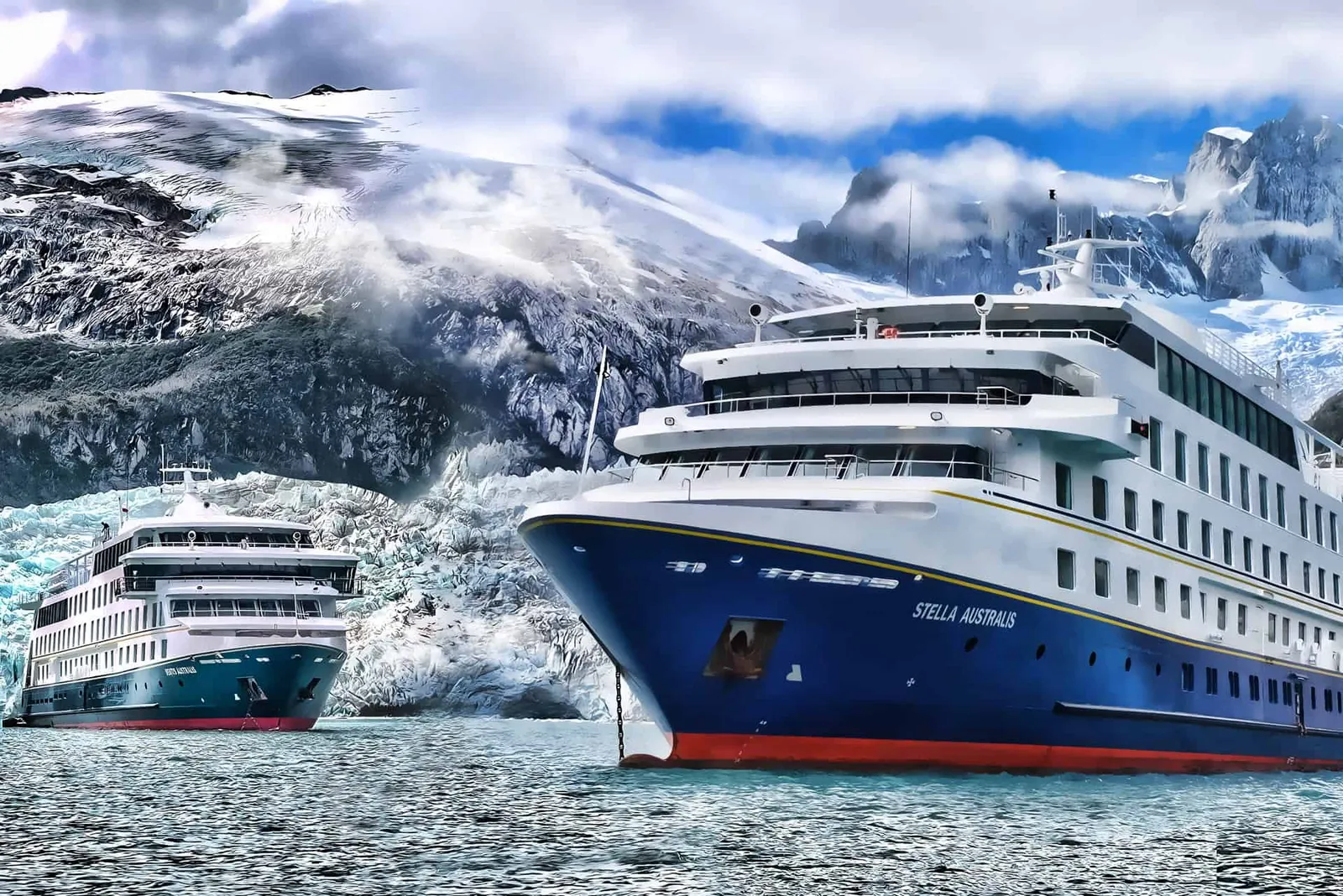
Australis is one of the most focused cruise operations I know — they do exactly one thing, and they do it brilliantly. Four or five nights through the Strait of Magellan and the Beagle Channel, past glaciers and penguin colonies, with a landing at Cape Horn if the weather cooperates. The ships are nimble enough to navigate fjords that larger expedition vessels cannot reach, and the all-inclusive pricing covers an open bar for the entire voyage. I always recommend combining the two routes into an eight-night roundtrip for the full experience.
Australis is one of those rare cruise operators that has found its niche and committed to it completely. Founded in 1990 by the Menendez family of Punta Arenas — a Patagonian dynasty whose roots in the region stretch back to the late 1800s — the company operates exclusively in the waterways of southern Patagonia and Tierra del Fuego, navigating the channels, fjords, and glaciers between Punta Arenas in Chile and Ushuaia in Argentina. There are no Mediterranean repositioning voyages, no Caribbean winters, no attempts to be all things to all travellers. Australis does exactly one thing, and over thirty-five years it has refined that single focus into arguably the definitive way to experience the southern tip of South America by water.
The company runs two purpose-built expedition vessels, both Chilean-constructed at the ASENAV shipyard in Valdivia, each carrying a maximum of 210 passengers. These are small, shallow-draught ships designed specifically for the extreme manoeuvrability required to thread through narrow Patagonian fjords that larger expedition vessels simply cannot access. The family ownership — three Menendez brothers still manage the business — has never changed hands, a rarity in the expedition cruise sector and one that translates into a personal, committed approach to both the guest experience and environmental stewardship. Australis holds exclusive concessions from the Chilean Navy to navigate the Murray Channel and is the only cruise company permitted to land passengers at both Cape Horn and Wulaia Bay. Those exclusive rights are a significant competitive moat that no amount of fleet investment from larger operators can replicate.
Every Australis voyage follows the same fundamental rhythm: scenic cruising through sheltered channels and fjords, punctuated by Zodiac excursions to glaciers, wildlife colonies, and remote landing sites led by a team of nine to ten bilingual naturalist guides. The guides cover glaciology, flora and fauna, indigenous Yamana history, and the European exploration of Magellan, Darwin, and FitzRoy. Lectures and documentary screenings fill the evenings. The guide-to-guest ratio of roughly 1:20 is lower than what you would find on a premium Antarctic operator like Ponant or Silversea, but it is adequate for the Patagonian programme where excursions are more structured and landings are less logistically complex than Antarctic operations.
Landing sites vary by route but typically include glacier approaches by Zodiac, Magellanic penguin colonies, sub-Antarctic forest walks, and — weather permitting — the marquee attraction: a landing at Cape Horn itself. Australis is the only operator in the world with permission to put passengers ashore at this legendary promontory, and landings succeed on approximately seventy per cent of voyages. The company uses a distinctive dry-landing method where crew transport a metal gangplank ahead of passengers, eliminating the wet landings that are standard on most expedition cruises. At most sites, multiple difficulty options are offered — gentle flat walks for those wanting an easy outing, forest trails with moderate elevation for the reasonably fit, and steeper moraine hikes for those looking for a challenge. You do not need to be an elite trekker, but you do need to be comfortable on uneven ground and able to navigate a ship with no lifts across five decks.
The Australis fare is genuinely all-inclusive in a way that removes most of the financial uncertainty from the voyage. Accommodation, all meals, and an open bar running from mid-morning through midnight are covered. The bar pours Chilean and international wines, spirits, cocktails, beers, and soft drinks — and the quality of the Chilean wine in particular is a recurring highlight in guest feedback. Every Zodiac excursion and guided shore landing is included, as are onboard lectures, documentary screenings, and the post-excursion whisky and hot chocolate ritual that has become something of an Australis signature.
What sits outside the fare requires some planning. Port taxes and national park fees are charged per passenger. Gratuities are recommended but not mandatory. Transfers between the airport or hotel and the ship in Punta Arenas or Ushuaia are not included and need to be arranged separately — your booking agent can usually handle this. Flights are not part of the fare. Australis does not provide a complimentary parka or boot loan programme, which is a notable difference from Antarctic expedition operators where these are standard; you need to bring your own waterproof trekking boots and wet-weather gear. There is also no Wi-Fi on either ship, so there is nothing to pay for in that regard — and nothing to distract you from the glaciers passing your window.
The atmosphere on board is intimate, sociable, and firmly expedition-focused. With a maximum of 210 guests and a single dining room where everyone eats together, you will recognise fellow passengers by the second evening and likely be sharing a bottle of Chilean red with people you met at the morning's penguin colony by the third. The ships are comfortable without pretending to be luxurious — think clean, modern, nautical interiors with picture windows in every cabin, a handful of lounges for lectures and socialising, and expansive open deck space for glacier viewing. There are no televisions in the cabins, no casino, no spa, no gym, and no Wi-Fi. The company's own marketing cheerfully notes that its ships have "no conga lines, Wi-Fi or gyms." The point is disconnection and immersion in the landscape.
The passenger demographic is broadly international — a mix of South American, European, North American, and Australian travellers, typically in their fifties and sixties, well-travelled and nature-curious. Lectures and briefings are delivered in both English and Spanish, with translation headsets available for additional languages depending on the passenger mix. Dress code is genuinely relaxed; smart-casual for dinner is the most anyone manages, and expedition gear is the uniform of the day. This is not a line for travellers seeking formal evenings, theatrical entertainment, or extensive onboard programming. It is for people who are content to spend a day hiking to a glacier viewpoint, return to the ship for a hot shower and a whisky, sit through a lecture on Yamana culture, and call it one of the best days of their holiday.
Reaching Patagonia from Australia requires commitment — there is no way to make it a quick trip. The most efficient routing is Sydney or Melbourne to Santiago on Qantas or LATAM, a roughly twelve-hour direct flight, followed by a domestic connection to Punta Arenas of about three and a half hours. For Ushuaia, you fly via Buenos Aires with a domestic leg on Aerolíneas Argentinas. Total transit time runs between twenty and twenty-eight hours depending on connections. There are no direct flights between Punta Arenas and Ushuaia, which means one-way voyages require flying into one city and out of the other — a logistical detail worth planning carefully with your agent. On the positive side, LATAM flights from Sydney earn Qantas Frequent Flyer points through the oneworld alliance, which helps offset the flight cost.
The real opportunity for Australian travellers is combining an Australis voyage with the broader Patagonian landscape. Torres del Paine National Park is accessible from Punta Arenas for a three-to-five-day trekking or lodge-based extension. Ushuaia offers Tierra del Fuego National Park and serves as the gateway for Antarctic expeditions. Buenos Aires, Santiago, and the Chilean wine country are all natural additions. I almost always recommend building the Australis sailing into a wider South American journey of two to three weeks rather than treating it as a standalone trip — the flight investment is significant enough that you want to maximise the time on the ground. The Australis season runs from September to April, aligning well with the Australian winter and spring school holidays for those looking to escape the cold at home.
Australis positions itself at the upper end of mid-range expedition cruising when measured on a per-diem basis. The all-inclusive nature of the fare — meals, unlimited drinks, all excursions — delivers strong value, and the relatively short voyage duration of four or five nights means the absolute cost is considerably more accessible than Antarctic expedition products that run ten to fourteen nights. The eight-night roundtrip roughly doubles the one-way fare and offers better per-diem value for those with the time.
Solo travellers face a fifty per cent supplement on the published double-occupancy rate, bringing the solo fare to one and a half times the standard per-person price. There is no cabin-share programme and no solo-specific cabins, which is a limitation compared to operators like Ponant who frequently waive the supplement entirely. Children aged four to twelve receive a fifty per cent discount when sharing a cabin with an adult. Deposits are modest, with full payment due sixty days before departure. The cancellation policy is relatively standard for the expedition sector — free cancellation well in advance, escalating penalties as the departure date approaches, and no refund within twenty-nine days of sailing. Travel insurance is strongly recommended given both the cancellation terms and the remote operating region.
Share your dates and preferences and we will come back with Australis cabin options, pricing, and insider tips.